Thermal Energy (VCE SSCE Physics): Revision Notes
📚Revision Notes
Thermal Energy
Introduction
What is temperature?
Temperature is what a thermometer measures. It is related to, but not the same as, the total amount of thermal energy in an object.
When you grab an object with a higher temperature than your hand, thermal energy moves into your hand and the object feels hot. If the temperature is lower than your hand, thermal energy flows out of your hand and the object feels cold.

Note
Thermal energy is the sum of all the random potential and kinetic energies of the atoms and molecules that make up an object or system.
Translational kinetic energy is the energy associated with an object of mass travelling with speed .
When thermal energy increases, temperature increases. When thermal energy decreases, temperature decreases. However, the exact relationship is complicated.
The tiny sparks from a birthday cake sparkler have a temperature over 1000°C, but they will not burn your skin. They do not have enough thermal energy because the number of molecules involved is very small.
Heat is the flow of thermal energy between two bodies of different temperature. Thermal energy always flows from hotter objects to colder ones because molecules in hotter objects have more random translational kinetic energy and potential energy.
Hot and cold burns
When too much thermal energy passes into our skin, we get a burn as cells are damaged. When too much thermal energy passes out of our skin, the cells are also damaged. This is called a 'cold burn', 'ice burn', or frostbite.
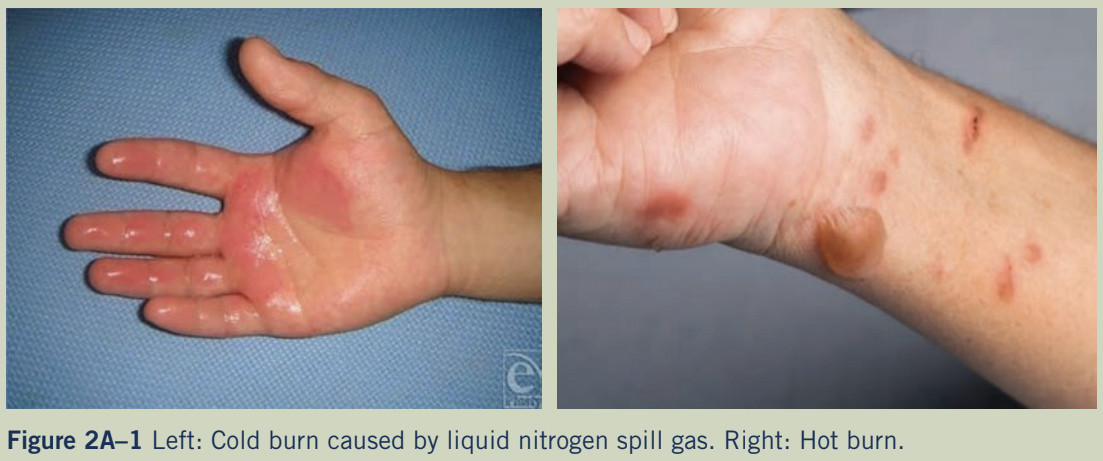
Cold burns can occur from:
- Being outside in low temperatures for extended periods
- Exposure to expanding gas from compressed or liquid sources (aerosol cans)
- Liquid nitrogen or helium spills
- Contact with metal cooled by such substances
Important
Cold burns are just as serious as hot burns and often require medical treatment, but hot and cold burns are managed very differently.
Temperature scales
The two most common temperature scales are Celsius and Kelvin, although Fahrenheit is also used in some countries.
Note
Celsius (°C) is a unit of temperature where the boiling point of water is 100°C and the freezing point is 0°C.
Kelvin (K) is a unit of temperature where the boiling point of water is 373.15 K and the freezing point is 273.15 K. Zero kelvin (0 K) corresponds to absolute zero.
| Scale | Unit | Freezing point of water | Boiling point of water |
|---|---|---|---|
| Celsius | degree, symbol °C | 0°C | 100°C |
| Kelvin | kelvin, symbol K | 273.15 K | 373.15 K |
| Fahrenheit | degree, symbol °F | 32°F | 212°F |
Converting between Celsius and Kelvin
The size of one degree Celsius equals the size of one kelvin. To convert from degrees Celsius to kelvins, simply add 273.15 to the Celsius number:
Important
Note: The Kelvin scale does not have degrees. Its unit is the kelvin (lowercase k) and its symbol is uppercase K. Temperatures in kelvins do not have degree signs, just a number followed by a space and K.
Absolute zero
Zero kelvin is absolute zero, corresponding to the state where molecules have effectively zero kinetic energy. It is not possible to cool an object any further. There are no negative temperatures on the Kelvin scale.
Heat transfer methods
Conduction
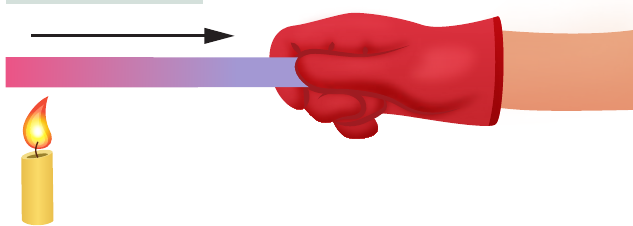
Conduction is the process of thermal energy transfer through interactions between nearby atoms, molecules and electrons.
Conduction is the most significant method of thermal energy transfer in solids because molecules are closely packed together. Vibrations caused by heating readily cause nearby particles to vibrate through interactions, transferring thermal energy through the solid.
When two objects at different temperatures are in contact, thermal energy flows as heat from the hotter object to the colder one. This occurs because the kinetic and potential energies of particles in the hotter object are greater, on average, than those in the colder object.
Thermal conductivity
The rate at which conduction occurs depends on the material involved. Some materials conduct better than others.
Note
Good conductors:
- Metals (due to free electrons that can move freely throughout the metal)
- Copper has the highest thermal conductivity
Poor conductors (good insulators):
- Non-metals (no free electrons)
- Gases (particles are far apart, interactions are rare)
| Material | Thermal conductivity (arbitrary units) |
|---|---|
| Copper | 17000 |
| Aluminium | 10000 |
| Household bricks | 55 |
| Window glass | 40 |
| Water | 25 |
| Concrete | 20 |
| Compacted snow | Between 25 and 5.0 |
| Polyvinylchloride (PVC) | 8.0 |
| Ethanol | 7.2 |
| Charcoal | 3.5 |
| Fibreglass | 2.0 |
| Nitrogen gas | 1 |
| Oxygen gas | 1 |
In this table, air is set at 1.0. Copper has 8500 times the thermal conductivity of fibreglass.
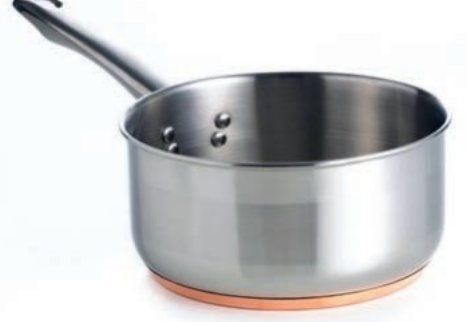
High conductivity is desirable for saucepan bases (copper), while low conductivity is desirable for handles (fibreglass or other insulators).
Note
Factors affecting conduction:
- Material thickness: Thicker layers provide better insulation
- Surface area: Greater contact area means better conduction and less effective insulation
- Temperature gradient: Greater temperature differences result in greater energy flow
Example
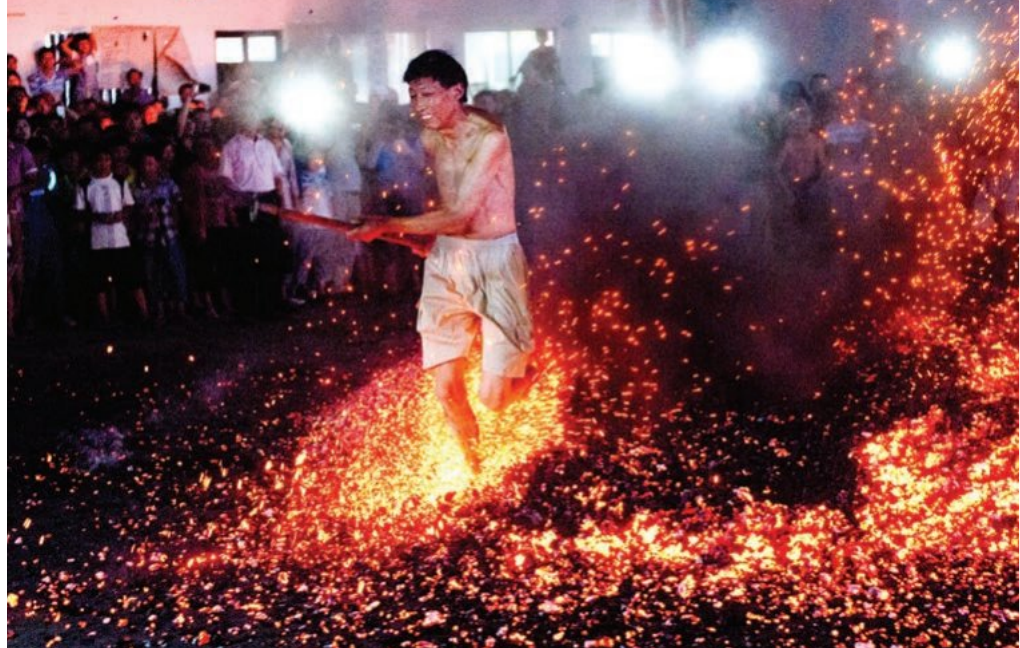
Worked Example: Firewalk
People can walk barefoot over hot coals at 500°C without getting burned feet. This is possible because:
- Low thermal conductivity of charcoal means slow heat flow into feet
- Low specific heat of charcoal means low amount of heat available
- Brief contact time (few seconds) during a brisk walk across 5 m firepit
Convection
Convection is the process of thermal energy transfer through the movement of a fluid or gas.
Convection is the main form of thermal energy transfer in liquids and gases. It occurs when there is significant flow of the liquid or gas itself, moving thermal energy by bodily movement of the material.
Note
Types of convection:
- Natural convection: Driven by warmer fluid rising and cooler fluid falling due to density differences
- Forced convection: Driven by fans or pumps
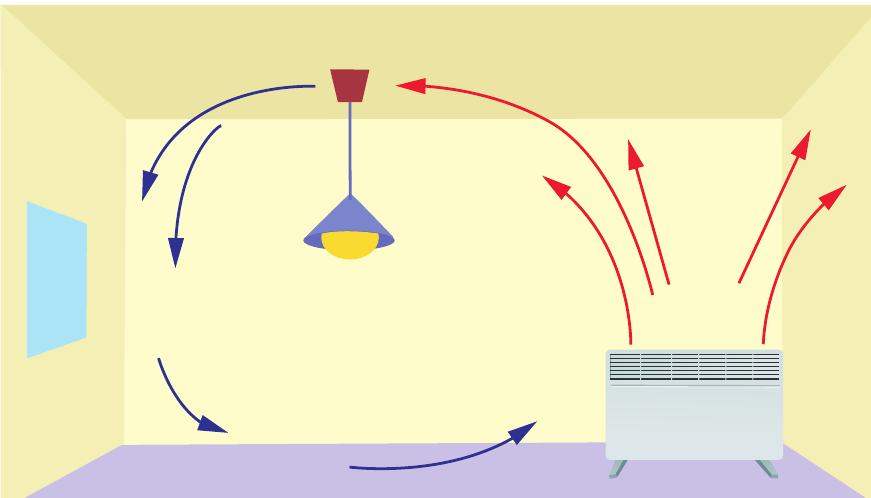
In a domestic setting, air is warmed by a heater and becomes less dense, so it rises to the ceiling. There it cools by conduction and radiation, becoming more dense and sinking to the floor. This drives a circulating convection current.
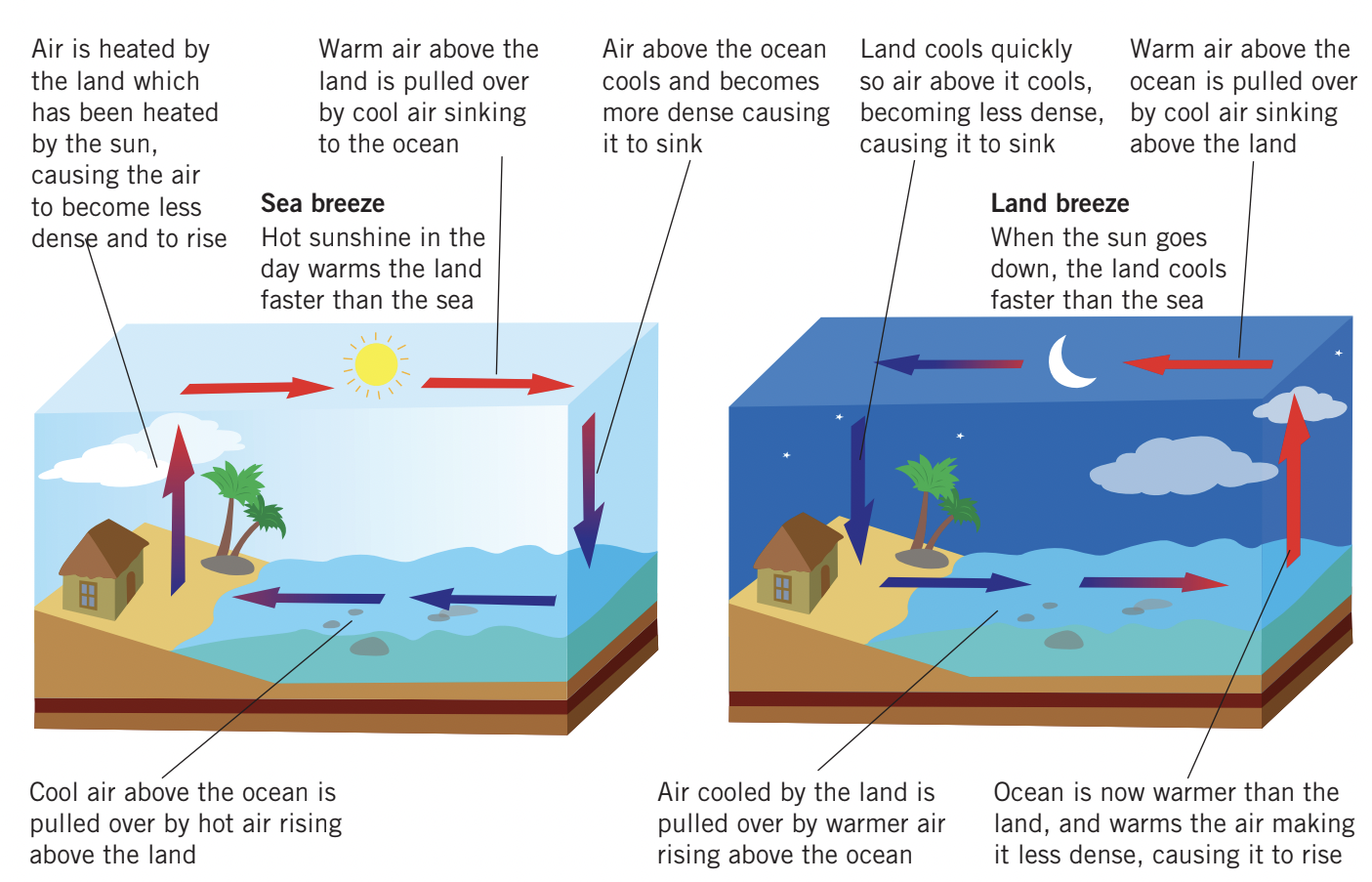
Example
Worked Example: Sea Breeze and Land Breeze
During the day: Hot sunshine warms the land faster than the sea. Air heated by the land becomes less dense and rises. Cool air above the ocean is pulled over to replace it, creating a sea breeze.
At night: When the sun goes down, the land cools faster than the sea. The ocean is now warmer than the land and warms the air, making it less dense and causing it to rise. Air cooled by the land is pulled over by warmer air rising above the ocean, creating a land breeze.
Radiation
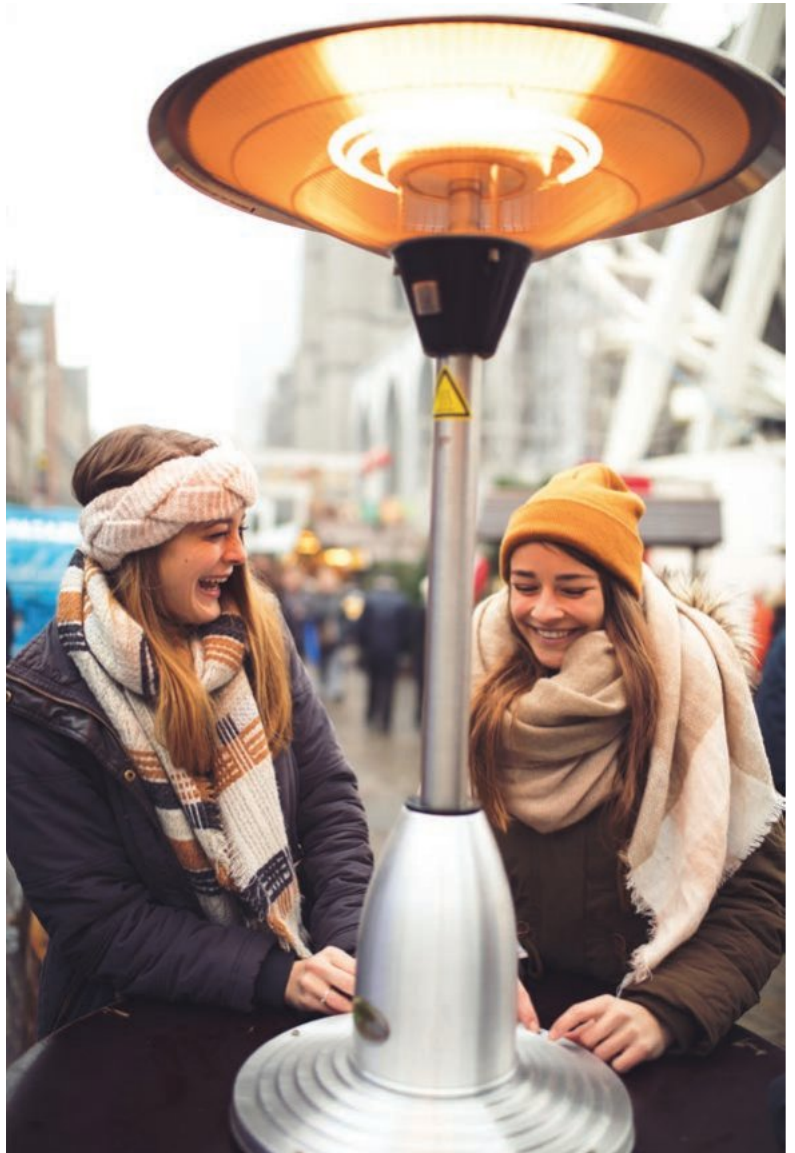
Thermal energy from the Sun reaches Earth after travelling through the near-perfect vacuum of space as electromagnetic radiation. The Sun's electromagnetic spectrum is 93% infrared and visible radiation and 7% ultraviolet.
All objects with temperatures above 0 K emit electromagnetic radiation. This is thermal radiation, a result of thermal energy. Earth re-radiates this received electromagnetic radiation at longer wavelengths, deep into the infrared region.
Note
Key points about thermal radiation:
- The hotter an object, the shorter the wavelength of radiation
- At 700 K, emitted thermal radiation becomes visible ('red hot')
- Perfect radiators are called 'blackbody' radiators
- Blackbody radiators are also perfect absorbers
Surface effects on radiation:
- Shiny and white surfaces (including snow and ice) reflect much radiation
- Black and matt surfaces absorb most radiation energy
Evaporative cooling
Evaporative cooling is the process of cooling that occurs in liquids when high-energy molecules evaporate and carry away energy from the system.
Hot drinks without lids lose considerable thermal energy through evaporative cooling. This process also occurs when we sweat, especially when there is wind blowing.
Mechanism of evaporative cooling
Within a liquid, molecules are free to move around and interact with each other, resulting in a wide range of kinetic energies for different molecules.
When molecules with higher than average kinetic energy are near the liquid surface, some have enough energy to escape the bonds of the liquid and move into the air. Now in a gas state, the molecules move away from the system (evaporation).
The evaporating molecules carry away the extra energy they obtained from collisions within the system. This means that evaporating molecules reduce both the thermal energy and the average kinetic energy of the remaining liquid molecules, lowering the temperature and creating a cooling effect.
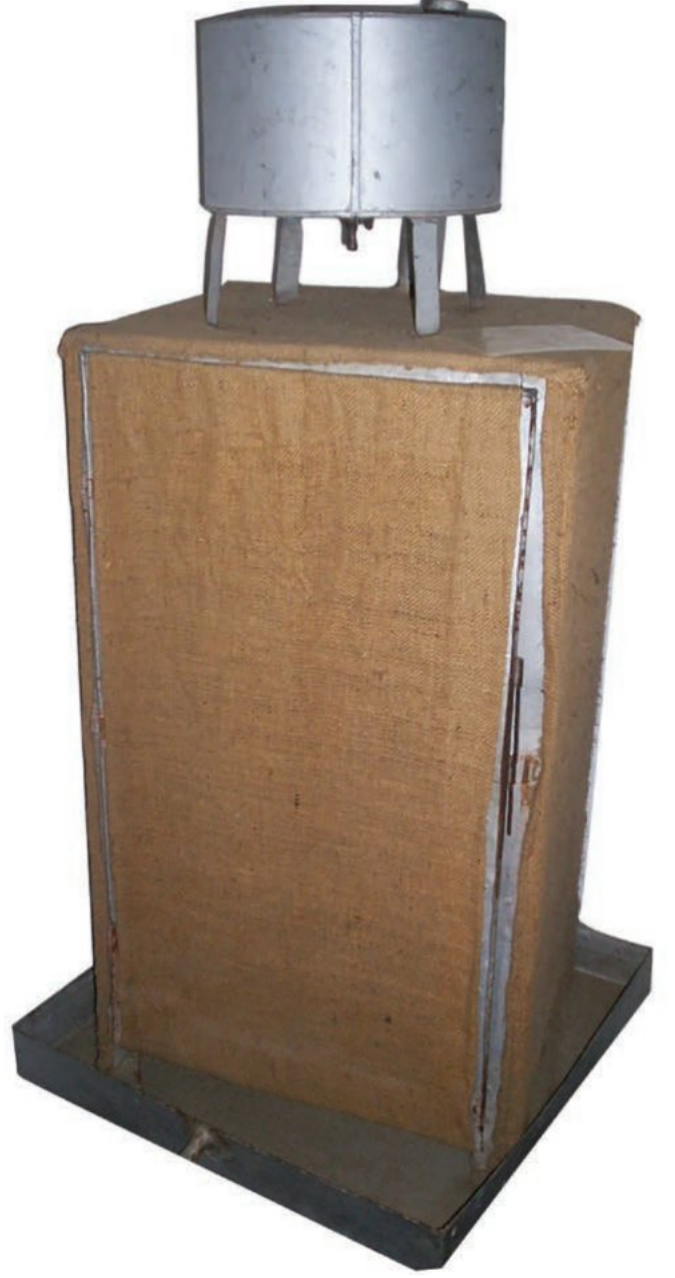
Applications of evaporative cooling
Example
Application: Coolgardie Safe
A box that keeps contents cool through evaporative cooling. Water from a tank on top drips onto hessian sackcloth covering the safe. The water diffuses through the cloth by capillary action and evaporates, taking away heat and cooling the safe.
Example
Application: Aboriginal Water Carriers
The kangaroo or wallaby skin water container is an important innovation developed by Aboriginal and Torres Strait Islander peoples to carry water through hot and arid environments.
The water carrier is made by removing the skin whole and making a bag from it. The skin is rubbed with tree resin to preserve it and make it waterproof. Water slowly diffuses through the skin and evaporates from the outside surface without making it wet, keeping the water relatively cool.
This principle is thought to have inspired the design of the Coolgardie safe.
Example
Application: Evaporative Air Conditioning
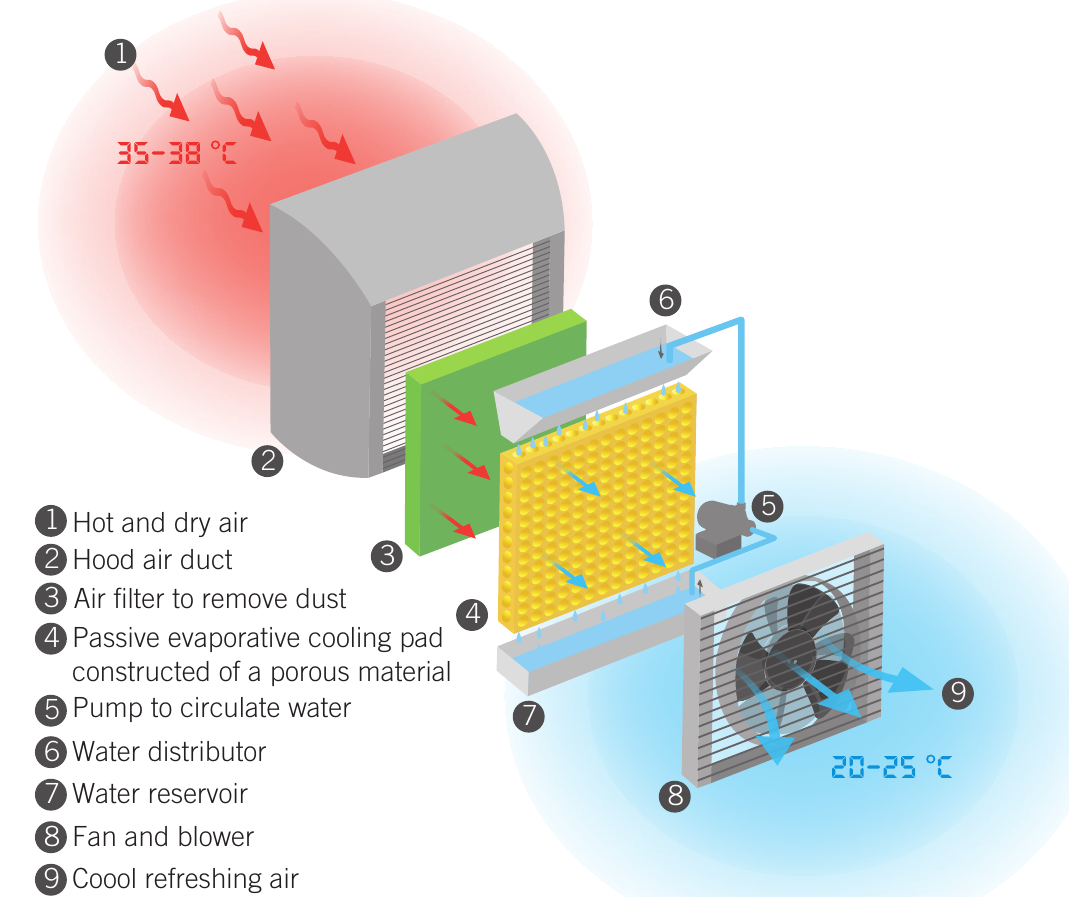
Popular in dry and warmer parts of Australia. The principle is similar to the Coolgardie safe, with a fan run by electricity. Hot air is drawn through a porous material kept wet by circulating water. As water evaporates from the material, it cools the air passing through.
Specific heat capacity
Specific heat capacity is the energy required to raise the temperature of 1 kg of a material by 1 K. Units are J kg⁻¹ K⁻¹. Its value depends on the material being heated. It is given the symbol .
Formula for temperature change
The symbol is used for the amount of thermal energy that must be added to a system in the form of heat to raise the temperature of a material.
Important
Where:
- = Amount of thermal energy required to increase the temperature of a material by (J)
- = Mass of the material being heated (kg)
- = Specific heat capacity of the material being heated (J kg⁻¹ K⁻¹)
- = Change in temperature before and after heating (K)
Specific heat capacity values
| Material | Specific heat capacity (J kg⁻¹ K⁻¹) |
|---|---|
| Water | 4190 |
| Wood | 1300–2400 |
| Wheat | 1000–2500 |
| Aluminium | 890 |
| Concrete | 880 |
| Household bricks | 850 |
| Window glass | 800 |
| Copper | 385 |
| Nitrogen gas | 1 |
| Oxygen gas | 1 |
Properties of water
Water has a relatively high specific heat capacity. This means:
- More energy is required to heat water
- Water releases more energy when it cools down
- Water takes a long time to heat up and cool down
Note
Consequences:
- Environments near lakes and oceans are protected from temperature extremes
- On very hot days, large bodies of water absorb thermal energy, minimising temperature rise
- On cold days, water releases thermal energy, minimising temperature drop
Applications:
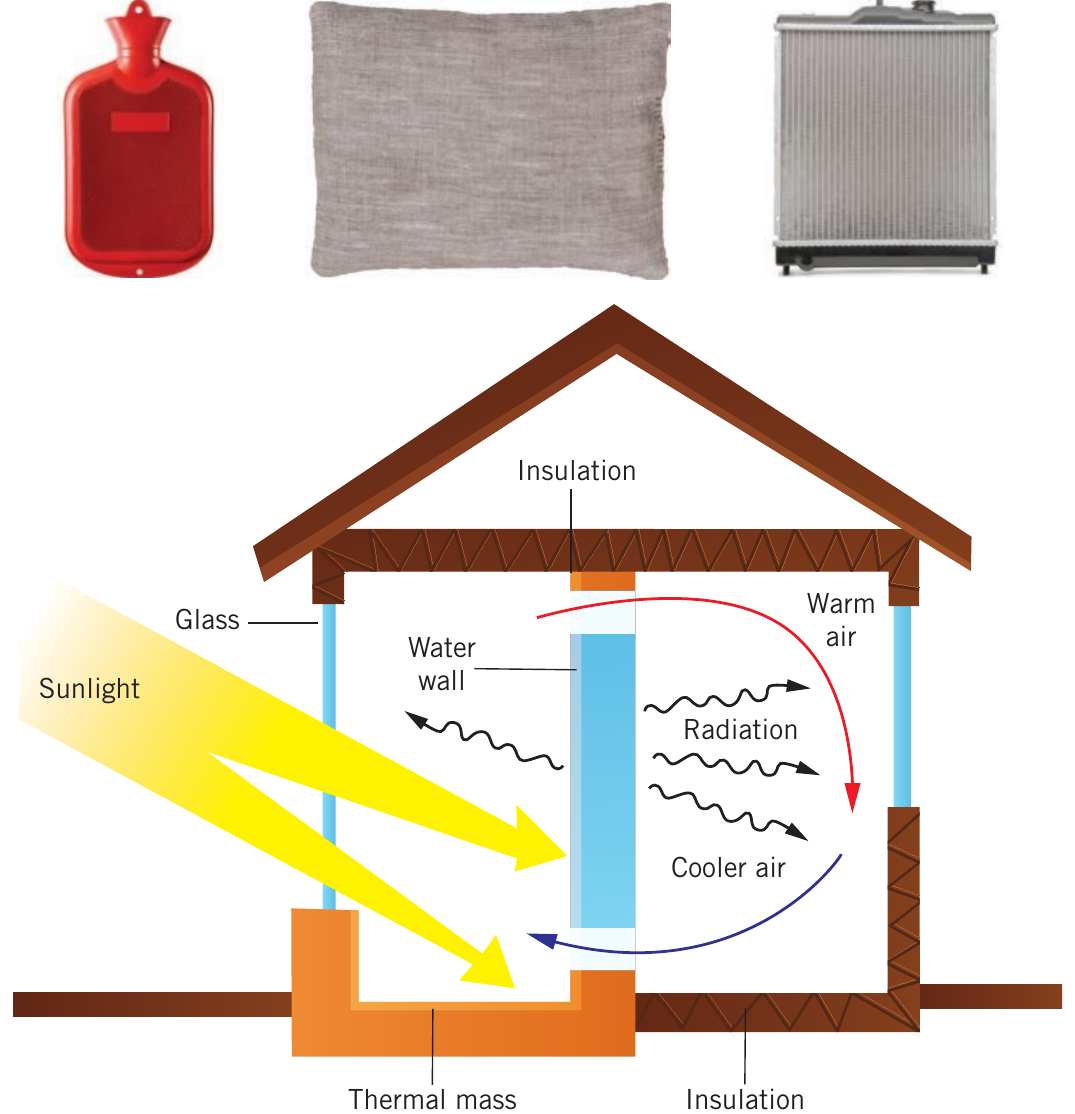
- Hot water bottles: Keep warm for a long time due to high specific heat capacity of water
- Wheat-filled bags: Can be heated in microwaves, taking advantage of wheat's high specific heat capacity without risk of water leakage
- Car radiators: Water is ideal for engine cooling due to its high specific heat capacity
- Water wall thermal storage: Houses with water-filled walls have high thermal energy capacity, smoothing out temperature extremes
Example
Worked Example: Heating Water
Question: How much energy needs to be added to 2 kg of water to raise its temperature from 20°C to 100°C? Take the specific heat capacity of water, , to be 4190 J kg⁻¹ K⁻¹.
Solution:
Using , where:
- kg
- J kg⁻¹ K⁻¹
- K
gives:
Therefore, 670 kJ of energy is required to heat the water.
Change of state
Change of state occurs when a substance changes from one state (solid, liquid or gas) to another by absorbing or releasing energy.
Note
Types of changes:
- Melting: Change of state from solid to liquid
- Fusion: Change of state from liquid to solid
- Vaporisation: Change of state from liquid to gas
- Condensation: Change of state from gas to liquid
When a substance changes state, energy is added or taken away, changing the interaction of molecules with each other by either breaking bonds or allowing them to form.
Important
Important: Changes of state do not change the temperature of the substance. The energy is solely involved in the change of state.
Specific latent heat
Specific latent heat is the energy needed to be absorbed or released per kilogram of a substance to cause a change of state, in units J kg⁻¹. It depends on both the substance and the change of state. It is given the symbol .
Important
Where:
- = Amount of thermal energy required (or released) in a change of state (J)
- = Mass of the substance changing state (kg)
- = Specific latent heat of the substance (J kg⁻¹)
Specific latent heat values
| Material | Specific latent heat of fusion (kJ kg⁻¹) | Specific latent heat of vaporisation (kJ kg⁻¹) |
|---|---|---|
| Carbon dioxide | 184 | 574 |
| Ethanol | 108 | 846 |
| Lead | 23 | 871 |
| Sulfur | 39 | 1510 |
| Water | 334 | 2256 |
Note
Note: The specific latent heat of vaporisation is much larger than the specific latent heat of fusion for the same substance.
Water phase diagram
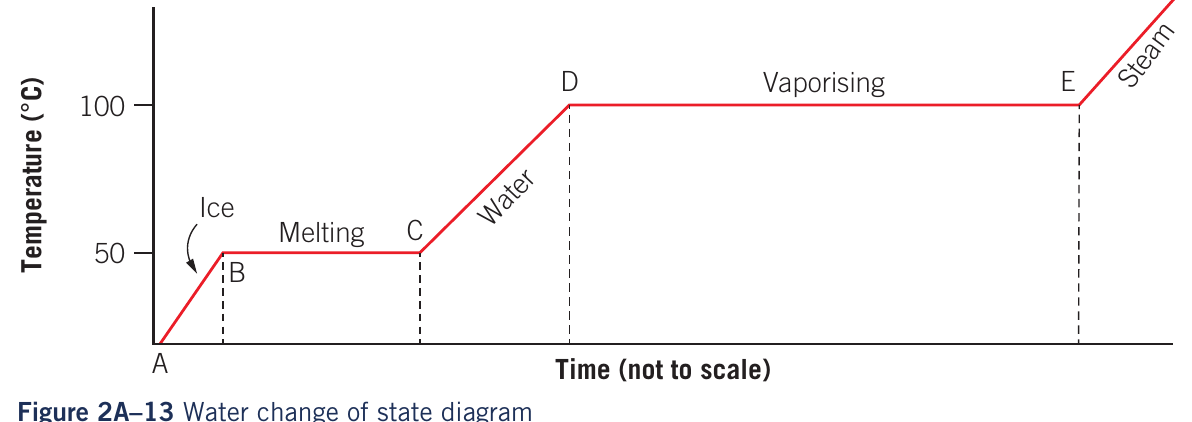
The diagram shows what happens when ice at -20°C is heated steadily, continuing after it all becomes steam:
A to B: Ice heating
- Water remains in solid state (ice)
- Temperature and thermal energy related by
- Note: J kg⁻¹ K⁻¹ (different from )
B to C: Melting
- Mixture of ice and water remains at 0°C
- All thermal energy added is used breaking bonds between ice molecules
- Energy needed:
- for water = 334 kJ kg⁻¹
C to D: Water heating
- Thermal energy related to temperature by
D to E: Vaporising (boiling)
- Water temperature remains constant at 100°C
- Thermal energy used to break bonds between water molecules
- Energy needed:
- for water = 2256 kJ kg⁻¹
Beyond E: Steam heating
- Temperature of steam increases
Important
Important conclusion: Food cooked in boiling water will not cook faster if the water is boiling rapidly rather than just boiling. The temperature is the same in both cases: 100°C.
Energy release in reverse processes
When the process is reversed, thermal energy is released:
Condensation:
Note:
Important
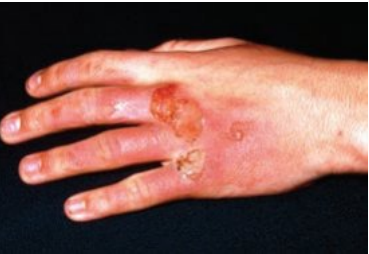
Allowing steam to condense on your hand can result in a nasty burn because energy is released.
Fusion (freezing):
Note:
When water freezes into ice, thermal energy is released and absorbed by the freezer compartment.
Example
Worked Example: Phase Change of Water
Question: How much energy needs to be added to 2.0 kg of ice at 0.0°C to convert all the ice into water? Compare this to the amount of energy needed to convert 2.0 kg of water at 100°C into steam.
Solution:
Use for water as 334 kJ kg⁻¹ and for water as 2256 kJ kg⁻¹.
To convert ice into water, use :
- kg
- kJ kg⁻¹
To convert water into steam, use :
- kg
- kJ kg⁻¹
Comparison: It takes 3844 kJ more energy to convert 2.0 kg of water at 100°C into steam than to convert 2.0 kg of ice at 0.0°C into water. It takes almost seven times the energy to change from water to steam than from ice to water.
Example
Worked Example: Cooling a Drink
Question: A container of 1.00 kg of water at 20°C is cooled by adding 100 g of ice at 0°C. Assume the container is insulated. Find the final temperature when all ice has melted and the entire container is at the same temperature.
Solution:
The ice gains energy:
- when melting
- when warming to final temperature
The drink loses energy:
- when cooling to final temperature
By conservation of energy:
Step 1: Find using :
- kg
- kJ kg⁻¹
Step 2: Find using :
- kg
- J kg⁻¹ K⁻¹
- K
Step 3: Find using :
- kg
- J kg⁻¹ K⁻¹
- K
Step 4: Apply conservation of energy:
Solving for :
Hence, the final temperature of the water is 10.9°C.
Remember!
Summary
Key Points to Remember:
- Temperature is what a thermometer measures and indicates the direction of heat flow between objects
- Thermal energy is the sum of all random potential and kinetic energies of atoms and molecules in a system
- Heat is the flow of thermal energy from hotter to colder objects
- Convert between Celsius and Kelvin by adding or subtracting 273.15
- Three methods of heat transfer are conduction (dominant in solids), convection (dominant in liquids and gases), and radiation (works in vacuum)
- Evaporative cooling occurs when high-energy molecules escape from a liquid surface, taking energy with them
- Use to calculate energy required to change temperature
- Use to calculate energy required (or released) during a change of state
- Water has high specific heat capacity (4190 J kg⁻¹ K⁻¹), making it useful for thermal energy storage
- Temperature remains constant during a change of state even though energy is being added or removed