Operant Conditioning (VCE SSCE Psychology): Revision Notes
📚Revision Notes
Operant Conditioning
What is operant conditioning?
Operant conditioning represents a form of learning where the likelihood of a voluntary behaviour being repeated is shaped by the consequences that follow it. This learning process differs from classical conditioning in one key respect: whilst classical conditioning involves passive, involuntary responses, operant conditioning requires the learner to be actively engaged. The organism is voluntarily aware of the behaviour they are exhibiting in response to environmental stimuli.
Note
The term 'operant' derives from the word 'operate', meaning to produce an effect through action. When we perform behaviours through operant conditioning, we are actively operating on our environment to achieve certain outcomes.
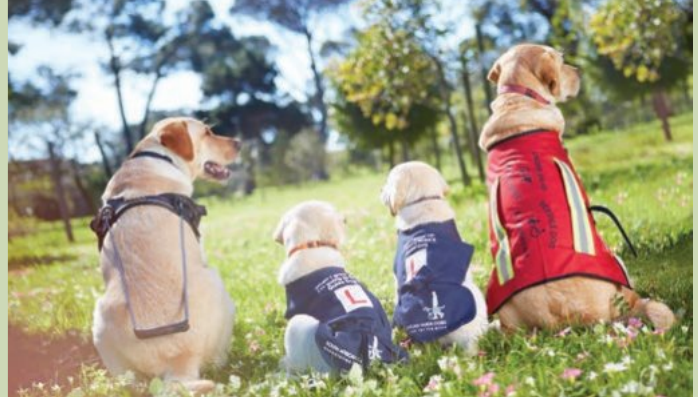
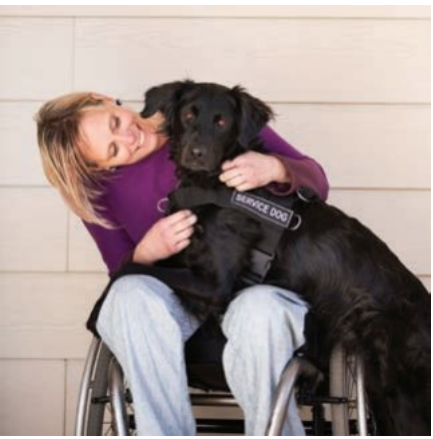
Consider how service dogs are trained to support people with various disabilities and chronic health conditions. These remarkable animals learn through operant conditioning to identify when their owners need assistance. For instance, diabetes service dogs can detect abnormal blood sugar levels through smell and alert their owners before the situation becomes dangerous. PTSD service dogs learn to disrupt their owners' nightmares and create protective boundaries with strangers. This training relies on providing consequences - rewards or corrections - that shape the dogs' behaviour over time.
Example
Real-Life Examples of Operant Conditioning:
Humans also learn continuously through consequences:
- A younger sibling might perform extra chores to gain parental attention
- If you miss putting out the rubbish bin on collection day, the consequence of overflowing bins might make you more vigilant next time
- If you tell a joke during a presentation and receive only silence, you may become hesitant about public speaking
In each scenario, the outcome that follows our action influences whether we will repeat that behaviour in future.
Historical development
In 1948, psychologist B.F. Skinner conducted groundbreaking experiments that established our understanding of operant conditioning. Working with mice and pigeons, Skinner trained these animals to perform specific behaviours by rewarding them with food pellets. His pigeons learned to match coloured lights with corresponding coloured panels, whilst rats learned to press levers when particular lights illuminated. Through their connection with the desired food reward, the animals actively learned to voluntarily change their behaviour.
Note
Skinner's apparatus, known as the Skinner box, allowed precise control over environmental stimuli and consequences. The box contained response levers, food dispensers, lights, and sometimes an electrified grid floor that could deliver mild shocks. This controlled setting enabled Skinner to systematically study how different consequences affected behaviour patterns.
The three-phase model
Operant conditioning operates through a three-component process: antecedent, behaviour, and consequence. Understanding this ABC model is essential for analysing any instance of operant conditioning.
Antecedent
The antecedent is any environmental stimulus that triggers an action. It represents the situation or context present before the behaviour occurs. The antecedent does not cause the behaviour directly, but rather sets the stage for it to happen. For example, when training a diabetes service dog, the antecedent would be the abnormal smell the dog detects from its owner's body chemistry when blood sugar levels change.
Behaviour
The behaviour component refers to any observable action performed by the organism. This must be a voluntary action that the learner consciously chooses to perform. In the service dog example, the behaviour would be the dog running towards its owner and alerting them to the blood sugar abnormality. Unlike classical conditioning where responses are automatic and involuntary, operant conditioning behaviours require conscious choice and effort.
Consequence
The consequence is something that occurs after the behaviour which influences whether that behaviour will be repeated in future. Consequences can either increase or decrease the likelihood of the behaviour reoccurring. When the service dog alerts its owner, receiving a treat as a consequence makes the alerting behaviour more likely to happen again next time the dog detects the abnormal smell.
Important
The process of acquisition occurs when a strong association forms between the behaviour and its consequence. This association can either strengthen or weaken the probability of the behaviour occurring again, depending on the nature of the consequence. During acquisition in operant conditioning, voluntary behaviour becomes strengthened through association with reinforcement or weakened through association with punishment.
Types of consequences
Consequences in operant conditioning fall into two main categories: reinforcement and punishment. Within each category, consequences can be further classified as positive or negative, creating four distinct types of consequences.
Reinforcement
Reinforcement describes any stimulus from the environment that increases the likelihood of a response occurring in the future. When behaviour is reinforced, the organism becomes more likely to repeat that behaviour under similar circumstances. Reinforcement can be positive or negative.
Positive reinforcement occurs when a behaviour is followed by adding a desirable or pleasant stimulus, increasing the likelihood of the behaviour occurring again. The word 'positive' here refers to addition - something pleasant is added to the situation. For example, when a service dog performs its alerting behaviour correctly, immediately giving the dog a food treat serves as positive reinforcement. The dog receives something it desires (food), making the alerting behaviour more likely to reoccur.
Negative reinforcement occurs when a behaviour is followed by the removal of an undesirable or unpleasant stimulus, increasing the likelihood of the behaviour occurring again. The word 'negative' refers to removal or subtraction - something unpleasant is taken away. For instance, if a service dog wears an uncomfortable face harness during training, and this harness is removed immediately after the dog performs the correct alerting behaviour, this removal serves as negative reinforcement. The dog experiences relief from discomfort, making the alerting behaviour more likely to reoccur.
Note
Both types of reinforcement have the same ultimate effect: they increase the probability that the behaviour will be repeated. The distinction lies only in whether something desirable is added or something undesirable is removed.
Punishment
Punishment describes any stimulus from the environment that decreases the likelihood of a behaviour occurring again in the future. When behaviour is punished, the organism becomes less likely to repeat that behaviour. Like reinforcement, punishment can be positive or negative.
Positive punishment occurs when a behaviour is followed by adding an undesirable or unpleasant stimulus, decreasing the likelihood of the behaviour occurring again. Again, 'positive' refers to addition - something unpleasant is added. For example, if a service dog inappropriately jumps on people and an unpleasant odour is then emitted from its collar, this addition of an unpleasant stimulus serves as positive punishment. The dog experiences something it dislikes, making the jumping behaviour less likely to reoccur.
Negative punishment occurs when a behaviour is followed by the removal of a desirable or pleasant stimulus, decreasing the likelihood of the behaviour occurring again. The word 'negative' indicates removal - something pleasant is taken away. If the same service dog jumps on its owner and its favourite toy is immediately taken away, this removal serves as negative punishment. The dog loses something it enjoys, making the jumping behaviour less likely to reoccur.
Note
Both types of punishment decrease the probability of behaviour repetition. The difference lies in whether something unpleasant is added or something pleasant is removed.
Summary framework
Important
Understanding the Four Types of Consequences:
The four types of consequences can be organised into a clear framework based on two dimensions:
- Whether the consequence increases or decreases behaviour
- Whether something is added or removed
| Effect on behaviour | Positive (Adding a stimulus) | Negative (Removing a stimulus) |
|---|---|---|
| Reinforcement (Increases likelihood) | Add something desirable (e.g. dog receives treat) | Remove something undesirable (e.g. uncomfortable harness removed) |
| Punishment (Decreases likelihood) | Add something undesirable (e.g. unpleasant odour emitted) | Remove something desirable (e.g. favourite toy taken away) |
Application in real life
Operant conditioning principles apply extensively to everyday human behaviour. Consider the common situation of using a travel card on public transport.

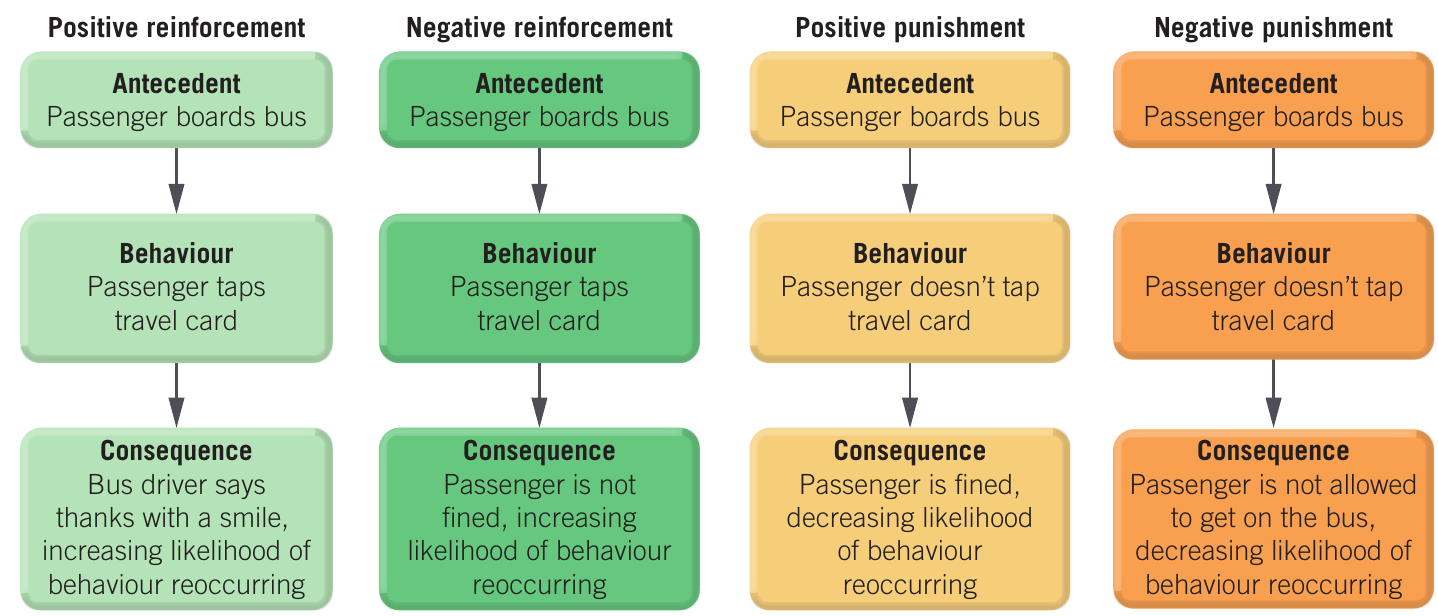
When boarding a bus, passengers are expected to tap their travel card to pay for their journey. In this scenario, the antecedent is boarding the bus, the behaviour is either tapping or not tapping the card, and the consequence determines future behaviour.
Example
Worked Example: Travel Card on Public Transport
Let us examine how each type of consequence might operate in this scenario:
Positive reinforcement: After tapping their card, the bus driver smiles and says thanks. This pleasant social interaction is added, increasing the likelihood the passenger will tap their card in future.
Negative reinforcement: After tapping their card, the passenger avoids receiving a fine. The removal of this unpleasant threat increases the likelihood they will tap their card in future.
Positive punishment: When a passenger fails to tap their card, they receive a fine. This undesirable consequence is added, decreasing the likelihood they will forget to tap in future.
Negative punishment: When a passenger fails to tap their card, they are not allowed to board the bus. A desirable opportunity (the bus journey) is removed, decreasing the likelihood they will fail to tap in future.
Key principles for effective learning
For operant conditioning to be most effective, two principles must be observed:
Important
Critical Principles for Effective Operant Conditioning:
Immediacy: The consequence should occur immediately after the behaviour. When there is a delay between the behaviour and its consequence, the association becomes weaker and learning is less effective. Animals and humans form stronger connections when consequences follow actions directly.
Consistency: The consequence should be delivered consistently each time the behaviour occurs. Inconsistent consequences create confusion and weaken the learning process. If a behaviour is sometimes reinforced and sometimes not, the learner cannot form a reliable association between the action and its outcome.
These principles explain why service dog training requires careful attention to timing and consistency. Trainers must deliver treats or corrections immediately after behaviours occur, and they must respond the same way each time to help the animal learn reliably.
Remember!
Summary
Key Points to Remember:
- Operant conditioning is a form of learning where voluntary behaviours are shaped by their consequences, requiring active participation from the learner
- The three-phase model consists of: antecedent (environmental trigger), behaviour (voluntary action), and consequence (outcome affecting future behaviour)
- Reinforcement increases behaviour likelihood through either adding something pleasant (positive) or removing something unpleasant (negative)
- Punishment decreases behaviour likelihood through either adding something unpleasant (positive) or removing something pleasant (negative)
- Effective operant conditioning requires consequences that are both immediate and consistent