Exponential Distribution (AQA A-Level Further Maths): Revision Notes
📚Revision Notes
Exponential Distribution
What is the exponential distribution?
The exponential distribution is a continuous probability distribution used to model the time between randomly occurring events. It is particularly useful for representing:
- Waiting times between random events
- Time until radioactive disintegrations occur
- Failure times of electronic components
- Duration of telephone calls
- Any scenario involving "memoryless" waiting times
The distribution has a positive skew and is only defined for positive values of the random variable.
Note
The exponential distribution is unique because it is memoryless: the probability of an event occurring in the next time interval does not depend on how long you've already waited. This makes it ideal for modeling truly random processes where the past does not influence the future.
Probability density function (PDF)
Definition: If is a random variable with an exponential distribution with parameter (where ), then its probability density function is given by:
Key properties:
- The parameter is called the rate parameter
- The PDF is defined only for (non-negative values)
- The function decreases exponentially as increases
- Different values of produce different decay rates
Important
The exponential distribution is only defined for positive values: . Always include this condition when stating the PDF or CDF.
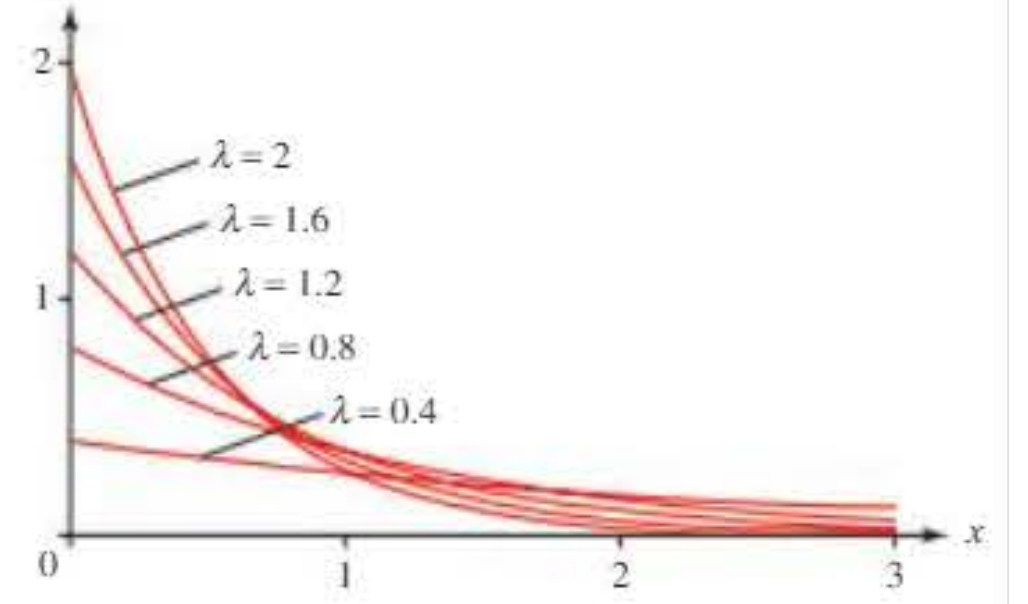
The graph shows how the PDF changes for different values of . Notice that:
- Larger values of result in steeper initial decline
- Smaller values of produce more gradual decay
- All curves start at different heights on the y-axis (equal to )
- All curves approach zero as increases
Cumulative distribution function (CDF)
The cumulative distribution function gives the probability that the random variable takes a value less than or equal to . We find it by integrating the PDF:
Example
Derivation of the CDF:
Starting with the integral:
Key result: If follows an exponential distribution with parameter , then:
This formula allows us to calculate probabilities directly without integration, making it extremely useful for problem-solving.
Note
A useful alternative form is , which is often quicker to use than calculating .
Mean and variance
Expected value (mean)
The mean of the exponential distribution is found using integration by parts.
Example
Derivation of the Mean:
Using integration by parts with and :
After evaluating the boundary terms and simplifying:
Variance
Similarly, we calculate using integration by parts twice:
Then using the variance formula:
Important
Key result: If has probability density function , , then:
The standard deviation is:
Notice that the mean and standard deviation are equal for the exponential distribution.
Connection to the Poisson process
The exponential distribution has a special relationship with the Poisson distribution, making it particularly useful for modeling real-world random processes.
Poisson process: If random events occur at a mean rate of per unit time, and represents the number of occurrences in a unit time interval, then .
Waiting times: Let be the time between successive events in a Poisson process. Then:
Since the number of occurrences follows a Poisson distribution:
Therefore:
This is the CDF of an exponential distribution with parameter .
Important
Key result: If is the time between successive random events that occur at a mean rate of per unit time, then follows an exponential distribution with parameter , where:
The parameter represents the rate of the underlying Poisson process, while represents the mean waiting time.
Worked examples
Example 1: Basic probability calculations
A random variable has an exponential distribution with parameter .
Example
Part (a): Write down the cumulative distribution function and find:
- i)
- ii)
- iii)
Solution:
The CDF is:
i) (3 dp)
ii) (3 dp)
iii)
Example
Part (b): If three -values are chosen at random, find the probability that one will be less than 1 and the other two will be greater than 1.
Solution:
Let = number less than 1 out of 3 values. Then
Example 2: Mean, variance, and standard deviation
A random variable has an exponential distribution with .
Example
Part (a): Write down the mean and variance of .
Solution:
Using the standard results:
Example
Part (b): Find the probability that a randomly chosen value of will be within 1 standard deviation of the mean.
Solution:
Standard deviation:
We need:
Example 3: Poisson process application
Random events occur at a rate of 4 per minute.
Example
Part (a): Write the probability density function, , and the cumulative distribution function, , of the random variable , the waiting time in minutes between events.
Solution:
The rate is per minute, so follows an exponential distribution with parameter .
Example
Part (b): Find the probability that, from the occurrence of one event, the waiting time until the next event will be greater than 15 seconds.
Solution:
Convert 15 seconds to minutes:
Example
Part (c): Calculate the mean and variance of the waiting time.
Solution:
Using the standard results with :
Note: is the distribution parameter (rate), not the mean.
Problem-solving strategy
To solve problems using the exponential distribution:
-
Check the conditions: Ensure the problem involves waiting times between random events or another appropriate scenario for the exponential distribution.
-
Identify the parameter: Determine (or ) from the given information. Remember:
- If given a rate, this is your parameter
- If given a mean waiting time,
-
Choose the right formula:
- For probabilities: use
- For mean: use
- For variance: use
-
Use technology: Calculator or statistical tables can help find probabilities quickly.
-
Check units: Ensure all time units are consistent throughout your calculations.
Note
Exam tips:
- The exponential distribution is "memoryless" – the probability of an event occurring in the next time interval does not depend on how long you've already waited
- Always write when stating the PDF
- Remember that is often quicker to use than
- For Poisson process problems, the rate parameter of the exponential distribution equals the mean rate of the Poisson process
Remember!
Summary
Key Points to Remember:
-
The probability density function is for , where is the rate parameter.
-
The cumulative distribution function is for , making probability calculations straightforward without integration.
-
The mean and variance are and , meaning the standard deviation equals the mean.
-
The exponential distribution models waiting times in a Poisson process: if events occur at rate per unit time, the waiting time between events follows an exponential distribution with parameter and mean .
-
The distribution has positive skew and is memoryless – past waiting time does not affect future probabilities.