Continuity and Change: Examples (AQA A-Level Geography): Revision Notes
📚Revision Notes
Continuity and Change: Examples
Understanding external forces that shape places
Places are constantly evolving due to various external pressures and influences. These transformations occur at multiple scales, from individual streets to entire cities, and are driven by what geographers call agents of change. Understanding these forces helps us recognise why some places maintain their character over time (continuity) whilst others experience dramatic transformation (change).
Note
Agents of change are the people who impact on a place whether through living, working or trying to improve that place. Examples include residents, community groups, corporate entities, central and local government, and the media.
Three major categories of external forces shape the character and development of places:
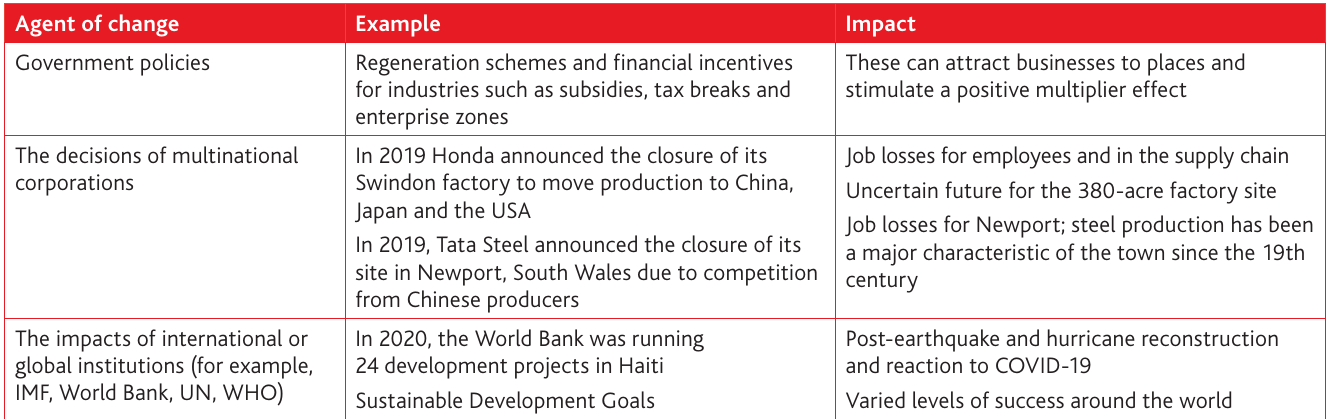
Government policies
Governments play a crucial role in shaping places through strategic interventions. Regeneration schemes provide targeted funding to transform struggling areas, whilst financial incentives such as subsidies, tax breaks and enterprise zones attract businesses to specific locations. These policies can trigger a positive multiplier effect, where initial investment stimulates further economic growth. When businesses establish themselves in an area, they create jobs, attract suppliers, and increase local spending power, which in turn supports additional services and employment opportunities.
Multinational corporation decisions
Large companies have enormous power to transform places through their location decisions. When a multinational corporation closes a factory or relocates production, the impacts ripple through entire communities:
Example
Real-World Impact: Honda's Swindon Factory Closure (2019)
The decision to move production to China, Japan and the USA resulted in:
- Direct job losses for employees
- Uncertainty for the 380-acre factory site
- Affected Newport's steel production, which had supplied the plant since the 19th century
This demonstrates how interconnected supply chains amplify the impact of such decisions.
- Tata Steel's Newport closure (2019): Competition from Chinese steel producers forced the closure of this South Wales site, ending a manufacturing tradition that had defined the town for over a century.
International institutions
Global organisations such as the World Bank, International Monetary Fund (IMF), United Nations and World Health Organisation (WHO) influence place development through funding, policies and programmes. Their interventions show varied success:
- The World Bank operated 24 development projects in Haiti during 2020
- Sustainable Development Goals shape national and local planning priorities
- Post-disaster reconstruction efforts (earthquakes, hurricanes) reshape physical and social landscapes
- Global health responses like COVID-19 programmes have transformed places worldwide with differing levels of effectiveness
Investigating places at different scales
Places can be studied at multiple scales, from individual streets to entire cities. In 2012, the BBC collaborated with the Open University to research six London streets, using historical poverty maps created by Charles Booth (c.1886) as a baseline. This project, called 'The Secret History of our Streets', revealed dramatic transformations in social and economic conditions.
Note
The contrast between streets illustrates how different factors shape place character. Portland Road in Notting Hill became 'the most gentrified street in the UK' by 2012, home to London's wealthiest residents. Meanwhile, Deptford High Street transformed from being the 'Oxford Street of South London' in 1899 to one of the capital's poorest shopping streets during the 1970s, only to experience regeneration through new housing developments.
The following case studies examine changing places at progressively larger scales, demonstrating how people, resources, money and investment shape communities in very different ways.
Case study: Port Sunlight, the Wirral
Port Sunlight demonstrates how one person's vision can transform a place and create a lasting legacy. William Hesketh Lever founded this industrial village in 1888 on the western bank of the River Mersey, four miles south of Birkenhead on the Wirral.
The original vision
Lever built Port Sunlight as a model village for workers at his expanding soap manufacturing business. Rather than maximising profits through property sharing arrangements, Lever prioritised employee welfare:
- High-quality, sanitary and spacious housing for all workers
- Social amenities integrated into the village design
- Welfare provision embedded in the picturesque surroundings
The village design reflected the 'garden city' movement and incorporated large amounts of open space for parks and recreation. This planning philosophy aimed to create healthy, attractive living environments that contrasted sharply with overcrowded industrial housing in other Victorian towns.
Architectural character
Lever's commitment to quality extended to the physical design. He employed over 30 architects influenced by the Arts and Crafts Movement to ensure each terrace of houses featured unique designs. This created visual variety and character throughout the village.
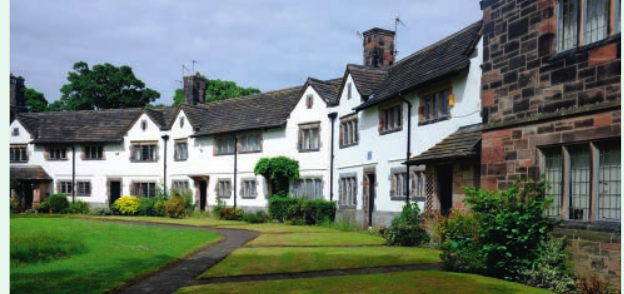
Community spaces reinforced the village's social purpose. Lever included uniquely designed public buildings such as a church, hospital, post office, fire station, schools, social clubs, dining halls and the nationally renowned neo-classical Lady Lever Art Gallery. These facilities served practical needs whilst creating a distinctive sense of place.
Continuity and preservation
The 'place' of Port Sunlight has changed very little since its creation. Although it is no longer primarily home to Unilever employees (the company Lever Brothers became after 100 years of growth), significant efforts maintain its original character:
Important
Preservation Measures:
- In 1966, almost 1,000 houses and most public buildings received Grade II listed status
- The village was designated a Conservation Area in 1978
- Unilever maintains an ongoing interest in preserving Port Sunlight's character
- In 1999, the Port Sunlight Village Trust (PSVT) was established
This commitment to preservation means the village remains true to William Lever's original ideals, despite the massive changes experienced by neighbouring areas. Whilst nearby Ellesmere Port and Liverpool underwent deindustrialisation and regeneration, Port Sunlight maintained its self-sustaining character as a testament to enlightened industrial planning.
Case study: Devonport, Plymouth
Devonport illustrates how a place's character can fluctuate dramatically based on external economic forces. This Plymouth district has experienced considerable change over the past sixty years, largely driven by factors beyond local control.
Historical foundation
Devonport was originally established as a naval dockyard town, taking advantage of its location on the sheltered, naturally deep-water harbour known as Plymouth Sound. By the eighteenth century, it had become one of the fastest growing towns in Britain, enjoying significant prosperity due to naval activity.
Decline and division (1952-1990s)
However, Devonport's fortunes became tied to the dockyard's changing role. In 1952, the Royal Navy requisitioned Devonport town centre as a storage enclave, enclosing it with a three-metre high wall. This decision had devastating social consequences:
- The community became effectively split in two
- Displaced residents were rehoused in flats and apartments ill-suited to family living
- Naval jobs continued to decline
- Significant social and economic problems emerged during the 1980s and 1990s
Important
This period demonstrates how a single institutional decision can fracture a community and trigger long-term decline.
Regeneration through government intervention (2001-2011)
From 2001-11, Devonport benefited from the New Deal for Communities initiative, which provided funding to improve some of the UK's most deprived areas. The scheme specified place-related outcomes addressing multiple dimensions of deprivation:
- Crime reduction
- Community cohesion and improved housing
- Education and health improvements
- Employment opportunities
Community groups, particularly the Pembroke Street Estate Management Board, became heavily involved in the regeneration process, ensuring local voices shaped development decisions.
Physical transformation
The physical environment of Devonport changed considerably through regeneration efforts:
Example
Physical Changes Through Regeneration:
- The divisive three-metre wall was removed
- Inter-war housing and flats were demolished
- Historical landmarks were incorporated into redevelopment plans
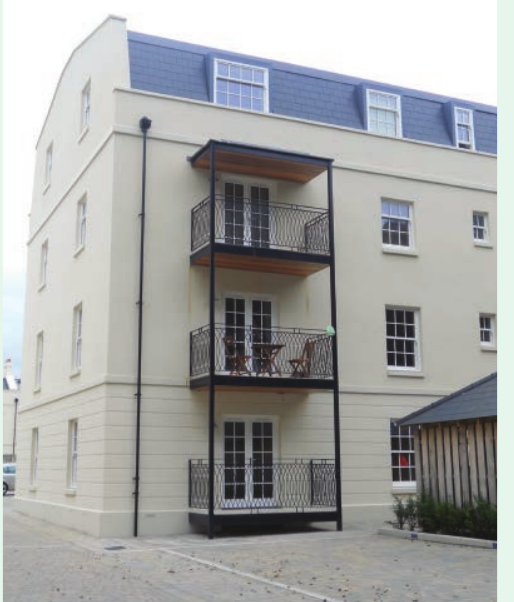
- The regeneration attracted a wider range of people with options for private or shared ownership housing
- Social housing availability increased
Ongoing challenges and opportunities
Despite improvements, pockets of deprivation remain within Devonport. However, both quantitative and qualitative evidence shows the New Deal programme and subsequent redevelopment projects significantly improved the area, delivering tangible benefits to local residents.
Note
A major redevelopment of Devonport's docks was announced in 2020, projected to create 600 jobs and future-proof the economy by enabling the facility to refit the latest nuclear submarines. This demonstrates how places continue to evolve as new opportunities emerge.
Case study: Medellín, Colombia
Medellín provides a powerful example of urban transformation at the city scale. This Colombian city, nicknamed 'The City of Eternal Spring' and the second largest in Colombia, was once associated with extreme violence but has become a model for urban regeneration and sustainable city planning.
The era of violence (pre-1993)
For an extended period, Medellín was linked with drugs, violence and danger, described as 'the most dangerous city in the world'. The notorious drug lord Pablo Escobar controlled the city until his death in 1993, wielding enormous power through illegal drug trade. During this period:
- Unemployment, crime and poverty became widespread
- Social inequality created deep divisions
- The city's reputation suffered internationally
Transformation through planning (1993-present)
Medellín, with a population of 2.4 million, has transformed into a model for urban regeneration and sustainable city planning. City planners recognised that to re-brand Medellín successfully, they needed to make the city equally accessible to all citizens, regardless of social class.
This planning philosophy meant previously divided social classes could now integrate in everyday economic and educational activities. Residents living in shanty houses in the Aburrá Valley gained access to the city's booming economic centre through innovative infrastructure.
Transport infrastructure as a catalyst for change
Long-term investments in infrastructure and education became the foundation of Medellín's transformation. The city developed multiple integrated transport systems:
Example
Integrated Transport Systems:
- Metroplus: A bus rapid transit system with dedicated bus lanes
- Above-ground tram system: Connecting different parts of the city
- Gondola system: A series of outdoor escalators and cable cars transporting people up and down the valley
These transport innovations physically connected rich and poor neighbourhoods, breaking down geographic barriers that had reinforced social segregation.
Sustainable transport initiatives
Emission-free transport has been actively promoted through the EnCicla initiative, a free bike-sharing programme offering an integrated alternative to the city's public and mass transportation systems. This environmental focus demonstrates how social regeneration can align with sustainability goals.
Social programmes and cultural investment
Education, social programmes and public arts and culture budgets all increased to transform the lives of Medellín's most underprivileged residents. These investments addressed the root causes of inequality rather than just symptoms.
Remaining challenges
Despite remarkable progress, Medellín still faces significant challenges:
Important
Ongoing Challenges:
- Poverty rates have fallen but inequality between rich and poor has increased
- Cultural and geographic barriers continue to limit social integration
- Crime rates and gang violence remain high
However, change takes time, and there is widespread optimism within the city about continued improvement. Medellín's transformation illustrates how comprehensive urban planning, infrastructure investment and social programmes can fundamentally reshape a place's character and prospects.
Summary
Key Points to Remember:
-
Three major agents of change shape places: government policies (regeneration schemes, tax incentives), multinational corporations (location decisions affecting employment), and international institutions (development projects and global programmes).
-
Places can be investigated at multiple scales: from individual streets to entire cities, with each scale revealing different aspects of continuity and change.
-
Continuity and change vary significantly between places: Port Sunlight has maintained its original character through conservation efforts, whilst Devonport and Medellín have undergone dramatic transformations.
-
External forces often drive change more than local factors: decisions made by governments, corporations or global institutions can reshape places regardless of local preferences.
-
Successful regeneration requires comprehensive approaches: Medellín's transformation succeeded because it combined infrastructure investment, transport systems, social programmes and education rather than focusing on a single intervention.