Relationships and Connections to Places (AQA A-Level Geography): Revision Notes
📚Revision Notes
Relationships and Connections to Places
Introduction: How places change over time
Places are constantly evolving and developing. They are dynamic environments shaped by four key flows:
- People - population movements and migration patterns
- Resources - availability and use of natural and economic resources
- Money and investment - financial flows and economic activity
- Ideas - cultural influences and innovations
Note
Memory Aid: Remember these four flows with the acronym PRIM: People, Resources, Ideas, Money - the key forces shaping places over time.
These flows interact to transform the character of places. For example, British industrial cities experienced dramatic economic rises and falls during the nineteenth and twentieth centuries, fundamentally changing their populations and environments. Similarly, British seaside resorts have undergone significant transformation over the past sixty years as they adapted to changing holiday patterns, with more British people travelling abroad.
Exogenous factors
Important
Exogenous factors are influences that have an external cause or origin. As places develop, these external factors become increasingly important in shaping their character, often diminishing the importance of the original functions that the place served.
Think of "EX" in exogenous as meaning "external" - factors coming from outside the place itself.
Types of exogenous factors affecting places
Several external forces can fundamentally alter the nature of places:
International migration and diasporas
- People from around the world settle in different locations
- Creates diasporas - communities of people living away from their country of origin
- Forms multicultural societies that reshape local culture and character
- New housing developments may be built to accommodate newcomers
- Can create both opportunities and tensions within existing communities
Deindustrialisation and economic restructuring
- Traditional industrial cities face decline as manufacturing moves overseas
- Creates unemployment and requires economic adaptation
- Former industrial areas must find new purposes and identities
- Can lead to urban regeneration projects or continued decline
Increasing mobility
- Greater movement of people strengthens connections between places
- Links and influences flow from other locations, creating interdependence
- Improved accessibility changes how places function and who uses them
Globalisation challenges
- Mining, steel and shipbuilding towns must adapt to international competition
- Global economic forces determine local employment prospects
- Places become vulnerable to decisions made elsewhere in the world
Note
These exogenous factors work together to reshape communities. For instance, newcomers may create conflict or enrich the local character. Second homes purchased in seaside resorts or rural areas can lead to gentrification, fundamentally changing who lives in and uses these spaces.
Economic change and social inequalities
Economic factors typically have the most significant impact on the character of places. However, changes in places can also result from various events and processes:
- Migration and conflict - population movements due to persecution or war (such as the Syrian crisis)
- Terrorism - attacks that reshape places and their security, such as New York City after 9/11
- Industrial accidents - disasters like Chernobyl that make places uninhabitable or change their purpose
- Natural disasters - events like Hurricane Katrina in New Orleans that require rebuilding
- Climate change - long-term environmental shifts affecting places like the Maldives
These factors influence how places are perceived and directly affect the lives of people living and working there.
External forces: Positive and negative impacts
External forces can bring about both beneficial and harmful changes to places. Conflict often arises when people resist changes imposed upon their location. The redevelopment of East London for the 2012 Olympic Games generated controversy, as do many regeneration projects currently planned or underway in London. Proposed housing developments, landfill sites, wind farms and bypasses frequently create tensions between different stakeholders.
Communities often resist change to their places. Understanding why people oppose development and how such conflicts might be resolved is crucial for managing place transformation effectively.
Key agents of change
Three major types of external agents drive change in places, each with distinct impacts on local communities and economies:
Government policies
- Regeneration schemes targeting declining areas
- Financial incentives for industries (subsidies, tax breaks)
- Enterprise zones to attract businesses
- Impact: Can stimulate positive multiplier effects, attracting businesses and creating employment
Multinational corporations
- Major decisions about factory locations and closures
- Example: In 2019, Honda announced closure of its Swindon factory, relocating production to China, Japan and the USA
- Example: Tata Steel announced closure of its Newport, South Wales site due to competition from Chinese producers
- Impact: Job losses for employees and throughout the supply chain; uncertain futures for factory sites; loss of industries that characterised towns since the nineteenth century
International institutions
- Organisations like the IMF, World Bank, UN and WHO
- Example: World Bank ran 24 development projects in Haiti in 2020
- Sustainable Development Goals influence global priorities
- Impact: Post-disaster reconstruction efforts; responses to health crises like COVID-19; varied success levels across different global locations
Important
External agents of change can have both positive and negative impacts on places. While government regeneration schemes may bring new employment and investment, multinational corporation decisions can result in devastating job losses and economic decline. Understanding these dual impacts is essential for managing place transformation.
Examples of continuity and change at different scales
Places can be investigated at various scales to understand how they transform. In 2012, the BBC collaborated with the Open University to research the past and present conditions of six London streets. Using historical poverty maps created by Charles Booth (c.1886) as a baseline, they investigated the changing social and economic conditions of residents.
Example
Contrasting Urban Transformations: Two London Streets
The research revealed dramatic contrasts in how places can change:
Portland Road, Notting Hill:
- Became 'the most gentrified street in the UK' by 2012
- Now home to some of London's wealthiest residents
- Demonstrates upward social and economic transformation
Deptford High Street:
- Was the 'Oxford Street of South London' in 1899
- By 2012, had become one of London's poorest shopping streets
- Marooned amid 1970s housing developments
- Demonstrates economic decline and social change
These examples demonstrate how place characteristics can be shaped by very different factors, including people, resources, money and investment. They also illustrate how past and present connections within and beyond localities help shape places and the lives of people living there.
Case study: Port Sunlight, the Wirral
Port Sunlight provides an excellent example of a place shaped by a singular vision that has maintained its character despite significant regional changes.
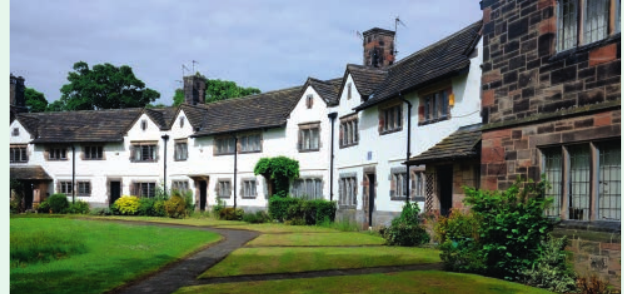
Origins and development
Port Sunlight was developed from 1888 by industrialist William Hesketh Lever on the western bank of the River Mersey, four miles south of Birkenhead. Lever acquired the site to build a new soap manufacturing factory for his expanding business, complete with an adjoining model village for his workers.
Note
Lever championed an innovative business model focused on 'prosperity sharing'. Rather than distributing profits directly to employees, he invested in providing them with high-quality living conditions and community amenities.
The prosperity sharing model provided workers with:
- High-quality, sanitary and spacious housing
- Social amenities and welfare provision
- Attractive surroundings influenced by the Arts and Crafts Movement
- Over 30 architects employed to ensure each terrace had unique design
Garden city influence
The village plan was heavily influenced by the 'garden city' movement and featured large areas of open space. Between the houses, community allotments were originally established, later transformed into beautiful gardens. The development included uniquely designed public buildings:
- Church
- Hospital
- Post office
- Fire station
- Schools
- Social clubs
- Dining halls
- The nationally renowned neo-classical Lady Lever Art Gallery
Parks and recreational spaces were integral to the design, creating an environment far superior to typical industrial housing of the era.
Maintaining character through conservation
As a company, Lever Brothers grew into Unilever, which over the past century has developed into a global enterprise producing a vast range of consumer goods. Despite this corporate evolution, the physical 'place' of Port Sunlight has changed remarkably little.
Conservation measures:
- In 1966, almost 1,000 houses and most public buildings received Grade II listed status
- In 1978, the village was designated a Conservation Area
- In 1999, the Port Sunlight Village Trust (PSVT) was established
Note
Although no longer primarily housing Unilever employees, significant efforts maintain the original physical appearance and community atmosphere of the place. This demonstrates how deliberate conservation efforts can preserve place identity.
Regional context
Whilst Port Sunlight has preserved its character, the surrounding areas of Ellesmere Port and Liverpool across the River Mersey have experienced enormous change:
- Deindustrialisation affecting traditional industries
- Economic regeneration attempts
- Social and demographic shifts
Residents have worked hard to maintain a self-sustaining village that remains true to William Lever's original ideals. This demonstrates how deliberate conservation efforts can preserve place identity even as broader regional transformations occur around it.
Summary
Key Points to Remember:
- Places are dynamic environments shaped by four key flows: people, resources, money and ideas
- Exogenous factors are external influences that increasingly shape place character as locations develop, including international migration, deindustrialisation, and globalisation
- Economic changes create the most significant impacts on places, but events like conflicts, terrorism, natural disasters and climate change also transform locations
- External agents of change include government policies (regeneration schemes), multinational corporations (location decisions), and international institutions (development projects)
- Port Sunlight demonstrates how a place can maintain its original character through active conservation efforts, even when surrounding regions undergo dramatic transformation
- Conflicts often arise when external forces impose changes on communities, highlighting the importance of understanding stakeholder perspectives in place management