Case Study: Landfill vs Incineration, Amsterdam (AQA A-Level Geography): Revision Notes
📚Revision Notes
Case Study: Landfill vs Incineration, Amsterdam
Understanding waste disposal methods
When cities need to deal with their waste, they typically have two main options: landfill or incineration. Each method has its own benefits and drawbacks that need to be carefully considered.
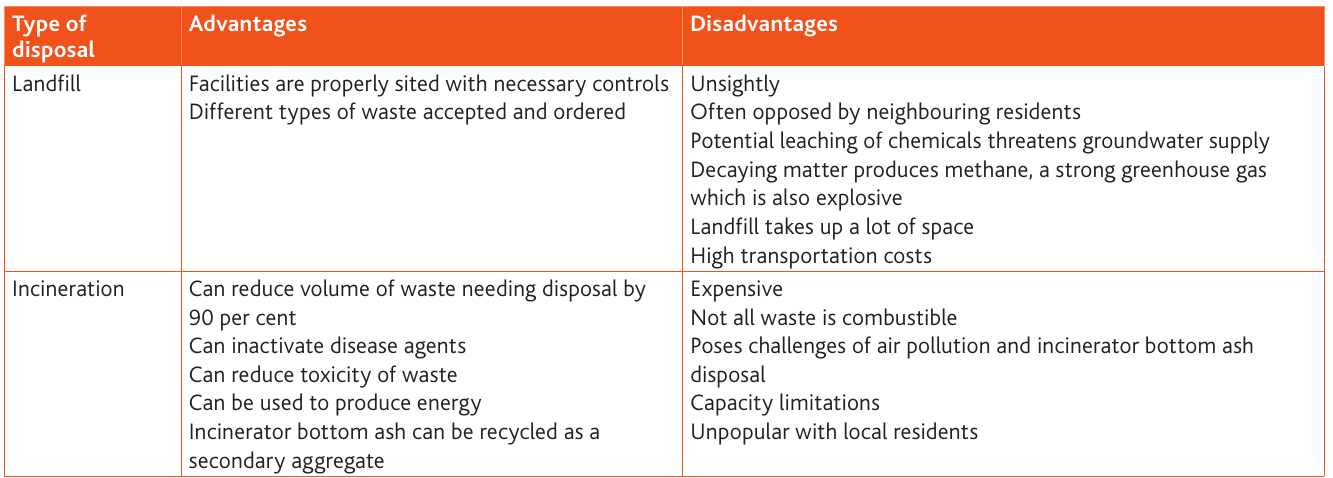
Note
Both waste disposal methods serve the same purpose - dealing with the waste we produce - but they achieve this in fundamentally different ways, with distinct environmental, economic, and social implications.
Advantages and disadvantages of landfill
Landfills offer some practical benefits. When properly designed and located, they can accept different types of waste in an organised manner. However, the disadvantages are significant:
- Local residents often oppose landfill sites in their area (the "not in my back yard" problem)
- Chemicals can leak into the ground, threatening underground water supplies
- Decomposing rubbish produces methane, a powerful greenhouse gas that contributes to climate change
- They require large amounts of valuable land
- Transporting waste to landfill sites is costly
Important
The environmental risks from landfills are particularly serious in densely populated areas where groundwater contamination can affect large numbers of people and where land is scarce.
Advantages and disadvantages of incineration
Incineration presents a different set of trade-offs. The main advantages include:
- Reduces waste volume by 90%, meaning far less material needs disposing of
- Destroys harmful disease-causing agents
- Lowers the toxicity of dangerous waste
- Generates electricity that can be supplied to homes and businesses
- The remaining ash can be recycled as construction material
However, incineration also has drawbacks:
- Building and running incinerators is expensive
- Not all types of waste can be burnt
- Creates air pollution concerns
- Limited capacity to process waste
- Often faces opposition from nearby residents
Amsterdam's waste challenge
Amsterdam, the cultural capital of the Netherlands, faces unique waste management challenges. The country is densely populated and low-lying, with limited available land. During the twentieth century, increasing prosperity led to greater production and consumption of goods, which generated more waste.
The lack of space combined with growing environmental awareness pushed the Dutch government to reduce their dependence on landfill disposal methods.
Note
The Dutch Context:
The Netherlands is one of the most densely populated countries in Europe, with much of its land lying below sea level. This unique geography means that traditional landfill approaches pose even greater risks to groundwater and present severe space limitations.
The Dutch approach: Lansink's Ladder
Important
The Dutch government adopted a waste hierarchy called Lansink's Ladder in 1994. This establishes a clear priority order: first avoid creating waste, then recover valuable materials from it, next generate energy by burning what remains, and only dump what's left if there's no other option.
This approach represents a fundamental shift in thinking about waste - from simply disposing of it to actively reducing and recovering value from it.
Tackling the landfill problem
Why landfills became unsustainable
Several factors forced the Netherlands to move away from landfills:
- Rising material consumption created ever-increasing amounts of waste
- Physical space for new landfill sites was severely limited
- Environmental damage to land was becoming serious
- Growing numbers of complaints from the public about smell, soil pollution and groundwater contamination
Policy responses
The government introduced several measures to discourage landfilling:
Note
1995 Landfill tax:
A tax was placed on every tonne of material sent to landfill. This gave waste processing companies a financial reason to explore alternatives like recycling or incineration. The tax increased annually until 2012, when it was removed because landfilling had declined so much it was no longer necessary.
Note
1995 Landfill ban:
The government prohibited 35 specific categories of waste from being sent to landfill, forcing them to be handled differently.
Results: By 2006, the amount of waste going to landfill had dropped dramatically, allowing the Netherlands to meet the targets set by the Landfill Directive ahead of the 2016 deadline.
Waste-to-energy incineration: the AEB plant
How the system works
Amsterdam has embraced a waste-to-energy strategy (W2E), with the Afval Energie Bedrijf (AEB) incineration plant as its centrepiece. This facility demonstrates how waste can become a resource rather than just a problem.
Example
The AEB Plant in Action:
Key features of the AEB plant:
- Produces 1 million MWh of electricity annually - enough to power many homes
- Generates 300,000 gigajoules of heat each year for district heating
- Serves several communities around Amsterdam
- Receives waste from across the metropolitan area - approximately 600 trucks and one freight train deliver refuse daily
- Recycles 64% of the waste that arrives at the facility
The Waternet partnership
The AEB plant works alongside the Waternet water treatment facility in an innovative partnership. The water treatment plant sends its sludge and biogas to the incinerator to be used as additional fuel. In return, the incineration plant supplies energy and heat needed for water treatment processes. This cooperation demonstrates how different urban facilities can support each other.
Note
This type of industrial symbiosis - where waste from one facility becomes a resource for another - represents best practice in modern waste management and creates a more circular economy at the local level.
Managing environmental impacts
The burning process inevitably produces gases that could harm the environment. To address this, the AEB plant has installed sophisticated scrubbing systems that clean the flue gases. The facility is also exploring ways to close the loop on by-products, using trace elements for manufacturing and fly ash for construction. Any material that cannot be reused becomes landfill.
Comparing environmental impacts
CO₂ emissions analysis
Example
Worked Example: Comparing CO₂ Emissions
If Amsterdam put the same amount of waste into landfill instead of incinerating it, the CO₂ emissions would be much higher - approximately 1,036 kilotons per year. This increase would mainly come from methane gases produced as waste decomposes in landfill.
Even if these methane gases were captured or burnt off, total emissions would still be around 404 kilotons.
In comparison, the AEB incineration plant produces 438 kilotons of CO₂. Whilst this seems similar to the best landfill scenario, the incineration plant provides the added benefit of generating electricity and heat, making it more efficient overall.
The verdict
Because the AEB plant performs multiple functions simultaneously - eliminating waste, generating electricity, and producing heat - it compares favourably to other disposal methods. It avoids the equivalent of 438 kilotons of CO₂ that would be produced by alternative methods.
Overall assessment
Amsterdam's waste-to-energy strategy is considered both economically and environmentally superior to landfill. Nevertheless, incineration remains controversial as a long-term solution. In 2014, the Dutch government set a target to reduce waste-to-incineration by 50% and instead focus on improving rates of reduction and recycling. This reflects the broader goal in twenty-first century cities: moving away from waste disposal entirely towards overall waste reduction and a more circular economy.
Summary
Key Points to Remember:
- The Netherlands faced a waste crisis due to limited land, growing population, and increasing consumption
- Lansink's Ladder established a waste hierarchy: avoid → recover → incinerate → dump
- Financial measures (landfill tax) and regulations (landfill ban) successfully reduced landfill use
- The AEB incineration plant produces 1 million MWh of electricity and 300,000 gigajoules of heat annually
- Incineration produces lower CO₂ emissions (438 kilotons) compared to landfill (1,036 kilotons)
- Despite improvements, the ultimate goal is waste reduction and increased recycling, not just better disposal