Changes in the City Centre (AQA A-Level Geography): Revision Notes
📚Revision Notes
Changes in the City Centre
Understanding urban land values
City centres are dynamic spaces where land values play a crucial role in determining what activities can afford to locate there. Understanding these patterns helps explain why city centres have changed over recent decades.
Note
Land values aren't just abstract numbers—they directly determine which businesses can operate in different locations and shape the entire character of a city centre. The most valuable land attracts the most profitable businesses, while less valuable areas become home to different activities.
Peak Land Value Intersection (PLVI)
Important
The Peak Land Value Intersection (PLVI) is the location with the highest land value in a city. From this central point, land prices decline following the principle of distance-decay.
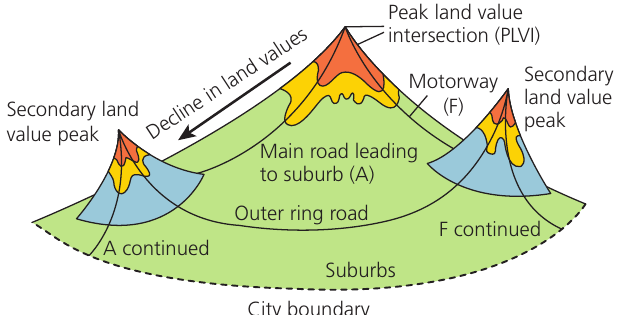
In UK cities, the PLVI is typically found at the very heart of the city centre. Historically, only very profitable businesses such as large national retailers could afford these premium locations. For example, stores like Marks & Spencer often occupied prime PLVI sites because they could generate enough revenue to justify the high costs.
Smaller retailers and commercial businesses fill the rest of the Central Business District (CBD)—the central area containing major shops, offices and entertainment facilities. However, these smaller businesses cannot afford the most accessible, high-value locations and tend to be found towards the edge of the CBD.
Secondary land value peaks
An important development in modern cities is the emergence of secondary land value peaks. These occur along major transport routes, particularly:
- Motorways
- Main roads leading to suburbs
The increase in traffic along these routes meant that the city centre was no longer always the most accessible location. When space for expansion in the city centre became limited, large retailers began looking for alternative sites.
Note
Why edge-of-town became attractive:
Edge-of-town locations offered significant advantages that challenged the traditional dominance of city centres:
- Free parking (compared to expensive city centre charges)
- Modern facilities like cinemas and restaurants
- Easier accessibility for suburban residents with cars
These new developments proved highly attractive to consumers, and land values in these areas subsequently increased.
Bid-rent theory
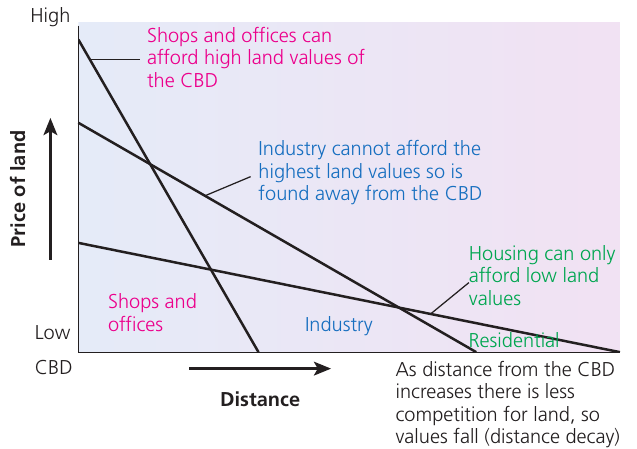
The bid-rent theory explains how different land uses compete for space within a city based on their ability to pay for land. The key principle is simple: as distance from the CBD increases, there is less competition for land, so values fall. This is known as distance-decay.
Different types of land use occupy different zones:
Shops and offices (closest to CBD):
- Can afford the highest land values
- Need maximum accessibility to customers
- Occupy central, premium locations
- Generate high revenue per square metre
Industry (middle zone):
- Cannot afford the highest land values
- Located away from the CBD where land is cheaper
- Still need reasonable accessibility for transport
- Require larger areas of land
Housing/residential (furthest from CBD):
- Can only afford low land values
- Occupies outer areas and suburbs
- Less reliant on central accessibility
- People willing to commute for lower housing costs
Note
Think of bid-rent theory as an economic competition where different activities "bid" for locations based on how much profit they can generate. Shops win the competition for central locations because they need customer access the most and can afford the high costs. Residential areas "lose" this competition but benefit from lower costs further out.
This traditional pattern has been disrupted in recent decades by the changes discussed below.
The decline of city centres
During the 1980s and 1990s, many UK city centres experienced significant decline. Understanding why this happened is essential for appreciating the regeneration strategies introduced later.
Main causes of decline
Out-of-town retail developments:
The development of large out-of-town retail parks was perhaps the single biggest factor. These shopping centres offered:
- Ample free parking
- Modern, purpose-built facilities
- All shops under one roof
- Easy access by car from suburbs
Decentralisation of business and residential areas:
Both businesses and residents began moving away from city centres. This created a self-reinforcing cycle where fewer people meant fewer services, which encouraged more people to leave.
Important
The vicious cycle of decline:
City centres faced interconnected problems that reinforced each other:
- High costs and congestion (expensive parking charges, traffic congestion, limited space for expansion)
- Negative perceptions (viewed as dirty, unsafe, lacking appeal, uncomfortable for shopping)
- People and businesses leaving, which made problems worse
- Later, the phenomenal growth of internet shopping created additional competition, allowing people to shop without visiting any physical location
Strategies for city centre regeneration
Faced with declining city centres, urban planners and local authorities developed numerous strategies to reverse the trend. The 2000s saw two particularly notable approaches emerge.
Town centre mixed development
Rather than focusing solely on retail, cities began encouraging a mix of different functions to increase the attractiveness of city centres. This approach recognises that modern city centres need to offer more than just shopping.
Key elements of mixed development include:
Leisure and cultural facilities:
- Wider range of cinemas and theatres
- Wine bars and restaurants
- Cafés and coffee shops
- Cultural venues and meeting places
The diversity of these facilities, offering different prices and quality levels, means a greater range of people will be attracted to the city centre.
Public spaces and gardens:
Creating attractive public spaces such as:
- Gardens and squares
- Plazas for people-watching
- Pedestrianised areas
- Places for community activities
Note
Public spaces serve a crucial purpose beyond aesthetics—they encourage people to spend time in the city centre beyond just shopping. When people linger in pleasant environments, they're more likely to visit shops, cafés, and other businesses, supporting the local economy.
Street entertainment and events:
Cities have promoted street entertainment and special events to create vibrant atmospheres. A notable example is Covent Garden in London, which features regular street performers.
Example
Covent Garden Street Entertainment:
Covent Garden demonstrates how street entertainment can transform a city centre space. The area features:
- Regular professional street performers (musicians, magicians, acrobats)
- Outdoor performance spaces that attract crowds
- A mix of free entertainment and nearby shops/restaurants
- An atmosphere that encourages people to stay longer and spend more
This creates a self-sustaining entertainment ecosystem that benefits both performers and local businesses.
Nighttime economy:
Developing nightlife including:
- Evening entertainment venues
- Late-night bars and clubs
- Cultural evening events
Note
Challenge: The nighttime economy brings economic benefits but also challenges, including the need for increased policing to manage safety issues and anti-social behaviour.
Flagship attractions:
Creating unique attractions that draw visitors, such as:
- We The Curious science centre in Bristol
- M Shed heritage museum in Bristol
- Other distinctive cultural venues
New construction:
Building new facilities to raise the status of the CBD:
- Modern office buildings
- Hotel and conference centres
- Luxury apartments
- Mixed-use developments
Encouraging residential return:
Cities actively encourage people to return to city centre living by:
- Providing affordable flats
- Redeveloping old buildings (a form of gentrification)
- Building new upmarket apartments
Improved infrastructure:
- Better public transport links
- Improved shopping malls
- Enhanced pedestrian environments
- Coordinated management through business teams
- Special marketing events and campaigns
Note
Success of regeneration strategies:
The combination of these strategies, along with stricter planning controls on out-of-town developments, has meant that many large UK cities have successfully attracted shoppers and visitors back to city centres. However, decision makers in smaller cities and urban areas remain concerned about ongoing decline.
Cultural and heritage quarters
What are cultural and heritage quarters?
Many cities across the UK have developed cultural or heritage quarters as a deliberate strategy for regenerating declining inner urban areas. This approach to culturally-led urban development first emerged in the 1980s and early 1990s.
Important
Cultural quarters are areas characterised by cultural production (making objects, goods, products) or cultural consumption (people visiting shows, galleries and venues).
Heritage quarters focus specifically on the history of an area, often based around small-scale industries that once existed there.
Key examples include:
- Sheffield Cultural Industries Quarter
- Manchester Northern Quarter
- Birmingham Jewellery Quarter
Why develop cultural quarters?
The most successful cultural quarters are those that genuinely produce something or are associated with a product, rather than just being themed areas. For instance, the Birmingham Jewellery Quarter has built up a regional and even national reputation, attracting visitors and tourists and bringing financial benefits to the wider area.
Note
What makes cultural quarters successful:
These quarters succeed because they:
- Create unique identities for areas
- Attract tourists and visitors
- Generate economic activity
- Preserve heritage and history
- Provide creative spaces
Critical perspective
Note
Some critics argue that not all towns and cities need cultural quarters. In some areas, they have simply created higher property values without delivering broader benefits. Different 'quarters' have experienced varying levels of success, suggesting that the approach works better in some contexts than others.
As a regeneration tool for improving perceptions of place and preserving history and culture, 'quarters' tend to be viewed positively, even where economic impacts are limited.
Gentrification and urban change
What is gentrification?
Important
Gentrification is the buying and renovating of properties, often in more run-down areas, by wealthier individuals.
Gentrification represents an important process of housing improvement supported by various groups including estate agents and local authorities. It has helped regenerate large parts of British inner cities over the last few decades.
Unlike large-scale regeneration schemes, gentrification involves the rehabilitation of old houses and streets on a piecemeal basis. The process is carried out by individual households or small groups of individuals rather than large organisations.
Why does gentrification happen?
Understanding the drivers of gentrification helps explain why this process has become so widespread:
1. The rent gap:
This refers to situations where property prices have fallen below their real value, usually due to:
- Lack of maintenance
- Lack of investment
- Area decline
Such properties become attractive to:
- Builders and property developers
- Individuals who can afford to renovate
Note
The rent gap creates an opportunity: buyers can purchase properties, renovate them, and then either sell them for a profit or live in upgraded housing at a lower cost than similar properties elsewhere.
2. Commuting costs:
Living closer to the city centre offers significant advantages:
- Commuting becomes less time-consuming
- Travel expenses are reduced
- Commuting is less stressful
Moving to inner-city areas closer to the city centre can eliminate or significantly reduce the daily commute.
3. The 'pioneer' image:
Gentrification is often driven by creative individuals such as:
- Artists
- Designers
- Young professionals
These groups are attracted to more 'edgy' neighbourhoods rather than conformist suburban living. They value:
- Diverse cultural opportunities
- Unique character of urban areas
- Vibrant street life
Example
Hoxton and Shoreditch, London:
The gentrification of areas such as Hoxton and Shoreditch in London, or SoHo in New York City, has been linked to their reputation as locations for vibrant arts scenes. Artists and creative professionals moved to these affordable areas, creating a cultural atmosphere that eventually attracted more affluent residents and businesses.
4. Government and local authority support:
Both national and local decision makers actively support gentrification because:
- It improves the economy of inner city areas
- It enhances the physical environment
- It's seen as an important component of urban regeneration
- It increases local tax revenues
5. Changing household composition:
Many cities have experienced growth in:
- Single-person households
- Two-person households without children
Note
These household types are more likely to appreciate the benefits of inner-city living, including:
- Proximity to entertainment and culture
- Reduced need for garden space
- Access to restaurants and nightlife
- Professional networking opportunities
Case study: Exeter city centre redevelopment
Princesshay mixed-use development (2007)
In 2007, Exeter opened the Princesshay mixed-use city centre redevelopment, providing an excellent example of how regeneration strategies work in practice.
What replaced:
The development replaced an unattractive, dated post-war facility that no longer met the needs of a modern city centre.
What it includes:
- Retail units
- Residential flats
- Cafes and restaurants
- Public art pieces
- Event and festival hosting space
- Entrance to the city's medieval underground passages
Note
Key features of Princesshay:
The development creates a secure and safe setting for city centre living and supports a vibrant nighttime economy. The mixed-use nature means the area remains active throughout the day and evening.
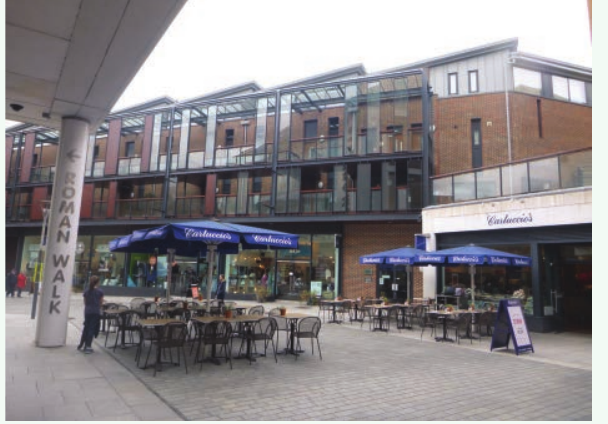
The image shows the City Centre Quarter with its distinctive features:
- Modern mixed-use architecture combining retail and residential
- Cedar-clad walkways creating an attractive pedestrian environment
- Restaurant with outdoor seating (two storeys of flats visible above)
- Shops and dining areas at street level
- Design that creates a sense of place and community
- Integration with heritage elements (Roman walk signpost visible)
Continued development:
In late 2019, plans were unveiled for:
- CityPoint: A nearby development
- Redevelopment of the old bus station into:
- Hotels
- Restaurants
- Residential accommodation
- Office space
- Civic centre facilities
Note
This ongoing investment demonstrates the success of the initial Princesshay development and confidence in the future of Exeter's city centre.
Remember!
Summary
Key Points to Remember:
-
Land values are highest at the Peak Land Value Intersection (PLVI) in the city centre and decrease with distance following the principle of distance-decay. Only profitable businesses can afford these premium locations.
-
UK city centres declined in the 1980s-1990s primarily due to out-of-town retail parks, business decentralisation, high costs and congestion, and later internet shopping competition.
-
Mixed development is a key regeneration strategy involving leisure facilities, public spaces, nighttime economy, flagship attractions, new construction and encouraging residential return to make city centres more attractive and vibrant.
-
Cultural and heritage quarters regenerate declining areas by focusing on cultural production or consumption based on local heritage. Success varies, but they generally improve perceptions and preserve history.
-
Gentrification is driven by five main factors: the rent gap (undervalued properties), reduced commuting costs, the 'pioneer' image of edgy neighbourhoods, government support, and changing household composition favouring city living.