Dereliction (AQA A-Level Geography): Revision Notes
📚Revision Notes
Dereliction
What is dereliction?
Dereliction means that buildings have been left empty and abandoned, falling into a state of disrepair. In urban areas, these derelict buildings are typically found at former industrial sites or in run-down housing estates.
Important
Dereliction is the state of buildings having been abandoned and become dilapidated.
In the UK, de-industrialisation during the late 20th century led to many people leaving inner cities. As a result, industrial buildings were abandoned and left empty. Alongside this, services such as public houses and shops also became vacant as these areas experienced urban decline.
Impacts of dereliction
Dereliction creates serious problems for surrounding areas and communities. The effects span across social, economic, and environmental dimensions.
Note
Social impacts:
- Crime and vandalism rates tend to increase in areas with derelict buildings
- House prices fall, making the area less desirable
- Out-migration occurs as residents leave the area, further accelerating decline
Note
Economic impacts:
- The high costs involved in urban renewal often discourage authorities and developers from renovation or rebuilding
- Listed buildings require considerable investment due to planning regulations, which significantly increases the costs needed
Note
Health and environmental impacts:
- Derelict land can pose a risk to human health through contamination
- Pollution from industrial processes can remain in the environment long after the industry has closed
- In Glasgow, research has linked proximity to contaminated derelict sites with health problems including low birth weight in infants, heart disease, cancer and respiratory disease
Many industries prevalent in Glasgow during the industrial period were particularly harmful. These included shipbuilding, dye works, tanneries, distilleries, cast iron foundries and chemical manufacturing - all of which used toxic and dangerous chemicals, causing environmental degradation in surrounding areas.
Case study: Derelict London
For some people, derelict buildings provide a fascinating glimpse into the architectural past. The Derelict London website includes over 3,000 photographs of London sights not normally seen by tourists. The author, Paul Talling, clearly states that not all photographs are of derelict buildings. However, as the New Statesman review suggests, the appeal of the website lies in how it seems to trace the skeleton of a dead city whilst it is still apparently thriving.
The website serves as a useful resource for examining how buildings have changed over time. Some properties have fallen into even greater disrepair, whilst others show how regeneration has transformed areas through before and after photographs.
Example
Example: Lambeth Hospital Regeneration
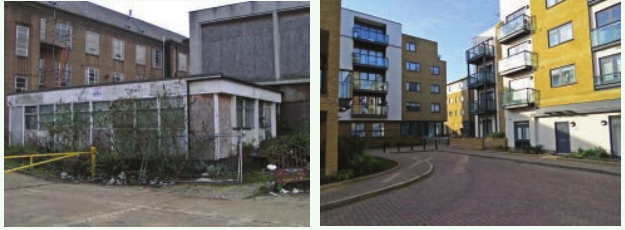
Lambeth Hospital shut in 1976. Much of the original workhouse was demolished, although the water tower survived but lay derelict. Some of the more modern hospital buildings remained in a derelict condition until being cleared for a new housing development. The former workhouse block is now a cinema museum.
This example demonstrates how derelict buildings can remain abandoned for decades before regeneration occurs. The transformation shows the potential for bringing derelict sites back into productive use.
Strategies to address urban dereliction
Regeneration schemes
One of the most common strategies for tackling urban dereliction involves regeneration schemes. UK government-led schemes such as Urban Development Corporations, City Challenge and City Deals have been well documented. These have had varying levels of success in tackling derelict areas.
The government focus has shifted towards using brownfield sites for new building developments rather than greenfield sites, though this approach has met with limited success.
Important
A brownfield site is land previously used for industrial purposes or some commercial uses.
A greenfield site is an area of undeveloped land.
According to government figures, the area of homes built on the green belt doubled from 2 to 4 per cent of all new homes built between 2016 and 2017. Meanwhile, the share built on brownfield land fell from 61 to 56 per cent.
London had the greatest proportion of dwellings (including conversions) built on previously-developed land, at 98 per cent.
Advantages of using brownfield sites in urban areas:
- Improves the physical environment by removing eyesores and contamination
- Revives older urban communities, bringing new investment and activity
- Existing infrastructure can reduce costs and encourage faster occupancy
- Preserves historical landmarks and heritage architecture
- Reduces urban sprawl by building on already-developed land
- Preserves greenfield land for agriculture and recreation
Disadvantages of brownfield sites:
- Greater costs involved in clearing contaminated land before development
- Most brownfield sites are located in inner city areas, which experience higher levels of traffic congestion and noise
- Sites may require extensive decontamination, which is time-consuming and expensive
Land remediation
Important
Land remediation is the removal of pollution or contaminants from the ground. This enables large areas of derelict former industrial land to be brought back into commercial use.
The land remediation process involves several techniques:
- Soil excavation and removal
- Soil washing to remove contaminants
- Chemical stabilisation to neutralise pollutants
- Bioremediation using microorganisms to break down contaminants
- Sorting to separate contaminated from clean material
Example
Case Study: 2012 London Olympic Games
In preparation for the 2012 London Olympic Games, a 350-hectare area of East London was 'cleaned up' and has now become the largest new urban park created in Europe in over a century. The site includes 100 hectares of open land and 45 hectares of new habitat.
Key statistics from the remediation:
- Over 2.2 million square metres of soil was excavated
- Nearly half was treated using soil washing, chemical stabilisation, bioremediation or sorting
- Eighty per cent of the excavated material was re-used on site
- A total of 235,000 m³ of contaminated groundwater was successfully treated
This major project demonstrates how even heavily contaminated industrial land can be transformed through comprehensive remediation programmes.
Community action
Community action has been at the heart of Detroit's recent strategy to tackle its derelict land areas. Detroit experienced dramatic urban decline - the city's population has fallen from nearly two million in the 1950s to less than one million today.
The city now has 100,000 vacant and derelict lots, comprising around one-third of its area. Between 1970 and 2000, over 150,000 buildings were demolished and large commercial developments built in an attempt to revitalise the area, but the decline continued.
Example
Example: Detroit's Community-Led Response
Detroit community groups are now using vacant areas of the city for a range of small, community-based activities including urban farming. By 2010, they had converted over seven hectares of unused land into more than 40 community gardens and microfarms.
These urban farms yield over six tonnes of produce a year, including:
- Hay and alfalfa
- Honey
- Eggs and milk
- Beef
- Flowers, vegetables and herbs
Much of the produce is grown by volunteers and students, then sold to other community organisations such as soup kitchens. Derelict buildings have been converted into community centres, cafés and greenhouses.
The chief executive of Recovery Park Farms, an organisation creating urban farms, points out that as the city has so much vacant land, it could farm up to 2,000 hectares commercially indoors. This could create between 20,000 jobs directly and indirectly, providing economic opportunities whilst transforming derelict spaces.
Summary
Key Points to Remember:
-
Dereliction occurs when buildings are abandoned and fall into disrepair, typically affecting former industrial sites and run-down housing estates following de-industrialisation
-
Dereliction has serious negative impacts including increased crime, falling property values, health risks from contamination, and high costs for renewal
-
Brownfield sites (previously developed land) are preferred over greenfield sites (undeveloped land) for new development, as they improve the environment, preserve green spaces, and revive communities
-
Land remediation removes contamination from former industrial land through techniques like soil washing, chemical stabilisation and bioremediation - the 2012 Olympic site cleaned 350 hectares in East London
-
Community action, such as Detroit's urban farming initiatives, can transform vacant derelict land into productive community spaces, creating jobs and food production opportunities