Tackling Poverty and Inequality (AQA A-Level Geography): Revision Notes
📚Revision Notes
Tackling Poverty and Inequality
Understanding quality of life in urban areas
Quality of life refers to how well people are able to live in their environment. We can assess this using various types of information. Primary data includes direct observations of housing quality, building conditions and the state of the physical and social environment. Secondary data from sources like census information helps us understand patterns of deprivation across different areas.
When examining urban poverty, it's important to recognise that deprived communities often experience problems across multiple dimensions at once.
Important
Multiple deprivation means a combination of social, environmental and economic deprivation affecting the same area or population. Poor neighbourhoods may suffer from inadequate health services, lack of possessions like cars, and various other disadvantages simultaneously.
Measuring quality of life
Urban geographers assess quality of life using four main categories of indicators. This framework is sometimes remembered as SEPP: Social, Economic, Physical, and Political factors.
Note
The four-category framework helps us build a comprehensive picture of living conditions. Areas scoring poorly across multiple indicators are experiencing significant deprivation. By examining all four dimensions together, we can identify where interventions are most needed.
Social factors include:
- Health standards and access to medical facilities
- Percentage receiving free school meals
- Crime statistics and fear of crime
- Education standards (e.g., staying in education post-16)
- Percentage of people on state benefits
Physical factors include:
- Quality and condition of housing
- Pollution levels (air and noise)
- Incidence of litter, graffiti and vandalism
Economic factors include:
- Access to employment opportunities
- Unemployment rates (including long-term and youth unemployment)
- Income levels
- Percentage of lone pensioners
- Percentage of lone-parent families
Political factors include:
- Opportunities to participate in community life
- Ability to influence local decisions (e.g., voting in elections)
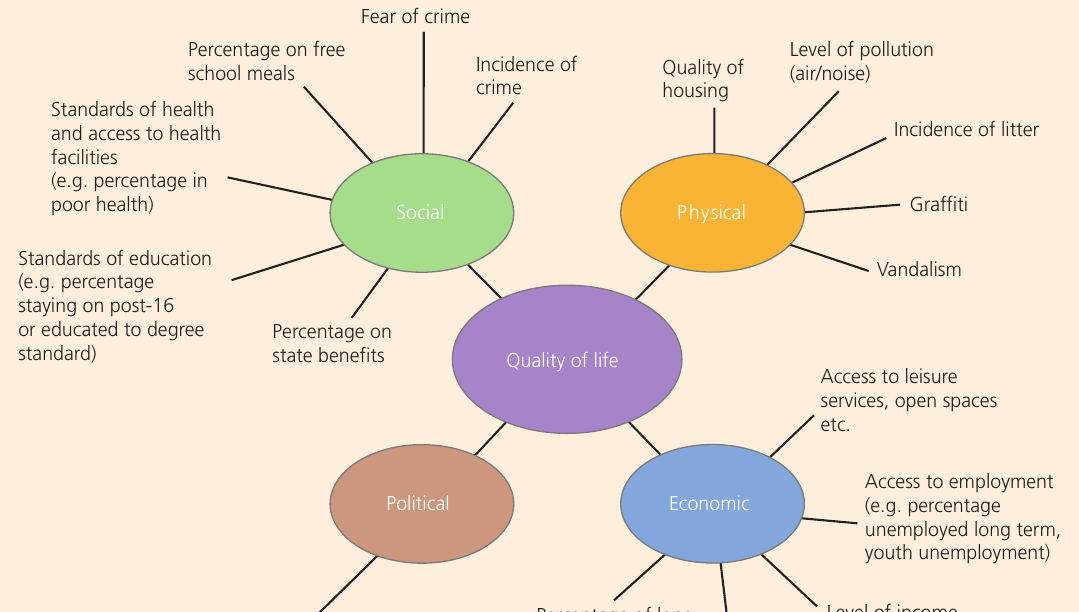
These different measures help us build up a comprehensive picture of living conditions in urban areas.
Poverty versus inequality
It's crucial to understand the difference between these two related but distinct concepts.
Important
Poverty is an absolute term, referring to a level of deprivation that does not change over time. It describes people who cannot afford basic necessities for survival.
Important
Inequality is a relative term referring to the differences between people, usually economic, over a geographic distribution. It measures the gap between different groups in society.
In practice, poverty and inequality often rise and fall together, but this need not necessarily be the case. A society can have high levels of poverty without high inequality if most people are poor. Inequality can be high in a society without high levels of poverty when there's a large difference between the top and the middle of the income spectrum.
The challenges of inner city decline
Low-income neighbourhoods in cities face numerous interconnected challenges. These create a web of problems that reinforce each other, making it difficult for communities to escape cycles of deprivation.
Note
Inner city problems don't exist in isolation - they form an interconnected system. For example, population loss reduces the tax base, which means less money for public services, which makes the area less attractive, causing more people to leave. Understanding these connections is key to developing effective solutions.
Key issues include:
- Population loss as people move away seeking better opportunities
- Declining industries and lack of capital investment
- Poor infrastructure that cannot support economic growth
- Overcrowded and run-down housing, including slums
- High unemployment and lack of skills in the workforce
- Inadequate public services and difficult schools
- Rising crime rates and social unrest
- Environmental problems like pollution and dereliction
- Traffic congestion and lack of adequate open space
Strategies to tackle poverty and inequality
The main driver of urban inequality is wealth. Richer cities like London tend to have much higher rates of inequality, while more equal cities are typically those that are smaller, have lower average wages and are experiencing industrial decline. Various strategies can help reduce poverty and narrow inequality gaps.
Enforcing living wages and urban subsidies
Ensuring workers receive adequate pay is fundamental to reducing poverty. A living wage is set higher than the legal minimum wage and reflects the actual cost of living in an area.
Example
Case Study: China's Wage Policies
China has seen minimum wages grow steadily. By 2020, Shanghai had the highest minimum wage in China at $358 per month, followed by Shenzhen and Beijing at $318 per month. However, wage inequality remains significant. In some rural areas, wages can be as low as $166 per month.
Despite these improvements, China still has some of the highest income inequality in the world, demonstrating that rising wages alone don't eliminate inequality.
Urban subsidies provide direct financial support to help people afford essential services. In China, for instance, some cities offer subsidies to help residents with living costs.
Provision of education
Education is often taken for granted in many high-income countries, but extending schooling beyond primary level helps lift millions of people out of poverty in lower-income countries. Education provides:
- Skills needed for better-paid employment
- Understanding of health and nutrition
- Ability to participate fully in society
- Social mobility opportunities for the next generation
Investment in schools, teachers and educational resources in deprived urban areas can break cycles of poverty by giving young people better prospects.
Supporting low-skilled workers
Cities need to ensure labour markets are inclusive, giving all residents the skills and opportunities needed to enter the workforce. This involves:
- Vocational training programmes
- Apprenticeship schemes
- Language courses for migrants
- Job placement services
- Support for career development
By helping low-skilled workers develop their abilities, cities can reduce unemployment and increase incomes in deprived communities.
Access to affordable housing
The presence of slum housing in poorer cities should not hide the fact that access to affordable housing is a major problem in wealthy cities too. In London, the lack of affordable housing has been blamed for breaking up families, reducing employment prospects and mobility, and slowing the economy.
Example
Case Study: London Living Rent Scheme
The London Living Rent scheme offers affordable rented accommodation to middle-income households who currently rent and want to build up savings to buy a property. It is one of three schemes introduced by the Mayor of London:
- London Living Rent - for middle-income households building savings
- London Affordable Rent - for households on low incomes
- London Shared Ownership - helps people buy a share of a property
These schemes recognise that without intervention, many working families cannot afford decent housing in expensive cities, which perpetuates inequality.
Greater provision of public transport
Affordable public transport schemes improve mobility for city poor, enabling them access to employment, education and services that could improve their lives.
Example
Case Study: Medellín's Cable Car System
Medellín, Colombia, has developed a cable car system to help its citizens get around. The Metrocable opened in 2004 and has four separate lines. It allows people from previously isolated neighbourhoods to travel into the centre of the city.
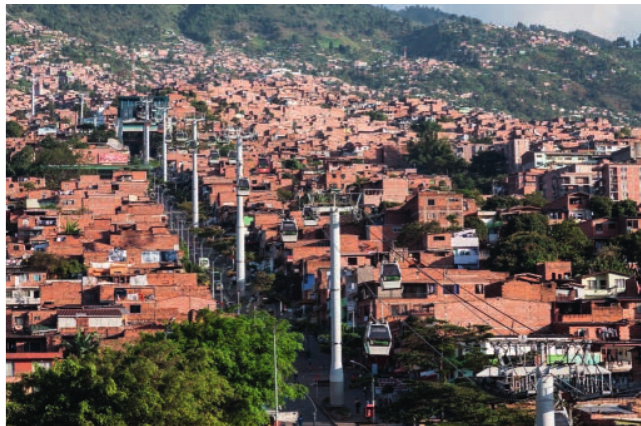
The cable car system connects to the city's metro system and offers spectacular views of the city. It has helped transform what was once a very dangerous city into a top global tourist destination.
Key impacts:
- Improved access to jobs and services for residents of hillside informal settlements
- Connected previously isolated communities to the city centre
- Reduced travel times and costs for low-income residents
- Further lines are currently under construction
Enforcing minimum environmental standards
Poor health is strongly linked to poor environmental conditions. This can be improved through effective legislation. Environmental improvements include:
- Reducing air and noise pollution
- Providing clean water and sanitation
- Waste collection and disposal services
- Reducing overcrowding
- Improving housing conditions
Note
A number of British cities, including Liverpool and Sheffield, have established 'Fairness Commissions' looking at how local areas can address inequality. These bodies examine environmental justice issues and ensure deprived communities aren't disproportionately exposed to pollution and poor conditions.
Cultural diversity and urban inequality
Understanding cultural diversity is important when examining urban inequality because immigrant communities often experience particular challenges.
Important
Cultural diversity refers to the existence of a variety of cultural or ethnic groups within a society. Culture can relate to nationality, ethnicity, age and traditions. Immigration is a key influence.
Urban areas, especially large cities, are places where cultural diversity tends to flourish. Cities like London, New York and Amsterdam have received migrants from all over the world, creating multicultural urban societies. London is considered one of the most diverse cities in the world. More than 300 languages are spoken by people of London, and the city has at least 50 non-indigenous communities with populations of 10,000 or more.
Globalisation has increased movement around the world and it is now common to find people from different parts of the world living in major urban areas. The term diaspora is commonly used to describe a large group of people with a similar heritage or homeland who have settled elsewhere in the world.
Why cities have greater cultural diversity
Cultural diversity results largely from immigration, and immigrants are more likely to choose to live in urban areas for several reasons:
Note
Why Urban Areas Attract Immigrants:
Cities offer unique advantages that make them attractive destinations for immigrant communities. The presence of established ethnic communities creates support networks, while urban areas generally provide greater tolerance and more opportunities for economic and social integration.
- Cities tend to offer a greater range of employment opportunities
- Cities are the first point of entry into the country for many immigrants
- Cities tend to house earlier immigrant groups with the same ethnicity, providing established communities
- Established cultural diversity in cities means there are specialist shops and religious centres located there
- Urban populations tend to be more tolerant of immigrants
UK examples:
The port city of Liverpool attracted many Irish migrants in the nineteenth and twentieth centuries and there are now large minority ethnic Indian communities in cities such as Leicester and Greater Manchester, where labour-intensive industries such as clothing were traditionally located. More recently, the influx of Eastern European migrants has led to changes in the demographic make-up of many British cities. In Southampton, for example, more than 10% of the population are now Polish and specialist Polish supermarkets and restaurants have opened to cater for them.
Cultural diversity brings many benefits to an urban society. The most commonly cited advantages relate to the greater exposure people get to different foods, music, language and religion. Events such as the Notting Hill Carnival in London and Mela in Newcastle have become part of the British calendar and serve to illustrate acceptance of and interest in different cultures.
Summary
Key Points to Remember:
-
Quality of life can be measured using SEPP: Social, Economic, Physical and Political indicators. Multiple deprivation occurs when communities suffer across several dimensions simultaneously.
-
Poverty is an absolute measure of deprivation, while inequality is a relative measure of differences between groups. These often occur together but are distinct concepts.
-
Strategies to tackle urban poverty and inequality include enforcing living wages, providing education, supporting skills development, ensuring affordable housing, improving public transport, and enforcing environmental standards.
-
Case studies demonstrate successful interventions: China's rising minimum wages (though inequality remains high), London's affordable housing schemes, and Medellín's cable car system connecting isolated hillside communities to jobs and services.
-
Cultural diversity is greater in cities because they offer more employment opportunities, act as entry points for immigrants, contain established ethnic communities, and tend to be more tolerant. This diversity brings benefits but also requires careful management to ensure all groups can access opportunities equally.