Urban Forms (AQA A-Level Geography): Revision Notes
📚Revision Notes
Urban Forms
Introduction to megacities and world cities
Urban areas around the world are growing rapidly. In the UK alone, there are multiple large metropolitan areas including Birmingham, Leeds, Liverpool, Manchester, Newcastle-Upon-Tyne and Sheffield. These are significant population centres, each home to more than 125,000 people. However, the largest urban forms are megacities and world cities, which play crucial roles in the global economy.
The rise of megacities has been driven by several interconnected factors:
- Globalisation and economic competition between countries and cities has accelerated urban growth
- Mass migration from rural to urban areas, as people seek better economic opportunities and living standards in cities
- Government policies such as China's Special Enterprise Zones have encouraged financial investment and urban development
- Perception of opportunity draws people to cities despite the challenges they face
Characteristics of megacities and world cities
What is a world city?
Important
World city (or global city): Cities that have significant influence on a global scale due to their financial power and worldwide commercial importance. Traditionally, New York, London and Tokyo have dominated the global hierarchy, but they are now joined by Beijing, Shanghai and Mumbai. These cities host the headquarters of many transnational corporations (TNCs), serve as centres of world finance, and provide international consumer services.
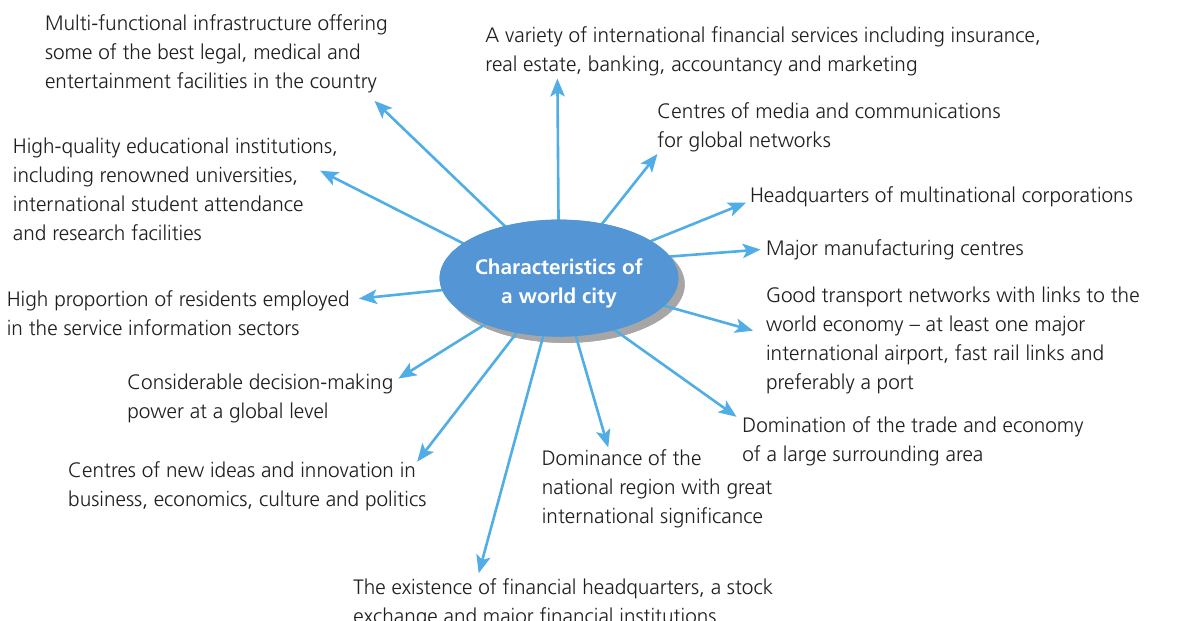
World cities possess distinctive characteristics that set them apart:
Economic and financial features:
- International financial services including insurance, real estate, banking, accountancy and marketing
- Headquarters of multinational corporations
- Major manufacturing centres
- Stock exchanges and major financial institutions
- Domination of trade and economy in their surrounding regions
Infrastructure and connectivity:
- High-quality transport networks with links to the world economy
- At least one major international airport with fast rail links, preferably including a port
- Multi-functional infrastructure offering excellent legal, medical and entertainment facilities
Knowledge and innovation:
- High-quality educational institutions including renowned universities
- International student attendance and research facilities
- Centres of new ideas and innovation in business, economics, culture and politics
- High proportion of residents employed in service and information sectors
Global influence:
- Considerable decision-making power at a global level
- Centres of media and communications for global networks
- Dominance of their national region with great international significance
Note
Historically, the world's greatest global cities were generally the largest in population. However, size is no longer the primary indicator of global importance. Today, influence matters more than population, which is why the term 'world city' has been adopted to describe cities with the greatest global impact.
The benefits of megacities
Despite facing significant challenges, megacities offer important advantages:
-
Economic efficiency: They generate two to three times more GDP than other cities. Services such as healthcare and education can be delivered more cost-effectively to large, concentrated populations compared to dispersed rural areas.
-
Environmental benefits: Providing public transport, housing, electricity, water and sanitation for densely settled urban populations is less environmentally damaging than servicing dispersed rural communities.
-
Market access: Urban residents have access to larger and more diverse employment markets, offering greater opportunities for economic advancement.
-
Social improvement: Better levels of education and healthcare can enhance the lives of vulnerable populations and empower women, particularly in countries where they lack equal status.
-
Innovation centres: Megacities serve as hubs of innovation where solutions to global challenges are developed and tested.
Important
Challenges in Lower-Income Countries
Megacities in lower-income countries face particular challenges. Population growth often outpaces the development of resources and infrastructure, leading to problems with:
- Haphazard expansion (sprawl)
- Inadequate housing
- Insufficient employment opportunities
- Difficulties in providing basic services
Questions also arise about how city authorities can effectively govern such large populations. Large urban concentrations can also generate political pressure for change, as they bring together many younger people who may organise protests.
The global hierarchy of world cities
The GaWC ranking system
One widely recognised method for ranking world cities is the Globalization and World Rankings Research Network (GaWC), based at Loughborough University. This system classifies cities into Alpha, Beta and Gamma categories based on their connectivity and integration into the world economy.
The ranking focuses on four 'advanced producer services':
- Accountancy
- Advertising
- Banking and finance
- Law
While economic factors remain the most important criteria, some cultural indicators were added to the system in 2004. Cities are evaluated on how well they serve international markets and complement other world cities in providing global services.
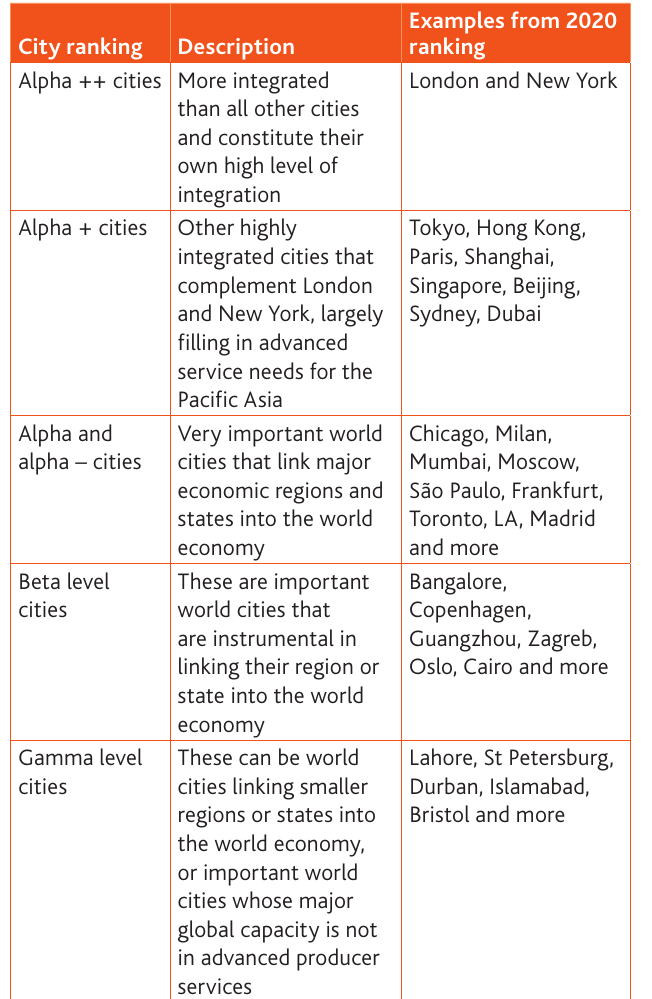
City classifications
Alpha++ cities sit at the top of the global hierarchy:
- These are more integrated than all other cities and constitute their own level of integration
- Examples: London and New York
Alpha+ cities are highly integrated cities that complement London and New York:
- They largely fill in advanced service needs for the Pacific Asia region
- Examples: Tokyo, Hong Kong, Paris, Shanghai, Singapore, Beijing, Sydney, Dubai
Alpha and alpha- cities are very important world cities:
- They link major economic regions and states into the world economy
- Examples: Chicago, Milan, Mumbai, Moscow, São Paulo, Frankfurt, Toronto, Los Angeles, Madrid
Beta level cities are important world cities:
- They are instrumental in linking their region or state into the world economy
- Examples: Bangalore, Copenhagen, Guangzhou, Zagreb, Oslo, Cairo
Gamma level cities can be world cities:
- They link smaller regions or states into the world economy
- They may also be important world cities whose major global capacity is not in advanced producer services
- Examples: Lahore, St Petersburg, Durban, Islamabad, Bristol
Note
Below these rankings are cities with 'sufficiency of services'. These are not classified as world cities but have sufficient services to avoid dependence on world cities. They tend to include smaller capital cities and traditional manufacturing centres.
Spatial patterns of land use in urban areas
Urban morphology
Important
Urban morphology: The spatial structure and organisation of an urban area.
The physical layout of cities has been shaped by various factors throughout history. Understanding these patterns helps explain why cities look the way they do today.
Physical factors affecting land use
Traditionally, physical geography played a significant role in determining urban development patterns:
Relief (topography):
- Flat land was historically important for transportation of goods via road or rail
- Flat areas were easier and cheaper to build on
- Relief continues to influence land value today, as flat land attracts higher prices
- However, flat land close to rivers may pose flood risks
- In poorer cities, informal settlements are often located on undeveloped steep land
Example
Worked Example: Rocinha, Brazil
Rocinha, Brazil's largest shanty town, is built on steep hillside overlooking Rio de Janeiro. The settlement demonstrates how physical constraints affect urban development in lower-income areas, with the poorest residents living on the hilltop where access is most difficult and infrastructure hardest to provide.
Drainage:
- Early industrial areas developed close to rivers to harness water power for energy
- Rivers provided important transportation routes for moving goods
- Water availability remains an important consideration for industrial location
Note
While physical factors were once dominant, human factors now play a much more significant role in shaping urban land use patterns in modern cities.
Human factors affecting land use
In high-income countries, the most important factor affecting land use is land value. Traditionally, land values are highest in the city centre where accessibility is greatest. This creates competition for space and influences what activities can afford to locate in different areas of the city.
Modern urban development is increasingly influenced by:
- Economic factors and market forces
- Planning policies and regulations
- Transportation networks and accessibility
- Social and cultural preferences
- Technological capabilities that allow development in previously challenging locations
Today's cities can overcome many of the physical limitations that constrained earlier urban development, meaning human decisions and economic factors have become the primary drivers of urban form.
Summary
Key Points to Remember:
-
World cities are defined by influence, not size. Cities like London and New York dominate the global hierarchy because of their financial power and international connections, not just their population.
-
The GaWC ranking system classifies world cities from Alpha++ (most integrated) down to Gamma level based on their connectivity and advanced producer services like banking, law, accountancy and advertising.
-
Megacities offer significant benefits including economic efficiency, environmental advantages of density, better access to services, and innovation opportunities, despite facing challenges with growth and governance.
-
Urban morphology describes the spatial structure of cities. While physical factors like relief and drainage historically shaped cities, human factors (especially land value) now dominate land use patterns in modern urban areas.
-
World cities serve as global hubs with multinational corporation headquarters, international financial services, major transport infrastructure, quality educational institutions, and significant decision-making power that extends beyond their national borders.