Urban Policy and Regeneration in Britain Since 1979 (AQA A-Level Geography): Revision Notes
📚Revision Notes
Urban Policy and Regeneration in Britain Since 1979
Understanding urban policy and regeneration
Urban areas in Britain have undergone significant changes since the late 1970s. The decline of traditional manufacturing industries led to serious economic and social problems in many inner cities. In response, governments have introduced various policies aimed at reviving these struggling areas.
Important
Key Definitions
Urban policy refers to the strategies chosen by local or central government to manage the development of urban areas and reduce urban problems such as unemployment, poor housing and environmental decline.
Regeneration is the process of improving the physical, economic, social and environmental conditions of urban areas that have experienced decline.
The evolution of urban policy: four distinct phases
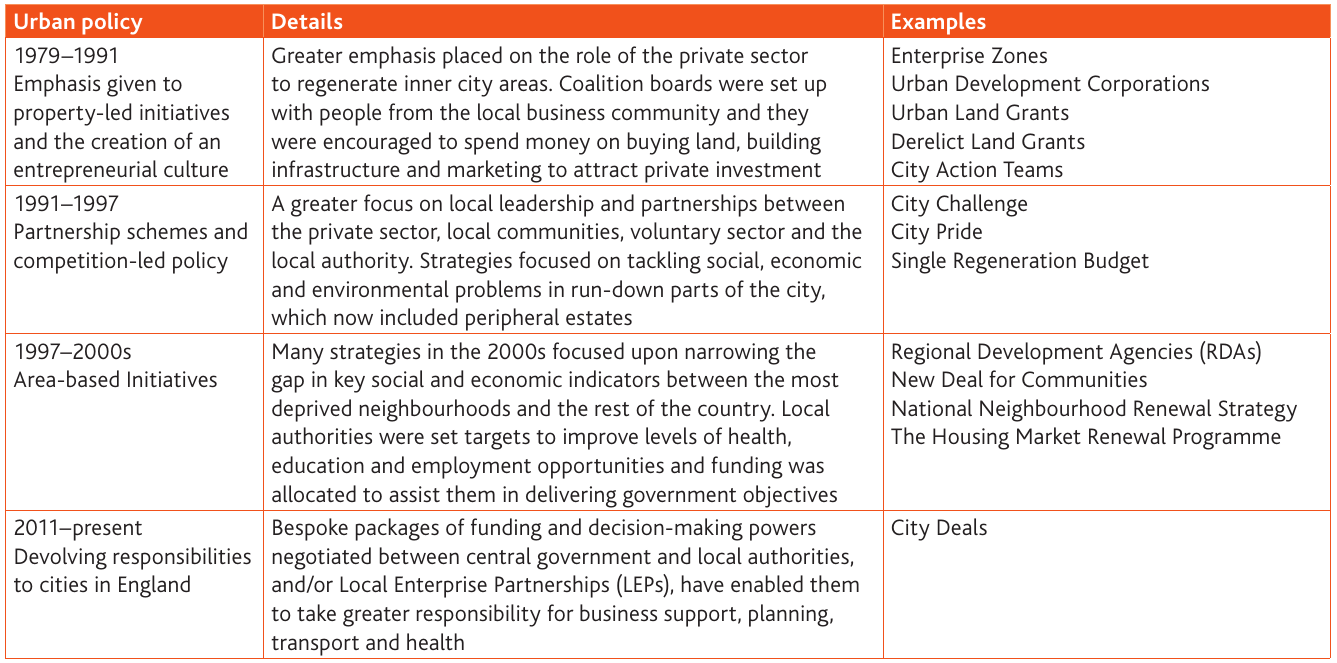
Since 1979, urban policy in Britain has evolved through four main phases, each with different priorities and approaches. Understanding these changes helps explain how regeneration strategies have developed over time.
Phase 1: Property-led initiatives (1979-1991)
During the 1980s under the Conservative government, urban policy focused heavily on encouraging private sector investment to regenerate inner city areas. The thinking was that by attracting businesses and developing property, economic benefits would "trickle down" to local communities.
Note
The Trickle-Down Theory in Practice
The property-led approach was based on the belief that attracting businesses and developing infrastructure would automatically benefit local communities. However, this assumption was later questioned when it became clear that economic benefits did not always reach existing residents.
Key characteristics:
- Coalition boards were established linking local business people with government
- Private companies were encouraged to invest in buying land, constructing buildings and developing infrastructure
- Marketing campaigns aimed to attract private investment to declining areas
- Limited involvement of local communities in decision-making
- Creation of an entrepreneurial culture focused on business growth
Major programmes introduced:
- Enterprise Zones: Areas with reduced taxes and simplified planning regulations to attract businesses
- Urban Development Corporations: Powerful organisations with authority to regenerate specific areas
- Urban Land Grants and Derelict Land Grants: Financial support for land improvement
- City Action Teams: Groups coordinating regeneration efforts
- City Challenge: Competitive funding scheme
- City Pride: Programmes promoting city development
- Single Regeneration Budget: Combined funding stream for regeneration projects
Phase 2: Partnership schemes and competition (1991-1997)
By the early 1990s, it became clear that property-led regeneration alone was insufficient. A new approach emerged emphasising collaboration between different groups.
Key characteristics:
- Greater focus on local leadership and partnership working
- Partnerships formed between private sector, local communities, voluntary organisations and local authorities
- Recognition that regeneration needed to address social, economic and environmental problems together
- Strategies began to include peripheral estates, not just inner city areas
- More emphasis on improving conditions for existing residents rather than just attracting new investment
Important
Critical Shift in Approach
This period marked a move away from purely "top-down" approaches towards more collaborative models that included local voices. This represented a fundamental rethinking of who should have power in regeneration decisions and whose interests should be prioritized.
Phase 3: Area-based initiatives (1997-2000s)
When the Labour government came to power in 1997, urban policy shifted again. The focus moved to narrowing the gap between the most deprived neighbourhoods and the rest of the country.
Key characteristics:
- Multiple strategies targeting specific disadvantaged areas
- Local authorities given targets to improve health, education and employment opportunities
- Funding allocated to help authorities deliver government objectives
- Recognition that concentrated deprivation required targeted interventions
Major programmes:
- Regional Development Agencies (RDAs): Organisations coordinating economic development across regions
- New Deal for Communities: Intensive support for the most deprived neighbourhoods
- National Neighbourhood Renewal Strategy: Comprehensive approach to improving deprived areas
- Housing Market Renewal Programme: Tackling problems in areas with low housing demand
Note
The Area-Based Approach
Unlike previous phases that attempted city-wide regeneration, this phase recognised that deprivation was often concentrated in specific neighbourhoods. By targeting resources at these areas, the government hoped to achieve more focused and effective results.
Phase 4: Devolved responsibilities (2011-present)
Since 2011, urban policy has emphasised giving cities greater control over their own development through tailored funding packages.
Key characteristics:
- Bespoke packages of funding negotiated between central government and local authorities
- Cities and Local Enterprise Partnerships (LEPs) gained greater responsibility for:
- Business support and economic development
- Planning and development decisions
- Transport infrastructure
- Health services coordination
- Move away from centrally-imposed solutions towards locally-designed strategies
- Recognition that different cities face different challenges requiring different solutions
City Deals: The centrepiece of this approach, allowing cities to design their own strategies for growth and development.
Evaluating major regeneration policies
Three policies stand out as particularly significant in shaping urban regeneration in Britain. Each had distinct approaches, achieved notable successes, but also faced important criticisms.
Urban Development Corporations (1980s)
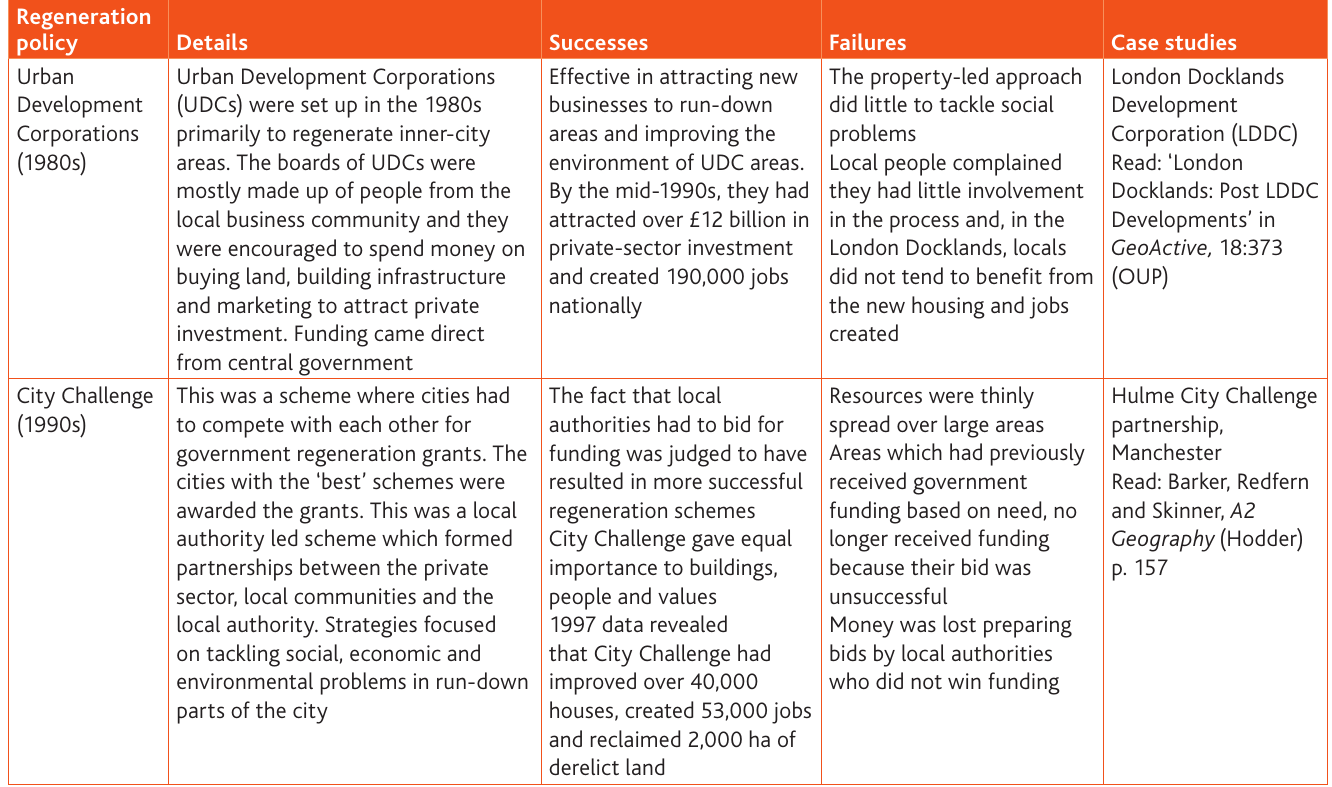
Urban Development Corporations were powerful organisations established to regenerate specific inner-city areas during the 1980s. They represented the property-led approach to regeneration.
How they operated:
- Set up primarily to regenerate inner-city areas experiencing severe decline
- Made up largely of people from the local business community
- Received direct funding from central government
- Had significant powers to acquire land, develop infrastructure and market areas to attract private investment
- Operated with considerable independence from local authorities
Successes:
Urban Development Corporations proved effective at attracting new businesses to run-down areas and improving the physical environment. The results were impressive:
- By the mid-1990s, they had attracted over £12 billion in private-sector investment
- Created approximately 190,000 jobs nationally
- Transformed the appearance of many derelict industrial areas
- Successfully marketed previously unattractive locations to businesses
Failures and criticisms:
Despite these achievements, UDCs faced significant criticism:
- The property-led approach failed to adequately address social problems
- Local communities had very little involvement in decision-making processes
- Many local people complained they did not benefit from the regeneration
- In areas like London Docklands, locals felt excluded from the new housing and employment opportunities created
- The focus on attracting outside investment sometimes overlooked existing community needs
Example
Case Study: London Docklands Development Corporation (LDDC)
The LDDC became the most famous and controversial UDC. The regeneration of London's Docklands transformed a vast area of derelict docks and warehouses.
Achievements:
- Attracted massive private investment
- Created thousands of new jobs, particularly in financial services
- Developed Canary Wharf into a major business district
- Improved transport links including the Docklands Light Railway
- Built thousands of new homes
Criticisms:
- Many new jobs were unsuitable for former dock workers
- New housing was often too expensive for existing residents
- Local communities felt the regeneration was imposed upon them rather than designed for their benefit
- Social divisions increased between old and new residents
For more detail, refer to GeoActive 18:373 and the Oxford University Press publication "London Docklands: Post LDDC Regeneration."
City Challenge (1990s)
City Challenge represented a shift in approach, introducing competition and partnership working into urban regeneration.
How it operated:
- Cities competed against each other for government regeneration grants
- Local authorities had to bid for funding by presenting detailed schemes
- The cities with the strongest plans received funding
- Successful bids formed partnerships between:
- The private sector
- Local communities
- The voluntary sector
- Local authorities
- Strategies focused on addressing social, economic and environmental problems simultaneously in run-down parts of cities
Successes:
The competitive element encouraged local authorities to develop high-quality, innovative regeneration schemes:
- By 1997, City Challenge had resulted in the improvement of over 40,000 houses
- Created approximately 53,000 jobs
- Reclaimed around 2,000 hectares of derelict land
- The competitive bidding process meant funding went to the most promising schemes
- Gave equal importance to buildings, people and community values rather than just physical development
- Partnership approach ensured diverse stakeholder involvement
Note
The Competitive Advantage
The bidding process forced local authorities to think carefully about their regeneration strategies and develop comprehensive, well-planned schemes. This competition-driven innovation became a model for future regeneration programmes.
Failures and criticisms:
Despite its successes, City Challenge had notable drawbacks:
- Resources were thinly spread across many areas
- Some areas that previously received government funding lost out if their bids were unsuccessful
- Areas receiving no funding because their bids failed felt penalised
- Money was wasted by local authorities preparing unsuccessful bids that received no funding
- The competitive nature meant cooperation between authorities was discouraged
Example
Case Study: Hulme City Challenge, Manchester
Hulme, an area of Manchester, had experienced severe decline with poor housing and social problems. The City Challenge approach brought significant improvements.
Key outcomes:
- Large-scale housing improvement and redevelopment
- Creation of employment opportunities for local residents
- Regeneration of community facilities
- Partnership approach ensured local voices were heard
- Mixed-tenure housing created more balanced communities
For further reading, see Barker, Redfern and Skinner's A2 Geography (Hodder), page 157.
City Deals (2011-present)
City Deals represent the latest evolution in urban policy, emphasising local decision-making and tailored solutions.
How they operate:
Between 2012 and 2014, 26 City Deals were agreed across England. The process occurred in two waves:
- First wave (2012): Covered the eight largest English cities outside London
- Second wave (2014): Extended to the next 18 largest English cities and their wider areas
Cities that secured City Deals gained the ability to:
- Take responsibility for decisions affecting their local area
- Design their own strategies to help businesses grow and thrive
- Create economic growth plans suited to local circumstances
- Decide how public money should be spent on local priorities
Successes:
The City Deal approach has delivered several benefits:
- Successful in delivering increased economic activity in participating cities
- Provided substantial infrastructure funding and development certainty
- Some cities continue to be rolled out across the United Kingdom, indicating the model's perceived effectiveness
- Allows flexibility for cities to address their unique challenges
- Empowers local decision-makers who understand their areas best
Failures and criticisms:
However, City Deals face ongoing challenges:
- Many employers feel that adult employment and skills funding streams remain too fragmented and project-specific
- This fragmentation prevents cities from effectively integrating policy and coordinating delivery across sectors
- Barriers remain to achieving further local integration of employment and skills delivery
- The payment-by-results mechanism creates challenges:
- It rewards service providers for achieving employment-related outcomes
- However, this has resulted in funding for specific programmes and projects
- It has not created the more flexible, non-ringfenced funding sources that cities need
- This limits cities' ability to design comprehensive, integrated approaches
Example
Case Study: Manchester Working Well Pilot
Implemented in 2014, the Manchester Working Well pilot demonstrates both the potential and challenges of City Deals.
How it works:
- Built around a payment-by-results mechanism
- Service providers receive funding for helping people into employment
- Aims to provide coordinated support for those struggling to find work
Assessment:
The pilot shows promise in delivering employment outcomes, but the payment-by-results structure limits flexibility. For more information, visit: www.greatermanchester-ca.gov.uk/what-we-do/work-and-skills/working-well/
Ongoing challenges in urban areas
Despite decades of regeneration efforts, several problems persist in British cities:
Important
Employment Issues:
- Many people who lost jobs through de-industrialisation continue to suffer long-term unemployment
- Service sector jobs created often don't fully replace lost manufacturing employment in terms of:
- Job security (many are part-time or temporary)
- Skill requirements
- Pay levels
- The number of service jobs created hasn't always compensated for manufacturing job losses
Note
Location Challenges:
- Both service industries and newer manufacturing companies often avoid inner city locations
- They prefer peripheral or suburban sites with better accessibility
- This continues the pattern of inner city economic decline
- Creates a spatial mismatch between where unemployed people live and where new jobs are created
Important
Social Integration:
- In areas like London Docklands, physical regeneration hasn't always benefited existing residents
- New housing and jobs are sometimes inappropriate or inaccessible for local communities
- Regeneration can increase social divisions rather than reduce them
These ongoing challenges demonstrate that urban regeneration remains an evolving process requiring continued policy adaptation and improvement.
Summary
Key Points to Remember:
-
Four phases of urban policy have evolved since 1979: property-led (1979-91), partnerships (1991-97), area-based initiatives (1997-2000s), and devolved responsibilities (2011-present), each reflecting changing understanding of how to regenerate urban areas effectively.
-
Urban Development Corporations successfully attracted £12 billion in private investment and created 190,000 jobs, but were criticised for excluding local communities from decision-making and failing to address social problems adequately.
-
City Challenge introduced competitive bidding and partnership working, improving 40,000 houses and creating 53,000 jobs, though unsuccessful bids wasted resources and left some areas without support.
-
City Deals give cities greater control over their development, but face challenges with fragmented funding streams and payment-by-results mechanisms that limit flexibility in designing comprehensive solutions.
-
Persistent challenges remain in British cities including long-term unemployment from de-industrialisation, creation of part-time service jobs that don't fully replace lost manufacturing work, and continued avoidance of inner city locations by new businesses.