Case Study: Antarctica - Climate Change (AQA A-Level Geography): Revision Notes
📚Revision Notes
Case Study: Antarctica - Climate change
Krill and the Antarctic ecosystem
Krill are small crustaceans that resemble shrimp and exist in enormous numbers throughout the Southern Ocean. They play a vital role as almost all Antarctic species depend on krill for survival. The entire food web of the region relies on these creatures as a primary food source.
Note
Krill are tiny shrimp-like crustaceans which swim in massive numbers and form a key part of the entire food chain of the Southern Ocean. Seabirds, penguins, seals, whales and fish such as toothfish all depend on krill populations.
The Antarctic food web demonstrates the critical position of krill within the ecosystem:
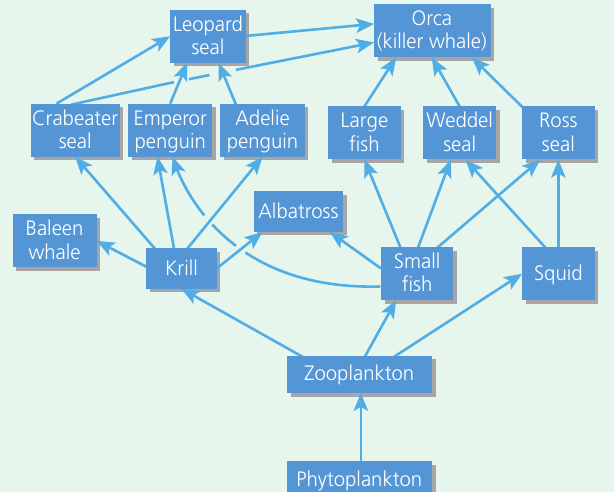
The diagram shows how krill feed on zooplankton and phytoplankton at the base of the food chain, whilst themselves being consumed by numerous species including:
- Baleen whales
- Adelie and Emperor penguins
- Crabeater, Weddell and Ross seals
- Large fish and squid
- Albatrosses
Important
Any significant decline in krill numbers would have devastating consequences for virtually every species in the Antarctic ecosystem.
Commercial fishing threats
Fishing is becoming an increasingly serious threat to the Southern Ocean and Antarctic ecosystems. There are two main concerns:
Overfishing and by-catch
Target species face high risk from overfishing practices. By-catch refers to the unintentional capture of non-target species whilst fishing for desired species. This causes direct harm to marine habitats through multiple methods including overfishing vessels and abandoned fishing equipment. Ships also contribute to pollution by dumping waste into the ocean, including discarded plastic that contaminates the water. Marine life can be killed either by ingesting plastic or becoming trapped in lost fishing nets and hooks.
The krill oil industry
Krill are now being harvested for processing into feed for farmed fish and as a nutritional supplement in the form of krill oil. This oil is distributed globally and serves as an excellent protein source. Krill oil contains extremely high levels of omega-3 fatty acids and is marketed to prevent hypertension, strokes and depression. The commercial value is substantial - cartons of krill oil capsules can cost as much as \£40 for 100 capsules in health food retail outlets.
Important
The sudden and dramatic surge in demand for krill products has triggered a sharp increase in fishing activity. This coincides with long-term evidence of declining krill populations. Unsustainable fishing methods could trigger a krill population crash, which would have catastrophic consequences for the entire Antarctic ecosystem.
Climate change impacts
Antarctica is a vast continent where climate change creates varied effects across different regions. Eastern and western Antarctica are experiencing markedly different impacts.
Western Antarctic Ice Sheet and Antarctic Peninsula
The Antarctic Peninsula demonstrates particular sensitivity to even minor increases in annual average temperature. This region has recorded air temperature rises of nearly 3°C over the past 50 years, which represents a much faster rate than the global average for warming. The Intergovernmental Panel on Climate Change (IPCC) has documented this accelerated warming, noting that temperatures across Western Antarctica have risen significantly.
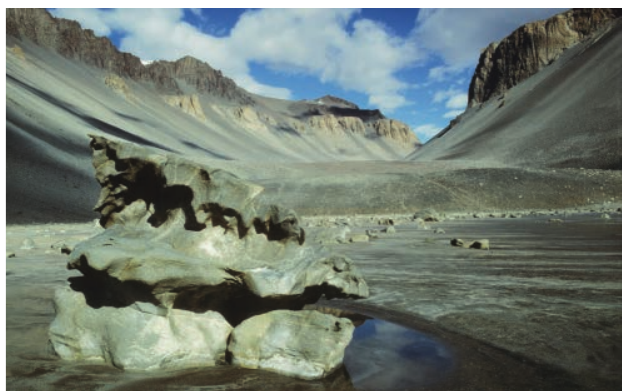
This warming extends beyond the land surface. Southern Ocean temperatures to the west of the Antarctic Peninsula have also increased by over 1°C since 1955. Research has established that the Antarctic Circumpolar Current is warming more rapidly than the global ocean as a whole.
Effects on the physical and living environment
The warming has produced the following impacts on western Antarctica:
- Penguin distribution changes: Penguin colonies have altered their locations in response to environmental changes
- Snow and ice cover melting: Increased melting has led to greater colonisation by plant species in previously ice-covered areas
- Krill decline: The abundance of Antarctic krill has decreased significantly
- Glacier and ice shelf retreat: Glaciers and ice shelves surrounding the Peninsula have retreated substantially, with some collapsing entirely
- Thwaites Glacier concern: There is particular alarm about the Thwaites Glacier on the west coast as it is melting more rapidly than previously predicted. It is an unusually broad glacier and represents one of the largest contributors to global sea level rise. Scientists believe that complete collapse could trigger a sea level rise of up to 63cm
- Ice shelf breakup: The Ronne and Ross ice shelves will not directly add to sea level change as they break up, but their disintegration increases the flow rate of glaciers behind them - it is the melting of these glaciers that will cause sea levels to rise
Note
Temperature predictions
The temperature of Antarctica as a whole is predicted to rise by a small amount over the next 50 years. Any increase in the rate of ice melting is expected to be partly offset by increased snowfall resulting from the warming.
East Antarctica and sea ice expansion
The temperature of Eastern Antarctica has risen by a much smaller amount than the Peninsula. Unlike the Peninsula, there is no significant loss of ice occurring in this region.
The sea ice paradox
Surprisingly, whilst global temperatures are rising, sea ice is actually expanding on the eastern side of Antarctica towards the Indian and Pacific Oceans. In 2014, the extent of Antarctic sea ice reached an all-time record extent of 20.11 million square kilometres - larger than the continental land mass itself.
Note
Sea ice is a thin layer between one to two metres thick. It forms when water is cooled sufficiently by the surrounding atmosphere. Once formed, it can be blown by wind or carried by currents, ultimately expanding and bonding with other floating sheets of ice.
Four reasons for Antarctic sea ice expansion
Climate change may contribute to Antarctic sea ice expansion through several mechanisms:
- Increasing westerly winds: Climate change and ozone depletion are driving the seas northwards with stronger westerly winds around the Southern Ocean
- Rain and snow layering: More rain and snow resulting from climate change are creating a cooler, denser layer on top of the Southern Ocean
- Freshening storms: These storms are also reducing the salt content of local water, making it less salty and thus raising the temperature needed for sea ice to form
- Increased melting of land ice: Melting of continental land ice creates more floating icebergs which contribute to sea ice formation
Ocean acidification
The decline in pH of ocean water results from an increase in atmospheric carbon dioxide (CO₂) concentrations. This creates carbonic acid, which makes the ocean slightly less alkaline - a process known as ocean acidification.
This poses potential threats to the marine environments of the Southern Ocean. The rapid rate at which acidification is progressing will make any adaptation difficult for marine species. Ocean water may actually become corrosive to the unprotected shells and exoskeletons of certain organisms. Losing these organisms will disrupt food webs throughout the ecosystem.
Important
Ocean acidification threatens organisms with shells and exoskeletons, potentially causing widespread disruption of food webs throughout the Antarctic marine ecosystem.
The search for mineral resources
There has never been commercial mining in Antarctica as it is completely banned by the Antarctic Treaty. There are no current or known future plans by any of the Antarctic Treaty nations to reverse this decision.
Nevertheless, future demand for resources will undoubtedly put pressure on the vast mineral reserves that are to be found on the continent.
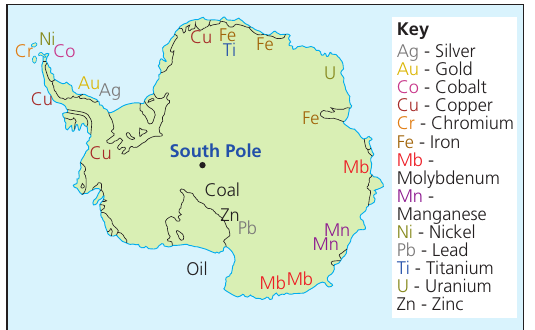
The map shows the distribution of numerous valuable minerals and metals across Antarctica, including silver, gold, cobalt, copper, chromium, iron, molybdenum, manganese, nickel, lead, titanium, uranium and zinc. Coal and oil deposits are also present.
Practical challenges
The difficult and dangerous Antarctic conditions make exploitation unlikely as it is unviable. The expense of extracting resources through very thick ice and then establishing transport systems across moving glaciers and melting streams would prevent any commercial operation from being economically feasible.
Note
The initial moratorium on mining was voluntary, but the issue was raised by some Treaty members in the 1980s who attempted to formulate a new convention allowing exploration for mineral and gas resources.
Remember!
Summary
Key Takeaways:
- Krill are the foundation of the Antarctic food web - virtually all species depend on them, making any population decline potentially catastrophic for the entire ecosystem
- Western Antarctica is warming rapidly (nearly 3°C in 50 years), causing the West Antarctic Ice Sheet to thin, glaciers to retreat, and the Thwaites Glacier to threaten a 63cm sea level rise
- Eastern Antarctica shows a climate paradox - whilst warming is occurring, sea ice is actually expanding due to stronger westerly winds, rain/snow layering, freshening storms, and increased iceberg formation
- Ocean acidification from rising CO₂ levels threatens organisms with shells and exoskeletons, potentially disrupting the entire marine food web
- Antarctica contains vast mineral reserves but commercial mining remains banned under the Antarctic Treaty, though future resource pressures may test this agreement