Case Study: Antarctica - Governance of Antarctica (AQA A-Level Geography): Revision Notes
📚Revision Notes
Case Study: Antarctica - Governance of Antarctica
Introduction to Antarctic governance
Antarctica has been a politically sensitive area since its discovery and exploration, particularly during the era of colonial and territorial claims. Many geopolitical issues require careful management to ensure the continent's ongoing protection as a global common. Despite ongoing challenges, Antarctica is frequently highlighted as an exemplary model of successful global governance and international cooperation between nation states.
The Antarctic Treaty (AT)
Background and formation
The Antarctic Treaty was drafted in 1959 against the backdrop of Cold War tensions between global superpowers. The treaty was ratified by the 12 original member nations and came into force in June 1961.
Important
The Antarctic Treaty (AT) established that Antarctica does not 'belong' to any single nation. Instead, it designated the entire area south of 60°S latitude as a zone where countries would collaborate for the common cause of scientific research.
Key provisions of the treaty
The Antarctic Treaty established several fundamental principles:
- Peaceful purposes only: Antarctica must be used exclusively for peaceful activities; all military operations are banned
- Scientific freedom: The treaty guarantees continued freedom to conduct scientific research
- International scientific cooperation: Countries must promote international scientific collaboration, including exchanging research plans and personnel, and sharing research results
- Sovereignty freeze: All claims to sovereignty are frozen for the duration of the treaty, and any new or enlarged claims are prohibited
- Nuclear-free zone: The treaty prohibits nuclear explosions and the disposal of radioactive waste
- Inspection rights: Ships, stations and equipment can be inspected by observers to ensure compliance
- Advance notification: Parties must give advance notice of their expeditions
- Dispute settlement: The treaty includes procedures for settling disputes and a review mechanism for modifications
Membership and decision-making
Members of the Antarctic Treaty committed to operating on a consensus basis, regardless of their size or status. This meant that superpowers of the time, such as the Soviet Union (Russia) and USA, had to work on equal footing with smaller nations like Belgium, New Zealand and South Africa.
Other nations were permitted to become signatories to the AT, but to gain voting rights, they had to demonstrate 'substantial scientific activity', such as establishing a research station in Antarctica.
International government organisations and pressures
The role of the United Nations
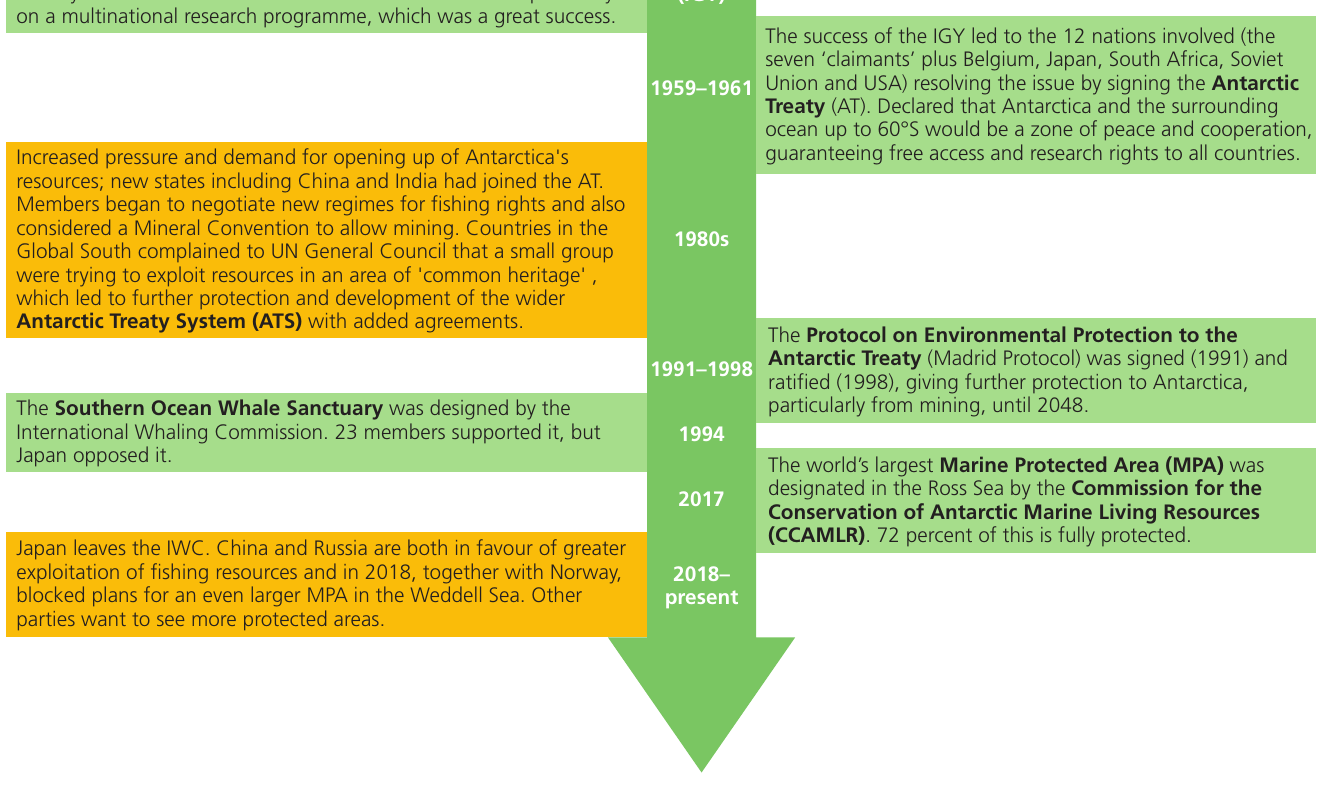
Initially, the United Nations (UN) had minimal involvement in establishing the treaty or the early governance of Antarctica. Responsibility was devolved to AT member states. However, by the 1980s, international pressure for access to Antarctic resources was mounting.
Key pressures included:
- New members: Countries including China and India became AT signatories with interests in gaining influence over resource control in Antarctica
- Fishing rights: Some member states wanted to negotiate management of the fisheries
- Mining proposals: A Convention on the Regulation of Antarctic Mineral Resource Activities was proposed in 1988 that would have allowed mineral exploration
UN intervention and the "common heritage" concept
Countries in the Global South complained to the UN General Council that a small group was trying to control resources in an area of 'common heritage'. This led to concerns about the AT's accountability and whether it was succumbing to pressures for resource development.
Note
Under the legal provision of 'common heritage of mankind', AT members accepted proposals from the UN that the United Nations Environment Programme (UNEP) would extend the treaty by adding agreements that would strengthen and secure protection for Antarctica. This approach recognised that Antarctica's resources should benefit all of humanity, not just a select group of nations.
This led to the establishment of the broader Antarctic Treaty System (ATS).
The Antarctic Treaty System (ATS)
Structure and management
International governance of Antarctica operates under the control of the ATS, which is managed through annual Antarctic Treaty Consultative Meetings (ATCM). These meetings comprise the original 12 member states plus a further 16 'consultative parties'. The ATS includes various other organisations, such as NGOs and scientific institutions, that influence the decision-making process regarding activities on the continent.
Components of the ATS
The ATS includes the Antarctic Treaty at its core, together with several additional agreements:
- The Protocol on Environmental Protection to the Antarctic Treaty (Madrid Protocol, 1991)
- Two separate conventions dealing with the conservation of Antarctic seals
- The Commission for the Conservation of Antarctic Marine Living Resources (CCAMLR)
Expanded scope of governance
These supplementary agreements have broadened the scope of governance to include:
- Protection of the Antarctic environment
- Conservation of plants and animals
- Preservation of historic sites
- Designation and management of protected areas
- Management of tourism
- Collection of meteorological data and hydrographic charting
The Protocol on Environmental Protection to the Antarctic Treaty 1991 (the Madrid Protocol)
Negotiation and adoption
The 'Environmental Protocol' was negotiated by UNEP and treaty members at an Antarctic Treaty conference in Madrid in 1991. This negotiation followed years of discussions about controlling mineral resources in Antarctica.
International pressure had mounted after the 1988 Convention on the Regulation of Antarctic Mineral Resource Activities proposed allowing mineral exploration. However, AT members decided against adopting this Convention due to pressure from France, Australia and many non-AT countries expressing the need for environmental protection. Instead, they pursued a separate proposal that eventually became the Environmental Protocol, which was ratified and came into force in 1998.
Key provisions of the Madrid Protocol
The Protocol established several crucial environmental safeguards:
- Natural reserve designation: Antarctica is designated as a 'natural reserve, devoted to peace and science'
- Environmental principles: Establishes comprehensive environmental principles for the conduct of all activities
- Mining prohibition: Prohibits mining or mineral resource exploration, including exploration of the continental shelf
- Committee for Environmental Protection: Established a dedicated committee to oversee environmental matters
- Contingency planning: Requires operators to develop contingency plans to respond to environmental emergencies
- Waste return requirement: Mandates that waste of all kinds be returned to the country of origin wherever possible
The mining ban
Important
The ban on mining can only be modified if all parties agree. Otherwise, the next review of the mining prohibition is due in 2048. This means any modifications to the prohibition are unlikely beforehand and only possible if 75 per cent of the consultative parties agree.
Systems for inspection and enforcement
Challenges of enforcement
Inspection and observation of all operations on Antarctica are compulsory under the terms of the Treaty. However, enforcement presents unique challenges:
Note
Antarctica has no permanent population, and therefore no citizenship or government. All personnel present on Antarctica are citizens of nations outside Antarctica and fall under their nation's jurisdiction. Consequently, there is no single unifying 'legal system'. Prosecutions against treaty violations are the responsibility of individual nation states through the ATCM.
Observer and audit systems
The Madrid Protocol introduced a more rigorous regime for monitoring compliance:
- Designated observers: Observers are appointed by the ATCM
- Environmental audits: These are carried out at scientific bases, on land and in the sea to assess the impact that bases and their activities are having on the surrounding area
- Broad scope: Inspections include stations, ships, aircraft and loading areas, though maritime areas unfortunately receive less focus
Environmental impact assessments
Any new activities by operators are subject to environmental impact assessments, which evaluate potential environmental consequences before activities proceed.
International Whaling Commission (IWC)
Role and responsibilities
Important
The International Whaling Commission (IWC) is the global body responsible for the conservation of whales and the management of whaling activities. It was established in 1946 to provide for the proper conservation of whale stocks and the sustainable development of the whaling industry.
Main duties and measures
The primary duty of the IWC is to oversee the measures established by the Whaling Convention, which governs the conduct of whaling globally. These measures include:
- Providing complete protection of certain whale species
- Designating specified areas as whale sanctuaries
- Establishing limits on the numbers and size of whales which may be taken
- Prescribing open and closed seasons and areas for whaling
- Prohibiting the capture of suckling calves and female whales accompanied by calves
- Requiring catch reports and other statistical and biological records
- Special permit whaling for scientific research
The Southern Ocean Whale Sanctuary
In 1994, the IWC established the Southern Ocean Whale Sanctuary (Figure 7.43), covering an area of 50 million km², where all commercial whaling is banned. However, Japan continued its 'research whaling' activities in this sanctuary despite the ban, with 23 member countries supporting the sanctuary but Japan opposing it.
The whaling moratorium
In 1982, the IWC decided that there should be a suspension of commercial whaling on all stocks from 1986 onwards. This is known as the whaling moratorium, and it has remained in effect despite efforts from Japan and other pro-whaling nations to overturn it.
Controversies and compliance issues
Japan's exploitation of loopholes:
- Japan continued to evade the moratorium through 'special permit' whaling, which enabled them to exploit a loophole in IWC regulations that permitted whaling for 'scientific research' in the Southern Ocean
- Japan stated that the purpose of its 'research whaling' was to monitor stocks to pave the way for the resumption of commercial whaling
- Japan's whaling activities in the ocean were continually monitored by the Sea Shepherd Conservation Society, a marine conservation NGO, and by the Australian government
- In 2014, the International Court of Justice ruled that Japan's whaling fleet had, in effect, used 'research whaling' as a cover for commercial whaling
Recent developments:
- Norway and Iceland continue to hunt common minke whales commercially within their own exclusive economic zones (EEZ); neither takes whales from the Southern Ocean
- In 2018, IWC members met in Florianopolis, Brazil and rejected a proposal by Japan to remove the moratorium on commercial whaling
- As a result of the discussions, the 'Florianopolis Declaration' concluded that the moratorium would continue in perpetuity to allow for the recovery of whale populations to pre-industrial whaling levels
- This led to Japan withdrawing its membership of the IWC to resume commercial whaling within its own territorial waters and EEZ
- Japan had to cease 'special permit' whaling activities in the Southern Ocean
Aboriginal subsistence whaling
The moratorium does not apply to 'aboriginal subsistence whaling' carried out by indigenous cultures in Alaska, Greenland and parts of Canada. This is not viewed as commercial whaling, though it is regulated by the IWC, which sets catch limits every six years.
Current challenges
Ongoing disputes (2018-present):
- Japan, China, Russia and Norway favour greater exploitation of fishing resources
- In 2018, together with Norway, these nations blocked plans for an even larger Marine Protected Area (MPA) in the Weddell Sea
- Other parties want to see more protected areas established
Remember!
Summary
Key Points to Remember:
-
The Antarctic Treaty (1959-1961) established Antarctica as a zone of peace and scientific cooperation, with sovereignty claims frozen and military activities banned
-
The Antarctic Treaty System (ATS) broadened governance through the Madrid Protocol (1991), which designated Antarctica as a natural reserve and banned mining until at least 2048
-
Enforcement challenges exist because Antarctica has no permanent population or unified legal system; prosecutions rely on individual nation states through the ATCM
-
The International Whaling Commission (IWC) established the Southern Ocean Whale Sanctuary (1994) and maintains a whaling moratorium (1986-present), though Japan exploited loopholes until 2018
-
Ongoing tensions persist between conservation and resource exploitation, with countries like Japan, China, Russia and Norway seeking greater access to fishing resources, while others push for more Marine Protected Areas