Case Study: Antarctica - Search for Resources (AQA A-Level Geography): Revision Notes
📚Revision Notes
Case Study: Antarctica - Search for Resources
Mineral resources in Antarctica
Antarctica contains significant deposits of valuable mineral resources, though their exact extent remains uncertain. The continent holds reserves of coal, oil, and numerous metallic minerals distributed across different regions.
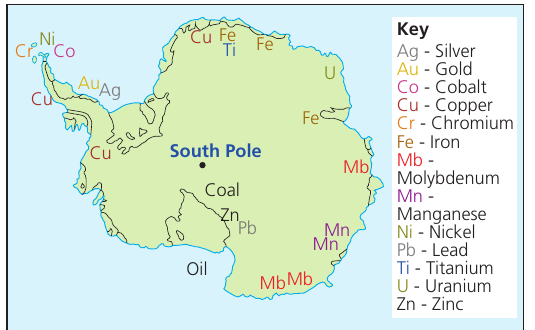
Known mineral deposits include:
- Fossil fuels: coal and oil reserves
- Precious metals: gold (Au) and silver (Ag)
- Base metals: iron (Fe), copper (Cu), nickel (Ni), zinc (Zn), and lead (Pb)
- Strategic metals: chromium (Cr), titanium (Ti), manganese (Mn), cobalt (Co), molybdenum (Mb), and uranium (U)
Legal protection and governance
Important
The Madrid Protocol protects Antarctica from exploitation until 2048. This international agreement completely bans commercial mining activities on the continent.
Commercial mining has never occurred in Antarctica. The Antarctic Treaty system provides comprehensive protection, with the Madrid Protocol serving as the key legal instrument preventing resource extraction. Currently, no plans exist among Treaty nations to reverse this mining prohibition.
Note
During the 1980s, some Treaty members attempted to establish a voluntary moratorium on mining. They proposed creating a Convention on the Regulation of Antarctic Mineral Resource Activities, but this initiative failed to gain ratification and the Madrid Protocol was later agreed instead, providing stronger protection.
Challenges of exploitation
Even if legal restrictions were removed, extracting mineral resources from Antarctica would face enormous practical difficulties:
- Extreme ice coverage: Resources lie beneath very thick ice sheets, making access nearly impossible
- Harsh climate conditions: Extreme cold and dangerous weather create unviable working conditions
- Infrastructure requirements: Establishing transport systems across moving glaciers and navigating melting streams would prevent effective commercial operations
- Enormous costs: The expense of extraction through ice and establishing infrastructure makes operations economically unviable
These physical barriers mean that resource exploitation remains unlikely in the foreseeable future, regardless of potential future demand pressures.
Tourism as an economic resource
Antarctica has no permanent population except for scientists at research stations. However, tourism has emerged as a significant economic activity, bringing thousands of visitors to the continent each year.
Types of Antarctic tourism
The summer tourism season in the Southern Hemisphere runs from mid-November to March. Visitors can reach Antarctica through three main approaches:
Seaborne tourism represents the most common option. Cruise ships typically depart from Ushuaia in Argentina or Punta Arenas in Chile. Passengers have opportunities to transfer to smaller boats for landing or cruising close to shore, allowing intimate encounters with the Antarctic environment.
Airborne tourism involves flying from Australia, New Zealand or South America. Some tours include scenic flights over the continent, while others involve landing to allow exploration on the ground.
Fly-cruises cater to visitors with less time available or those wanting to avoid long sea journeys. Flights land on King George Island, where visitors board cruise boats for their Antarctic experience.
Note
Tourism Types Mnemonic (SAF):
- Seaborne - Cruise ships from South America
- Airborne - Flights from Australia, New Zealand, or South America
- Fly-cruises - Combined flights and cruise boats
Growth and scale of tourism
Tourist numbers have grown dramatically over recent decades. In the late 1950s, only a few hundred specialist visitors made the journey to Antarctica. By 2018-19, this figure had increased to nearly 56,000 visitors, of whom 45,000 actually landed on the continent.
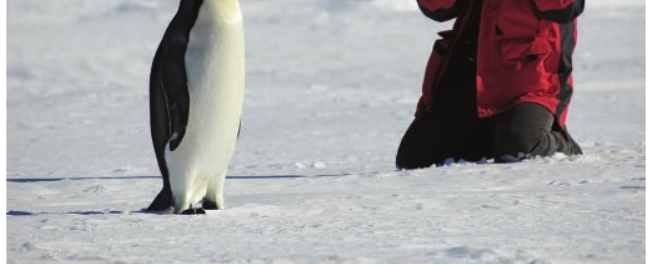
Visitors are attracted by the spectacular glacial landscapes and unique wildlife opportunities, particularly encounters with penguins. Many tourists also seek out historic sites such as McMurdo Sound with its huts dating from the Scott and Shackleton expeditions. The remoteness and isolation of a true wilderness experience provides another major draw.
The tourist experience varies considerably depending on whether visitors set foot on land. Different itineraries offer optional activities including visits to penguin or seal colonies, and kayaking expeditions.
Tourism governance
As prices have become more affordable and more tour operators have entered the market, concerns have emerged that Antarctica might transition from a niche destination towards mainstream tourism. What was once an exclusive experience may be edging towards mass tourism.
Important
The International Association of Antarctic Tour Operators (IAATO) is a well-governed industry body with strict rules set by member tour operators and enforced through a sound record of environmental concern.
Tour operators and tourists widely accept and follow regulations designed to protect the Antarctic environment. Visitors increasingly act as ambassadors for Antarctica, raising awareness about the need for preservation and protection from development.
Scientific research activities
Scientific researchers represent the only other significant human presence in Antarctica besides tourists. Scientists work either in the interior regions near the South Pole or in coastal areas, conducting vital research programmes.
Although scientists working in remote research stations receive thorough briefings about environmental care, any human activity inevitably creates some degree of disturbance to the environment and wildlife. Key impacts include:
- Construction of buildings and related facilities
- Development of fuel storage infrastructure
- Creation of runways for supply aircraft
- Disposal of various waste materials including rope, fuel drums and plastics
All of these activities endanger living organisms in Antarctica's fragile ecosystems.
Environmental impacts and mitigation
Human activities in Antarctica, particularly tourism and scientific research, create various environmental pressures. However, strong arguments exist both for limiting activities and for allowing carefully managed access.
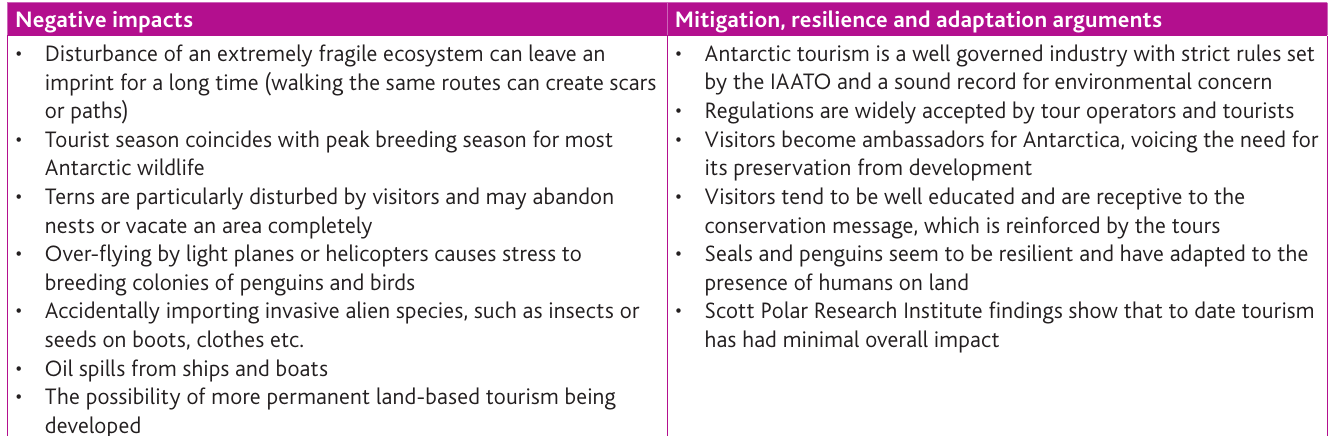
Negative environmental impacts
Ecosystem disturbance: Repeated walking along the same routes creates visible scars and paths in Antarctica's extremely fragile ecosystem, which recovers very slowly from damage.
Wildlife disruption: The tourist season coincides with peak breeding season for most Antarctic wildlife. Visitors can disturb animals significantly, sometimes causing terns to abandon their nests or vacate areas completely. Over-flying by light planes or helicopters creates stress for breeding colonies of penguins and birds.
Invasive species introduction: Tourists and researchers may accidentally import alien invasive species, such as insects or seeds, on boots, clothes and equipment. These non-native organisms can disrupt local ecosystems.
Pollution risks: Ships operating in Antarctic waters pose risks of oil spills, which would devastate the pristine environment.
Infrastructure development: The possibility exists that more permanent land-based tourism facilities could be developed, increasing human footprint and environmental pressure.
Note
The timing of the Antarctic tourist season (mid-November to March) creates particular challenges because this period coincides with the critical breeding season for most Antarctic wildlife, making careful management essential to minimise disruption.
Mitigation and adaptation measures
Strong governance framework: Antarctic tourism operates as a well-governed industry. The IAATO enforces strict rules among member tour operators, maintaining a sound record of environmental protection and concern.
Regulatory compliance: Tour operators and tourists widely accept and follow regulations. These rules help minimise environmental impacts whilst allowing access.
Education and ambassadorship: Visitors become well-educated about Antarctic conservation issues and are receptive to conservation messages, which the tours reinforce. Many tourists subsequently become ambassadors for Antarctica, advocating for its preservation from development.
Wildlife resilience: Evidence suggests that seals and penguins have shown resilience to human presence and have adapted to visitors on land.
Limited overall impact: Research findings from the Scott Polar Research Institute indicate that to date, tourism has had minimal overall impact on Antarctica's environment.
Example
Case Study: Tourist Impact Assessment
Research by the Scott Polar Research Institute has shown that despite concerns about tourism growth, the overall environmental impact remains minimal. This is attributed to:
- Strict visitor limits: Tour operators restrict the number of people who can land at any one site
- Guided tours: All visitors must be accompanied by trained guides who ensure compliance with regulations
- No-go zones: Sensitive breeding areas are off-limits during critical periods
- Rapid response protocols: Any signs of wildlife stress result in immediate visitor withdrawal
Result: Wildlife populations, particularly penguin colonies, have shown remarkable resilience and adaptation to managed human presence.
Summary
Key Points to Remember:
-
Antarctica contains extensive mineral deposits including coal, oil, gold, silver and strategic metals, but the Madrid Protocol bans all commercial mining until 2048.
-
Resource exploitation faces enormous practical challenges including extreme ice thickness, harsh conditions, and massive infrastructure costs that make operations unviable.
-
Antarctic tourism has grown from a few hundred visitors in the 1950s to nearly 56,000 in 2018-19, with three main types: Seaborne, Airborne and Fly-cruises (SAF).
-
The IAATO (International Association of Antarctic Tour Operators) provides strong governance, ensuring tour operators follow strict environmental rules and maintain high standards of protection.
-
Whilst tourism and research create environmental pressures including ecosystem disturbance and wildlife disruption, strong mitigation measures, education programmes and regulatory compliance help minimise impacts whilst allowing carefully managed access to this unique wilderness.