Case Study: Antarctica - Tourism and Science (AQA A-Level Geography): Revision Notes
📚Revision Notes
Case Study: Antarctica - Tourism and Science
Introduction
Antarctica remains one of Earth's most pristine environments, with virtually no permanent human population. The continent is inhabited only by scientists stationed at research facilities and visited temporarily by tourists. Both groups represent the primary human activities that pose potential threats to this fragile ecosystem.
Note
Antarctica is unique in having no indigenous human population and no permanent inhabitants - only temporary scientific staff and seasonal tourists visit this remarkable continent.
Tourism in Antarctica
Tourism season and visitor numbers
The period for tourist visits to Antarctica spans from mid-November through to March, coinciding with the Southern Hemisphere's summer months. This timing allows for more favourable weather conditions and increased wildlife activity.
Tourist activity has experienced remarkable growth over recent decades. In the late 1950s, only a few hundred specialist visitors travelled to Antarctica. By 2018-19, this figure had increased dramatically to approximately 56,000 visitors, of whom 45,000 actually set foot on the continent.
Forms of Antarctic tourism
Antarctic tourism takes three distinct forms:
Seaborne tourism
- Typically involves cruise ships departing from South American ports, particularly Ushuaia in Argentina or Punta Arenas in Chile
- Passengers have opportunities to transfer to smaller vessels for shore landings or close-range coastal exploration
- Most common form of Antarctic tourism
Airborne tourism
- Involves scenic flights operating from Australia, New Zealand or South America
- May include flights over the continent or, in some instances, actual landings on Antarctic territory
- Allows visitors to experience Antarctic landscapes from above
Fly-cruises
- Designed for visitors who wish to avoid lengthy sea voyages
- Passengers fly to King George Island where they board cruise vessels
- Combines efficiency of air travel with intimate cruise experience
Tourist attractions and experiences
Visitors are drawn to Antarctica for several compelling reasons:
- Spectacular glacial landscapes featuring massive ice formations and pristine wilderness
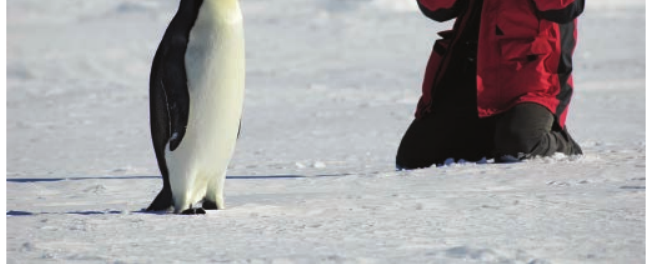
- Unique wildlife encounters, particularly with penguin colonies
- Historical sites such as McMurdo Sound, which preserves huts from the Scott and Shackleton expeditions
- The experience of extreme remoteness and isolation in a true wilderness environment
The nature of each visitor's experience varies considerably depending on whether they remain aboard ships or participate in shore-based activities.
IAATO regulations and management
Important
The International Association of Antarctic Tour Operators (IAATO) is an industry organisation that establishes and enforces strict guidelines to minimise tourism's environmental impact. Tour operators join this association annually, and there are growing concerns that what was once a specialist niche market is shifting towards mainstream tourism.
To maintain sustainable operations and protect the Antarctic environment, the IAATO has implemented mandatory regulations including:
- Vessel size restrictions: Large ships carrying more than 500 passengers are prohibited from visiting; most vessels accommodate between 50 and 200 people
- Landing group sizes: When groups disembark, they must be divided into small units of approximately 20 people, each supervised by a qualified guide
- Code of conduct: Tourists receive thorough briefings covering health and safety protocols and wildlife observation guidelines
- Site rotation: Visiting sites may only be accessed every three to four days, allowing time for environmental recovery and minimising cumulative impacts
Impacts of tourism on Antarctica
Negative environmental impacts
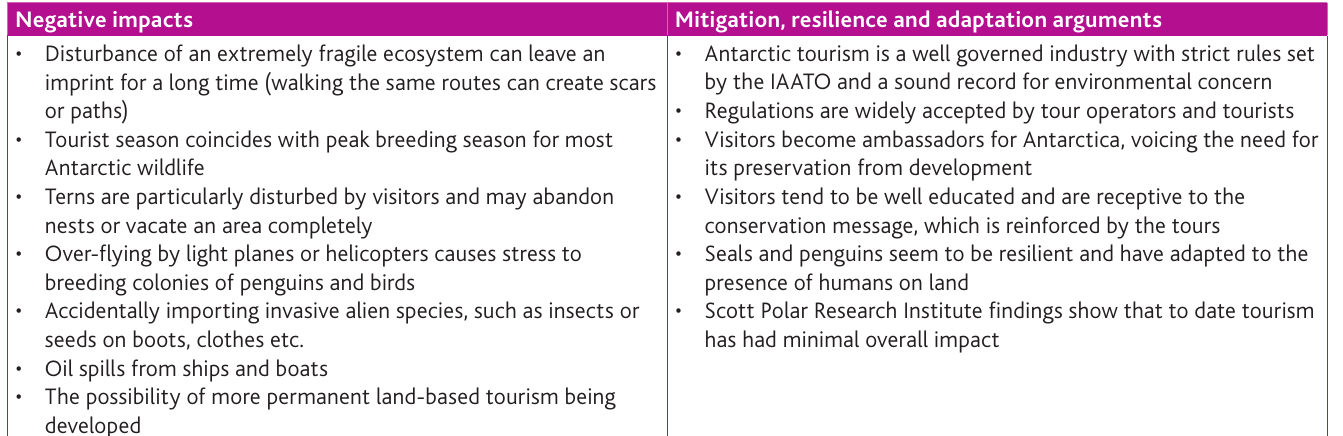
Although landings typically last only a few hours, they concentrate in limited accessible areas, creating relatively high localised impacts. The expansion of tourism presents significant long-term environmental challenges:
Ecosystem disturbance
- Antarctica's ecosystem is extremely fragile and vulnerable to human interference
- Repeatedly walking the same routes creates visible scars and pathways across the landscape
- Physical disturbance can have lasting effects in this slow-recovery environment
Wildlife disruption
- Tourism peaks during the breeding season for most Antarctic wildlife species
- Tern populations have been observed abandoning nests or deserting entire areas when disturbed
- Low-flying aircraft and helicopters cause considerable stress to penguin colonies and other bird populations
Important
Common Environmental Threats: Visitors may accidentally import alien species through seeds or insects carried on boots and clothing. These non-native organisms could threaten the delicate ecological balance, potentially causing irreversible damage to Antarctica's unique ecosystems.
Pollution risks
- Oil spills from ships and boats pose serious environmental hazards
- Waste disposal from vessels and land-based activities threatens marine and terrestrial environments
Infrastructure development
- Growing pressure exists to develop more permanent land-based tourism facilities, which would significantly increase environmental footprint
Mitigation, resilience and adaptation
Despite these concerns, several factors suggest that Antarctic tourism can be managed sustainably:
Effective governance
- Antarctic tourism operates as a well-governed industry with strict regulations enforced by IAATO
- Tour operators and visitors demonstrate a sound record of environmental responsibility
- Many visitors become ambassadors for Antarctic conservation, advocating for protection against development pressures
Wildlife resilience
- Research indicates that seals and penguins appear generally receptive to conservation messages and educated tourism
- These species show resilience and have demonstrated ability to adapt to measured human presence on land
Scientific evidence
- The Scott Polar Research Institute has conducted comprehensive studies showing that tourism has produced minimal overall environmental impact to date
- Ongoing monitoring continues to assess long-term effects
Note
The balance between tourism growth and environmental protection demonstrates that with proper management and strict regulations, sustainable tourism in Antarctica is achievable. The key lies in maintaining effective oversight and ensuring all visitors and operators adhere to established guidelines.
Scientific research in Antarctica
Scientists working at permanent research stations or in coastal and interior locations receive comprehensive briefing about environmental care requirements. However, all human activity inevitably creates some degree of environmental disturbance.
Research-related impacts
Scientific operations generate environmental pressures through:
- Vehicle emissions: Exhaust fumes from research vehicles and transport equipment
- Infrastructure construction: Building research stations and associated facilities
- Support systems: Fuel storage depots required for heating and power generation
- Transportation facilities: Runway construction and maintenance for aircraft operations
- Waste management: Disposal of various waste types including rope, fuel drums, plastics and other materials
All these activities pose risks to living organisms in Antarctica's pristine environment. Even with careful management, scientific research leaves an ecological footprint on the continent.
Note
While scientific research is essential for understanding Antarctica's ecosystems and monitoring environmental change, researchers must balance the need for knowledge with the responsibility to minimise their impact on this fragile environment.

Governance of Antarctica
Since its discovery and subsequent exploration during an era of colonial and territorial expansion, Antarctica has remained a politically sensitive region. Numerous geopolitical issues require ongoing attention to ensure Antarctica's protection as a global commons. Despite challenges, Antarctica is frequently cited as an exemplar of successful international cooperation and global governance.
The Antarctic Treaty (AT)
Important
The Antarctic Treaty was drafted in 1959 against the backdrop of Cold War geopolitical tensions. It came into force in June 1961 with 12 original member nations agreeing to collaborative management of the continent.
The treaty established a revolutionary framework by designating the entire area south of 60°S latitude as a zone where nations would collaborate for shared scientific objectives rather than competing for territorial control. Crucially, the treaty stipulated that Antarctica does not 'belong' to any single nation.
Key provisions of the Antarctic Treaty:
- Peaceful purposes mandate: Antarctica must be used exclusively for peaceful activities; all military operations are prohibited
- Scientific freedom: Continued freedom to conduct scientific research is guaranteed
- International scientific cooperation: Promotes collaboration including exchange of research plans, personnel and findings between nations
- Sovereignty freeze: All territorial claims to sovereignty are frozen for the treaty's duration, and no new or enlarged claims may be made
- Nuclear prohibition: Nuclear explosions and disposal of radioactive waste are strictly forbidden
Note
Madrid Protocol context
The treaty framework was strengthened by the Madrid Protocol, which protects Antarctica from mineral resource exploitation until 2048. Although a Convention on the Regulation of Antarctic Mineral Resource Activities was proposed, it was never ratified, providing additional safeguards against commercial development.
Vulnerability to environmental change
Antarctica's environment faces threats that may disturb its fragile ecosystem and impact indigenous species and biodiversity. The Scientific Committee on Antarctic Research (SCAR) monitors how well the continent responds to these challenges through three key ecological concepts:
Resilience
Important
Resilience (ecological) refers to the amount of disturbance that an ecosystem can withstand without changing its existing structures and processes.
Resilience provides ecosystems with the capacity to recover from shock events, disturbances or ongoing changes, whether naturally occurring or caused by human activity. Endemic species that evolved in Antarctica typically demonstrate greater resilience as they develop strategies allowing their populations to rebuild.
Example
Historical Example: Species Recovery
Sealing, whaling and hunting pushed penguin populations to the brink of extinction in the past. Once these damaging activities ceased, many species recovered successfully. In some cases, such as the king penguin, populations have thrived following protection measures, demonstrating the resilience of Antarctic wildlife when given the opportunity to recover.
Adaptation
Important
Adaptation means any alteration or adjustment in the structure or function of an organism or system which enables it to survive better in changing environmental conditions.
An ecosystem's ability to return to equilibrium is closely linked to how species adapt to changing conditions. Some organisms may benefit from environmental changes, at least in the short term. For instance, certain species might find new advantages in climate change.
However, many others face vulnerability because their capacity to adapt progresses more slowly than the rate of environmental change occurring around them. When change happens too rapidly, species lack sufficient time to develop necessary adaptations for survival.
Mitigation
Important
Mitigation includes any actions, strategies, measures or projects undertaken (by humankind) to offset the known detrimental impacts of a process.
In Antarctica's context, effective mitigation requires governance of the entire continental land mass through international agreements at a global level. Only coordinated global action can ensure mitigation efforts produce meaningful results in protecting this unique environment.
Summary
Key Points to Remember:
-
Antarctica's tourism season runs from mid-November to March, with visitor numbers reaching 56,000 in 2018-19, representing significant growth from just a few hundred in the 1950s.
-
The International Association of Antarctic Tour Operators (IAATO) enforces strict regulations including vessel size limits (no ships over 500 passengers), small landing groups (around 20 people), and site rotation every 3-4 days to minimise environmental impact.
-
Tourism and scientific research both create environmental pressures including wildlife disturbance during breeding seasons, invasive species risks, potential oil spills, and physical ecosystem damage, though evidence suggests overall impact has been minimal to date.
-
The Antarctic Treaty (1961) designated the area south of 60°S for peaceful international scientific cooperation, freezing territorial claims and prohibiting military activity and nuclear operations, making it a model of global governance.
-
Antarctica's vulnerability to environmental change is monitored through three key concepts: resilience (ecosystem recovery ability), adaptation (species adjustment to changing conditions), and mitigation (human interventions requiring global cooperation to offset impacts).