Case Study: Apple Inc. (a TNC) (AQA A-Level Geography): Revision Notes
📚Revision Notes
Case Study: Apple Inc. (a TNC)
Understanding TNCs: benefits and problems
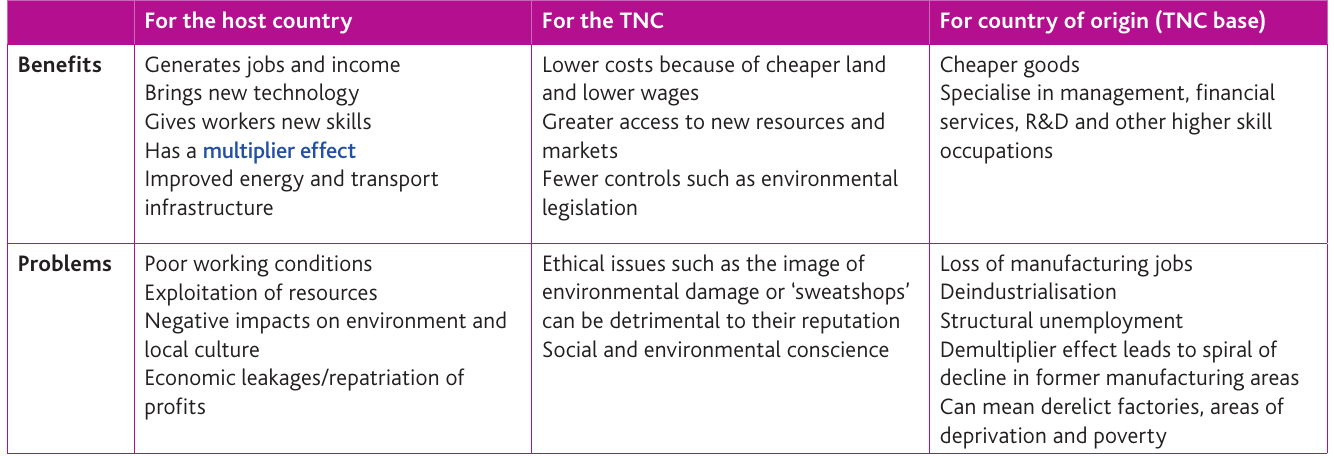
Before examining Apple specifically, it's helpful to understand how transnational corporations (TNCs) affect different stakeholders. TNCs create both opportunities and challenges for the countries where they operate, for themselves, and for their home countries.
Important
Transnational Corporation (TNC) Definition
A transnational corporation (TNC) is a company that operates in multiple countries, with production facilities, offices, or retail operations spanning across national borders. TNCs coordinate their business activities globally to maximise efficiency and profits.
The table above shows that TNCs bring investment, jobs and technology to host countries, but may also exploit resources and workers. For the TNC itself, operating globally allows access to cheaper labour and new markets, though it can damage their reputation if they're associated with poor working conditions. For the country of origin, TNCs provide cheaper goods and specialist jobs, but often lead to deindustrialisation and job losses in manufacturing.
Introduction to Apple Inc.
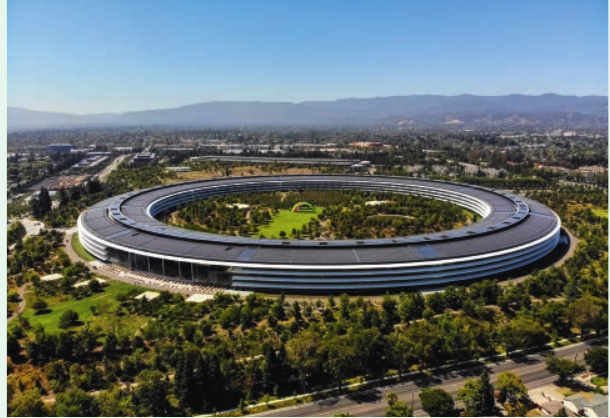
Apple is an American-based transnational corporation operating in the electronics and technology sector. The company's headquarters is located at Apple Park in Cupertino, northern California.
The company manufactures well-known technology products and provides services that are sold globally under its recognisable brand name. These include:
- iPhones
- iPads
- Apple Watch
- Apple TV
- MacPro computers
- Smart speakers (HomePod, launched in 2018)
Company history and growth
Apple began operations in 1976 during the early era of personal computer development. In 1982, the company acquired the MacIntosh organisation and introduced a new brand of desktop computer that eventually became known as AppleMac computers.
Over time, Apple built a strong reputation for quality products and attracted a dedicated customer base. From 2000 onwards, the company experienced remarkable growth through developing mobile and Wi-Fi devices.
Note
Apple's transformation from a computer manufacturer to a mobile device powerhouse represents one of the most successful business pivots in corporate history. This strategic shift allowed the company to tap into the growing demand for portable technology and connectivity.
Apple's position in the global market (2019)
By 2019, Apple had achieved significant milestones:
- Largest information technology company measured by revenue
- Third-largest mobile phone manufacturer worldwide
- Number one global brand valued at US$234 billion
- 137,000 full-time employees across its operations
- Over 510 retail stores located in 22 countries
Factors behind Apple's success
Apple's growth can be attributed to several key elements:
- Product design: Stylish and well-designed products that appeal to consumers
- Marketing and branding: Effective marketing strategies that have generated brand loyalty among customers
- Innovation: Regular product updates and innovative features that keep consumers interested
- Market focus: Concentration on highly mobile devices that meet market demands
- Integrated services: Selling products and services together, including music and TV programmes
- Platform evolution: Diversifying into new technologies and platforms as they develop
Spatial organisation and linkages
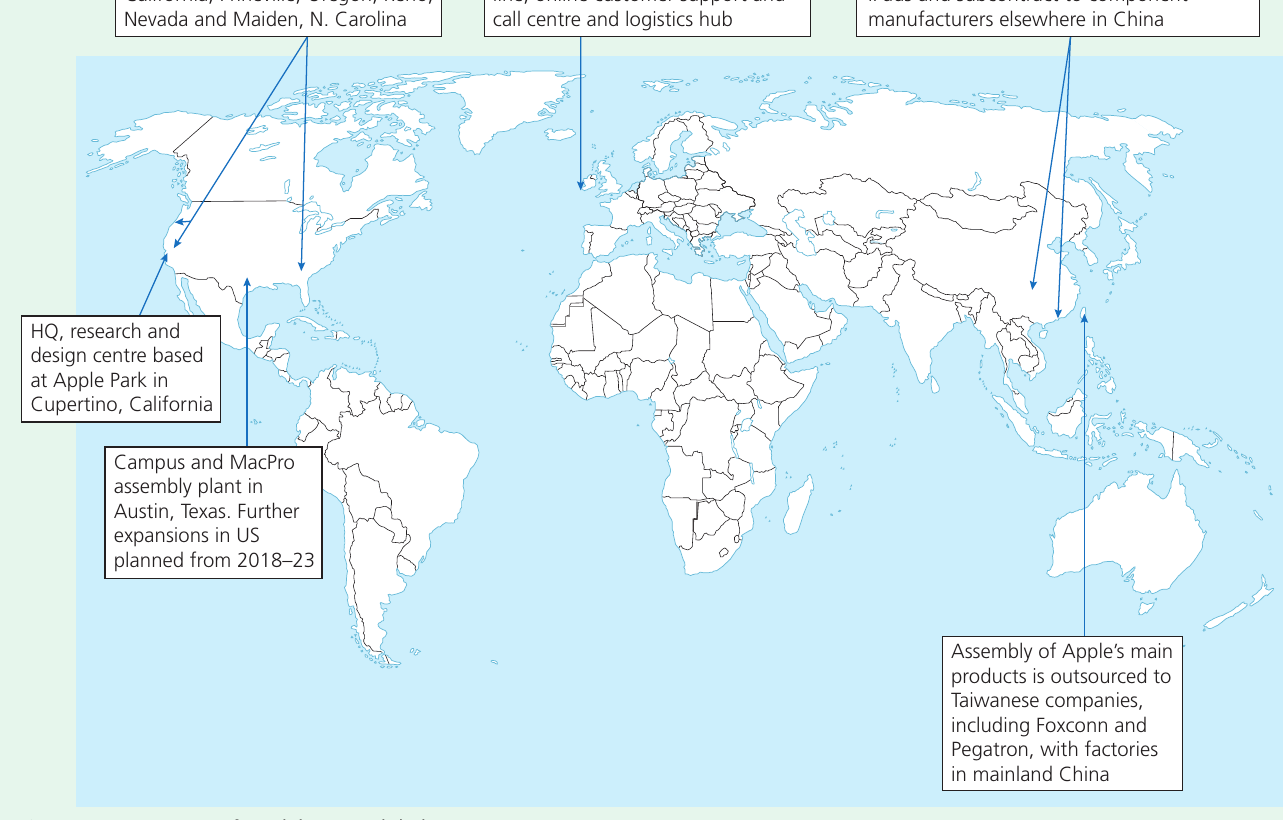
Apple operates as a truly global company with a distinctive geographical structure. The corporation strategically locates different business functions in various parts of the world to maximise efficiency and profitability.
Design and research: Silicon Valley, California
The company's main products are designed in Silicon Valley, California. This location benefits from a concentration of high-tech industries where information exchange and access to highly qualified staff are crucial.
Manufacturing: mainland China
Production is primarily carried out in mainland China through Foxconn, a Taiwan-based company that Apple contracts for manufacturing. The various components used in Apple products are sourced from companies with operations in numerous countries globally. For instance, Wi-Fi chips may originate from any of 20 countries across the Americas, Europe or Asia.
Note
Global Component Sourcing
Apple's supply chain demonstrates the complexity of modern manufacturing. A single iPhone contains components from dozens of countries, showcasing how TNCs leverage global networks to access the best suppliers at optimal costs. This distributed production model allows Apple to maintain competitive pricing while ensuring component quality.
Distribution: worldwide
Once assembled, products are sold internationally to consumers around the globe.
Apple's operations in the United States
Most of Apple's employees work in more economically developed countries (MEDCs), predominantly in the USA. This reflects the high-tech, knowledge-intensive character of the business. Manufacturing Apple products, however, is handled by other companies employing approximately 2.5 million people, nearly 20 times the number Apple directly employs.
Apple has significantly expanded its American operations in recent years:
Headquarters and research facilities
- Apple Park in Cupertino, California houses both the headquarters and the research and design centre
- Now employs 90,000 people across all 50 US states
Manufacturing and assembly facilities
- Large campus and MacPro assembly plant in Austin, Texas, currently employing 6,000 people with plans to expand to 16,000
- Five data centres throughout the USA: two in California (Newark and Santa Clara), two in western USA (Reno, Nevada and Prineville, Oregon), and one on the eastern seaboard in Maiden, North Carolina
- A further large centre is planned for Iowa in the mid-2020s to better serve North American users of iMessage and Siri
Apple's European operations: Cork, Ireland
The concentration of research and development activities in Silicon Valley, California demonstrates a pattern typical of high-tech industries. These sectors thrive in locations where information exchange and access to well-qualified expert staff are essential.
Apple established its European, Middle Eastern and African headquarters in Cork, Ireland. The facility employs 6,000 workers on its iMac production line. Cork also functions as the global transport logistics hub for Apple, coordinating shipments of assembled iPhones and iPads worldwide.
Manufacturing in Asia: Foxconn and Pegatron
Assembly of Apple's main products, particularly iPhones and iPads, is outsourced to major electronics corporations:
- Foxconn: Apple's longest-running manufacturing partner, with its main production base in Foxconn City, Shenzhen near Hong Kong
- Pegatron: Another Taiwanese electronics corporation handling Apple production
Foxconn operates large assembly complexes in several Chinese locations:
- Zhengzhou, Henan province
- Chengdu, Sichuan province
- Central China
Important
These three major sites together employ nearly one million workers, demonstrating the massive scale of Apple's manufacturing operations and the employment impact of TNCs in developing countries.
Retail distribution
Regarding Apple's 511 retail stores globally:
- Over half (more than 255) are located in the United States
- 115 stores operate in Europe and the Middle East
- 42 stores are based in China, where Apple has expanded its market presence
Production and linkages
Why Apple manufactures in China
Apple's mainstream products are manufactured in China for several strategic reasons:
Established manufacturing partnerships
- Apple can outsource production to experienced Taiwanese electronics firms such as Foxconn
- These companies compete for Apple's manufacturing contracts based on offering low production costs
Workforce characteristics
- Large pool of available workers
- Young demographic
- Skilled labour force
- Non-unionised workforce
- Workers willing to work extended hours
- Relatively low wage expectations
Special Economic Zones (SEZs)
- Shenzhen was the location of China's first and most successful Special Economic Zone
- The SEZ offered numerous incentives designed to attract foreign companies to the area
Note
Special Economic Zones
Special Economic Zones (SEZs) are designated areas within countries that offer favourable business conditions to attract foreign investment. These zones typically provide tax incentives, relaxed regulations, improved infrastructure, and streamlined customs procedures. China's SEZ strategy has been instrumental in attracting TNCs like Apple to establish manufacturing operations in the country.
Supply chain management
As a global leader in supply chain management, Apple has developed an exceptional system that maximises the efficiency of its spatial organisation. The company arranges for different components to be shipped directly from their various original sources to the assembly complexes in China.
This sophisticated approach delivers several advantages:
- Reduces stockpiling of components
- Minimises the number of warehouses required
- Enables one centralised location in California for exceptional inventory management
- Reduces overall costs
- Generates higher profitability compared to competitors
Recent expansion in the United States
Since 2018, Apple has expanded production within the USA, most notably in Austin, Texas, where it manufactures the MacPro for the domestic American market. Components for this production are shipped from locations around the world, including from China, to the assembly plant in Texas.
Impacts on countries where Apple operates
Apple's rapid growth has made it the subject of various controversial claims regarding its business operations and their effects on the countries where it functions. These issues demonstrate the risks of outsourcing production to foreign companies and highlight concerns about loose employment regulations in certain regions. The controversies reflect broader criticisms directed at TNCs generally.
Ireland: European headquarters and logistics hub
Apple's European headquarters is situated at Hollyhill Campus on the north side of Cork. This is the only fully Apple-owned manufacturing facility anywhere in the world.
Why Apple chose Ireland
Along with several other foreign technology firms, Apple was attracted to locate in Ireland in 1980 during a period of high unemployment. The Irish government offered a corporation tax rate of 12.5 per cent, which was the second lowest in the European Union at that time.
Positive impacts on Cork and Ireland
Apple's presence in Ireland, and Cork specifically, has generated numerous benefits:
Employment creation
- Employs 6,000 workers at Hollyhill, making it Cork's largest private employer
- Workers are engaged in the iMac production line
- Staff also provide online customer support and operate the call centre
Economic benefits
- Cork's designation as Apple's logistics hub has enhanced Ireland's reputation and global connectivity
- Over 100 people work in the logistics team, remotely coordinating the shipping of products to over 50 countries
- Apple's presence has generated approximately 3,000 jobs for workers in ancillary industries
Broader impacts
- The company has attracted other high-tech firms to the region
- Has helped develop a highly skilled workforce
- Provided inspiration for local education, research and development initiatives
- The company has contributed to infrastructural improvements in the city
- Together with other technology companies in Dublin and the south and west of Ireland, Apple has strengthened Ireland's reputation for hosting high-tech TNCs
Note
The Multiplier Effect
Apple's presence in Cork demonstrates the multiplier effect of TNC investment. Beyond the 6,000 direct jobs, the company has created approximately 3,000 additional jobs in supporting industries, attracted other technology firms to the region, and stimulated infrastructure development. This shows how a single major investment can transform a regional economy.
Criticisms and counter-arguments
Important
The criticism: Many of the highly skilled workers at Hollyhill are foreign nationals, predominantly from EU countries. Apple has been criticised for not creating sufficient employment opportunities for local Irish people. The workforce represents 90 nationalities, including 700 French workers and 460 Germans, with 53 different languages spoken. This suggests that only approximately 60 per cent of the workers are Irish.
The counter-arguments:
- Apple's presence has helped Cork develop into a more cosmopolitan and diverse city
- At least 60 per cent of the workforce are Irish citizens, which represents a substantial proportion
- The international workforce brings diverse skills and perspectives
China: manufacturing and labour practices
Foxconn employs 1.3 million people working on Apple products at its business parks throughout China. The company claims to support nearly five million jobs in the country through also supplying other prominent high-tech firms.
Working conditions
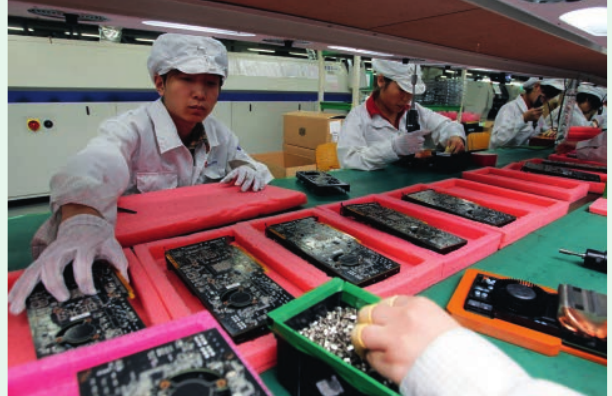
Factory environment Workers in Foxconn's high-security factory complexes predominantly live on site, where facilities include dormitories, shops and cafes. Most workers are young migrants from other regions of China.
Working hours and wages
- Workers typically work an average of 62 hours each week
- Monthly earnings are approximately $300
- Roughly half of this income is consumed by living expenses
Important
Ongoing Concerns
Media reports suggest that excessive working hours and other workplace problems may persist, despite Apple's attempts to reform factories following reports of alleged poor working conditions.
Health and safety issues
Apple products have historically been exposed to toxic chemicals during the cleaning process. It has been suggested that protective equipment such as earplugs and goggles have not always been available to employees when working on certain machinery.
Student and child labour concerns
2017 incident: Student interns working for Foxconn were discovered to have been working excessive hours and illegal overtime.
2018 incident: Quanta Computer, another contractor that manufactures Apple Watches, was found to have been employing high school students as interns.
Regulatory context: Factories are permitted by provincial authorities in China to employ individuals under 18 years of age as interns or trainees. However, Apple does not permit this practice due to its commitment to social responsibility.
Note
Cultural Differences in Business Practices
This situation provides an example of how different 'norms' are accepted and interpreted by various societies, and illustrates the problems many large 'western' companies encounter when seeking to outsource production. What may be legally acceptable in one country can conflict with corporate policies or ethical standards from another.
Apple's response: Following these cases, Apple now requires that its contractors limit student interns to 10 per cent of factories' workforces.
Current practice: Apple now maintains a Supplier Code of Conduct and conducts regular audits of supplier factories.
Tax practices and controversies
As a TNC operating across numerous countries, Apple utilises subsidiaries in other nations to declare profits and pay lower tax rates.
The 2014-2016 tax dispute
In 2014, both the United States and the European Union claimed that Apple owed them tax on its profits. In 2016, the EU Competition Commissioner reached a conclusion that Apple had received illegal state aid from Ireland. The company was ordered to pay €13 billion in unpaid taxes covering the period 2004-2014.
Important
Taxation in a Globalised World
These tensions reveal a fundamental flaw in taxation systems within an increasingly globalised world. Tax systems require updating to accommodate large TNCs such as Apple, which:
- Manufacture most of their products in China
- Derive the majority of their profit from 'intellectual property', including marketing, patenting and branding
- Can channel these profits through a complex network of subsidiaries
Apple is not alone in claiming that profits from substantial portions of its intellectual property are generated outside the United States.
Environmental issues and responses
Early criticisms
Following criticisms of its environmental practices from Greenpeace during the 2000s, Apple responded by launching a 'Green my Apple' campaign.
Current environmental initiatives
As a result of this campaign, Apple has implemented several environmental measures:
Renewable energy
- Uses 100 per cent renewable energy in its facilities in the United States
- Has established its own energy company, Apple Energy, which generates electricity mainly from solar power
Materials and chemicals
- Has removed all PVC plastics and toxic chemicals from its products
Recycling
- Promotes recycling of its products, although lack of 'repairability' remains an issue
Green finance In 2016, Apple issued a $1.5 billion green climate bond. Proceeds from this initiative are dedicated to financing environmental projects.
Note
Corporate Response to Environmental Pressure
Apple's environmental journey demonstrates how public pressure and advocacy campaigns can influence corporate behaviour. What began as criticism from Greenpeace evolved into comprehensive environmental initiatives, showing that TNCs can be responsive to stakeholder concerns when their brand reputation is at stake.
Recognition of progress
As a result of Apple's ongoing commitment to addressing environmental concerns, the company improved its position significantly in Greenpeace's 'Green Electronics' rankings, moving from eleventh place in 2006 to second place by 2017.
Trading and marketing
Market distribution
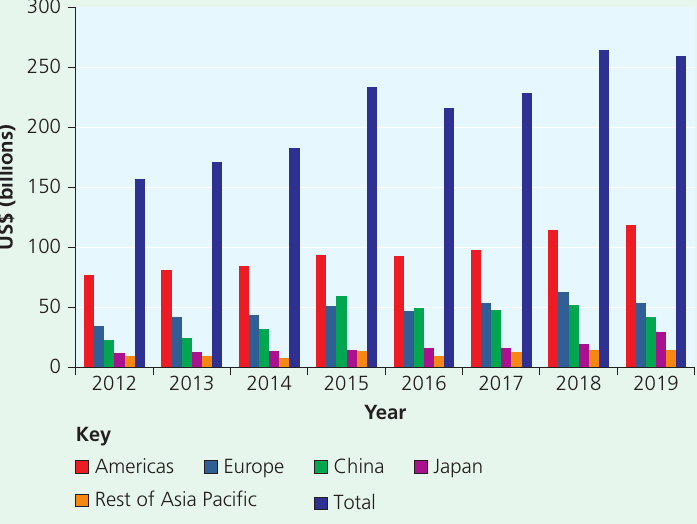
Apple's market is predominantly concentrated in wealthier, more developed countries.
United States: In 2019, 45 per cent of product sales occurred in the USA.
China: During 2015-16, China temporarily became Apple's second-largest market for Apple products. However, Europe has since re-established itself as Apple's second-largest market.
The growing importance of services
The services component of Apple's business now plays a more significant role than ever before in the company's success. Services revenue has increased more than threefold since 2013, growing from $13.5 billion to more than $50 billion by March 2020.
Note
Shifting Revenue Streams
Apple's growing focus on services (including Apple Music, iCloud, App Store, and Apple TV+) represents a strategic shift toward recurring revenue models. This diversification reduces dependence on hardware sales and creates more predictable income streams, demonstrating how TNCs adapt their business models to changing market conditions.
Impact of the US-China trade war
Apple has been caught in the crossfire of the trade dispute between the United States and China. This situation imposes heavy tariffs on Chinese imports entering the US, which means that Apple must pay additional costs for importing its products back to its main market in the United States.
Reinvestment in US manufacturing
Since 2017, Apple has aligned with the US administration's objective to reinvigorate domestic manufacturing. Supported by government incentives, the company is investing more in American domestic suppliers and manufacturers.
Commitment to US economy As part of a commitment to support US economic resurgence, Apple pledged to:
- Create 20,000 additional jobs
- Invest $5 billion to support innovation among US manufacturers
- Implement these measures from 2018 to 2023
Incentives encouraging US investment Apple's decision to invest in the United States is encouraged by federal tariff exclusion zones in Austin. This means the company does not have to pay tariffs on imported components used there. Further expansions in the United States are planned.
Competition and market challenges
China market saturation Since reaching a peak in 2016/2017, the market for Apple products in China has plateaued and may have reached saturation point. China remains a strong potential market due to its substantial iPhone user base, but Apple now faces competition from Chinese smartphone manufacturer Huawei, who can undercut iPhone prices within China.
Challenges in India Apple has attempted to enter the rapidly expanding Indian market. However, this effort has been largely unsuccessful, as the smartphone and tablet market in India is dominated by cheaper competitors.
Conclusion: Apple as a typical TNC
As a transnational corporation, Apple demonstrates typical characteristics of how TNCs can respond flexibly to incentives, expanding markets, and changes in trade and geopolitical developments. The company achieves this by redirecting investment to different parts of its operation across various locations globally.
Key TNC characteristics demonstrated by Apple
Risk diversification: Apple has diversified its operations geographically to reduce risk and capture additional markets in different regions.
Supply chain efficiency: Apple demonstrates that maintaining a well-organised global supply chain reduces costs and increases profits significantly.
Corporate social responsibility: The company's responses to criticisms about labour practices and environmental issues illustrate the concern shown by TNCs regarding corporate social responsibility and ethical purchasing practices.
Flexible location strategy: Apple shows how TNCs can relocate different business functions to optimise costs while maintaining quality and responding to political and economic pressures.
Summary
Key Points to Remember:
- Apple is the world's largest IT company by revenue and number one global brand, with operations spanning design in California, manufacturing in China, and sales worldwide
- The company strategically locates different functions globally: high-skill R&D in California and Ireland, low-cost manufacturing outsourced to Foxconn in China
- Apple's presence brings benefits including job creation (6,000 in Cork, Ireland; nearly 1 million via Foxconn in China) but also controversies over labour conditions, student workers, and tax practices
- Environmental improvements show TNC responsiveness to pressure: Apple now uses 100% renewable energy in US facilities and moved from 11th to 2nd in Greenpeace rankings (2006-2017)
- Recent trends show Apple reinvesting in US manufacturing (Austin, Texas facility) due to trade war pressures and government incentives, whilst facing market saturation in China and competition from Huawei