Case Study: China’s Expansive Foreign Policy (AQA A-Level Geography): Revision Notes
📚Revision Notes
Case Study: China's Expansive Foreign Policy
Overview of China's global expansion strategy
China has emerged as a major economic power and is now extending its influence far beyond its own borders. As China's economy has grown, it has strategically chosen to expand its wealth and power by investing in other parts of the world. This expansion is reflected in two major foreign policy approaches:
- Investment programmes across Africa
- The Belt and Road Initiative (BRI)
These policies aim to develop infrastructure internationally whilst securing resources and political influence for China.
Note
China's expansion strategy represents a shift from traditional military power projection to economic and infrastructural influence, allowing it to gain strategic advantages through investment rather than force.
Investment in Africa
China's objectives in Africa
China has been actively investing in Africa for several decades. The motivations behind this investment strategy are clear:
- Resource extraction: China needs access to raw materials including energy resources, minerals (such as copper in Zambia), and precious metals to fuel its industrial expansion
- Infrastructure development: China builds ports, roads, railways and airports to ensure secure transportation of materials to Chinese coastal ports
- Political support: By investing in poorer African countries to develop housing, healthcare and education, China gains political support and stability in these regions
China's multifaceted role in Africa
China's involvement in Africa takes many forms:
- Land acquisition: Buying up land for food production to support China's large population
- Stimulating growth: Supporting rapid economic growth in African trade and retail sectors
- Industrial expansion: Chinese textile industries and other companies are offshoring their operations and outsourcing production to Africa
- Infrastructure projects: Sending construction workers to help build communities, often at the expense of not training local workers
- Financial assistance: Providing loans in exchange for goods and commodities that Africa produces
- Migration and tourism: Increasing numbers of Chinese citizens now live in Africa, and Chinese tourism to the continent is growing (around one million visitors annually)
- Special economic zones: Establishing airports, ports and designated investment areas
Note
China's approach to African investment differs from traditional Western development aid by combining infrastructure development with resource extraction agreements, creating a mutually beneficial (though sometimes controversial) economic relationship.
Notable African investment projects
China has invested in several major infrastructure projects across Africa:
Example
Major Chinese Investment Projects in Africa
- Ethiopia: A joint project to construct the Grand Renaissance Dam, providing hydroelectric power (HEP)
- Kenya: Development of the port of Mombasa with a $14 billion road and bridge link to Nairobi and onwards to South Sudan's oil fields
- Democratic Republic of Congo: Modernisation of the Benguela railway, which links the country's resources (cobalt and copper) to the Angolan port of Lobito. This project is managed by the Chinese Railway Engineering Corporation (CREC)
- Angola: Construction of a new international airport in Luanda
The Belt and Road Initiative (BRI)
Overview and launch
In 2013, President Xi Jinping launched an ambitious infrastructure development programme designed to boost trade and stimulate economic growth across Asia and beyond into Europe and Africa. This became known as the Belt and Road Initiative (BRI).
Important
Understanding the Belt and Road Initiative (BRI)
The Belt and Road Initiative (BRI) is a massive infrastructure project involving the construction of overland road, rail and pipeline corridors (the 'belts') and maritime routes through ports and shipping lanes (the 'roads'). It aims to connect Asia, Europe and Africa to promote trade and economic development.
Think of it as a modern recreation of the ancient Silk Road, but on a much larger and more comprehensive scale.
The project is expected to cost more than US$1 trillion and involves construction work in over 60 countries. It has been described as a 'modern Silk Road' because it echoes the historic trade routes that once connected East and West.
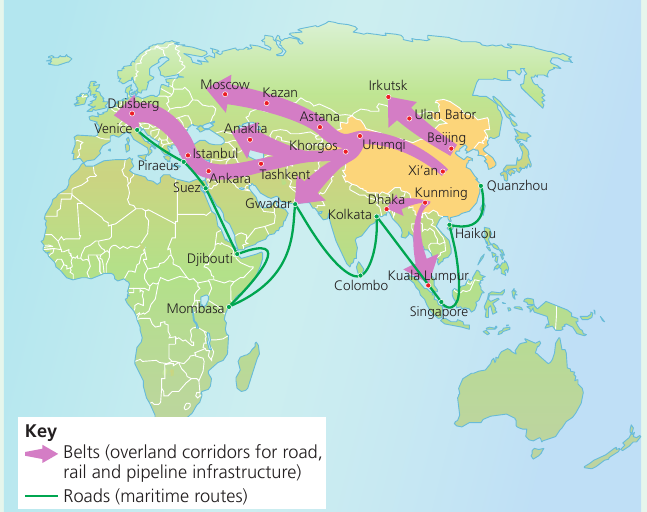
Key infrastructure corridors and projects
The BRI includes several major development corridors:
The China-Pakistan Corridor: This is a shared $46 billion project between the two countries. It involves building a highway network of roads, railways and pipelines stretching from China to the port of Gwadar on the Arabian Sea. This provides China with:
- More direct access to imported commodities from Africa
- Access to oil from Iran
- A route that bypasses the shipping lane choke point of the Strait of Malacca
European rail and road corridor: This route crosses through central Asian countries and is intended to help landlocked economies develop by providing improved access to markets for their products.
Note
The strategic importance of the China-Pakistan Corridor cannot be overstated. By bypassing the Strait of Malacca, China reduces its vulnerability to potential naval blockades and gains more direct access to Middle Eastern oil and African resources.
Concerns about economic imperialism
The BRI has raised several geopolitical concerns:
-
Economic imperialism: Critics argue this is a form of economic imperialism that gives China excessive leverage over other countries, particularly those that are smaller and poorer
-
Debt dependency: China is using its foreign exchange assets to underwrite many of the projects. However, it expects repayment from the countries where it is investing. Some analysts suggest that poorer countries, especially those in Central Asia, will struggle to afford repaying these debts
-
Power imbalance: The state with the greatest economic power will usually gain the most benefit from the system, meaning China stands to profit considerably while partner nations may remain dependent
Important
The Debt Trap Concern
One of the most significant criticisms of the BRI is the potential for debt dependency. When countries cannot repay their loans to China, they may be forced to grant China long-term leases on strategic assets (such as ports) or make political concessions. This creates an unequal power relationship that some analysts view as a new form of colonialism.
Territorial claims and geopolitical tensions
The South China Sea dispute
Beyond infrastructure investment, China's foreign policy includes territorial expansion claims. Part of the BRI encompasses China's claim to sovereignty over the South China Sea and its energy supplies. This claim is controversial because it is based on a map featuring a 'nine-dash line' that encircles numerous reefs and atolls, including the Spratly Islands.
Important
The Nine-Dash Line
The nine-dash line is a demarcation line on Chinese maps that encircles a large area of the South China Sea, including numerous reefs, atolls and islands. China uses this line to claim territorial sovereignty over these areas.
This claim is highly controversial as it overlaps with the territorial waters of multiple other nations and covers areas that are legally considered international waters under international maritime law.
International opposition
The South China Sea is, by definition, in international waters. Many other countries in the region also have territorial claims and fishing rights in these areas:
- Countries such as Malaysia, the Philippines, Brunei and Vietnam all have territorial claims
- All these countries are members of ASEAN (Association of Southeast Asian Nations)
- China prefers to negotiate with countries on an individual basis, which restricts ASEAN members' ability to respond collectively
Note
China's strategy of negotiating bilaterally rather than with ASEAN as a bloc is deliberate. By dealing with countries individually, China can leverage its superior economic and military power more effectively than it could against a unified regional organization.
Military implications
Analysts believe that China's growing commercial presence in the region is likely to lead to an expanded military presence. This would further strengthen China's strategic position and could alter the regional balance of power.
Remember!
Summary
Key Points to Remember:
-
China is strategically expanding its global influence through investment in infrastructure, particularly in Africa and across Asia to Europe
-
The Belt and Road Initiative (BRI) is a US$1 trillion+ project creating overland corridors ('belts') and maritime routes ('roads') to boost trade across three continents
-
China secures raw materials (minerals, energy, precious metals) through African investments whilst gaining political support by developing housing, healthcare and education
-
Major projects include the China-Pakistan Corridor ($46 billion), the Grand Renaissance Dam in Ethiopia, and Kenya's Mombasa port development
-
The BRI raises concerns about economic imperialism and debt dependency, with poorer countries potentially unable to repay Chinese loans and becoming economically dependent on China
-
China's nine-dash line claim over the South China Sea creates tensions with ASEAN member states and raises the possibility of increased military presence in the region