Factors in Globalisation (AQA A-Level Geography): Revision Notes
📚Revision Notes
Factors in globalisation
Globalisation has accelerated dramatically over the past 30 years. Multiple factors have combined to increase the breadth and depth of links between nations, transforming how the world economy operates. Understanding these factors is crucial for examining how global systems and governance have evolved.
The shift in global production patterns
Before examining the factors driving globalisation, it's important to recognise how production patterns have changed globally. Manufacturing has shifted away from traditional industrial economies in Western Europe and North America towards emerging economies, particularly in Asia.
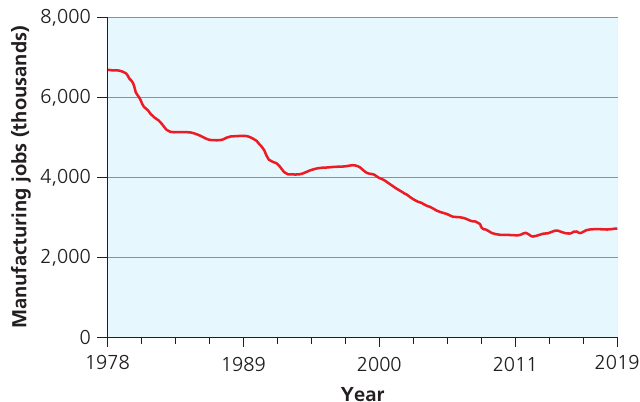

This deindustrialisation in developed countries has resulted from:
- Companies relocating production to lower-cost economies
- Competition from emerging manufacturing nations
- Automation reducing the need for labour in traditional industrial regions
Important
Deindustrialisation
Deindustrialisation is the decline in manufacturing employment and output in a country or region. This has affected many developed economies as production has shifted to emerging economies with lower labour costs.
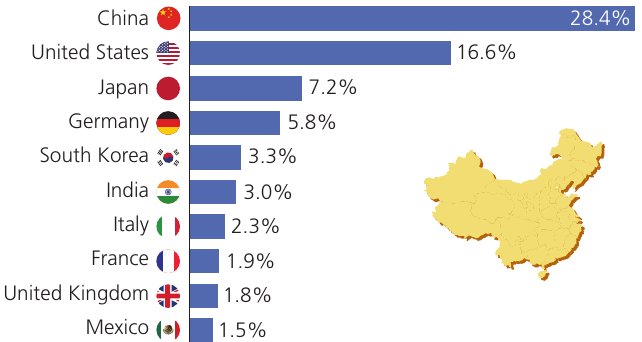
China now dominates global manufacturing, producing 28.4% of the world's manufactured goods in 2018. The United States accounts for 16.6%, followed by Japan (7.2%) and Germany (5.8%). This dramatic shift shows how globalisation has redistributed economic activity across the planet.
Key factors driving globalisation
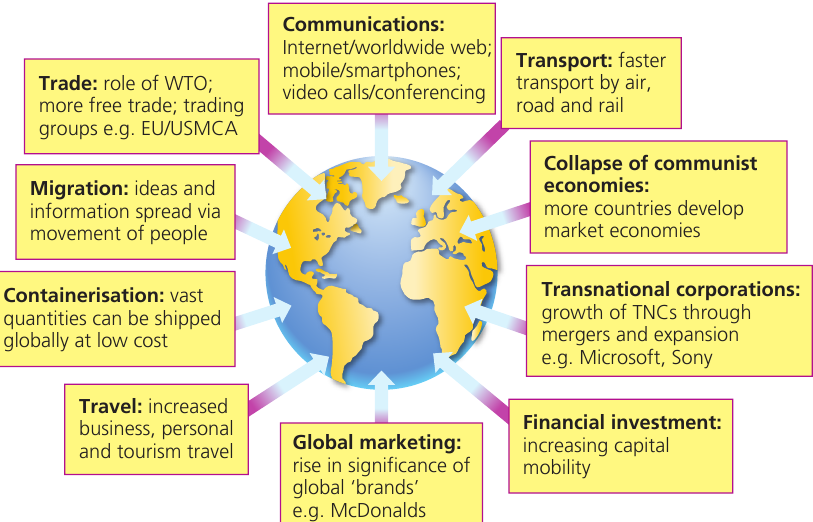
Several interconnected factors have accelerated globalisation since the 1990s. These factors work together to reduce barriers between countries and increase global connectivity.
Communications technologies
The digital revolution has been fundamental to globalisation. Communications technologies have virtually eliminated barriers to information exchange and data flow between countries.
Key developments include:
-
The internet – enables instant 24/7 global communication at the click of a button. Approximately 4.5 billion people worldwide now use the internet, allowing unprecedented information sharing
-
Mobile phones – particularly important in less developed economies (LDEs) where they connect people and markets more easily than fixed-line infrastructure. Nearly seven billion mobile phone subscribers exist worldwide
-
Video conferencing – allows face-to-face meetings between people in different countries without the time and cost of travel
-
Computer technology – enables sophisticated data processing, analysis and storage that supports global business operations
-
Computer control and robotics – have integrated manufacturing operations, allowing production lines to operate with greater efficiency and consistency
-
Computerised logistics systems – support supply chain distribution, tracking products as they move around the world
Note
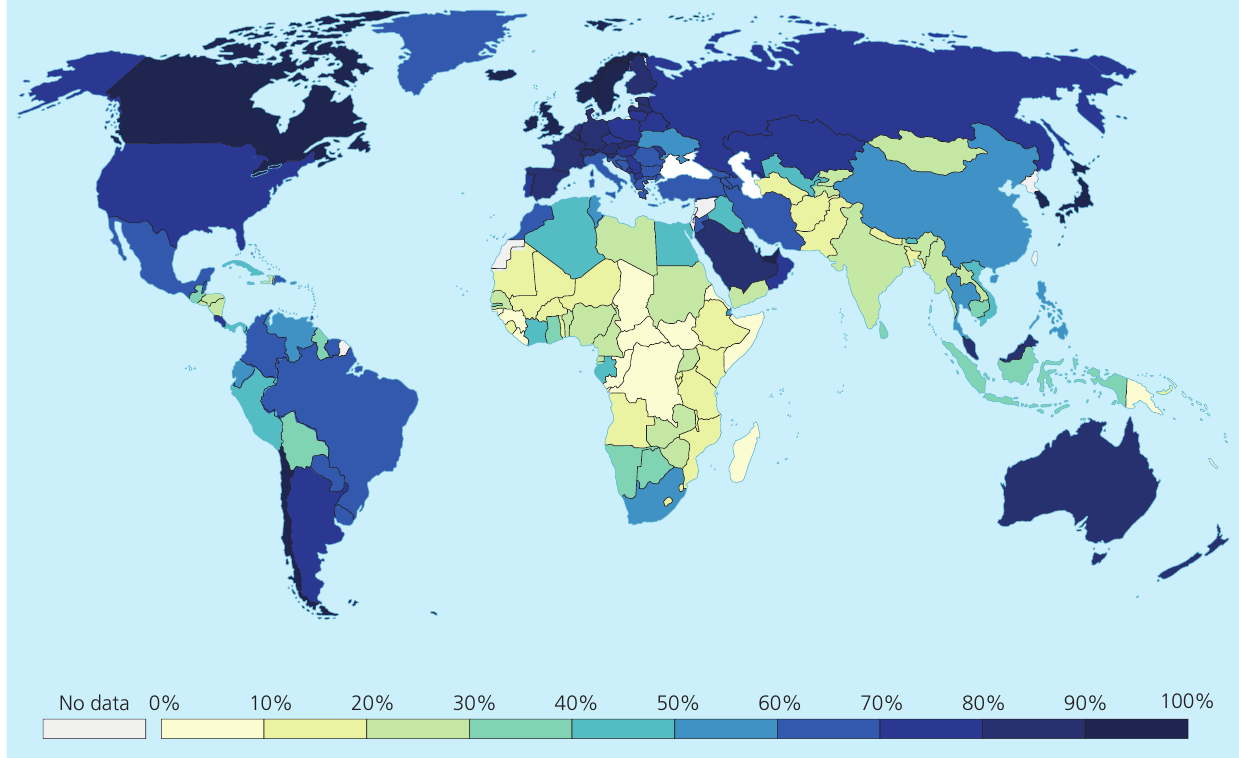
The map above shows significant variation in internet access globally. Developed countries typically have 80-100% of their population using the internet, whilst many African and South Asian countries have much lower rates. This digital divide affects how different countries can participate in the globalised economy.
Financial systems
Financial integration has been critical to enabling globalisation. The movement of capital across borders finances international trade and investment.
How financial integration developed:
The world became increasingly financially integrated during the 1980s and 1990s due to financial deregulation. Governments removed controls on capital movements, making it easier to move money across borders for trade and investment in other countries.
Important
Global financial system (GFS)
The global financial system provides a framework that facilitates flows of capital for the purposes of financing investment and trade. Financial institutions, transnational corporations (TNCs), consumers and investors use the GFS, which is monitored by regulatory bodies such as the International Monetary Fund (IMF).
Technological enablers of the GFS:
- High-speed electronic transmission systems allow rapid transfer of funds
- Global exchange connectivity means transactions between importers and exporters can be completed securely with lower concerns about exchange rates
- Integration of developing economies into the GFS has helped reshape international trade patterns
Challenges of financial deregulation:
One major disadvantage of deregulation and free movement of capital is that it leaves the system exposed to volatile capital flows. This triggered the global banking crisis in 2008-2009, demonstrating how interconnected the world's financial systems have become.
Transport systems
Physical movement of goods has been revolutionised by transport innovations. Products and commodities can now be shipped more quickly and in larger quantities than ever before.
Transport developments enabling globalisation:
- Increased aircraft size – larger planes carry more cargo over longer distances
- Integrated air traffic networks – coordinate global air transport efficiently
- Growth of low-cost airlines – make international travel more accessible
- Air freight companies – specialise in rapid delivery of high-value or time-sensitive goods
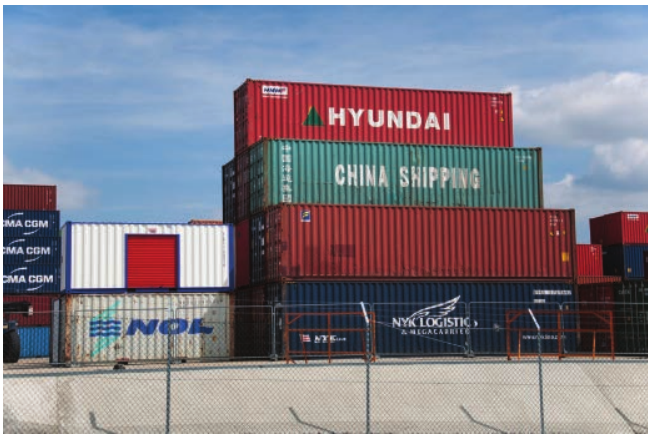
- Standardised containers – by sea, rail, road and air (Figure 7.14 below)
- Handling and distribution efficiencies – reduce time goods spend in transit
- High-speed rail networks – particularly in Asia and Europe, enable rapid movement of goods and people
Important
Containerisation
Containerisation involves shipping goods in standardised metal containers. These containers can be easily transferred between ships, trains and lorries without unpacking, dramatically reducing handling costs and time. Vast quantities can be shipped globally at low cost.
Dry ports for landlocked countries:
In larger countries where distances to sea terminals are considerable, especially in economies with less developed infrastructure, exporters use dry ports. These are located inland near businesses. Dry ports save exporters time and transport costs as all shipment arrangements and customs documentation are completed locally before goods are shipped to a seaport. These ports provide local 'hubs' offering global connectivity.
Note
For example, Pakistan has six inland dry ports where goods are deposited by producers before being sent to the port at Karachi for export.
Security systems
Whilst globalisation creates opportunities, it also poses security challenges. National boundaries are less of a barrier and easier travel means more fluid flows of products and people. This requires new security measures.
Security threats from globalisation:
- Terrorism – security forces must screen and monitor movements as part of counter-terrorism measures
- Food imports – ensuring imported products meet required safety standards
- Biosecurity – preventing the introduction and spread of harmful organisms or biochemical substances that could threaten people, animals and plants through transmission of infectious diseases
- Cybercrime – reliance on the internet has led to breaches of secure information, resulting in online fraud and other crimes
- Supply chains – securing supply chains is critical for international manufacturing businesses that assemble components from around the world. Products must be authentic, safe and able to travel through borders relatively freely
Measures to address security threats:
- Interpol enables police in most countries to work together to fight international crime
- Counter-terrorism agencies in many countries cooperate to thwart terrorist attacks
- World Customs Organization has introduced Authorised Economic Operators (AEOs) status to tackle trade security issues. AEO status is awarded to export and import operators who meet a minimum standard of criteria
Management and information systems
Globalisation is influenced by how large companies operate to produce and distribute goods and deliver services worldwide. High-volume production enables substantial economies of scale on a global level.
How companies benefit from global operations:
To benefit from these cost advantages, globally integrated companies have invested in:
- Large production and assembly plants capable of exploiting the most advanced technology
- Global marketing and distribution networks to ensure sales keep pace with increased production
Organising global operations:
Investments in international production, distribution and management are organised within global value chains, where different stages of the production process are located across different countries.
Managing these chains requires remote management of production and distribution lines. This has been enabled by information systems giving businesses:
- Virtually free telecommunications and video conferencing
- Integrated ICT management systems, usually supplied by third-party service providers (for example, Infor Nexus) to facilitate greater supply chain organisation
Impact on corporate structure:
Management and information systems have led to:
-
Higher-order business activities (such as research and development, design and engineering, marketing and advertising) being based at corporation headquarters and strategic hubs around the world
-
Lower-order activities (such as production and assembly) being located at low production-cost locations or near to large markets for the finished goods
-
Global corporations focusing on key strategic activities and increasingly outsourcing non-strategic activities
-
Rapid growth of the logistics and distribution 'solutions' industry that manages the movement of goods globally
Important
Just-in-time (JIT) systems
Just-in-time systems give greater efficiency in the supply chain for manufacturers. JIT involves ensuring the correct quantities of materials, components and assembled goods are available on time, in the correct location at each stage of production. This reduces costs by having fewer goods and materials held in stock. The principle underlying JIT is that production is 'pulled through' by customer orders, rather than 'pushed through' to build up stock.
Trade agreements
Trade agreements between countries have been fundamental to accelerating globalisation by removing barriers to international trade.
Important
Trade agreement
A trade agreement is a formal agreement between two or more countries that removes trade barriers between those in the agreement. Regional trade blocs have been formed around the world as a result of countries signing agreements to stimulate trade between themselves to gain economic benefits from cooperation.
Types of trade groupings
Trade groupings take various forms with increasing levels of integration between member countries. The World Trade Organization (WTO) generally recognises these distinctions, though in reality there is overlap between categories.
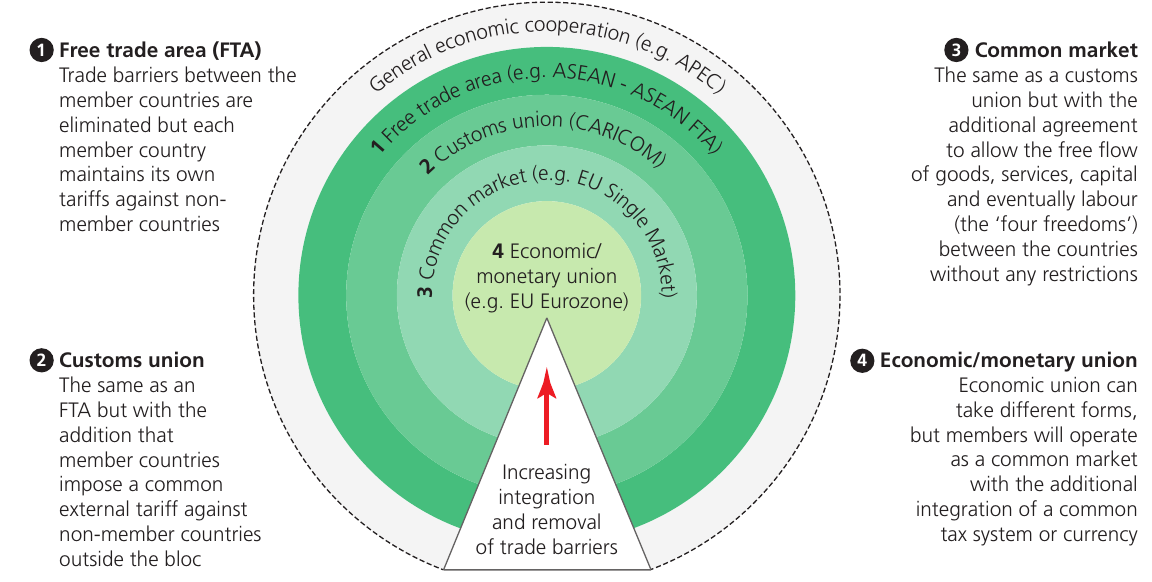
1. Free trade area (FTA)
Trade barriers between member countries are eliminated, but each member country maintains its own tariffs and controls against non-member countries. Examples include ASEAN and ASAFTA.
2. Customs union
The same as an FTA but with the addition that member countries impose a common external tariff against non-member countries outside the bloc. Examples include CARICOM.
3. Common market
The same as a customs union but with the additional agreement to allow the free flow of goods, services, capital and eventually labour (the 'four freedoms') between countries without any restrictions. Examples include the EU Single Market.
4. Economic/monetary union
Economic unions can take different forms, but members operate as a common market with the additional integration of a common tax system or currency. An example is the EU Eurozone, which uses the Euro (€) as its common currency.
Global trading blocs
Numerous trading blocs exist around the world. These vary in size, membership and level of integration.
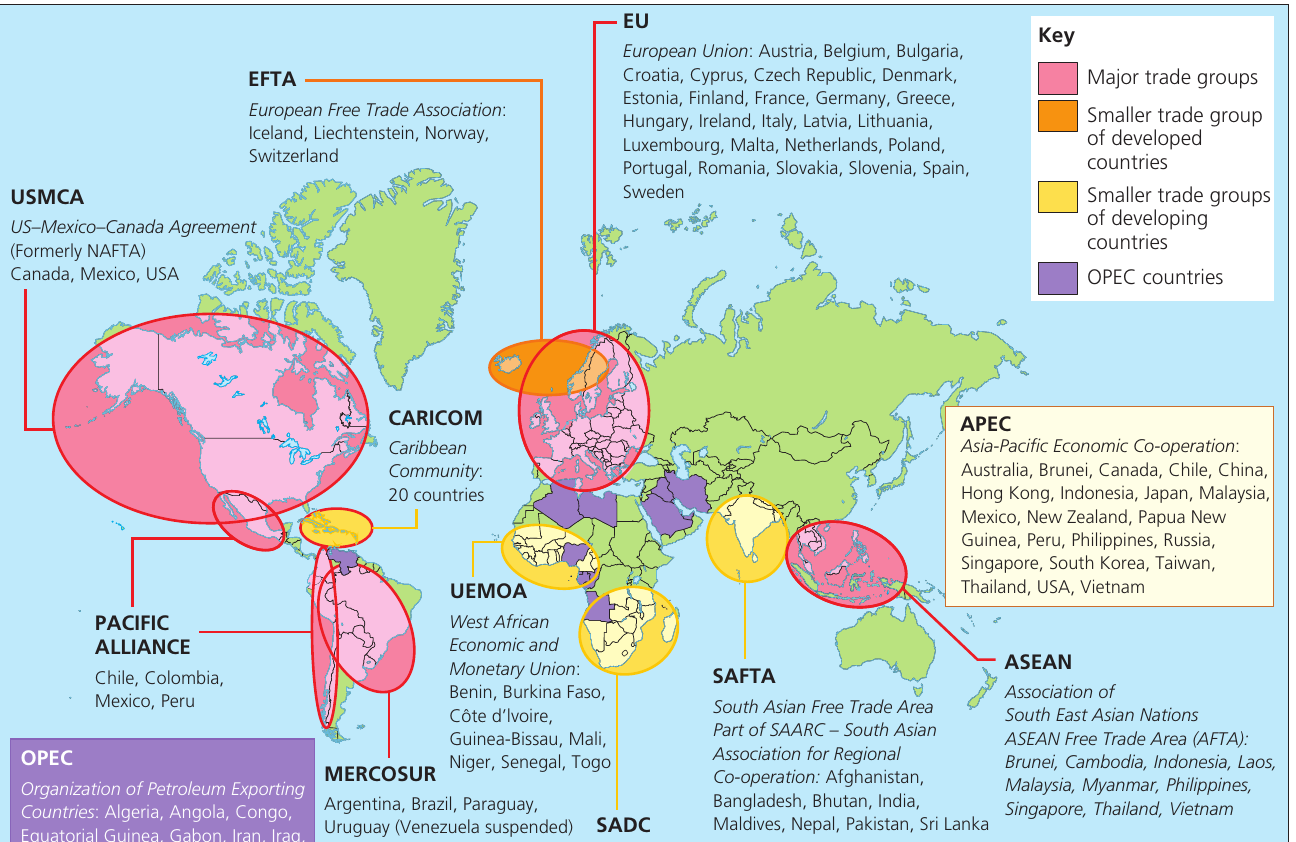
Major global trading blocs include:
- EU (European Union) – 27 member countries in Europe operating as a common market, with 19 countries also part of the Eurozone monetary union
- USMCA (US-Mexico-Canada Agreement) – formerly NAFTA, linking the three North American economies
- ASEAN (Association of South East Asian Nations) – 10 countries promoting regional cooperation
- MERCOSUR – South American bloc including Argentina, Brazil, Paraguay and Uruguay
- SADC (Southern African Development Community) – 16 member countries in southern Africa
- APEC (Asia-Pacific Economic Cooperation) – loose grouping of 21 economies around the Pacific Rim
Note
Important considerations:
- Many countries belong to more than one trade agreement. For example, Mexico is a member of both USMCA and APEC
- Not all trade agreements are regionally based. The Organization of Petroleum Exporting Countries (OPEC) focuses on the trade of oil globally, with members mainly from the Middle East but also from South America and Africa
- Some groupings are more loosely knit, with an interest in cooperation and development of trade but no formal trade agreement, though these might be developed (for example, APEC)
Advantages and disadvantages of trading blocs
Being part of a trading bloc has both benefits and drawbacks for member countries.
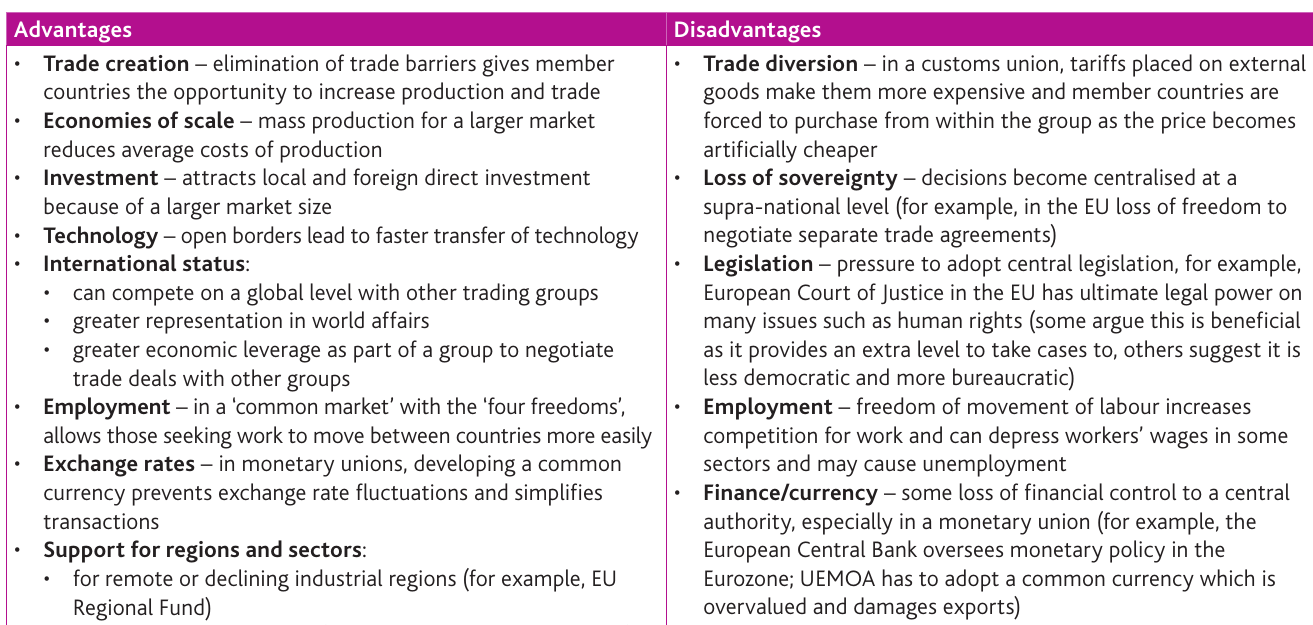
Advantages of trading blocs:
-
Trade creation – elimination of trade barriers gives member countries the opportunity to increase production and trade. Economies of scale from mass production for a larger market reduces average costs of production
-
Investment – attracts local and foreign direct investment because of a larger market size
-
Technology – open borders lead to faster transfer of technology
-
International status – members can compete on a global level with other trading groups and have greater economic leverage as part of a group to negotiate trade deals with other groups
-
Employment – in a common market with the 'four freedoms', people seeking work can move between countries more easily
-
Exchange rates – in a monetary union, developing a common currency prevents exchange rate fluctuations and simplifies transactions
-
Support for regions and sectors – such as declining industrial regions (for example, EU Regional Fund) or specific sectors of the economy (for example, agriculture in the EU)
-
Social improvements – raising standards in healthcare and education across the region
-
Political benefits – promoting democracy and human rights among member states
-
Regional cooperation – such as pooling resources in response to natural disasters, terrorism threats or pandemics
Disadvantages of trading blocs:
-
Trade diversion – in a customs union, tariffs placed on external goods make them more expensive. Member countries are forced to purchase from within the group as the price becomes artificially cheaper
-
Loss of sovereignty – decisions become centralised at a supra-national level. For example, in the EU loss of freedom to negotiate separate trade agreements
-
Legislation – pressure to adopt central legislation. For example, the European Court of Justice in the EU has ultimate legal power on many issues such as human rights. Some argue this is beneficial as it provides an extra level to take cases to; others suggest it is less democratic and more bureaucratic
-
Employment – freedom of movement of labour increases competition for work and can depress workers' wages in some sectors or increase unemployment
-
Finance/currency – some loss of financial control to a central authority, especially in a monetary union. For example, the European Central Bank oversees monetary policy in the Eurozone; UEMOA has to adopt a common currency which is overvalued and damages exports
-
Dependence – increased interdependence can mean that some members of the group become overly dependent on others
-
Sharing/over-exploitation of resources – certain sectors of the economy may be damaged by having to share resources. For example, the UK sharing its traditional fishing grounds with other EU nations such as Spain and France
Case study: USMCA – formerly the North American Free Trade Agreement (NAFTA)
The North American Free Trade Agreement (NAFTA) was signed by the USA, Canada and Mexico in 1994. NAFTA's main aims were to remove all trade barriers, increase investment opportunities and improve economic cooperation between the three countries. In 2017, the member economies generated $22 trillion in GDP, but NAFTA created 'winners' and 'losers' within each nation.
Example
Case Analysis: Winners and Losers under NAFTA
Supporters of NAFTA pointed out that:
- Trade between member countries quadrupled
- Manufacturing grew in the USA, creating five million jobs and increasing economic output. This helped North America compete with emerging economies in Asia
- Foreign direct investment (FDI) more than tripled. Mexico, in particular, gained from this as TNCs located production there to gain access to Mexico's trading partners' markets
- Consumer prices in the US were lowered, especially for oil and food
- More competitive bidding for government contracts reduced costs
- The heads of state met more frequently, improving diplomatic relations
Opponents of NAFTA pointed out that:
- 'Blue collar' jobs were lost in the US, particularly in the automotive sector, when manufacturers relocated to lower-waged Mexican maquiladora plants near the border
- Job migration suppressed wages in US factories
- Many Mexican farmers went out of business as they were neither able to compete with larger US agribusinesses nor with US and Canadian subsidised food surpluses being 'dumped' in Mexico
This example demonstrates that trade agreements create both opportunities and challenges, with winners and losers in different sectors and regions.
Summary
Key Points to Remember:
-
Multiple interconnected factors have driven globalisation: communications technologies, financial systems, transport innovations, management systems, and trade agreements
-
Technology has been fundamental – the internet (4.5 billion users), mobile phones (7 billion subscribers), containerisation, and ICT systems have removed barriers to global connectivity
-
Financial deregulation in the 1980s-1990s enabled capital to move freely across borders, though this also created vulnerabilities as seen in the 2008-2009 banking crisis
-
Trade agreements vary in integration levels – from free trade areas (FTA) through customs unions and common markets to economic/monetary unions, each with increasing integration
-
Trading blocs have both advantages and disadvantages – they create trade and investment opportunities but can also lead to trade diversion, loss of sovereignty and increased dependence between nations