Global Systems (AQA A-Level Geography): Revision Notes
📚Revision Notes
Global systems
Understanding globalisation and interdependence
As globalisation advances, nations and regions worldwide have become increasingly linked and reliant upon one another. Systems have developed to support the heightened economic, political, social and environmental connections that now exist across the globe.
In today's world, interdependence means that individual countries depend on others. Actions or events in one location can have far-reaching impacts elsewhere. The COVID-19 pandemic that began in Wuhan, China in 2020-21 demonstrates this perfectly. Due to faster and more frequent international travel, the virus spread rapidly, creating social, economic and political consequences in nearly every country. This illustrates how any significant global event can now have worldwide repercussions.
Note
The COVID-19 pandemic serves as a powerful real-world example of global interdependence in action. A health crisis that originated in one city quickly became a worldwide issue, affecting economies, political decisions, and social structures across every continent. This demonstrates how interconnected our modern world has become.
Forms of global interdependence
There are four main categories of interdependence that connect countries across the world: economic, political, social, and environmental.
Economic interdependence
Nations' economies are linked together in multiple ways:
International trade has expanded significantly, with more countries participating in global commerce. This provides nations with access to products and services from diverse locations. Countries depend on others both to supply their needs and to purchase their exports. Trading relationships matter greatly because one nation's economic policies often impact others. For instance, Russia's decisions regarding gas supply directly affect energy costs throughout Europe.
Technological advances play a crucial role in economic interdependence. When businesses compete or collaborate with foreign companies, they often share innovations and new approaches. This can enhance product and service quality whilst making them more affordable for consumers.
Employment patterns shift as economic interdependence grows. Jobs may be created in new regions but lost elsewhere. A UK manufacturing company might relocate production to Malaysia, where lower labour costs enable increased output through hiring more workers. This generates employment in Malaysia but results in job losses in the UK.
Important
The relocation of businesses creates a complex trade-off: whilst new jobs are created in developing countries with lower costs, workers in developed nations may face job losses and deindustrialisation. This highlights how economic interdependence produces both winners and losers in the global system.
International economic migration has become substantial. In 2019, international migrants comprised over 20% of the total population in 48 countries. In the United Arab Emirates, approximately 89% of the workforce consists of foreign workers from the Philippines. These migrant workers are essential in sectors like construction and engineering. Meanwhile, the Philippines benefits from remittances that workers send home from the UAE.
TNCs (transnational corporations) operate across multiple countries, providing services and running operations for foreign businesses. Companies from industrialised nations frequently invest in developing countries, attracted by lower land and labour costs. They may establish joint ventures with local firms, introducing new technology, creating employment opportunities and funding infrastructure development.
Global supply chains represent another dimension of economic interdependence. Components for manufactured products may be produced in different countries before final assembly. In the automotive industry, a single vehicle model might have engines, wheels and body panels manufactured in separate nations. These components are then brought together for assembly at another location before vehicles are distributed globally.
Example
Example: The Global Automotive Supply Chain
Consider a single car manufactured today:
- Engine components produced in Germany
- Electronic systems manufactured in Japan
- Wheels and tyres made in South Korea
- Body panels stamped in Mexico
- Final assembly in the United States
- Distribution to markets worldwide
This demonstrates how one product relies on manufacturing processes and resources from multiple countries, creating a complex web of economic interdependence.
Industrialisation effects show both benefits and drawbacks. Globalisation has enabled countries like India, Brazil, Mexico and Indonesia to industrialise. However, it has also contributed to deindustrialisation and structural unemployment in parts of Europe and North America.
Political interdependence
Global systems receive support from international organisations that have been created to foster stability, enable dialogue and build consensus between nations.
The International Monetary Fund (IMF) and World Bank work to facilitate international capital flows throughout the global financial system.
The World Trade Organization (WTO) oversees international trading arrangements, working to establish barrier-free trade and ensure fair market access.
The United Nations (UN) serves as the primary organisation for global governance, addressing worldwide issues and coordinating international cooperation.
Note
Key International Organisations:
These intergovernmental organisations each serve distinct but complementary roles:
- IMF & World Bank: Financial systems and development funding
- WTO: Trade agreements and market access
- UN: Overall global governance and cooperation
- WHO: International health coordination
Security and stability provide one justification for globalisation. Supporters argue it promotes greater political stability, as nations increasingly collaborate with each other. When countries become members of regional or international bodies, this can make it easier for governments to work together towards shared objectives.
World peace arguments suggest that wars become less probable due to interdependence. In 1999, Thomas Friedman, an American writer on globalisation, proposed his 'Golden Arches' theory of conflict prevention. He suggested that two countries with McDonald's restaurants would be unlikely to wage war because their interconnected economies and cultures make conflict counterproductive. Whilst this theory has been challenged multiple times since its proposal, it illustrates how economic ties might reduce international tensions.
Social interdependence
Technological advances in communications, combined with falling transportation costs, have enabled international exchanges and strengthened interdependence between human societies.
Health cooperation has intensified through organisations like the World Health Organization (WHO). During the COVID-19 pandemic, the WHO took the lead in coordinating international responses by sharing advice on symptoms and vaccine development. Different countries implemented distinctly different approaches at national level, but the WHO provided crucial global coordination.
Education has become more international through increased participation in student foreign exchange programmes. Initiatives like Erasmus in the European Union enable more students to study at foreign universities. This benefits both the students who gain international experience and the institutions that receive them.
Note
Educational exchanges create lasting social connections between countries. Students who study abroad often maintain ties with their host countries, fostering cultural understanding and creating networks that span borders. These connections contribute to stronger diplomatic and economic relationships in the long term.
Culture creates strong social ties between countries through migration. The substantial Indian diaspora settled in the UK has reinforced connections between the two countries, both economically and culturally. Extensive family networks now link the nations closely together.
Environmental interdependence
'Global commons' refer to environmental resources shared by all countries, including the oceans and atmosphere. These are governed by international legislation that applies to all nations.
Global climate change concerns have prompted increased international summits and the creation of international agencies. The UN Framework Convention on Climate Change (UNFCCC) and the UN Environment Programme (UNEP) encourage all nations and their citizens to work towards shared goals for climate change mitigation and biodiversity protection.
Important
Unsustainable practices pose challenges to environmental interdependence because their impacts affect multiple countries. Examples include air pollution, acid rain deposition and deforestation. The root causes of rainforest deforestation in the Amazon or South-East Asia may relate to hardwood supply for commercial purposes or land clearance for ranching and plantations serving developed country demand.
Deforestation operates on a global scale, and in some countries, forest loss may become irreversible. When one country engages in unsustainable environmental practices, the consequences—such as climate change, biodiversity loss, and atmospheric pollution—extend far beyond its borders, affecting the entire planet.
Issues associated with interdependence
Whilst interdependence and globalisation create opportunities, they also generate both positive and negative effects on different groups of people and places.
Unequal flows of people
Globalisation enables workers to move more freely around the world. The primary migration flows occur from developing countries towards highly developed economies (HDEs). This creates both opportunities and challenges.
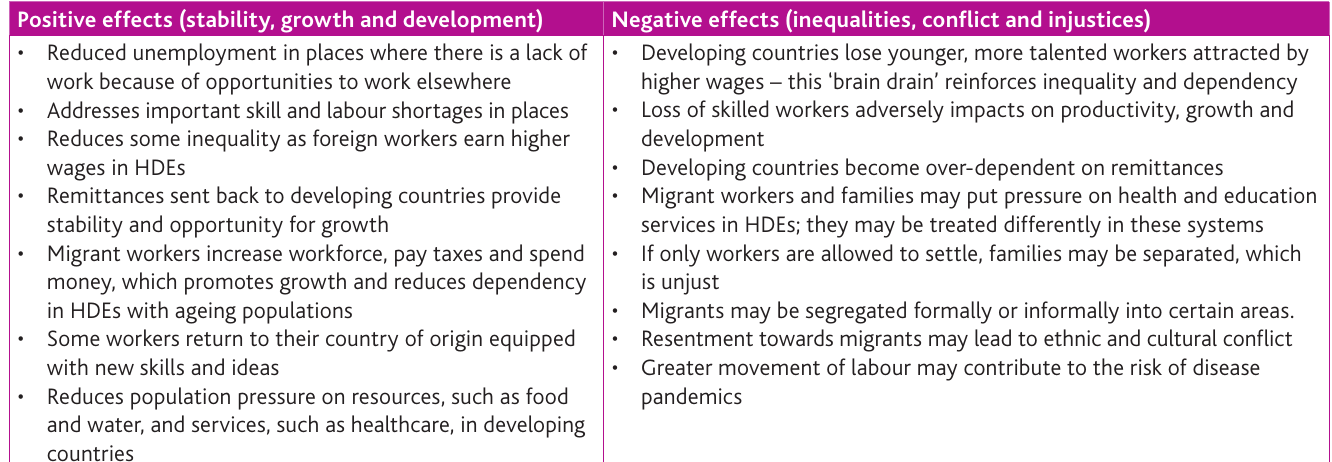
The positive effects include reduced unemployment where work opportunities are limited, as people can seek employment elsewhere. Important skill and labour shortages can be addressed in destination countries. Foreign workers in HDEs often earn higher wages, and remittances sent to developing countries provide stability and support growth. Migrant workers boost the workforce, contribute through taxes and spending, and help reduce dependency in HDEs with ageing populations. Some workers return to their origin countries equipped with new skills and ideas. Migration also reduces population pressure on resources like food, water and healthcare in developing countries.
However, significant negative effects emerge as well. Developing countries lose younger, talented workers who are attracted by higher wages. This 'brain drain' reinforces inequality and increases dependency. The loss of skilled workers can severely impact productivity, growth and development. Developing countries may become over-dependent on remittances from abroad. Migrant workers and their families can strain health and education services in HDEs, where they may face differential treatment. When only workers are permitted to settle, family separation creates injustice. Migrants may experience segregation, either formal or informal, into specific areas. Resentment towards migrants can trigger ethnic and cultural conflict. Additionally, greater labour movement may contribute to disease pandemic risks.
Important
The Brain Drain Challenge
When skilled workers migrate from developing to developed countries, the origin countries lose valuable human capital. Doctors, engineers, teachers and other professionals trained at considerable expense in their home countries may leave for better opportunities abroad. This creates a cycle where developing countries struggle to build their own capacity, as their best-trained workers continually depart for higher wages elsewhere.
This pattern reinforces global inequality, as developing countries effectively subsidise developed nations by training workers who then contribute their skills and taxes elsewhere.
Unequal flows of money
Money flows between nations produce both beneficial and negative consequences for people and places.
Remittances consist of money that migrants working overseas send home. This represents a vital income source for many developing economies.
Note
Remittances can constitute a significant portion of GDP in some developing countries. For families receiving these funds, remittances provide essential financial support, enabling access to education, healthcare and improved living standards. At a national level, this money flow can support economic stability and reduce poverty levels.
Loans from the World Bank help developing countries fund projects such as improving transport connectivity or health and education programmes that raise living standards, promote access and encourage inclusion. Loans for engineering and construction projects like transport or energy infrastructure can constitute sound investments for countries. However, much of the World Bank's lending to countries in 2020 funded emergency responses to the COVID-19 pandemic. These loans must be repaid, which is only viable if the money has been invested effectively. This becomes considerably more challenging when loans finance social programmes rather than economic development projects.
Summary
Key Points to Remember:
-
Globalisation has created four main types of interdependence: economic, political, social and environmental, making countries increasingly reliant on one another
-
Economic interdependence involves trade, technological advances, employment shifts, migration, TNCs, supply chains and industrialisation effects
-
Key international organisations support global systems, including the IMF, World Bank, WTO, UN and WHO
-
Environmental interdependence requires international cooperation on shared resources (global commons) and challenges like climate change
-
Unequal flows of people and money create both opportunities (reduced unemployment, skill transfer, remittances) and challenges (brain drain, inequality, dependency, conflict)