Globalisation (AQA A-Level Geography): Revision Notes
📚Revision Notes
Globalisation
What is globalisation?
Globalisation describes the process through which countries around the world have become increasingly connected and interdependent. This connection happens through networks of trade, communication, transport systems, and the movement of people across borders. National economies, societies and cultures no longer operate in isolation, but instead function as parts of a larger global system.
Important
Globalisation is a process by which national economies, societies and cultures have become increasingly integrated through the global network of trade, communication, transportation and immigration.
The concept of a 'global village' was first proposed by Canadian philosopher Marshall McLuhan in the late 1960s. He predicted that organisations would increasingly operate in an international manner, thinking and acting beyond national boundaries. McLuhan envisioned a world where economic and information flows would be sustained internationally, reflected in three key ways:
- Thinking globally rather than within national boundaries
- Acting globally by having a presence in many countries
- Making 'planet-wide' decisions that affect multiple nations
Note
McLuhan's vision, made over 50 years ago, has largely materialised in today's interconnected world. His predictions about global thinking, acting, and decision-making are now standard practice for major organisations worldwide.
This vision has largely materialised. Today's world economy operates on a truly global scale, where events in one country can have ripple effects across the entire planet.
The world economy
The world economy refers to the interconnected system where global events impact most countries simultaneously. A clear example occurred in 2008 when the global financial crisis began in the United States but quickly developed into an international crisis. This threatened the entire world financial system and triggered a global economic downturn. Recovery has been uneven, with the world economy experiencing further challenges including trade wars, falling commodity prices, and international conflicts.
More recently, globalisation revealed both its reach and its risks during the COVID-19 pandemic. When the World Health Organisation (WHO) declared COVID-19 a global pandemic, many countries entered extended lockdowns. The outbreak demonstrated how rapidly a disease can spread internationally in our interconnected world.
Important
The social and economic impacts of the COVID-19 pandemic potentially exceeded those of the 2008 financial crisis, affecting billions of people across all continents. This demonstrates the vulnerability of our interconnected global system to both financial and health crises.
Dimensions of globalisation
Globalisation is not simply about economics or trade. It encompasses multiple interconnected dimensions that together create our modern globalised world. Understanding these different aspects helps explain how globalisation affects various parts of society and the environment.
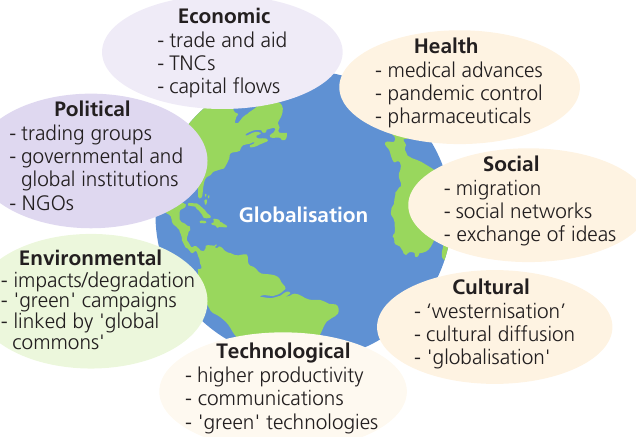
Economic dimension
Economic globalisation focuses on the movement of goods, services, money and investments across international borders. Key elements include:
- International trade: The exchange of products and services between countries, with imports flowing in and exports flowing out
- Transnational corporations (TNCs): Large companies that operate in multiple countries, producing and selling goods globally
- Capital flows: The movement of money for investment, trade or production purposes
- Foreign direct investment (FDI): When companies or individuals invest in businesses or assets in other countries
Important
Capital flows refer to the movement of money for the purpose of investment, trade or to produce goods and provide services. This is usually regarded as investment into a production operation.
International trade is the exchange of capital, goods and services across international borders. Inbound trade is defined as imports and outbound trade as exports.
The economic dimension traditionally received the most attention when discussing globalisation, as it represents the most visible and measurable aspect of global integration.
Cultural and social dimension
Cultural and social globalisation involves the spread of ideas, values, information and lifestyles across the world. This dimension includes:
- Migration of people between countries for work, education or refuge
- Global communication networks connecting people instantly across vast distances
- Social networks that allow people to maintain relationships internationally
- The exchange of ideas, art, music, and cultural practices
- 'Westernisation' where Western (particularly American and European) culture influences other societies
- Cultural diffusion as practices and beliefs spread from one place to another
Note
This dimension has accelerated dramatically with digital technology, as the internet and social media enable instantaneous global communication. A message can now travel around the world in seconds, fundamentally changing how cultures interact and influence each other.
Technological dimension
Technology acts as both a driver and dimension of globalisation. Technological advances have enabled:
- Higher productivity in manufacturing and services
- Advanced communications systems connecting people and businesses globally
- Faster and cheaper transportation of goods and people
- Development of 'green technologies' addressing environmental concerns
- New flexible processes of production and organisation
- Digital platforms enabling global commerce and interaction
The information technology revolution of the 1990s particularly accelerated globalisation, making it easier and cheaper for businesses and individuals to operate internationally.
Political dimension
Political globalisation involves the spread of political systems, policies and governance structures across borders. Key aspects include:
- Trading groups and regional economic blocs (like the European Union)
- Governmental institutions operating at the international level
- Global institutions (such as the United Nations, World Bank, International Monetary Fund)
- Non-governmental organisations (NGOs) working across multiple countries
- The growth of Western democracies and their influence on other nations
- The decline of centralised communist economies, though communist political control remains strong in countries like China and Russia
Political globalisation has seen the diffusion of government policies and the development of market economies in former communist states.
Environmental dimension
Environmental globalisation recognises that environmental challenges transcend national borders. This dimension includes:
- Recognition of environmental impacts and degradation affecting the whole planet
- Global environmental campaigns addressing climate change, deforestation and pollution
- The concept of 'global commons' - shared resources like the atmosphere and oceans
- International agreements and protocols to address environmental issues
- Connections created through environmental networks and movements
Note
Climate change exemplifies environmental globalisation perfectly. Greenhouse gas emissions in one country contribute to global warming affecting all nations, regardless of where the emissions originated. This creates a shared responsibility for environmental action.
Health dimension
Health-related globalisation has become increasingly prominent, encompassing:
- Medical advances shared internationally through research collaboration
- Pandemic control requiring global coordination
- International pharmaceutical companies developing and distributing medicines worldwide
- The World Health Organisation coordinating global health responses
- Rapid international spread of diseases due to increased travel and connectivity
The COVID-19 pandemic starkly illustrated both the challenges and necessities of global health cooperation.
Factors of production
Understanding globalisation requires examining the fundamental economic inputs that enable production and trade. Economists identify four key 'factors of production' that must be combined to create goods and services. The increasing international movement of these factors has been both a cause and consequence of globalisation.
Land
Land represents all natural resources provided by Earth. This includes:
- Minerals and metals extracted from the ground
- Water resources for drinking, irrigation and industrial use
- Forests providing timber and other products
- Agricultural land for growing crops
- Energy resources like coal, oil and natural gas
Different countries possess different natural resources, creating the need for international trade as nations seek resources they lack domestically.
Labour
Labour refers to the human resource available in any economy. Several characteristics of labour affect a country's ability to produce goods and services:
- Quantity: The number of workers available
- Quality: The skills, education and training levels of the workforce
- Cost: Wage levels and employment costs in different countries
Globalisation has enabled companies to access labour forces in different countries, either by relocating production facilities or through international migration of workers seeking better opportunities.
Capital
In economic terms, capital refers to physical resources that aid production. This includes:
- Buildings such as factories, warehouses and offices
- Machinery and equipment used in manufacturing
- Infrastructure like roads, ports and communications networks
- Financial resources used to acquire physical capital
Important
Capital in economic terms refers to any physical resource that can be regarded as a man-made aid for production, such as buildings, factories, machinery, etc. Capital flows can involve the transfer of these physical resources from one place to another, though it usually refers to the flow of investment finance used to provide this capital.
Capital flows internationally as companies invest in facilities abroad or as financial institutions lend money across borders.
Enterprise
Enterprise represents a particular form of human capital - people willing to take risks by establishing businesses and organising the production of goods or provision of services. Entrepreneurs combine the other three factors of production (land, labour, and capital) to create value.
Note
The Circular Relationship: The globalisation process has both increased international flows of these factors and been driven by such flows, creating a reinforcing cycle of global integration. This means factors of production are simultaneously causes of globalisation (they enable it) and consequences of globalisation (they flow more freely because of it).
Flows of capital
International capital flows have become a defining feature of the modern global economy. Understanding how money moves between countries helps explain many contemporary economic phenomena and challenges.
Understanding international capital flows
For the purpose of understanding international capital flows, capital includes all money that moves between countries. This money is typically used for:
- Investment purposes: Building factories, purchasing equipment, or acquiring land and physical capital
- Trade: Paying for goods and services exchanged across borders
- Production: Financing the creation of goods or provision of services
Capital flows represent the financial dimension of globalisation, connecting national economies into a global financial system.
Deregulation of world financial markets
A crucial development accelerating globalisation occurred in the late twentieth century: the deregulation of world financial markets. This process involved removing restrictions that had previously limited the activities of financial institutions.
Before deregulation, banks, insurance companies and investment firms faced significant constraints on international operations. They could typically only operate within the borders of specific countries. Deregulation changed this fundamentally, allowing financial institutions to:
- Open branches and subsidiaries in multiple countries
- Move money freely across national borders
- Invest in assets and securities globally
- Offer services to international clients
- Participate in global financial markets
Note
This created unprecedented flows of money around the world, generating new global financial systems where transactions routinely cross national boundaries. Financial markets became interconnected, with trading happening 24 hours a day as markets opened and closed across different time zones.
Important
A Double-Edged Sword: While deregulation created new opportunities for growth and investment, it also created new vulnerabilities. The 2008 financial crisis demonstrated how problems in one country's financial sector could rapidly spread globally through these interconnected systems, threatening the entire world economy.
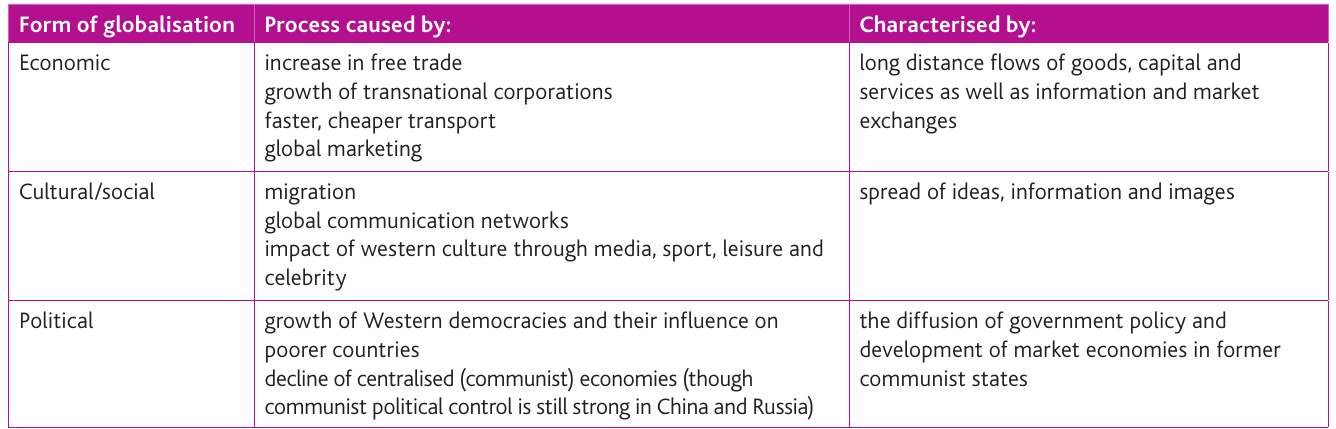
Forms of globalisation
Globalisation takes different forms depending on what flows across borders and how this movement affects societies. Three main forms can be identified: economic, cultural/social, and political globalisation.
Economic globalisation
Economic globalisation is characterised by long-distance flows of goods, capital and services, as well as information and market exchanges. This form is driven by several key processes:
- Increase in free trade: Reduction of tariffs, quotas and other barriers to international commerce
- Growth of transnational corporations: Large companies expanding operations across multiple countries, producing and selling globally
- Faster, cheaper transport: Improvements in shipping, aviation and logistics reducing the cost and time of moving goods internationally
- Global marketing: Companies selling products worldwide with standardised or adapted marketing strategies
The result is a highly integrated global economy where production chains span multiple countries, and consumers can access products from around the world.
Cultural and social globalisation
Cultural and social globalisation involves the spread of ideas, information and images across the world. Key processes include:
- Migration: People moving between countries for work, education, refuge or other reasons, bringing their cultures with them
- Global communication networks: The internet, satellite television, and mobile communications connecting people instantly across vast distances
- Impact of Western culture: The influence of Western (particularly American) culture through media, sport, leisure activities and celebrity culture
- Cultural diffusion: The spread of cultural practices, languages, foods, music and other elements between societies
Note
This form of globalisation has led to both greater cultural exchange and concerns about cultural homogenisation, where local cultures are replaced by global, often Western-dominated, cultural forms. The debate continues about whether globalisation creates cultural diversity through exchange or cultural uniformity through dominance.
Political globalisation
Political globalisation centres on the spread of political systems and the influence of more powerful nations on less powerful ones. Key processes include:
- Growth of Western democracies: The spread of democratic political systems and their influence on countries with other forms of government
- Decline of centralised communist economies: The transition of formerly communist countries toward market economies, particularly after the collapse of the Soviet Union in 1991, though communist political control remains strong in countries like China and Russia
This form results in the diffusion of government policies and the development of market economies in former communist states. It also involves the creation of international political institutions and agreements that operate above the level of individual nation-states.
Remember!
Summary
Key Points to Remember:
-
Globalisation is multidimensional: It encompasses economic, cultural, social, technological, political, environmental and health dimensions, not just trade and economics.
-
The world economy is interconnected: Events in one country can rapidly affect the entire global system, as demonstrated by the 2008 financial crisis and COVID-19 pandemic.
-
Four factors of production drive globalisation: Land (natural resources), labour (human resources), capital (physical and financial resources), and enterprise (businesses) all flow internationally, both causing and resulting from globalisation.
-
Capital flows transformed through deregulation: Late twentieth century deregulation of financial markets allowed money to move freely across borders, creating integrated global financial systems but also new vulnerabilities to financial crises.
-
Globalisation creates both uniformity and diversity: While global brands and cultural practices spread worldwide, creating some uniformity, the process also involves complex interactions between global and local cultures.