Trading Relationships and Patterns (AQA A-Level Geography): Revision Notes
📚Revision Notes
Trading Relationships and Patterns
Trading relationships between nations vary significantly depending on their level of economic development, political ideology, and regional connections. Countries engage in trade through bilateral agreements, regional trading blocs, or multilateral arrangements. Understanding these patterns helps explain global economic interdependence and inequality.
Highly developed economies (HDEs)
USA - shifting trade policy
The USA has historically adopted a protectionist approach to trade, avoiding comprehensive free trade agreements for many years. However, this stance has shifted dramatically over recent decades.
Obama administration (2009-2017):
During this period, the USA actively pursued major multilateral free trade agreements:
- Trans-Pacific Partnership (TPP) - negotiations with Asia-Pacific countries to create a large free trade zone
- Trans-Atlantic Trade and Investment Partnership (TTIP) - proposed agreement with the EU to reduce tariffs and regulatory barriers
Trump administration (2016-2020):
President Trump campaigned on protecting American domestic industries and reversing the trend towards multilateral trade deals. Key changes included:
- Withdrawal from TPP - Trump removed the USA from negotiations. Other countries continued without American involvement
- TTIP collapse - negotiations ended in 2016 when the USA demanded access to EU markets that many European countries found unacceptable. The EU officially closed negotiations in 2019
- USMCA creation - the North American Free Trade Agreement (NAFTA) was renegotiated and replaced with the United States-Mexico-Canada Agreement
- Bilateral trade focus - Trump pursued individual agreements with specific countries rather than large trading blocs
Note
The shift from Obama's multilateral approach to Trump's bilateral focus represents one of the most significant changes in American trade policy in recent decades. This transformation affected not only US trading relationships but also influenced global trade patterns and negotiations worldwide.
Current bilateral trade arrangements:
The USA maintains twenty separate free trade agreements with individual nations, including:
- Several TPP countries
- Central American and Middle Eastern nations
- South Korea (the only Asia-Pacific agreement)
Future direction:
The election of President Joe Biden in late 2020 signals a probable shift back towards multilateral cooperation and international trade engagement.
The European Union - trading as a bloc
The EU operates differently from the USA due to its structure as a customs union. This means:
Important
A customs union allows free trade between member states but maintains a common external tariff barrier for countries outside the union. The EU negotiates trade deals as a single bloc representing all 27 member states, so agreements apply universally across the Union.
Intra-regional trade patterns:
- Approximately 65% of EU trade occurs between member states
- This high level of internal trade creates strong integration and interdependence
- Free movement of goods between members enhances cooperation
External trade relationships:
The EU has negotiated bilateral trade deals with various countries and regions:
- Australia, New Zealand, Mexico
- Japan, Singapore, Vietnam
- Canada-EU deal (2017) - The Comprehensive Economic and Trade Agreement (CETA) created virtually free trade and regulatory compatibility between the two economies
- Mercosur agreement (2019) - A trade deal with the South American trading bloc, though ratification by all member states remains pending
Growing opposition to free trade:
Anti-free trade movements have gained momentum in the EU for several reasons:
Note
Agricultural concerns - Farmers in Belgium, France and the Netherlands worry that cheap imported beef and sugar will create unfair competition.
Environmental and labour standards - Groups claim Brazilian and Argentinian cattle production involves harmful chemicals, and that Mercosur countries fail to meet EU standards for working conditions, food production and environmental protection.
Amazon deforestation - Opposition to Brazilian President Bolsonaro's policies on Amazon rainforest commercial development.
These concerns make it difficult to reach new agreements between the EU and USA, given their differing standards and production methods.
Brexit implications:
The UK's departure from the EU presents challenges:
- The UK was a major contributor to EU funds
- It attracted significant manufacturing investment
- It provided a large market for goods
During the 2020 transition period, the UK negotiated a new free trade deal with the EU. This was crucial for British firms who had built supply networks across the EU over decades of integration.
Emerging economies
China - manufacturing powerhouse
China's remarkable economic growth over the past 30 years stems from becoming the manufacturing centre for consumer goods sold to wealthier nations.
Recent developments:
- China has emerged as the world's leading trading power
- It accounts for nearly 20% of global exports
- It represents around 15% of global imports
Trading patterns:
China's trade reflects its role in global manufacturing supply chains:
Imports:
- Raw materials from developing countries, particularly Latin America and sub-Saharan Africa
- Processed metals (steel) and manufactured electronic components from developed countries
Exports:
- Cheaply produced, state-subsidised steel to global markets
- Manufactured electronic consumer goods to developed countries, especially Europe and North America
Example
Trade Pattern Analysis: China's Manufacturing Role
China imports raw materials (iron ore, copper) from developing countries → processes them into steel and components → exports finished manufactured goods (electronics, consumer products) to developed markets.
This pattern demonstrates China's position as the "middle link" in global supply chains, adding value through manufacturing while serving as both a market for raw materials and a source of finished products.
Trade war with the USA:
The export of heavily subsidised Chinese steel triggered a trade conflict with the USA:
- High tariffs imposed on goods traded between the two countries
- Some experts argue this represents the primary cause of current stagnation in world trade growth
- Tensions continue to affect global economic patterns
Belt and Road Initiative:
China is pursuing ambitious plans to expand its trade connections through major infrastructure investments, creating new trade routes and partnerships.
India - diverse economic growth
India has experienced sustained and rapid industrial growth over the past 25 years, though its emergence as a major economic power has been slightly less dramatic than China's.
Economic characteristics:
- More diverse economy than China
- More globally integrated commercial and services sector
- Food security remains a crucial concern, as it does in China
Historical context:
Both India and China experienced devastating famines in the 1960s. India's Green Revolution improved staple food production, alleviating concerns. However, agricultural change displaced many rural labourers who migrated to urban areas seeking work. Wholesale rural change created demographic shifts, with a large, young workforce attracting industrial development investment.
Trading patterns (2018):
Exports:
- Refined petroleum, chemicals, gold and diamonds
- Rice, cars and textiles
Imports:
- Crude oil (for refining and exporting)
- Coal briquettes and gas
Trading partners:
- Main export destinations: EU (mainly Germany and UK), USA, UAE, China, Hong Kong and Singapore
- Main import sources: China, USA, Saudi Arabia and UAE
Important
Trade balance concerns:
India's imports have expanded faster than exports, creating balance of payments problems that make the economy vulnerable. In 2018, there was a deficit of US$166 billion.
Westward trading focus:
India has traditionally maintained stronger trading relationships with western partners, partly due to high English language proficiency amongst its population. However, trade with emerging markets in Asia and the Middle East has expanded significantly, giving India a distinctive trading pattern.
Less developed economies (LDEs)
Latin America - two competing models
Latin America's future trading relationships centre on two distinct regional trading blocs, each with different approaches to developing trading links.
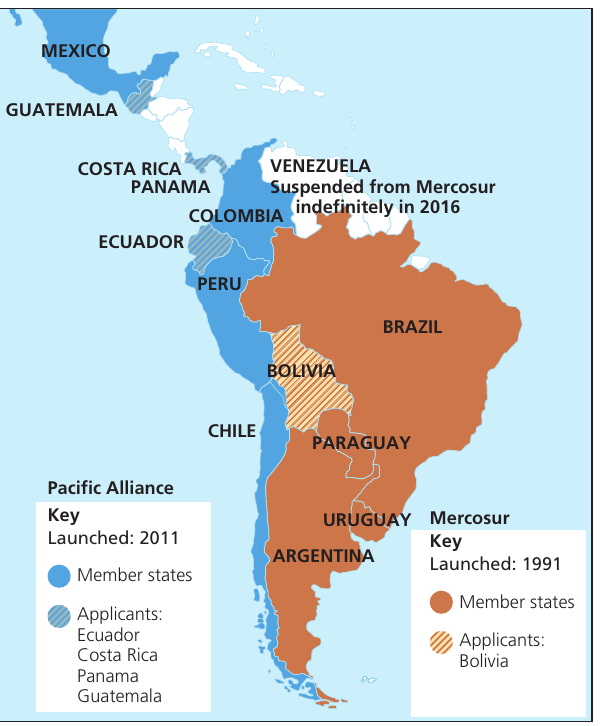
Mercosur (Southern Common Market):
Formed in 1991, Mercosur is the larger bloc with combined GDP of US$3.4 trillion. Current members include:
- Brazil
- Argentina
- Uruguay
- Paraguay
- Venezuela (suspended indefinitely in 2016 for failing to comply with trade regulations)
Key features:
- Functions as a single market and customs union, attempting to emulate the EU model
- Called the 'Common Market of the South'
- Allows free movement of labour between member states
- Most exported products are raw materials, energy, minerals and food resources, enabling global trade but creating vulnerability to fluctuating prices
- Apart from mineral exports to China, Mercosur views the EU and North America as primary markets
- The proposed EU trade deal represents a major development opportunity once ratified
Pacific Alliance:
Formed more recently in 2011, the Pacific Alliance comprises:
- Chile
- Peru
- Colombia
- Mexico
Combined GDP: US$2.3 trillion. Ecuador is expected to join soon.
Note
Key differences from Mercosur:
- More open to bilateral trade agreements with other nations
- Views the Asia-Pacific region as its main market focus
- Some member countries (notably Peru and Colombia) are experiencing faster growth in individual economies and trade volumes
- Reflects the trend that trans-Pacific trade has been more dynamic than trans-Atlantic trade in recent years
Potential future integration:
Since 2017, there has been increased discussion about merging the two blocs to form one large free trade area. This would be directed by the intergovernmental body, the Union of South American Nations (UNASUR), and would include all Latin American countries as members.
Benefits of integration:
- Increased intra-regional trade
- Greater collective trading power on the global stage
Challenges to integration:
- Varying levels of economic development between nations
- Different political ideologies across countries
- Political instability, as seen in Venezuela and Ecuador in recent years
Sub-Saharan Africa - primary resource dependency
Trading relationships in sub-Saharan Africa share similarities with Latin America but face more disadvantages and less integration.
Current trading challenges:
- Minimal intra-regional trade between African nations
- Main exports remain primary resources and commodities such as minerals, energy and food resources
- Lack of skills, poor transport and energy infrastructure, and widespread corruption discourage industrial investment
- African countries struggle to add value to exports, relying on imports of manufactured goods instead
Changing trading partners:
- Traditionally, Africa's main trading partner has been Europe
- This has changed with China's growing involvement on the continent
- Africa is larger, poorer and more culturally divided than South America
- Many more language, ethnic and cultural divisions exist
Future developments:
Two factors may transform African trading relationships:
1. Chinese investment:
Chinese infrastructure investment in Africa has undoubtedly benefited China's own interests. However, it has also increased African connectivity and integration between nations.
2. African Continent Free Trade Area (AfCFTA):
Africa has five main regional trading groups with some overlap but minimal integration between them. Even within these groupings, linguistic and cultural divisions exist.
In 2018, after years of negotiations by the African Union, these five groups agreed to work together and created AfCFTA:
- The world's largest free trade area
- Population of 1.3 billion people
- The largest single market
- Came into effect in 2019 without Nigeria initially, but Nigeria joined shortly afterwards
- 54 of the 55 African nations have now signed the deal
Example
Trade Implications for African Nations:
Main purpose: Increase intra-regional trade, historically low at around 16%. This is seen as critical for economic growth and job creation on the continent.
Greater global influence: African nations gain more voice and leverage in international trade negotiations.
Potential disadvantages: Trade liberalisation may disadvantage the poorest people within some countries due to fragmentation and different development stages.
Ensuring shared prosperity: The African Union needs to create supportive policies, eliminate monopolies and prevent uncompetitive behaviour, such as state subsidies.
Fair trade in LDEs
Fair trade is a social movement whose goal is to help producers in LDEs achieve better trading conditions. The movement focuses mainly on agricultural-based products including coffee, tea, cocoa, sugar, bananas, cotton and chocolate.
The fair trade argument:
Producers of commodities do not receive an equitable deal from the organisations they supply to. Buyers such as transnational corporations, food processing companies and supermarket chains from developed countries can force down prices because individual suppliers:
- Have little market influence
- Are extremely reliant on income from their goods
How fair trade works:
The fair trade movement advocates paying higher prices to producers, whilst helping them achieve improved social and environmental standards. Fair trade organisations assist producers to:
- Form into co-operatives, giving them more influence over market conditions
- Negotiate better deals with buyers or supply directly
- Access the International Fairtrade Certification mark
This allows 'ethical consumers' to recognise they are buying goods for which the producer received a fair price.
Important
It is crucial not to confuse fair trade with free trade, especially as the two ideas can be conflicting. The terms are quite different.
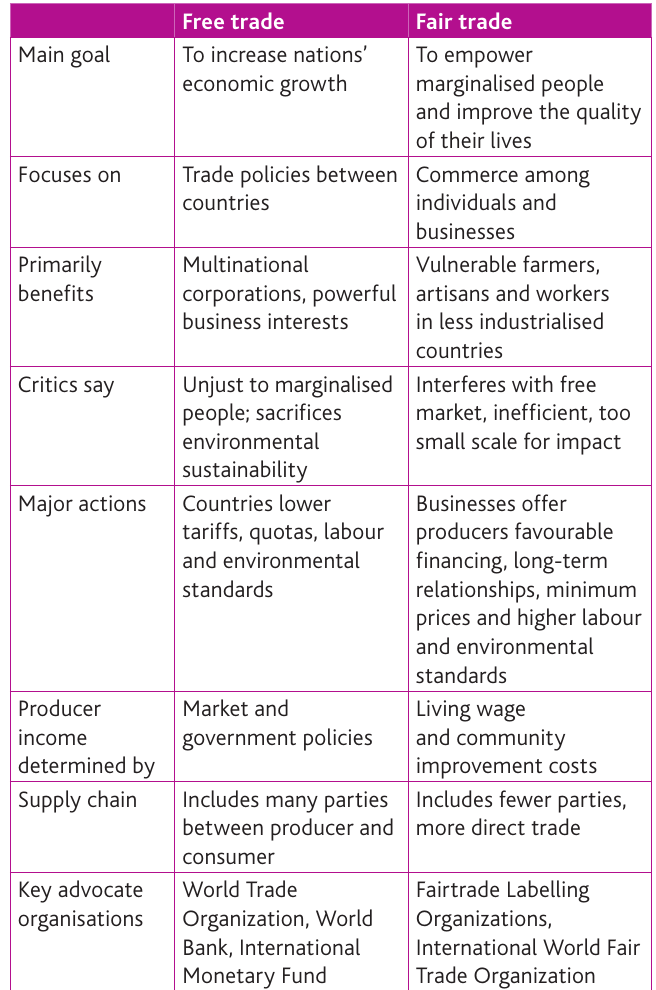
Key differences:
Free trade focuses on:
- Increasing nations' economic growth
- Trade policies between countries
- Benefiting multinational corporations and powerful business interests
- Lowering tariffs, quotas and labour/environmental standards
Fair trade focuses on:
- Empowering marginalised people
- Commerce among individuals and businesses
- Supporting vulnerable farmers, artisans and workers in less industrialised countries
- Offering producers fair financing, long-term relationships, minimum prices and higher labour and environmental standards
Differential access to markets
Each country's access to markets is determined by its ability to trade with other countries. Access to international markets is limited by any barriers that might be in place, such as tariffs, quotas or trade regulations. This depends on the degree of protectionism used by other countries or trading blocs.
Access associated with levels of economic development
Wealthier, more developed economies generally have better access to markets because:
- They can afford to pay higher tariffs on exported goods
- They have greater negotiating power when forming trade agreements
- Their producers can meet strict regulatory standards required by other markets
- They possess the infrastructure and resources to overcome trade barriers
Conversely, less developed economies face restricted market access due to:
- Limited ability to pay high tariffs
- Weaker negotiating positions in trade talks
- Difficulty meeting technical and regulatory standards
- Poor infrastructure hampering trade capacity
Remember!
Summary
Key Points to Remember:
-
The USA has shifted from Obama-era multilateral agreements (TPP, TTIP) to Trump's bilateral approach and protectionism. Biden's administration may reverse this trend.
-
The EU operates as a customs union with high intra-regional trade (65%) and negotiates collectively, but faces growing anti-free trade movements over agricultural, environmental and labour concerns.
-
China dominates global manufacturing, importing raw materials and exporting manufactured goods, whilst its trade war with the USA affects global trade growth.
-
Latin America has two distinct trading blocs: Mercosur (EU-style, Atlantic-facing) and Pacific Alliance (bilateral-focused, Pacific-facing), with potential future integration through UNASUR.
-
Sub-Saharan Africa faces challenges from minimal intra-regional trade and primary resource dependency, but the AfCFTA (launched 2019) and Chinese investment may transform trading relationships.
-
Fair trade differs fundamentally from free trade: fair trade empowers marginalised producers through higher prices and better standards, whilst free trade focuses on reducing barriers between countries to boost economic growth.