Case Study: Japan - Decline and Ageing population (AQA A-Level Geography): Revision Notes
📚Revision Notes
Case Study: Japan - Decline and Ageing population
Overview
Japan represents one of the world's most aged populations, facing distinctive challenges from population decline and demographic ageing. In 2019, the total population stood at 126.3 million, making it the eleventh largest globally. However, with a population density of 347 people per km², the distribution is highly uneven across the archipelago.
The country experiences natural population decrease, with a birth rate of 7 per 1,000 and a death rate of 11 per 1,000. The fertility rate sits at just 1.4 children per woman, well below the replacement level. This demographic profile places Japan firmly in Stage 5 of the Demographic Transition Model, with projections suggesting the population will shrink from 170 million to just 100 million by 2050, potentially declining further to 85 million by 2100.
Note
Stage 5 of the Demographic Transition Model is characterized by very low birth rates and low death rates, resulting in natural population decrease. Japan is one of the few countries to have entered this stage, where deaths outnumber births and the population shrinks without immigration.
Environmental factors
Japan's physical geography significantly influences its population distribution and economic development. The nation comprises a mountainous archipelago, with major islands including Honshu, Hokkaido, Kyushu and Shikoku. These islands contain fertile valleys and narrow coastal plains where most settlement occurs. Approximately 70% of the land consists of mountains with sparse population, whilst around 92% of people live in densely populated urban areas, particularly major metropolises like Tokyo and Osaka.
The climate varies considerably across the country's north-south extent. Northern regions, including Hokkaido and the Sea of Japan coast, experience long, cold winters. By contrast, the southernmost islands such as Okinawa enjoy subtropical conditions with an average January temperature of 17°C. Major cities like Tokyo have temperate climates with mild summers and four distinct seasons. Early summer brings a rainy season, whilst typhoons frequently strike during late summer.
Japan's location where several continental plates meet makes it prone to natural hazards including typhoons, earthquakes and volcanic eruptions. However, volcanic activity has created fertile soils that support intensive agricultural production. Despite this advantage, only 20% of land is suitable for farming. The population has overcome landscape limitations through intensive farming of alluvial plains and terracing slopes to increase farmland availability. Agriculture receives significant subsidies, with rice as the main crop. Nevertheless, food security requires importing substantial quantities, especially meat products, to meet domestic demand.
Note
Resource Constraints and Geography
Japan's limited natural resources have historically shaped its development:
- Must import food, fuel, and minerals to support its population
- During industrialization, relied on importing resources from neighboring countries
- Resource scarcity contributed to imperial expansion into the Pacific region prior to WWII
- Today, maintains a robust fishing industry and marine aquaculture sector, though still requires large seafood imports
The archipelagic geography makes Japan a seafaring nation with a robust fishing industry. This includes a well-developed marine aquaculture sector that contributes to food security, though large seafood imports are still necessary to satisfy domestic consumption.
Character, scale and patterns of population change
Japan maintains a distinctive culture characterized by tradition, order and harmony. Japanese society emphasizes being responsible family and community members, with individuals expected to serve others' needs before their own. This creates a reputation for hardworking citizens who demonstrate intense loyalty to family, employer and nation.
As the third largest economy worldwide, Japan has a gross national income per capita of US$41,690. Traditionally, the main income source came from manufacturing, but as the economy has evolved towards post-industrial services, well-educated women have become increasingly important workforce participants. This shift significantly impacts birth and fertility rates.
The average life expectancy of 85 years ranks among the highest globally. Over 65s comprised 28% of the population in 2019, with more than 71,000 centenarians. Infant mortality, at just 2 per 1,000 live births, represents one of the world's lowest rates.
Young dependants constitute only 12.5% of the population. The economically active proportion stands at 59.50%, resulting in a dependency ratio of 68. Estimates suggest nearly 40% of Japan's population will exceed 65 years by 2050 as the demographic "time bomb" unfolds. The declining population means insufficient young people to replace the older generation dying out. The burden of supporting the elderly by the working and younger population may become unsustainable.
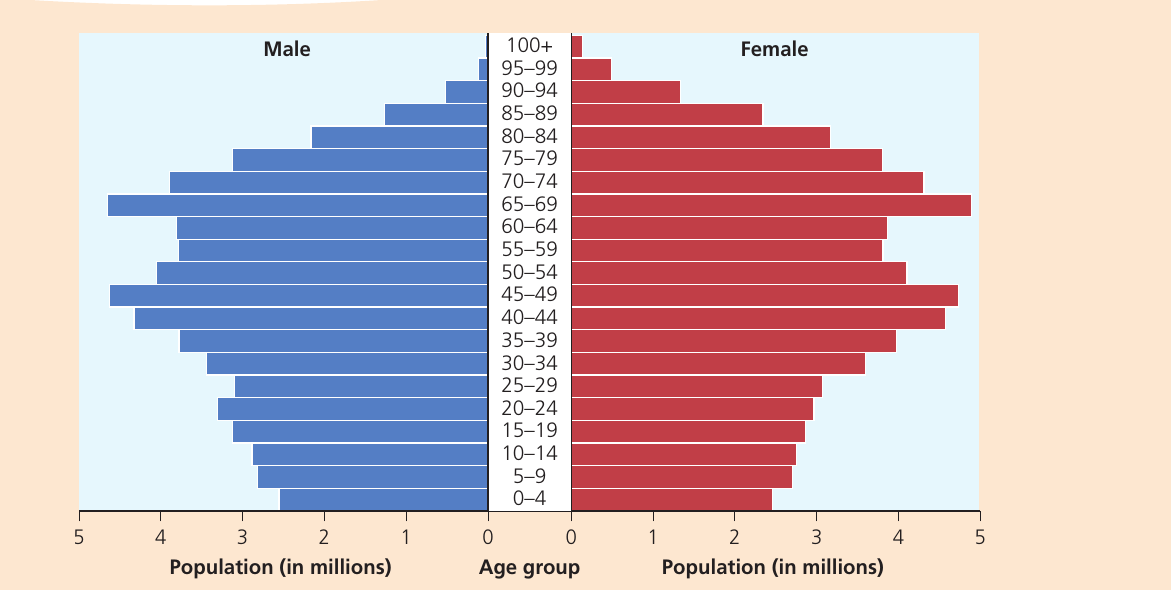
The population structure depicted in the pyramid demonstrates Japan's ageing demographic profile, with the largest cohorts in the 45-49, 65-69, and 70-74 age ranges.
Important
Natural Decrease Explained
Japan is experiencing natural decrease – when the death rate exceeds the birth rate, causing population decline. This occurs because the country has:
- Very low fertility rate (1.4)
- Low birth rate (7/1,000)
- Relatively high death rate (11/1,000) due to the large elderly population
This combination means more people are dying than being born each year, leading to population shrinkage.
Socio-economic factors
Two primary factors drive Japan's ageing population: higher life expectancy and low fertility. Several social and economic elements contribute to these trends.
Factors contributing to high life expectancy:
- Excellent healthcare, sanitation and high living standards produce extended life spans
- Healthy diets – unlike many western developed countries, Japan has lower obesity and heart disease rates
- Low rates of premature death from non-communicable diseases compared to other nations
- Clean air quality – Japan uses fewer fossil fuels for energy generation, relying more on nuclear power and hydroelectric power (they also favour public transport)
- Good education – women receive quality education, leading many to focus on careers rather than having multiple children
Note
Japan's Healthcare Advantage
Japan's combination of excellent healthcare infrastructure, healthy traditional diet, clean environment, and strong education system creates one of the world's highest life expectancies. These factors work together synergistically – educated populations make better health choices, while clean air and healthy diets reduce chronic disease burden on the healthcare system.
Factors contributing to low fertility:
- Accessible contraception – few religious or social taboos restrict use
- Rising education costs during a period of stagnating wages place financial strain on families. These costs particularly burden households funding one child through high school and university, with expenses reaching ¥10 million (nearly US$100,000). High costs are considered a factor in low fertility and population decline
- Later marriage reduces the childbearing window for women
- Women's career focus – as more educated females enter the workforce, they prioritize professional development over having many children
Implications for the country and Japanese society
The negative consequences arising from Japan's ageing population range from serious economic impacts to more trivial social changes. For example, the domestic economy is contracting as adult incontinence nappies outsell baby nappies. All generations experience effects from the population structure.
Economic and fiscal challenges:
- Approximately 10% of GDP funds pensions, with a further 21% allocated to health and social security for the elderly
- The "2025 problem" generates widespread concern – in that year, all postwar baby boomer generation members will reach 75 or older, further increasing social security benefit demands
- Since the 1960s, retirees receive only a small portion of medical care through a universal healthcare system, partly covered by national insurance
- The working population is shrinking rapidly, creating negative impacts on domestic economic growth. This affects production (fewer workers) and consumption (fewer earning people means reduced spending). Fewer workers also means reduced tax collection, which primarily supports pensions and social security
- Rising home care needs mean families may need to provide full-time care, removing people from the economic workforce. Around 65% of elderly people live with their children, with three-generation households typical
- Pressure on care services for the elderly means more medical and care provision is required. A shortfall of 370,000 medical staff, nurses and care workers is predicted by 2025
Important
The "2025 Problem"
This term refers to the critical year when all postwar baby boomer generation members will reach 75 or older. This demographic shift will create:
- Massive increase in demand for social security benefits
- Overwhelming pressure on healthcare and care services
- Predicted shortfall of 370,000 healthcare workers
- Unsustainable burden on government spending (already 10% GDP on pensions, 21% on health and social security)
This represents a "demographic time bomb" that will fundamentally challenge Japan's social and economic systems.
Social challenges:
- Increased pressure on NGOs (charitable organisations) to provide care. Residential home numbers are restricted and there is stronger emphasis on community care, justified on fiscal grounds but also considered more supportive and well-being focused. An emerging voluntary sector with more reliance on unpaid volunteers (many of whom are over 65) provides this care
- Approximately 6 million elderly Japanese live alone without family support
- Growing numbers of elderly live on streets, in poor quality housing, or end up in prison (especially males). Offending rates are high as prisons offer better care for some
- Rising cases of dementia. Predictions suggest one in five elderly will suffer from dementia by 2025
- More elderly are returning to work to supplement income – around 25% of senior citizens (over 65s) have jobs
Positive aspects:
Despite challenges, several positive features emerge:
- Due to globalisation, Japanese manufacturing remains highly successful, with income from large transnational corporations such as Toyota and Sony bringing repatriated profits to support the domestic economy
- Growth in private hospitals specializing in elderly healthcare creates jobs and generates income
- Increasing demand for leisure activities and tourism among affluent elderly also generates income and employment
- One positive feature specific to Japan involves embracing new artificial intelligence (AI) and robotic technology. Building "robot carers" to assist the elderly includes companion animals, bionic limbs that aid mobility, fetch-carry robots, and even robots providing toilet assistance. Japan leads globally in AI field and exponential growth of which robotic technology applies to the care industry helps address some shortfalls in human healthcare workers. Current costs mean only affluent elderly can afford it, though prices will likely decrease as technology becomes more widely adopted. This sector of automation is already estimated to be worth US$2 billion to the economy
Note
Japan's Robotic Care Innovation
Japan is pioneering the use of AI and robotics in elderly care, developing:
- Companion animals for emotional support
- Bionic limbs to aid mobility
- Fetch-carry robots for daily tasks
- Robots providing toilet assistance
This technology sector, already worth US$2 billion, helps offset shortages in human healthcare workers. While currently expensive, costs are expected to decrease as adoption increases, making robotic care more accessible to the broader elderly population.
Government responses
The Japanese government has a responsibility to tackle some issues for a sustainable future whilst being cautious about policies that might alienate the elderly, which represents a powerful voting bloc (the "grey vote").
Raising taxes
The government raised the consumption tax rate to 10% in 2019 in an effort to cover growing costs of supporting the country's ageing population.
Raising retirement age
The standard retirement age is being raised to 65 by 2025 (compared to 62 since 2016). Workers are encouraged to continue working until age 70 and beyond, offering employment incentives to retain or recruit those older than 65. This accompanies pension and social security reforms.
Note
Extending Working Lives
By raising the retirement age and incentivizing older workers to continue employment, the government aims to:
- Keep more people in the tax-paying workforce
- Reduce the dependency ratio
- Delay pension payments
- Maintain productivity despite shrinking working-age population
Around 25% of senior citizens (over 65s) already have jobs, showing some success of this approach.
Pro-natal population policies
The Plus One Policy, introduced in 2009, is predominantly pro-natalist, encouraging parents to have more children. Measures include:
- Increasing paid maternity leave
- Providing child benefit payments
- Offering cheaper healthcare and childcare support to create better work-life balance for mothers
- Shops offering discounts for larger families
- Local economic incentives
Example
Plus One Policy in Action: Yamatsuri
The town of Yamatsuri near Tokyo implemented generous local incentives to encourage families to have more children:
- US$4,600 payment on a child's birth
- Additional US$460 per year for the first 10 years
- Total value: approximately US$9,200 per child over 10 years
While these initiatives have enjoyed moderate success with fertility rising slightly in the past 10 years, overall the incentives have been relatively ineffective and are seen as symbolic gestures rather than serious practical help when compared to the ¥10 million (US$100,000) cost of raising and educating a child.
Encouraging robot technology
The government promotes robot technology and automation revolution in industry to offset production losses due to a shrinking workforce.
Immigration of skilled foreign workers
This represents the most obvious short-term solution to labour shortage and dependency problems.
Immigration has traditionally posed challenges for Japan for several reasons:
- Japanese is a difficult language and immigrants typically experience high test failure rates
- Foreigners struggle integrating with Japanese culture, particularly matching the demanding work ethic that employers expect
- Accepting immigration as a solution has traditionally been viewed as a threat to social stability, cultural heritage and public safety by wider Japanese society
Softening of anti-immigration attitudes has occurred, possibly resulting from increased inbound tourism in recent years. Additionally, there is increased acceptance that Japan needs foreigners to maintain functioning society.
Note
2019 Immigration Control and Refugee Recognition Act
Facing critical blue-collar labour shortages and pressure from industry groups, the government took action in 2019. The new act:
- Officially opened Japan's doors to lower-skilled foreign workers
- Targets certain industries experiencing critical skills shortages
- Offers temporary "guest worker" basis (unaccompanied by family)
- Provides initial five-year stay period
- Remains cautious to avoid anti-immigration backlash
However, to prevent a fall in the working age population proportion, it is estimated that 600,000 immigrants will be needed each year until 2050 – numbers that seem unlikely to be received or accepted given Japan's cautious approach.
Japan already has a permanent immigrant population of around three million (about 2.4% of the population), mainly from neighbouring East Asian countries such as China and Vietnam, who integrate more easily. It also accepts much needed skilled nurses from Indonesia and the Philippines.
Summary
Key Points to Remember
-
Japan has one of the world's most aged populations with 28% over 65 and a life expectancy of 85 years. Young dependants make up only 12.5% of the population.
-
Population is declining due to natural decrease – with a birth rate of 7/1,000, fertility rate of 1.4, and death rate of 11/1,000, the population may shrink from 126.3 million to 85 million by 2100.
-
Low fertility stems from multiple factors: high education costs (¥10 million per child), women prioritizing careers, accessible contraception, and later marriage ages.
-
The "2025 problem" looms when all baby boomers will be 75+, with predictions that 40% of the population will be over 65 by 2050, placing unsustainable burden on pensions (10% GDP) and healthcare (21% GDP).
-
Government responses include diverse strategies: raising retirement age to 65, the pro-natalist Plus One Policy, encouraging AI and robotics for elderly care (US$2 billion sector), and cautiously opening to skilled immigration through the 2019 Immigration Act.