Case Study: Wolverhampton - Place, Health and Wellbeing (AQA A-Level Geography): Revision Notes
📚Revision Notes
Case Study: Wolverhampton - Place, Health and Wellbeing
Introduction to the case study
This case study examines the relationship between place characteristics and health outcomes in Wolverhampton, with a particular focus on the Blakenhall ward. It demonstrates how physical environment, socio-economic factors, and population characteristics influence health and wellbeing in an urban setting.
Wolverhampton as a place
Location and context
Wolverhampton sits within the Black Country urban area, positioned north and west of Birmingham. The city achieved city status in December 2000 and has undergone significant economic regeneration since then.
Note
Key facts about Wolverhampton:
- Population: approximately 263,000 (2019 estimate)
- Located on the Midlands Plateau
- Positioned next to the main Severn-Trent watershed of England
- Annual rainfall is lower than England's average (681mm versus 879mm)
- Receives less weekly sunshine (26.2 hours compared to 29.50 hours nationally)
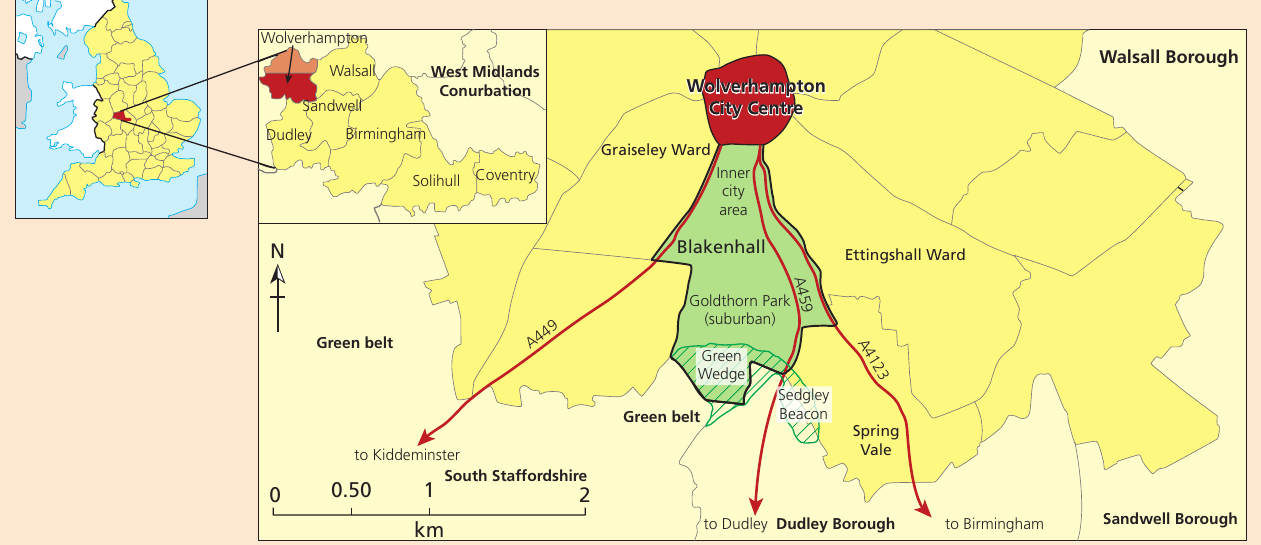
The council has invested substantially in regeneration, focusing on transport, retail, hospitality and cultural facilities. This investment has particularly targeted deprived areas such as Blakenhall, located to the south of the city centre.
Physical environment of Wolverhampton
The city exhibits diverse environmental characteristics:
City centre:
- Densely built with numerous high-rise buildings
- Contains significant public open spaces
Beyond the inner ring road:
- Building density decreases
- More dispersed development pattern
Northern and western boundaries:
- Open countryside of Staffordshire and Shropshire
Important
Index of Multiple Deprivation (IMD) is a government measure that ranks small areas across England based on deprivation across seven domains: income, employment, education, health, crime, barriers to housing and services, and living environment. Lower scores indicate higher deprivation.
Wolverhampton had an overall IMD value of 33.20 in 2015, significantly above the national average of 21.67. At that time, it ranked as the 17th most deprived local authority in England. However, regeneration efforts improved its ranking by seven places by 2019.
Blakenhall ward
Location and physical characteristics
Blakenhall occupies a southern sector of Wolverhampton, running from the inner ring road to the southern boundary with Dudley Borough. The ward contains three main roads radiating from the city centre, which are major thoroughfares that frequently experience congestion. This contributes to increased air pollution in the area.
The physical environment of Blakenhall shows distinct zones:
Near the city centre:
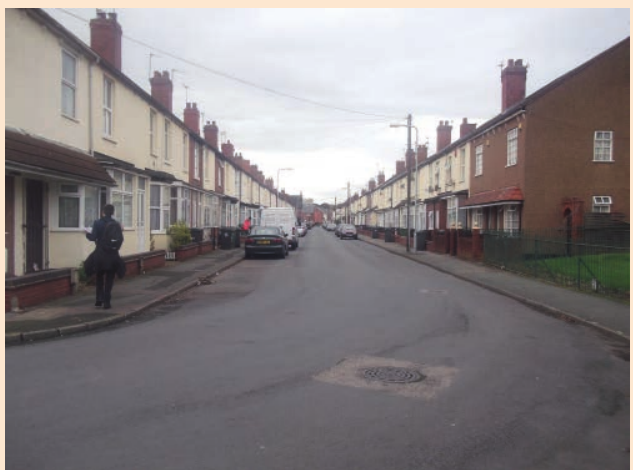
- Typical inner-city grid-iron pattern streets
- Terraced housing (see image below)
- Some older semi-detached private and council housing
- Contains several older factories
Regeneration area:
- A group of six 1960s tower blocks were demolished between 2002 and 2011
- Replaced with modern town houses and retail premises
- Small public open spaces with children's playgrounds
- Larger recreational area with playing fields
Suburban area (Goldthorn Park):
- Lower building density
- Mainly semi-detached and detached housing
Semi-rural fringe:
- Outermost part of the ward
- Rising steadily towards Dudley Borough
- Green wedge of land formed by fields and Sedgley Beacon
- Limestone ridge separating the two boroughs
Socio-economic character of Wolverhampton
Wolverhampton's economy has transformed significantly over recent decades:
Historical context:
- Many larger engineering and manufacturing industries declined during the 1980s deindustrialisation period
Current economy:
- Diverse economic base including brewing and civil engineering
- Large employers in finance industry and public sector (education and health)
- In 2014, Jaguar Land Rover opened a $500 million engine assembly plant at i54 Business Park
Employment challenges:
- Unemployment rate for 2019-2020 was 6.7%
- Almost twice the national average
- Despite variety of employment opportunities
Socio-economic character of Blakenhall
Population: Approximately 13,000 in 2018 (about 5% of Wolverhampton's total population)
Note
Multicultural characteristics:
Blakenhall is a highly diverse ward with a strong multicultural identity:
- 74% of the population are from 'black or minority ethnic' background
- Nearly 50% are of Indian heritage
- Sikhism is the predominant religion (36.5%)
- Contains three Sikh Gurdwaras, two Sikh community centres, a Hindu temple and a mosque
- For around 20% of the population, English is a second language
Housing patterns:
- Settled extended families are common
- Many households are three generational
- In smaller, older inner-city properties this can mean overcrowding
- 21% of houses have one or more category one hazards (risks to health and safety)
Education:
- Educational attainment above city average at GCSE and graduate level
- Slightly below national average at GCSE level
Age structure:
- Younger than average population
- Mean age of 39
- Over 60% of population of working age
Employment:
- Around 32% work in semi-skilled or unskilled work
- Only 13% describe themselves as professional
- 16% of over-65 population affected by fuel poverty
Deprivation:
- IMD value of 32.90
- Around the average deprivation level for the city
Economic function:
The inner-city part of Blakenhall predominantly serves a retail function:
- 'Out-of-town' retail park (St John's) near the ring road
- Four supermarkets
- Variety of small and medium-sized specialist independent shops
- Convenience stores and fast food outlets catering for local Asian population
- Former factories converted into community centres or smaller business units
- Auto services businesses
- Personal or professional service businesses run by and for the local community (e.g., immigration legal services, Indian bridal wear)
Relationship with health outcomes
Wolverhampton city health profile
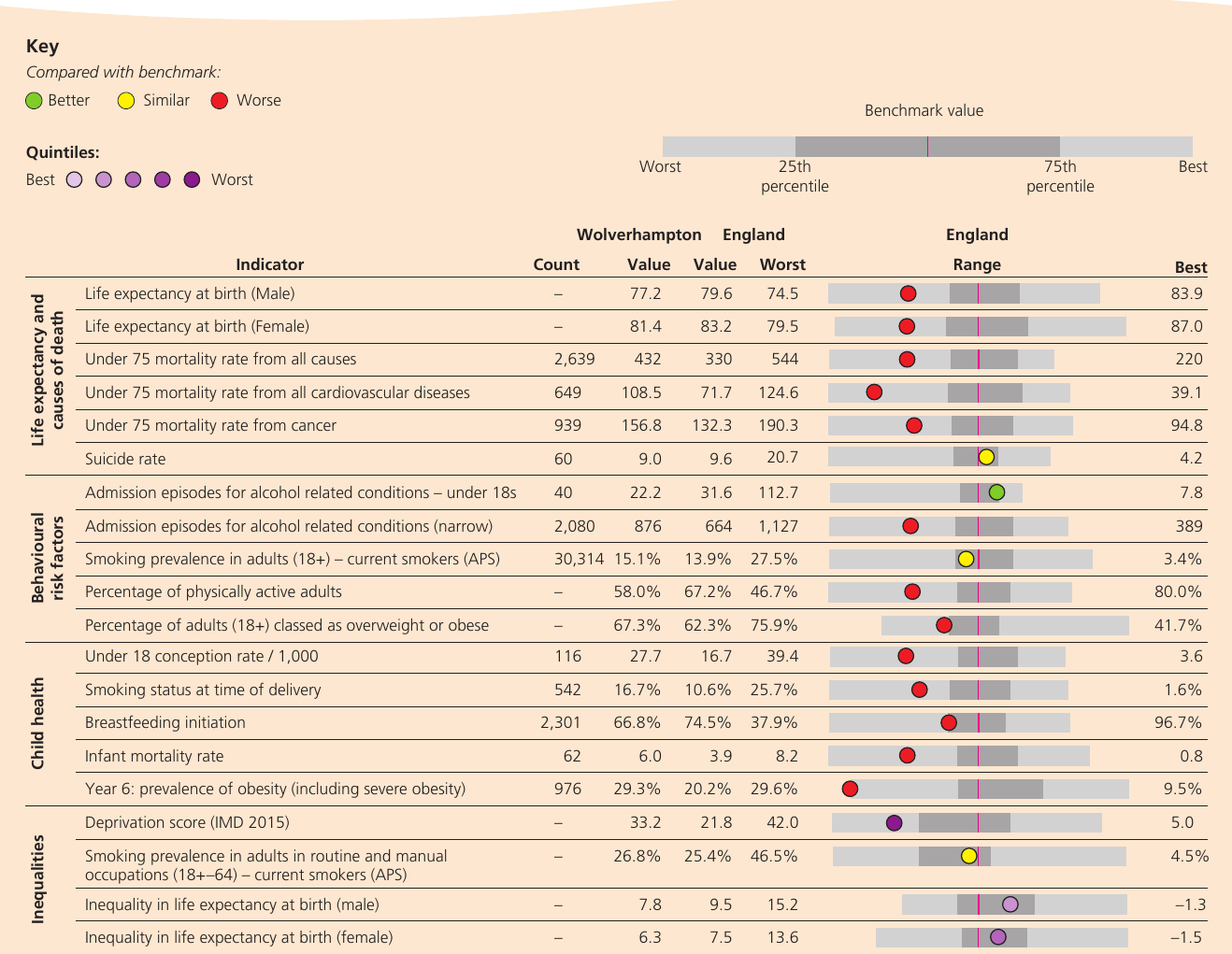
The health profile data (collected 2015-2019) reveals that Wolverhampton performs below average on several key indicators:
Life expectancy:
- Males: 77.2 years (below England average of 79.6)
- Females: 81.4 years (below England average of 83.2)
Mortality rates:
- Under 75 mortality from cardiovascular diseases significantly higher than England
- Under 75 mortality from all causes above national average
Behavioural risk factors:
- Smoking prevalence in adults (18+): 15.1%
- Physical activity levels lower than England average
- 67.3% of adults classified as overweight or obese (higher than England's 62.3%)
Child health:
- Under 18 conception rate: 27.7 per 1,000 (versus England's 16.7)
- Infant mortality rate: 6.0 (higher than England's 3.9)
- Breastfeeding initiation: 66.8% (lower than England's 74.5%)
- Year 6 obesity prevalence: 29.3% (significantly higher than England's 20.2%)
Inequalities:
- Deprivation score (IMD 2015): 33.2 (England average: 21.8)
- Males in routine and manual occupations have 26.8% smoking prevalence
Health indicators for Blakenhall ward

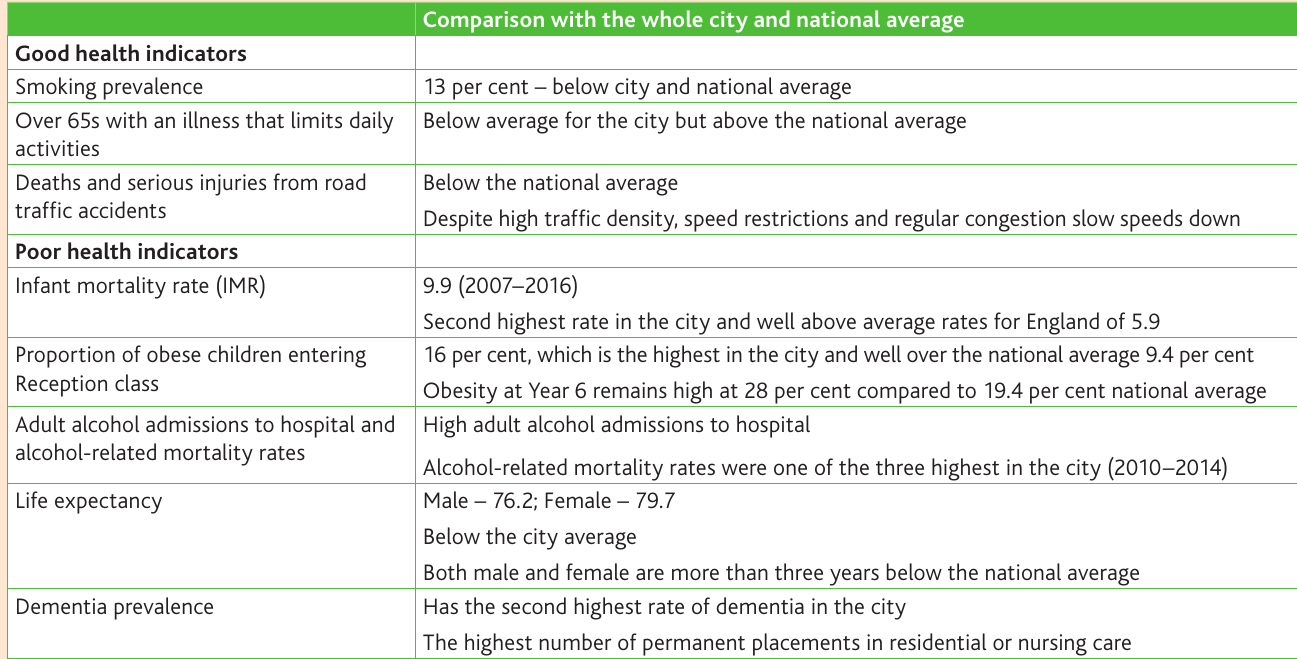
Blakenhall's health profile shows significant variation from both city and national averages:
Note
Good health indicators:
- Smoking prevalence: 13% (below city and national average)
- Deaths and serious injuries from road traffic accidents: below national average (despite high traffic density)
- Over 65s with illness limiting daily activities: below city average but above national average
Poor health indicators:
- Infant mortality rate: 9.9 (2007-2016) - second highest in the city, well above England's 5.9
- Childhood obesity: 16% - highest in the city, well over national average of 9.4%
- Obesity at Year 6: 29.3% compared to 19.4% national average
- Adult alcohol admissions to hospital: high
- Alcohol-related mortality: one of three highest rates in the city (2010-2014)
- Life expectancy: Male 76.2, Female 79.7 (below city average and more than three years below national average)
- Dementia prevalence: second highest rate in the city, with highest number of permanent placements in residential or nursing care
Population health attitudes and experiences
From Wolverhampton's Healthy Lifestyles survey in 2016, two predominant groups were identified in Blakenhall:
-
'Healthy weight but poor lifestyle' group:
- Associated with deprivation and younger population
- Despite healthy weight, lifestyle choices are poor
-
'Overweights' group:
- Generally eat unhealthily
- Neither smokers nor drinkers
Important
Obesity is a particular concern in Wolverhampton, especially among children. The city's Clinical Commissioning Group has made a special plea for campaigning and mitigation strategies.
Reasons for poor health outcomes in Blakenhall
Deprivation and income
Blakenhall has relatively high unemployment and below-average incomes. Deprivation alone contributes to many poor health indicators, including:
- Higher rates of infant mortality
- Increased alcohol-related mortality
- Poor diet contributing to childhood obesity and 'overweights'
- Reliance on convenience food or fast food due to economic constraints
Housing quality and fuel poverty
The housing situation in Blakenhall presents several health challenges:
- High population density in the inner-city area
- Poor housing quality in older properties increases risk of contracting and transmitting illnesses
- High levels of fuel poverty among over-65s contribute to illness, especially in winter
- Overcrowding in three-generational households may increase disease transmission
Environmental factors
Air pollution:
- High traffic density and congestion on three major thoroughfares
- Contributes to respiratory infections and disease
- Increases morbidity and lowers life expectancy
Limited exercise opportunities:
- Opportunities exist at local school and in open spaces at ward edge
- Limited opportunities for organised activities
- Many residents cannot afford formal groups or clubs
- Partly addressed by Bob Jones Community Hub providing indoor fitness and recreational activities
Population characteristics
Note
Minority ethnic health disparities:
The high proportion of minority ethnic residents may explain increased morbidity, especially among elderly:
- South Asian populations are four times more likely to develop cardiovascular diseases
- Also more likely to suffer from respiratory diseases
Language barriers:
- For 20% of population, English is a second language
- Although multilingual information is provided, language barriers may deter use of healthcare services
- May impact antenatal and postnatal care access
Positive developments and conclusion
Despite the overall balance towards poor health indicators, the local population generally responds positively to surveys about well-being. Recent developments have contributed to this:
Regeneration impact:
- New housing replacing 1960s tower blocks
- New stores and support funding for local community businesses
- Given the area a more positive feel
Community strength:
- The community is strong, well-connected and integrated
- Support groups such as dementia care operate in Blakenhall
- Ensures carers have support and promotes well-being
Challenges remain:
- Obesity, particularly childhood obesity
- High infant mortality
- Lower life expectancy
- Alcohol-related health issues
- Environmental health impacts from traffic pollution
The case study demonstrates how place characteristics - including physical environment, socio-economic factors, population composition, and deprivation - interact to influence health outcomes in complex ways.
Summary
Key Points to Remember:
- Wolverhampton is a regenerating post-industrial city in the Black Country with high deprivation (IMD 33.20 in 2015) that has improved through regeneration efforts
- Blakenhall ward has a multicultural population (74% black or minority ethnic, 50% Indian heritage) with specific health challenges including the city's highest childhood obesity rate at 16%
- Key poor health indicators include high infant mortality (9.9 vs England's 5.9), lower life expectancy (male 76.2, female 79.7), and second-highest dementia prevalence in the city
- Main causes of poor health are deprivation, poor housing quality, fuel poverty, high traffic pollution from congested roads, and health disparities among South Asian populations
- Despite challenges, community cohesion is strong and recent regeneration has created positive feelings, with support services like the Bob Jones Community Hub addressing some health needs