Climate Change and Agriculture (AQA A-Level Geography): Revision Notes
📚Revision Notes
Climate Change and Agriculture
Introduction
Climate change poses a significant threat to global agriculture and food security. According to the FAO, the impacts are already becoming evident worldwide. Rising temperatures, changing rainfall patterns, and more extreme weather events are creating major challenges for farmers, particularly in developing regions.
Important
Food security refers to the state where all people have reliable access to sufficient, safe, and nutritious food to meet their dietary needs.
Agriculture is especially vulnerable because it depends directly on climate and weather patterns. Changes in temperature and precipitation affect crop yields, growing seasons, and the viability of different farming practices.
Regional impacts of climate change on agriculture
Sub-Saharan Africa - The most vulnerable region
People living in sub-Saharan Africa face the greatest risks from climate change impacts on agriculture. This region is particularly vulnerable for several reasons:
- Over 60% of the population lives in rural areas and works on small farms
- Agriculture accounts for 23% of the sub-Saharan African economy
- Most farmers depend directly on climate and weather for their livelihoods
- The region has experienced increasingly frequent and intense climatic extremes over recent decades
With temperatures projected to rise higher than the global average, and the population expected to increase by over one billion by 2050, climate change creates a severe threat to food security across the region.
Note
More than one billion people will face the direct consequences of climate change, even with a 1.5°C global temperature rise.
Key impacts over the next few decades include:
- Longer and more frequent heatwaves
- Rapid drying of soils, especially in the western Sahel
- Less rain, with longer and more frequent droughts, particularly in West Africa and southern African countries
- Reduced crop yields, especially in West Africa (identified as a climate change hotspot)
Asia-Pacific region
The Asia-Pacific region also faces serious agricultural threats from climate change. Coastal areas of south and South East Asia are particularly at risk from combined threats of changing rainfall patterns leading to severe water shortages or floods, rising temperatures, and rising sea levels.
Specific impacts include:
- Changes to growing conditions in the south-west Pacific, causing altered growing seasons and reduced yields
- Threats to people's ability to live on low-lying Pacific islands
Climate Smart Agriculture (CSA)
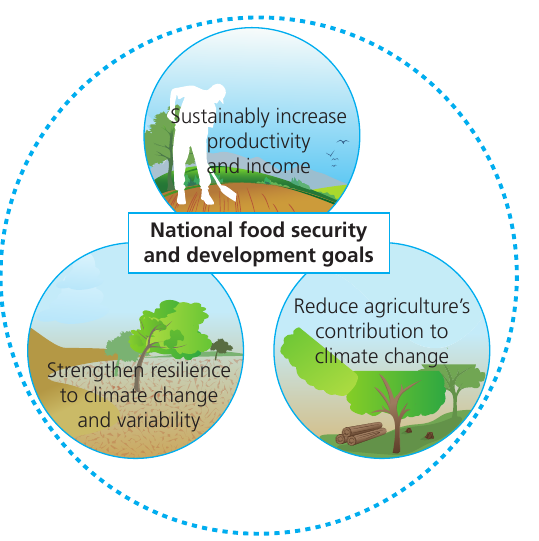
At its global conference on Agriculture, Food Security and Climate Change, the FAO introduced the concept of Climate Smart Agriculture (CSA) as a framework for addressing the interconnected challenges facing global food systems.
Important
Climate Smart Agriculture (CSA) is an integrated approach to address the interlinked challenges related to food security and climate change.
The three pillars of CSA
CSA works through three interconnected objectives:
-
Increased productivity (economic pillar) - Improving food and nutrition security whilst boosting the incomes of rural poor people who rely on agriculture for their living
-
Enhanced resilience (social pillar) - Reducing vulnerability to drought, pests and disease, and improving capacity to adapt to challenges such as shortened seasons or erratic weather patterns
-
Reduced emissions (environmental pillar) - Pursuing lower emissions for each unit of food produced and reducing or removing greenhouse gas (GHG) emissions from agriculture, including avoiding deforestation
Note
Memory Aid: Remember the three pillars as "PRC"
- Productivity (economic)
- Resilience (social)
- Climate/emissions reduction (environmental)
Implementation and concerns
Climate Smart Agriculture focuses on addressing the challenges presented by climate change by considering both the synergies and trade-offs that exist between productivity, adaptation and mitigation. The ideas behind CSA have been welcomed by many global organisations, including the World Bank, which has committed to supporting countries or specific projects to deliver CSA.
Current status:
- There are currently 453 members of the Global Alliance for Climate Smart Agriculture (GACSA)
- Many members are inter-governmental groups, NGOs, research institutions or private sector organisations
- However, only eight African countries are currently members, despite the region being most at risk
- There is concern in civil society groups about GACSA's promotion of CSA
Important
Greenwashing refers to creating an environmentally responsible impression whilst actually doing less than claimed. Some critics view GACSA's promotion of CSA as a plan to produce more with less, rather than genuine environmental action.
Case study: Adaptation to climate change in India
Context: The monsoon climate and agriculture
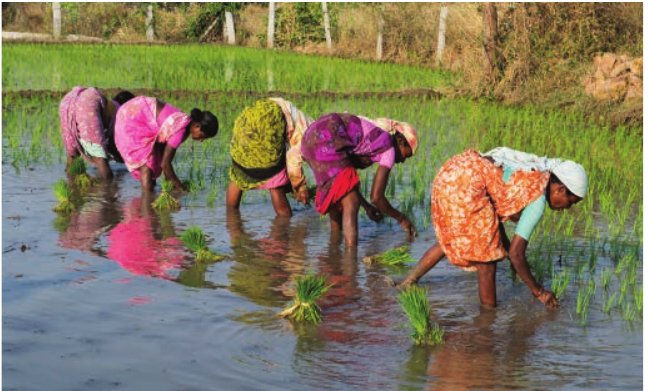
The Indian economy benefits greatly from good monsoon rains, which support large numbers of people in rural areas and the rapidly growing cities of the Indo-Gangetic Plain. In good years, agricultural surpluses have enabled India to become a leading exporter of both rice and wheat. However, weak monsoon rains result in crop failure, negatively affecting the economy through lower production, rising food prices, fewer exports, reduced food security and rising debts for farmers.
Note
Climate change is affecting the monsoon climate and increasing its unpredictability. More fluctuations in timing and amount of rainfall make it difficult for farmers to plan, resulting in crop failure.
Whilst the Indian government has increased the amount of land under irrigation, especially through more efficient micro-irrigation, it still stands at less than half the total land under cultivation.
Mewat district, Haryana, India
Changing climatic conditions and extreme weather events are particularly treacherous for small, resource-poor farmers who lack savings, alternative income or insurance. The Indian Agricultural Research Institute (IARI) carried out Climate Change Adaptation Projects to test technologies and strategies for sustainable livelihood security in rural communities vulnerable to climate risks.
Example
Location and Climate Analysis: Mewat District
The Mewat district is located in the Indian state of Haryana, approximately 100 km south of Delhi. It is a low rainfall, drought-prone area. Analysis of past weather data revealed concerning trends:
Temperature Changes:
- Mean minimum temperature increased at 0.18°C every 10 years during the monsoon season
- Temperature increased by 0.47°C every 10 years during the dry (rabi) season
- Between 2020 and 2050, temperatures are expected to accelerate, with minimum temperatures rising by 1.87°C during the monsoon season and by 2.73°C during the dry season
Extreme Weather Events:
- The district has experienced unseasonal hailstorms and extreme rainfall patterns
- In 2017, the winter crop was destroyed by hailstorms, then the summer crop was destroyed by intense rainfall leading to flooding (250 mm fell in just five hours)
- The annual average rainfall for the district is only 600 mm
These conditions have negatively impacted farmers and production.
Adaptation strategies implemented
Based on these findings, IARI developed a customised set of interventions to conserve resources, adapt to climate changes and improve livelihoods:
1. Improved seed varieties
- Superior seed varieties were tested, with successful ones made available through village seed banks
- Heat-stress tolerant varieties of wheat were introduced, increasing yields by 12 to 18%
2. Agro-forestry practices
- Tree-crop interactions were encouraged as they provide beneficial effects
- Cowpea and pearl millet performed better when planted alongside Prosopis trees
- Trees offered shade and created a windbreak, producing a micro-climate to conserve soil moisture
- Prosopis trees also produce high yields of pods, leaves and twigs, which act as mulch and add organic matter, as well as providing fuelwood from annual loppings
3. Water management improvements
- Farmland was levelled using lasers, improving water-use efficiency by 15 to 20%
- Underground pipelines were laid in farmers' fields and used for delivering high-tech drip irrigation, resulting in an additional 40% saving
- Overall, the irrigated area increased by 28%, even with the labour hours required for irrigating crops reduced by 28%
- Rainwater harvesting and storage in covered tanks was encouraged to maximise water efficiency
4. Crop diversification
- Greater crop diversification was introduced with high-yielding varieties of millet, aubergine, tomato and onion
- Accompanied by improved production technologies, including raised-bed planting, starting with seedlings in a nursery, and micro and sprinkler irrigation
- These changes increased household incomes by up to 86% - more than double compared to households maintaining conventional cropping
5. Technology and information access
- Farmers were given access to an information and communications technology platform called 'mKRISHI', operated by Tata Consulting Services
- Using mobile phones, farmers and farmers' groups were connected to weather forecasting and agricultural production advisory services
Note
Memory Aid: Remember Mewat adaptations as "SWAT"
- Seeds (improved varieties)
- Water management
- Agro-forestry practices
- Technology and information access
Plus crop diversification!
Results and benefits
The adaptation project in Mewat district demonstrated that even resource-poor farmers can successfully adapt to climate change through:
- Improved seed varieties suited to changing conditions
- Better water management and conservation
- Diversified cropping systems
- Access to technology and information
- Integration of trees with crops (agro-forestry)
These measures not only helped farmers cope with climate variability but also significantly improved their incomes and food security.
Summary
Key Points to Remember:
-
Climate change creates serious threats to agriculture, particularly through floods, droughts, and unpredictable weather patterns affecting food security globally
-
Sub-Saharan Africa is the most vulnerable region to agricultural impacts of climate change, with over 60% of people living in rural areas and depending on small farms for their livelihoods
-
Climate Smart Agriculture (CSA) has three pillars: increased productivity (economic), enhanced resilience (social), and reduced emissions (environmental) - but faces criticism for potential greenwashing
-
Successful adaptation requires multiple strategies including improved seeds, better water management, crop diversification, agro-forestry, and access to technology and information
-
Even small-scale farmers can adapt to climate change impacts when provided with appropriate support, resources and knowledge, as demonstrated in the Mewat district case study