Elements in the Physical Environment (AQA A-Level Geography): Revision Notes
📚Revision Notes
Elements in the Physical environment
Understanding the population-environment relationship
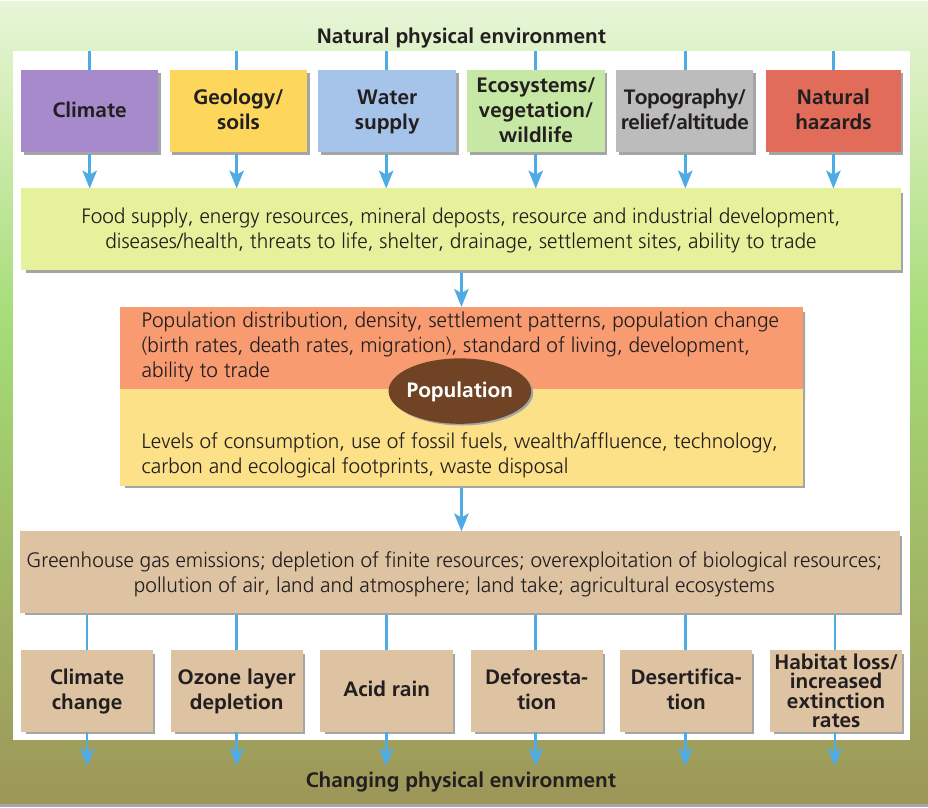
The physical environment and human population exist in a complex, two-way relationship. Natural elements like climate, water supply, and soil quality shape where people live and how they develop. At the same time, human activities transform the environment through resource consumption, pollution, and land use changes.
Note
This cyclical relationship means that the natural physical environment influences population distribution, population density, settlement patterns, and living standards. In turn, human populations impact the environment through consumption levels, fossil fuel use, and various forms of pollution, ultimately creating a changed physical environment.
Climate
Climate is arguably the most influential element of the physical environment. It shapes human settlement patterns and economic activities in fundamental ways.
How climate influences human activity:
- Food production: Rainfall, temperature, wind velocity, and solar insolation all determine food productivity levels. These factors influence which farming systems can be adopted and which crop species are suitable for cultivation
- Temperature requirements: Many crops require minimum temperatures of at least 5°C to grow successfully. In colder regions where temperatures fall below 5°C, pasture-fed livestock must be supplemented with fodder crops
- Population concentration: High population densities develop in areas with adequate rainfall and suitable temperatures for crop growth and livestock rearing. Sufficient sunlight for photosynthesis is also essential
Climate and disease patterns:
Climate characteristics directly drive the level and nature of diseases in different regions. Tropical diseases such as malaria, yellow fever, and Ebola significantly affect death rates and life expectancy in affected populations. High infant and child mortality rates in tropical and subtropical areas can influence fertility rates, as families seek to compensate for their loss.
Important
Climate change concerns:
Global warming represents the aspect of environmental change causing greatest concern for human populations at the start of the twenty-first century. Rising temperatures, changing precipitation patterns, and extreme weather events increasingly affect where and how people can live.
Soils
Soil quality plays a crucial role in determining agricultural potential and, consequently, population distribution patterns.
Soil fertility factors:
The most important feature of soil is its fertility, which depends on several interconnected factors:
- Structure: How soil particles are arranged affects drainage and root penetration
- Texture: The relative proportions of sand, silt, and clay particles
- Acidity (pH): Soil pH levels affect nutrient availability to plants
- Organic matter: Decomposed plant and animal material enriches soil
- Nutrients: Essential minerals required for plant growth
These characteristics determine agricultural output and influence which farming systems can be employed in different areas.
Managing soil fertility:
In areas with high population density, fertility can be maintained using artificial chemical fertilisers. However, this approach may have unsustainable outcomes, including:
- Water pollution through nutrient runoff
- Eutrophication of water bodies
- Increased greenhouse gas emissions
Note
Soil-related hazards:
Some fertile soils, such as rich volcanic or alluvial soils, are also prone to natural hazards like volcanic eruptions or floods. These hazards may negatively affect population numbers and distribution despite the agricultural advantages these soils offer.
Water supply
Access to water is fundamental to human survival and development. Water availability significantly influences where populations can establish and grow.
Essential uses of water:
- Human hydration: Basic survival requirement
- Irrigation: Maintaining food production, especially in drier climates
- Hygiene and sanitation: Public health and disease prevention
- Industrial processes: Manufacturing and production activities
Water and population distribution:
The importance of water supply in determining population distribution is clearly illustrated by specific examples:
Example
Egypt Case Study: Water and Population Distribution
Egypt demonstrates the critical role of water in population distribution. Of Egypt's population of 102 million people, approximately 95% live on just 4% of the country's land area. This concentration occurs within 12 miles of the River Nile, showing how population clusters around reliable water sources in otherwise arid environments.
Similar patterns relating to water supply and resource distribution are visible along:
- The Ganges Valley in India
- Eastern China
- South East Asia
- Parts of northern Europe
Areas of population sparsity:
Limited water availability correlates with low population densities. Sparsely populated areas include:
- Deserts
- Continental interiors
- Regions with extreme cold temperatures (e.g., Siberia and the Canadian Shield)
Geology and resource distributions
The distribution of geological resources, particularly fossil fuels and valuable minerals, has historically driven industrialisation and consequent population concentration.
Resources and population growth:
Concentrations of resources such as coal, oil, natural gas, and minerals have given rise to industrialisation and subsequently densely populated conurbations. Key examples include:
- The Ruhr Valley in Europe
- Parts of the USA
- Increasingly, China and India in recent decades
Note
Legacy populations:
Even when these resources become depleted through extraction, the industrial inertia often leaves behind a legacy of large, dense populations. New tertiary industries frequently emerge to serve these established populations, maintaining high density levels despite the loss of the original resource base.
Population parameters
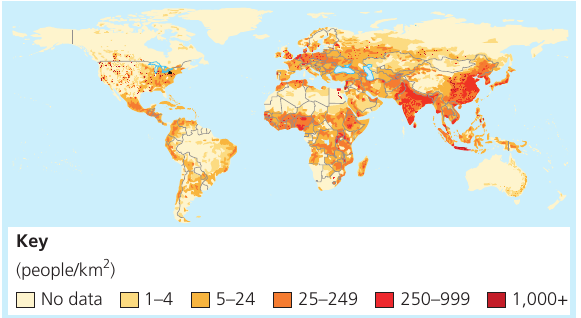
Elements of the physical environment clearly determine distribution patterns and population density across different scales.
Important
Population density is the average number of people living in a specified area, usually expressed as the number of people per km².
Important
Population distribution is the pattern of where people live. This can be considered at all scales from local to global, in an area or country.
Uneven distribution patterns:
On a national scale, populations are typically very unevenly distributed. Physical environment factors, combined with levels of urbanisation, create distinct patterns.
Example
Egypt Distribution Example:
Egypt illustrates extreme distribution inequality. The Nile Valley has a population density exceeding 2,000 people per km², while the national average for Egypt as a whole is only 103 people per km². Desert areas have fewer than 10 people per km². This dramatic variation results from the combination of physical environment factors and urbanisation patterns.
Global patterns:
Most countries worldwide exhibit uneven distributions. Urban areas tend to be more densely populated than surrounding rural areas. The global population density map reveals how densely populated areas relate to:
- Water supply availability
- Resource distributions (Ganges Valley, eastern China, South East Asia, northern Europe)
- Climate conditions suitable for agriculture
- Areas with extreme conditions show population sparsity (deserts, cold regions, continental interiors)
Population numbers and change:
Population numbers are recorded through census data, typically collected every five or ten years in most countries. Because numbers constantly change, population size between census periods is estimated using information on rates of population change, including birth rates, death rates, and net migration.
Population change represents a dynamic phenomenon that can be measured from both temporal and spatial perspectives. While growth (or decline) rates provide important information, many other aspects of population change exist, including distribution shifts and demographic composition changes.
Remember!
Summary
Key Points to Remember:
- Climate is the most important physical environment element, determining food productivity, farming systems, disease patterns, and ultimately where people can live successfully
- Water supply critically shapes population distribution - as seen in Egypt where 95% of 102 million people live within 12 miles of the River Nile
- Soil fertility depends on five key factors: structure, texture, acidity (pH), organic matter, and nutrients - all of which determine agricultural potential
- Resource distributions create lasting population patterns - even after fossil fuels and minerals are depleted, dense populations remain due to industrial legacy
- Physical environment and population exist in a two-way relationship - the environment shapes where people live, while human activities transform the environment through consumption and pollution