Environment and Population (AQA A-Level Geography): Revision Notes
📚Revision Notes
Environment and Population
Understanding the relationship between environment and population
The environment plays a crucial role in shaping population patterns and human activity. The relationship between environmental conditions and population is particularly evident in food production and security. Where you live on Earth significantly influences what food can be grown, how much can be produced, and ultimately, whether populations can be sustained.
Note
Understanding these environmental-population relationships is essential for addressing global challenges such as food security, sustainable development, and planning for demographic changes.
Population decline patterns
Whilst many parts of the world continue to experience population growth, this is not a universal trend. Several European and Asian nations are currently facing declining populations, particularly Italy, Poland, Russia, Japan, and South Korea. These countries have entered a phase of population decline that appears likely to continue into the future.
This pattern of population change varies significantly across the globe, with different regions experiencing vastly different rates of growth or decline.
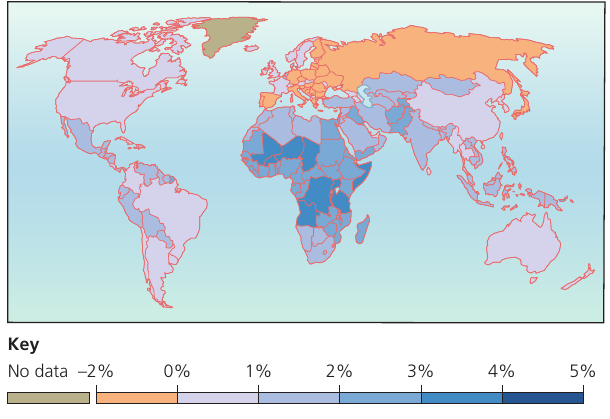
The map above illustrates the global pattern of population rate change in 2020. The darkest blue regions (particularly in Africa) show the highest rates of population growth (3-5%), whilst orange-coloured areas (such as Russia and parts of Eastern Europe) indicate population decline (-2%). Other regions show more moderate changes, with purple indicating near-zero growth and lighter blue showing modest growth (1-2%).
Note
Population decline in developed nations is often linked to factors such as lower birth rates, ageing populations, and changing socio-economic conditions. This contrasts sharply with rapid population growth in regions like sub-Saharan Africa, creating diverse demographic challenges globally.
Environmental factors affecting food production
Food production shows considerable geographical variation in both quantity and type. This variation results from the interaction between environmental conditions and human factors. Understanding how the environment influences agriculture is essential for understanding global food security patterns.
Important
Remember the four key environmental factors affecting food production: Climate, Water, Soil, and Topography (C-W-S-T). These factors interact with each other and with human management practices to determine agricultural productivity.
Climate and weather patterns
Climate – A region's long-term weather patterns, measured in terms of average precipitation, maximum and minimum seasonal temperatures, sunshine hours, wind speeds, humidity, and the frequency of extreme weather events.
Climate is one of the most significant environmental determinants of agricultural productivity. Different crops require specific temperature ranges, rainfall patterns, and growing season lengths. For example:
- Temperature determines which crops can be grown and when
- The length of the growing season affects the number of harvests possible each year
- Precipitation patterns influence whether irrigation is necessary
- Extreme weather events can devastate crops and reduce yields significantly
Note
Climate change is altering these patterns globally, affecting traditional agricultural zones and forcing farmers to adapt their practices. Regions that were once ideal for certain crops may become unsuitable, whilst new areas may become viable for agriculture.
Water availability
Access to water is fundamental for agriculture. Regions with adequate rainfall or efficient irrigation systems can support more intensive farming. Water scarcity limits agricultural options and can lead to reduced productivity. The timing and reliability of water availability throughout the growing season is just as important as the total amount received.
Soil characteristics
Soil – The upper layer of earth in which plants grow, a black or dark brown material typically consisting of a mixture of organic remains, clay and rock particles.
Soil quality directly affects what can be grown and how productive that growth will be. Different soil types have varying:
- Nutrient content and fertility
- Water retention capabilities
- Drainage properties
- pH levels
- Depth and structure
Zonal soil – A categorised soil group which covers a wide geographical region; its profile and properties are determined primarily by the actions of the regional climate and natural vegetation on the parent rock from which it is formed.
Zonal soils develop over large areas with similar climatic conditions. They reflect the long-term interaction between climate, vegetation, and underlying geology, creating distinct soil regions across the globe.
Salinisation – The build-up of salts in soil, eventually to toxic levels for plants.
Important
Salinisation is a major environmental problem that can render agricultural land unproductive. It commonly occurs in irrigated areas where poor drainage allows salts to accumulate in the upper soil layers. Once salinisation occurs, it is extremely difficult and expensive to reverse, making prevention through proper water management essential.
Topography
Topography – The relief and drainage of an area.
The physical landscape shape affects agriculture in multiple ways:
- Slope affects soil erosion rates and farming mechanisation
- Altitude influences temperature and growing seasons
- Drainage patterns determine water availability and flood risk
- Aspect (direction a slope faces) affects sunlight exposure and temperature
Agricultural production varies across all scales, from local differences within a single farm to global patterns across continents. This variation occurs due to the complex interaction of all these environmental factors.
Food security and regional variations
Food security – Food security exists when all people at all times have access to sufficient, safe, nutritious food to maintain a healthy and active life.
Food security is a critical global concern that varies dramatically by region. Access to adequate nutrition depends not only on local agricultural productivity but also on economic factors, distribution systems, and political stability.
Note
The three key components of food security are: Sufficient (adequate quantity), Safe (free from contamination), and Nutritious (providing necessary nutrients). All three must be present for true food security to exist.
Agriculture – The science or practice of farming, including cultivation of the soil for the growing of crops and the rearing of animals to provide food and other products such as wool, cotton or rubber.
Agricultural productivity – The ratio of agricultural outputs to agricultural inputs.
Agricultural productivity measures efficiency in food production. Higher productivity means more food can be produced from the same inputs (land, labour, water, fertiliser), which is essential for feeding growing populations.
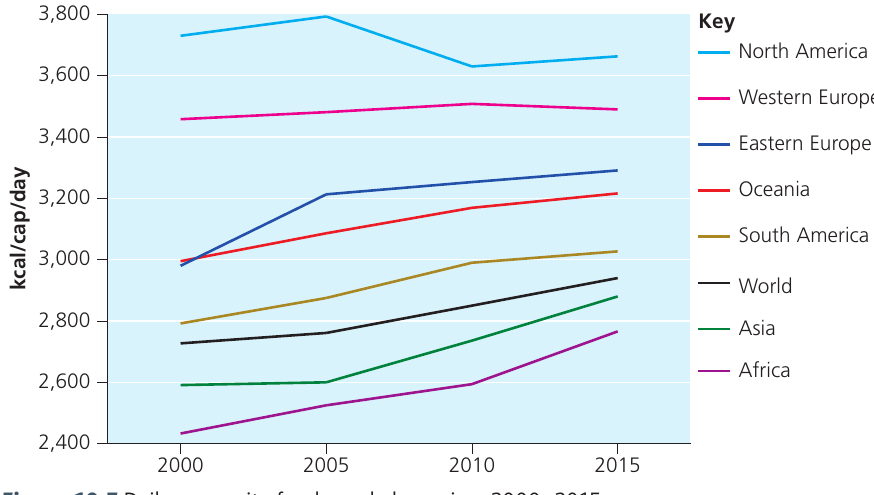
The graph above shows daily per capita food supply across different world regions from 2000 to 2015. Several important patterns emerge:
Regional disparities:
- North America has the highest caloric availability, consistently maintaining approximately 3,700-3,800 kcal per capita per day
- Western Europe ranks second with around 3,400-3,500 kcal per capita per day
- Africa has the lowest availability, ranging from 2,400-2,800 kcal per capita per day
- Asia, whilst below the global average initially, shows steady improvement throughout the period
Positive trends:
- All regions show gradual upward trends over the 15-year period
- This indicates improving global food security overall
- The gap between regions, whilst still significant, shows some signs of narrowing
- The world average increased from approximately 2,700 to 2,900 kcal per capita per day
Note
These patterns reflect both environmental conditions (affecting what can be grown) and socio-economic factors (affecting access and distribution). Even regions with high agricultural productivity may have food security issues if distribution systems are inadequate or economic inequality prevents access.
Understanding greenwashing
Greenwashing – A term used to describe exaggerated environmental claims, usually made to promote the green credentials of big corporations; a form of environmental propaganda.
As environmental concerns become increasingly important, some organisations make misleading claims about their environmental practices. Greenwashing involves presenting a falsely positive environmental image, often whilst continuing harmful practices. This is relevant to food production as companies may overstate the sustainability of their agricultural methods or products.
Important
Be critical when evaluating environmental claims made by food producers and corporations. Look for:
- Specific, verifiable data rather than vague statements
- Third-party certification from recognised environmental organisations
- Transparency about the entire supply chain
- Evidence of genuine environmental improvements rather than just marketing rhetoric
Remember!
Summary
Key Takeaways:
-
Population patterns vary globally: Whilst some regions experience rapid growth (particularly Africa), others face population decline (Italy, Poland, Russia, Japan, South Korea).
-
Environment fundamentally shapes food production: Climate, water availability, soil characteristics, and topography determine what can be grown and how productively, creating significant geographical variation.
-
Food security is unequally distributed: North America and Western Europe have the highest caloric availability (3,400-3,800 kcal/cap/day), whilst Africa has the lowest (2,400-2,800 kcal/cap/day).
-
Global food availability is improving: All world regions showed increasing food supply per capita between 2000-2015, indicating progress towards better food security.
-
Soil degradation threatens productivity: Problems like salinisation can render agricultural land unproductive, highlighting the importance of sustainable farming practices for maintaining food production.