Future Population-Environment Relationships (AQA A-Level Geography): Revision Notes
📚Revision Notes
Future Population-Environment Relationships
Projected global population changes
The global population is expected to continue growing significantly over the coming decades, but this growth will not be evenly distributed across the world. Understanding these patterns helps us anticipate future environmental pressures and plan appropriate responses.
Note
Analyzing regional population patterns is essential for anticipating where environmental pressures will be most intense and where resources will be most needed in the coming decades.
Africa's rapid population growth
Among the world's major regions, Africa is experiencing the most rapid population increase. The continent's population is growing at an annual rate of 2.5%, which is the highest rate globally. This means Africa's population is projected to double by 2050, representing a 99% increase from current levels.
Important
The most significant growth is occurring in sub-Saharan Africa, which faces particular challenges in meeting the needs of this expanding population whilst managing environmental resources sustainably.
Regional variations in population growth
Between 2019 and 2050, different regions will experience varying rates of population change:
- Australia and New Zealand: Expected growth of 28%
- Central and Southern Asia: Growth rate of 25%
- Latin America and the Caribbean: Growth rate of 18%
- Eastern and South Asia: Growth rate of 18%
- Europe and Northern America: Slowest growth at just 2%
These regional differences reflect varying levels of economic development, fertility rates, and demographic transitions.
Least developed countries
Important
Least Developed Countries (LDCs)
LDCs are a group of 47 countries designated as the least developed in the world. Of these, 33 are located in Africa and 13 in Asia. These countries continue to experience particularly high population growth rates.
Population growth remains especially high in LDCs. This presents significant development challenges as these nations often have limited resources and infrastructure to support rapidly expanding populations.
Asia's contribution to population growth
Whilst Africa has the highest growth rate, Asia remains the second largest contributor to future population growth in absolute numbers. However, the size of Asia's population increase is relatively small when compared to its already large existing population base.
Key countries driving global population growth
Just nine countries will account for more than half of the world's total population growth between now and 2050:
- India
- Nigeria
- Pakistan
- Democratic Republic of Congo
- Ethiopia
- Tanzania
- USA
- Indonesia
- Egypt
Note
This concentration of growth in relatively few countries means that policies and development strategies in these nations will have significant global implications for environmental sustainability and resource management.
Changes in population rankings and structure
The disparate population growth rates among the world's largest countries will fundamentally re-order global population rankings. This shift reflects the changing balance of demographic power worldwide.
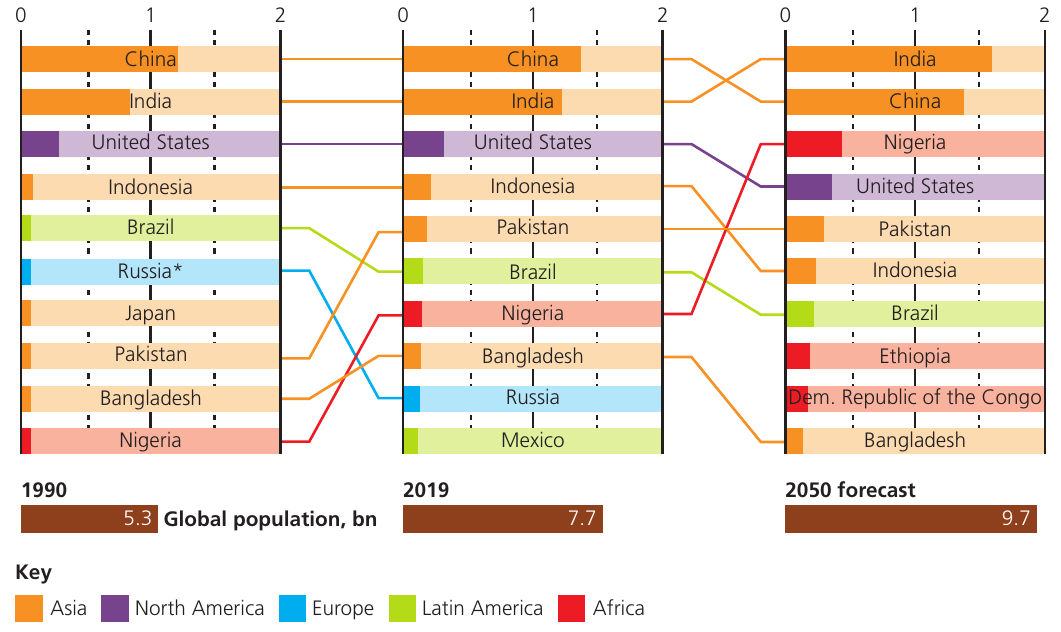
The figure above illustrates how dramatically the rankings of the world's most populous countries will change between 1990 and 2050. Notable changes include:
- China and India swap positions: China held the top position in 1990 and 2019, but India is forecast to become the world's most populous country by 2050
- African nations rise significantly: Nigeria climbs from 10th place (1990) to 3rd place (2050 forecast), whilst Ethiopia and the Democratic Republic of Congo enter the top 10
- Some countries fall in rankings: Japan drops out of the top 10 entirely, whilst Russia and Bangladesh also decline in relative position
- Global total increases: The world's population grows from 5.3 billion (1990) to 7.7 billion (2019) and is forecast to reach 9.7 billion by 2050
Changes in age structure
Beyond changes in total population size, the age structure of populations is also shifting, with important economic and social implications:
Regions with demographic opportunities:
In much of sub-Saharan Africa, as well as parts of Asia and Latin America, recent reductions in fertility rates mean that the working-age population is growing faster than other age groups. This creates what demographers call a demographic dividend.
Important
Demographic dividend
The demographic dividend refers to the economic growth potential that results from shifts in a population's age structure. When the share of the working-age population is larger than the non-working-age share, there is an opportunity to achieve accelerated economic growth through increased productivity and labour force participation.
Example
Demographic Dividend in Action
This demographic dividend provides an opportunity for these countries to achieve rapid economic development, provided they can create sufficient employment opportunities and invest in education and infrastructure. Countries that successfully harness this dividend can experience periods of rapid economic expansion similar to what occurred in East Asian nations during their development phase.
Regions facing demographic challenges:
Around 30 countries, including Japan and many across Europe, have a falling proportion of working-age populations and increased ageing dependency. This demographic shift creates several challenges:
- Increased pressure on social welfare systems
- Growing demands on pension schemes
- Rising healthcare costs for elderly populations
- Potential constraints on future economic performance due to labour shortages
These countries must adapt their economic and social policies to cope with ageing populations whilst maintaining economic productivity.
Critical appraisal of future population-environment relationships
The population versus consumption debate
Experts continue to discuss which poses the greater threat to environmental sustainability: growing population numbers or increased levels of consumption per person. This debate is central to understanding future environmental challenges.
Note
Both factors present serious challenges to sustainability, and they should not be viewed as opposing issues but rather as interconnected problems. A growing and more affluent global population creates particular challenges for managing environmental resources.
Both population growth and increasing consumption create challenges for:
- Ecological footprints: The amount of biologically productive land and water needed to supply the resources people use and absorb their waste
- Carbon budgets: The total amount of carbon dioxide that can be emitted whilst limiting global warming to agreed targets
Main sustainability challenges
Important
The Fundamental Challenge
The fundamental challenge facing humanity is twofold:
- Resource provision: To continue supplying the key resources needed for human survival and development, including food, water, energy and minerals
- Sustainable methods: To achieve this resource provision using approaches that do not compromise the ability of future generations to meet their own needs
Meeting these twin challenges requires balancing immediate human needs against long-term environmental protection.
The following sections examine specific challenges and opportunities for each major resource category.
Resource challenges and opportunities
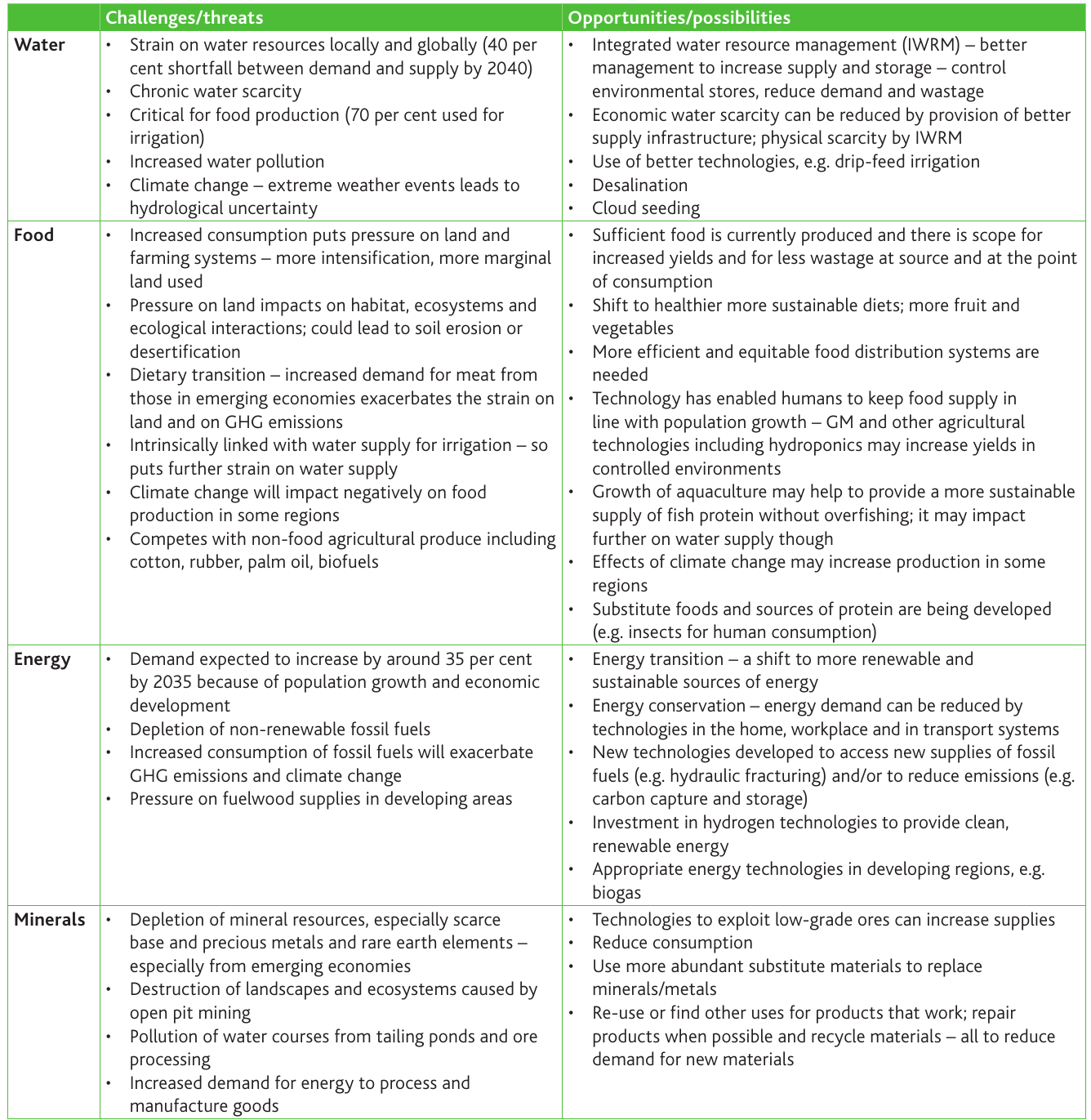
The relationship between future population growth and environmental resources presents both significant challenges and potential solutions. Understanding these helps identify pathways towards sustainability.
Water resources
Key challenges facing water resources:
Water scarcity is already affecting many regions and is set to worsen. There will be a strain on water resources both locally and globally, with projections suggesting a 40% shortfall between demand and supply by 2040. This gap represents a critical sustainability challenge.
Several factors contribute to water stress:
- Chronic water scarcity in many regions due to limited freshwater availability
- Agricultural demands: Critical food production requires vast quantities of water, with 70% currently used for irrigation purposes
- Water pollution: Increased contamination reduces the available supply of clean, usable water
- Climate change impacts: Extreme weather events are leading to hydrological uncertainty, with some regions experiencing droughts whilst others face flooding
Opportunities for improving water sustainability:
Despite these challenges, various approaches can help manage water resources more effectively.
Example
Integrated Water Resource Management (IWRM)
IWRM represents a comprehensive approach to water management. This system focuses on better management practices to increase supply and storage whilst controlling environmental impacts. IWRM helps reduce both water demand and wastage through more efficient allocation and use.
Economic water scarcity (where water exists but infrastructure is lacking) can be reduced through provision of better supply infrastructure. This includes improved pipes, storage facilities, and distribution systems. Physical scarcity can be addressed through IWRM approaches that maximise the value extracted from available water.
Advanced technologies offer additional solutions:
- Improved irrigation methods: Technologies such as drip-feed irrigation deliver water directly to plant roots, minimising waste through evaporation or runoff
- Desalination: Converting seawater into freshwater can supplement supplies in coastal areas, though it remains energy-intensive
- Cloud seeding: This technique attempts to enhance precipitation in water-scarce regions, though its effectiveness varies
Food security
Key challenges for food production:
The pressure on global food systems is intensifying due to several interconnected factors.
Increased consumption is putting pressure on land and farming systems. As populations grow and become more affluent, demand for food increases. This drives more intensive farming practices, brings marginal land into use, and increases overall pressure on agricultural systems.
The environmental impacts are significant. Pressure on land affects habitats and ecosystems, potentially leading to soil erosion and desertification through unsustainable farming practices. Ecological interactions are disrupted as natural landscapes are converted to agriculture.
Note
Dietary transitions create additional challenges. As economies develop, there is increased demand for meat from populations in emerging economies. This is particularly problematic because meat production requires far more land and resources than plant-based foods. It also exacerbates strain on land use and increases greenhouse gas emissions.
Water competition intensifies as intensive agriculture demands more water supply for irrigation, putting further strain on already stressed water resources. Meanwhile, climate change will impact food production negatively in some regions, creating additional uncertainty about future food security.
Food production also competes with non-food agricultural produce, including cotton, rubber, palm oil and biofuels. This competition for land can reduce the area available for food crops.
Opportunities for sustainable food systems:
Despite these challenges, there is reason for optimism:
Sufficient food is currently produced globally, and there is scope for increased yields and reduced wastage both at source (in fields and farms) and at the point of consumption (in shops and homes). More efficient production and distribution could feed more people without expanding agricultural land.
Dietary shifts towards healthier, more sustainable diets with increased fruit and vegetables could reduce pressure on land and resources whilst improving human health. More efficient and equitable food distribution systems are needed to ensure food reaches those who need it.
Example
Technology Solutions for Food Security
Technology has enabled humans to keep food supply in line with population growth. Several innovations offer promise:
- GM (genetically modified) technologies: These can increase yields and create crops resistant to pests, diseases or environmental stresses
- Hydroponics and aquaponics: Growing plants in water-based nutrient solutions rather than soil uses less land and water
- Controlled environments: Greenhouses and vertical farms allow year-round production with precise resource management
Growth of aquaculture (fish farming) may help provide a more sustainable supply of fish protein without overfishing wild stocks, though it may further impact water supplies and quality.
Effects of climate change may increase production in some regions where warmer temperatures extend growing seasons or bring currently marginal land into productivity.
Substitute foods and new protein sources are being developed, including insects for human consumption, which require far less land and resources than traditional livestock.
Energy resources
Key challenges for energy supply:
Global energy demand is expected to increase by around 35% by 2035 because of population growth and economic development. Meeting this growing demand whilst addressing climate change represents one of the greatest challenges facing humanity.
Several factors create energy challenges:
- Depletion of non-renewable fossil fuels means these traditional energy sources are being exhausted, raising questions about long-term supply security
- Increased consumption of fossil fuels will exacerbate greenhouse gas emissions and accelerate climate change, creating a feedback loop of environmental problems
- Pressure on fuelwood supplies in developing areas affects local populations who rely on biomass for cooking and heating, often leading to deforestation and land degradation
Opportunities for sustainable energy:
Note
The Energy Transition
The transition to sustainable energy systems is already underway, offering multiple pathways to meet future energy needs. The energy transition towards more renewable and sustainable sources represents the most fundamental solution to our energy challenges.
Renewable energy sources include:
- Solar power (photovoltaic panels and concentrated solar)
- Wind energy (onshore and offshore turbines)
- Hydroelectric power
- Geothermal energy
- Tidal and wave power
Energy conservation offers significant potential. Energy demand can be reduced through improved technologies in homes (insulation, efficient heating systems, LED lighting) and in transport systems (electric vehicles, public transport, reduced vehicle use).
Example
New Technologies for Energy Sustainability
New technologies are being developed to access new supplies and reduce environmental impacts:
- Hydraulic fracturing (fracking): Extracting gas and oil from shale rock formations, though this raises environmental concerns
- Carbon capture and storage: Technologies to capture carbon dioxide emissions from fossil fuel use and store them underground, reducing atmospheric release
Investment in hydrogen technologies could provide clean, renewable energy for various applications, particularly in transport and industrial processes.
Appropriate energy technologies in developing regions, such as small-scale biogas digesters or solar panels, can provide energy access whilst avoiding dependence on fossil fuel infrastructure.
Mineral resources
Key challenges for mineral supplies:
The availability and extraction of mineral resources face several sustainability challenges:
Depletion of mineral resources is occurring, especially for scarce base and precious metals and rare earth elements. These materials are particularly important for emerging economies requiring resources for industrial development and for manufacturing modern technologies like smartphones, computers and renewable energy systems.
Environmental destruction from mining activities includes:
- Destruction of landscapes and ecosystems caused by open pit mining operations
- Pollution of water courses from tailings ponds and ore processing facilities
- Habitat loss and biodiversity impacts
Increased energy demand is required to process and manufacture goods from minerals, contributing to greenhouse gas emissions and climate change.
Opportunities for sustainable mineral use:
Moving towards more sustainable use of mineral resources requires fundamental changes in how we extract, use and dispose of materials.
Note
The Circular Economy Approach
Circular economy approaches fundamentally rethink how we use materials by keeping resources in use for as long as possible and recovering value from products at their end of life. This represents a shift from the traditional linear "take-make-dispose" model to a regenerative system.
Strategies for sustainable mineral use include:
- Improved extraction technologies can exploit low-grade ores that were previously uneconomical to mine, extending the life of existing deposits and reducing the need to open new mines
- Reduced consumption represents the most direct approach. Simply using fewer materials reduces demand for new mining. This requires changes in consumer behaviour and product design
- Substitute materials can replace scarce minerals and metals in some applications. Research into alternative materials can reduce pressure on critical resources
Example
Circular Economy in Practice
Circular economy principles can be applied through:
- Re-use or repair: Finding other uses for products that still work, or repairing them when possible instead of discarding
- Recycling materials: Recovering valuable materials from products at end-of-life to reduce demand for newly mined resources
- Product design: Creating products that are easier to repair, upgrade and recycle from the outset
These approaches reduce overall demand for new materials by keeping existing materials in use for longer periods, significantly reducing environmental impact.
Remember!
Summary
Key Takeaways
-
Africa has the highest regional population growth rate (2.5% annually) and will double its population by 2050, whilst Europe and Northern America will see minimal growth (2%).
-
Just nine countries (India, Nigeria, Pakistan, DR Congo, Ethiopia, Tanzania, USA, Indonesia and Egypt) will account for more than half of global population growth by 2050, with dramatic shifts in country rankings.
-
The population-environment debate centres on both population growth AND increased consumption as threats – they are interconnected challenges affecting ecological footprints and carbon budgets.
-
Each major resource category (water, food, energy, minerals) faces serious sustainability challenges, but technological innovations, better management practices, and circular economy approaches offer pathways to meet future needs sustainably.
-
Demographic dividends offer economic opportunities for regions with growing working-age populations, whilst ageing populations in developed countries present challenges for social welfare and pension systems.