International Migration (AQA A-Level Geography): Revision Notes
📚Revision Notes
International migration
What is international migration?
International migration is a major element of population change worldwide. It describes the movement of people across national borders to establish a new permanent or semi-permanent home. This geographical definition focuses on crossing specified boundaries between countries.
Migration operates at various scales and results from multiple factors. Regardless of the scale or causes, migration impacts population change in both the origin country (where migrants leave from) and the destination country (where migrants arrive).
International migration has become a high-priority issue for governments in both developing and developed nations. It shapes global systems and influences economic, social, and political structures across the world.
The scale of international migration
Note
According to UN estimates from 2019, 272 million people were international migrants, representing 3.5% of the world's population. This substantial figure highlights the global significance of migration as a demographic phenomenon.
Most migrants cross borders seeking better economic and social opportunities. Others are forced to flee because of wars, conflict, persecution, or natural disasters.
The majority of migration follows a directional pattern from less developed countries towards high-income nations. However, migration can also be multi-directional, particularly when we consider return migration. Immigration and emigration between two countries often operate as interlinked processes rather than separate movements. For example, population flows between Poland and the UK, or between China and Canada, work in both directions.
Global patterns of international migration
Note
Key Findings from UN International Migration Report 2019:
- Two-thirds of all international migrants live in just 20 countries
- One-third of all international migrants originated from only 10 countries
- 74% of all international migrants are of working age (20-64 years old)
- Forced migration across borders has risen significantly in the last 10 years
- Women and girls make up around 48% of all international migrants
- Few governments actively seek to lower immigration numbers through legal channels. Instead, most prioritise promoting orderly, safe, regular, and responsible migration

The table above shows the top five countries of origin and destination for international migrants in 2019. India has the largest diaspora with 17.5 million people living outside their country of origin. The USA is the top destination country, hosting 51 million immigrants. These patterns reflect both historical colonial links and modern economic opportunities.
Types of international migrants
During large-scale migration events, such as the European migrant crisis that began in 2015, confusion often arises in media and public debate about the differences between asylum seekers, refugees, and economic migrants. Understanding the legal distinctions between these categories is essential.
Important
Legal Framework: The 1951 UN Refugee Convention
The 1951 UN Refugee Convention (and the subsequent 1967 Protocol on the Status of Refugees) provides the key legal framework for protecting refugees. This Convention offers the most comprehensive statement defining who qualifies as a refugee, outlining the rights and obligations of refugees, and establishing the legal obligations of states. The Convention has 145 signatories and is overseen by the UNHCR (the UN's Refugee Agency).
Key definitions
Asylum seeker – A person who has fled their country of origin and applies for asylum under the 1951 Convention. They cannot return to their country of origin because of a well-founded fear of death or persecution. An asylum seeker is someone seeking international protection but whose claim for refugee status has not yet been determined.
Economic migrant – A person who has voluntarily left their country of origin to seek employment in another country, by lawful or unlawful means.
Refugee – In its broader context, this term describes a person fleeing from civil war or natural disaster, though not necessarily fearing persecution as defined by the 1951 Refugee Convention. Legally, however, a refugee is an asylum seeker whose claim for asylum has been successful under the 1951 Convention. They are granted refugee status in a new country to live there permanently.
Overlaps between categories
These categories frequently overlap, leading to confusion. For example, the terms 'asylum seekers' and 'refugees' are often conflated, which wrongly suggests that all asylum seekers automatically receive refugee status. The reality is different:
- People fleeing conflict or disaster are initially labelled generally as 'refugees'
- When they reach a destination country, they seek asylum
- Only when their asylum application is granted do they receive legal 'refugee status'
Note
Similarly, asylum seekers may include people who are primarily economic migrants hoping to secure entry by claiming asylum. This particularly applies to migrants from areas experiencing ongoing conflict or civil disorder, where distinguishing between forced and voluntary migration becomes complex.
Causes of migration - push and pull factors
Global migration has declined slightly since reaching an average of 6.4 million migrants per year between 2005 and 2010. Between 2015 and 2020, numbers were estimated at around 4.9 million per year, though recent signs suggest growth is resuming.
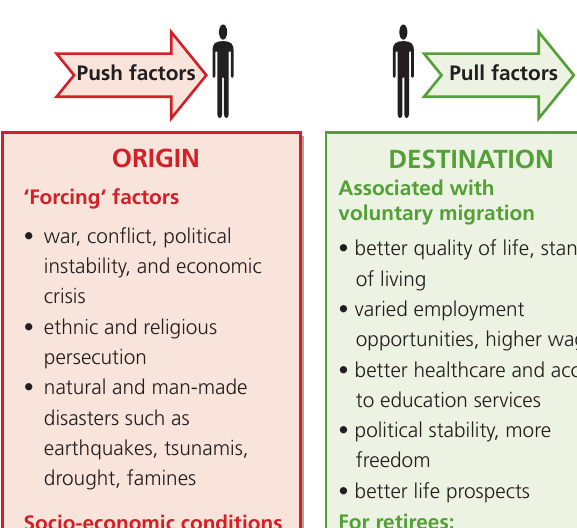
People migrate for various reasons. These can be categorised as push factors (conditions that force or encourage people to leave) or pull factors (conditions that attract people to a destination).
Push factors
Push factors originate at the place where migration begins. They are based on negative conditions that initiate a migrant's desire to leave. Push factors include:
'Forcing' factors:
- War, conflict, and political instability
- Economic crisis
- Ethnic and religious persecution
- Natural and human-made disasters (earthquakes, tsunamis, droughts, famines)
Socio-economic conditions:
- Poverty
- Unemployment
- Low wages or poor working conditions
- Limited opportunities
- Shortage of food, water, or poor healthcare
Pull factors
Pull factors exist at the intended destination. They attract people and are associated with voluntary migration. Pull factors include:
- Better quality of life and higher living standards
- Varied employment opportunities and higher wages
- Better healthcare and access to education services
- Political stability, more freedom
- Better life prospects
For retirees specifically:
- Particular types of environment (for example, coastal or countryside locations)
- Range of services to cater for their needs
Forced versus voluntary migration
Observers often distinguish between 'forced' migration (where individuals or families have little choice but to move) and 'voluntary' migration (where decisions to migrate are based on weighing up push and pull factors at both origin and destination).
Important
Forced migration is always caused by extreme push factors at the origin, such as natural disasters or wars. A voluntary decision to migrate, however, may be based on factors present at both the origin and destination, as shown by Lee's Push-Pull Model of migration.
A combination of war, religious and ethnic persecution, and poverty is driving the movement of refugees and economic migrants on a global scale. UN figures from 2018 suggest that 1 in every 117 people globally is either a refugee, a displaced person, or is seeking asylum. The total global refugee population was 25.9 million, whilst the number of internally displaced persons due to violence and conflict reached 41.3 million.
The migration process
Lee's push-pull model demonstrates that the process of migration from one area or country to another is rarely straightforward. The decision to migrate is made by individuals or families based on existing conditions at the origin.
Intervening obstacles
Between the origin and destination exist intervening obstacles that make migration a 'step by step process'. These obstacles include:
- Geographic barriers and distance
- Family pressures
- Language barriers
- Misinformation about destination conditions
- Immigration controls and bureaucracy
- Border controls and restrictions
Note
Migrants must evaluate these factors and obstacles before they move. Initial moves may involve seeking refuge in 'safer' towns, countries, or refugee camps before deciding on a longer and more permanent relocation.
Case study: The European migrant crisis 2015-2016
Example
Case Study: The European Migrant Crisis 2015-2016
During the peak of Europe's 'migrant crisis' in 2015-2016, the majority of migrants were fleeing civil war in Syria. Innocent civilians were caught up in fighting between government forces and various rebel groups, including the militia of the so-called Islamic State (of Iraq and Syria), or ISIS.
Push factors in action: Migrants genuinely feared for their lives. The negative conditions at the origin far outweighed any positives for them to remain in Syria.
Pull factors in action: The prospect of higher living standards and the promise of better opportunities in the EU meant that the positives at the destination outweighed any negatives. For many, the decision to migrate was an obvious choice.
Intervening obstacles: However, both refugees and economic migrants still had to overcome numerous intervening obstacles. Many faced:
- Negotiations with people traffickers in Turkey
- Hazardous sea voyages, often on unstable craft
- Closed borders after reaching EU territory in Greece
- Relentless marches by foot through Balkan countries to reach Austria or Germany
- The need to find alternative routes when faced with closed borders
This migration process truly demonstrated the step-by-step nature of such journeys, with migrants constantly evaluating conditions and making new decisions based on the obstacles they faced.
Remember!
Summary
Key Points to Remember:
-
International migration involves the movement of people across national boundaries to establish new permanent or semi-permanent residence. In 2019, 272 million people (3.5% of world population) were international migrants.
-
There are important legal distinctions between asylum seekers (those seeking protection but whose claim hasn't been determined), refugees (those granted protection under the 1951 Convention), and economic migrants (those voluntarily seeking employment abroad).
-
Migration is driven by push factors (negative conditions at origin like war, persecution, poverty) and pull factors (positive conditions at destination like better opportunities, higher wages, political stability).
-
The migration process isn't straightforward. Lee's push-pull model shows that intervening obstacles (geographic barriers, border controls, family pressures, misinformation) create a step-by-step journey where migrants must constantly evaluate and make new decisions.
-
Most international migrants are working age (74% are aged 20-64), and migration flows are concentrated, with two-thirds of migrants living in just 20 countries and one-third originating from just 10 countries.