Physical Environmental Variables (AQA A-Level Geography): Revision Notes
📚Revision Notes
Physical Environmental Variables
Introduction
When farmers decide how to use their land, they consider several key factors including their own abilities and knowledge, cultural influences, economic conditions, and importantly, physical environmental factors. Among the physical factors, climate and soil conditions are particularly crucial in determining agricultural success.
Global agricultural productivity trends
Agricultural output worldwide has grown significantly over the past six decades, though the sources of this growth have changed considerably over time.
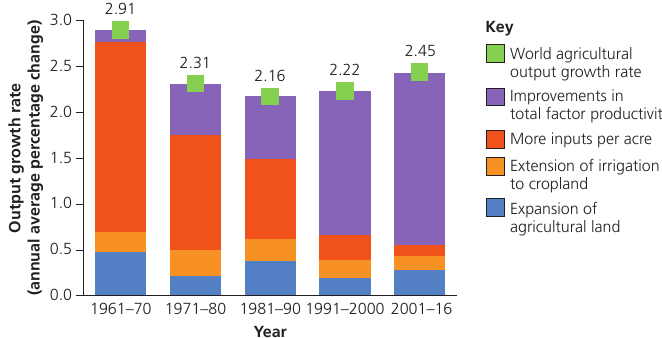
The data reveals several important patterns:
- From 1961 to 2016, global agricultural output consistently increased, though annual growth rates varied between approximately 2.2% and 2.9%
- In earlier decades (1961-1980), expanding agricultural land and developing irrigation systems contributed substantially to output growth
- More recently (2001-2016), improvements in total factor productivity have become the dominant driver of agricultural growth
- The contribution from simply adding more inputs per acre has remained relatively steady across all periods
Note
This shift indicates that the world is becoming more efficient at producing food. Rather than relying on bringing new land into production or building large irrigation projects, modern agriculture increasingly depends on scientists and farmers using existing resources more effectively. Each unit of input now generates more output than in previous decades.
Looking ahead, forecasts suggest agricultural productivity will continue growing until 2050, though at a slightly reduced rate of around 2.3% annually.
Climate and soils as limiting factors
Important
Limiting factors are environmental conditions that restrict where specific crops can be grown economically. Climate and soils act as limiting factors because crop types can only survive and produce viable yields within certain environmental conditions.
The relationship between crops and their environment is not simply binary (suitable or unsuitable). Instead, there is a gradient of productivity based on how closely conditions match a crop's ideal requirements.
The Optima and Limits model
McCarty and Lindberg developed a theoretical model that helps explain how environmental conditions affect agricultural production. Their Optima and Limits Model demonstrates the relationship between environmental conditions and crop productivity.
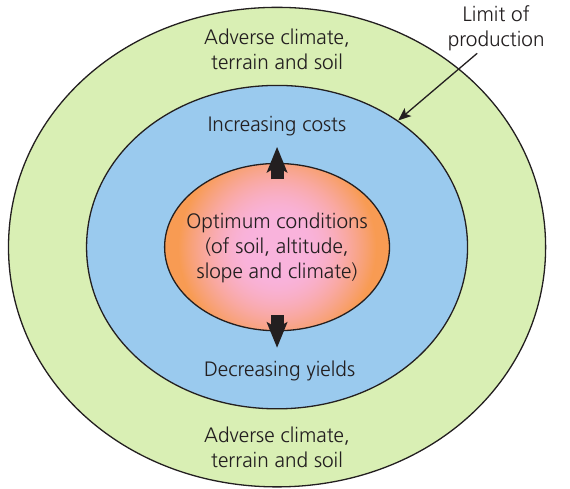
The model shows three distinct zones:
Optimum conditions (centre)
- This represents the ideal combination of soil quality, altitude, slope angle, and climate
- Crops achieve their maximum productivity in these conditions
- Production costs are lowest and yields are highest
Transition zone (middle ring)
- As conditions deviate from the optimum, two things happen simultaneously
- Production costs increase (more fertilisers, irrigation, or other inputs become necessary)
- Yields decrease (crops become less productive)
- Farming remains viable but becomes progressively less profitable
Limit of production (outer ring)
- Beyond a certain point, environmental conditions become too adverse
- Climate, terrain, and soil conditions are unsuitable for economic production
- The crop cannot be grown viably, regardless of inputs applied
Note
Key Principles of the Model:
- Every crop variety performs best in specific environmental conditions where both climate and soil characteristics are most suitable
- Physical boundaries exist beyond which particular crop types cannot be successfully cultivated
- Moving away from optimal conditions increases production costs (requiring additional inputs like fertilisers) and/or reduces yields
- Crops are not universally grown in their ideal conditions; economic viability exists within a range of environmental limits
Crop adaptation and modification
Agricultural scientists have made significant progress in extending the environmental ranges within which crops can be grown successfully.
Plant breeding and modification
- Many crop varieties have been hybridised or genetically modified to tolerate a wider range of climatic and soil conditions
- New crop varieties have extended the spatial boundaries within which different crops can be cultivated
- Some varieties have been specifically developed to perform optimally in particular environmental conditions that were previously unsuitable
Livestock considerations
- Generally, livestock demonstrate greater resilience to varying climatic and soil conditions compared to crops
- However, even within livestock farming, certain climatic and soil conditions favour particular animals over others
- Specific breeds have been developed that are optimally productive in certain environments rather than others
Note
This ongoing adaptation means that the limits shown in the Optima and Limits model are not fixed permanently. Through selective breeding and technological advances, agriculture continues to push these boundaries outward.
Remember!
Summary
Key Takeaways:
- Climate and soils are limiting factors that determine where crops can be grown economically and productively
- The Optima and Limits Model shows that crops have ideal conditions at the centre, with increasing costs and decreasing yields as conditions become less suitable
- Agricultural productivity growth has shifted from expanding farmland to improving efficiency and productivity of existing agricultural systems
- Crop modification through hybridisation has extended the environmental ranges in which crops can be successfully grown
- Every crop has environmental boundaries - there are physical limits beyond which specific crops cannot be viably cultivated, regardless of inputs