Population Numbers, Densities and Changes (AQA A-Level Geography): Revision Notes
📚Revision Notes
Population Numbers, Densities and Changes
Introduction to global population growth
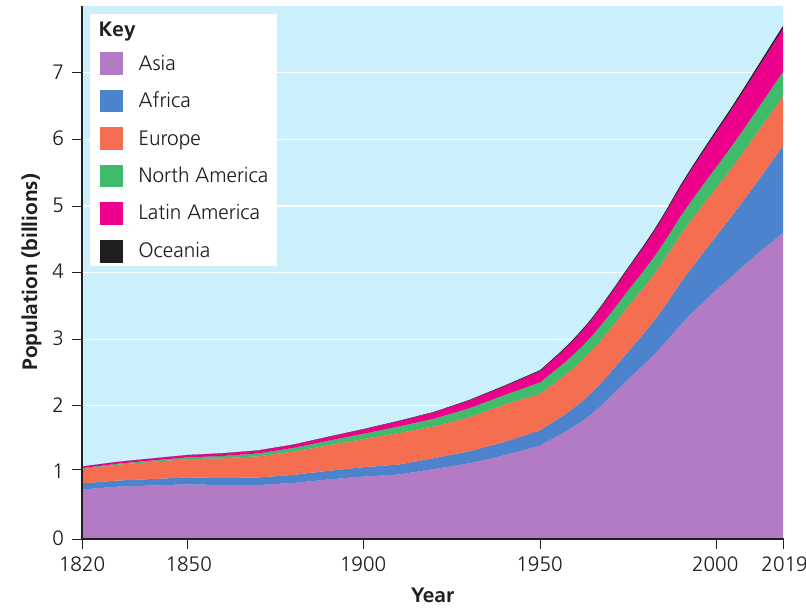
The world's human population has grown dramatically over the past two centuries. Throughout most of human history, population numbers remained relatively stable. However, significant events have triggered rapid expansion. Understanding these patterns helps us grasp the relationship between people and their environment.
In 1800, the global population stood at approximately 1 billion people. By 2019, this figure had surged to 7.7 billion. Today, we've reached around 7.8 billion inhabitants, and projections suggest we'll hit 9.7 billion by 2050.
Note
This represents a nearly eight-fold increase in just over 200 years - an unprecedented rate of growth in human history. This dramatic expansion has profound implications for resource management, environmental sustainability, and global development.
Key drivers of population growth
Several major developments have enabled such rapid population expansion:
-
The Neolithic Agrarian Revolution (around 12,000 years ago in Mesopotamia) - This marked humanity's shift from hunting and gathering to settled agriculture, allowing communities to support larger populations through reliable food production.
-
The Industrial Revolution (18th and 19th centuries in Europe) - Technological advances increased productivity and improved living standards, enabling specific regions and ultimately the entire planet to sustain more people.
-
Medical advances and disease control - Growing ability to combat infectious diseases has dramatically reduced death rates, contributing significantly to population growth.
Continental population distribution
Population is distributed very unevenly across the world's continents. This uneven spread reflects historical migration patterns, environmental conditions and resource availability.
Current distribution patterns
Asia dominates global population:
- Contains approximately 60% of the world's total population
- Home to the two most populous countries: China and India
- India is expected to overtake China as the world's most populous nation by the end of the 2020s
Other continental patterns:
- Africa's population is growing rapidly
- Europe, North America, Latin America and Oceania each contain smaller proportions
- Oceania has the smallest share of global population
Note
Asia's demographic dominance isn't just about numbers - it represents a concentration of economic potential, cultural diversity, and environmental challenges. The region's ability to sustain such a large population whilst managing resources and development will be crucial for global stability.
Where people live
Population density varies dramatically based on environmental and economic factors:
- Coastal areas - Tend to have higher population densities due to access to trade, fishing and milder climates
- River basins - Fertile soils and water availability support larger populations
- Industrialised and urbanised areas - Cities and industrial regions attract high population concentrations
- Areas with fertile soils and abundant resources - Historical migration has concentrated populations in these favourable locations
Regional population growth rates
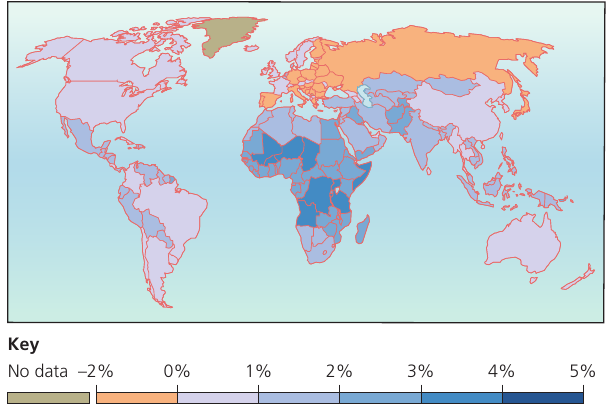
Whilst the global population continues to expand, the rate of growth varies significantly between different regions. This creates a complex global picture with some areas booming whilst others stagnate or even decline.
Fastest growing regions
Sub-Saharan Africa leads global population growth:
- Projected to double in size by 2050
- Experiencing the most dramatic expansion of any world region
Moderate growth regions (projected growth until 2050):
- North Africa and West Asia: 46% increase
- Australia and New Zealand: 28% increase
- Central and Southern Asia: 25% increase
- Latin America and the Caribbean: 18% increase
- Eastern and South East Asia: 3% increase
Slowest growing regions
Europe and Northern America:
- Expected to grow by only 2% until 2050
- Some countries already experiencing population decline
- This includes nations like Italy, Poland, Russia, Japan and South Korea
Important
Population decline:
Several economically developed countries are experiencing population decline. This trend, particularly evident in parts of Europe and Asia, reflects changing birth rates, ageing populations and socio-economic factors. Understanding why some populations shrink whilst others boom is crucial for planning future resources and services.
Countries facing population decline must address challenges such as:
- Shrinking workforce and economic productivity
- Increased burden on pension and healthcare systems
- Potential loss of innovation and economic dynamism
Environment and population relationships
The relationship between human populations and the environment is complex and bidirectional. Environmental conditions influence where and how many people can live, whilst population size and lifestyle affect environmental quality.
Environmental influences on population
The physical environment plays a crucial role in determining population distribution and the capacity to support human life:
Climate factors:
- Temperature patterns affect growing seasons and agricultural potential
- Precipitation levels determine water availability for drinking, irrigation and industry
- Extreme weather events can make areas less suitable for dense habitation
Soil quality:
- Fertile soils enable productive agriculture, supporting larger populations
- Poor soils limit food production capacity
- Soil characteristics vary based on climate, vegetation and parent rock material
Topography:
- Flat, low-lying areas generally support higher population densities
- Mountainous terrain presents challenges for agriculture, transport and settlement
- Relief affects drainage patterns and water availability
Note
The interaction between these environmental factors creates distinct patterns of habitability. For instance, the fertile river valleys of the Nile, Ganges, and Yangtze have supported dense populations for millennia, whilst harsh desert and arctic environments remain sparsely populated despite modern technology.
Food production and security
Food production capacity varies considerably across the globe. This variation depends on both environmental and human factors.
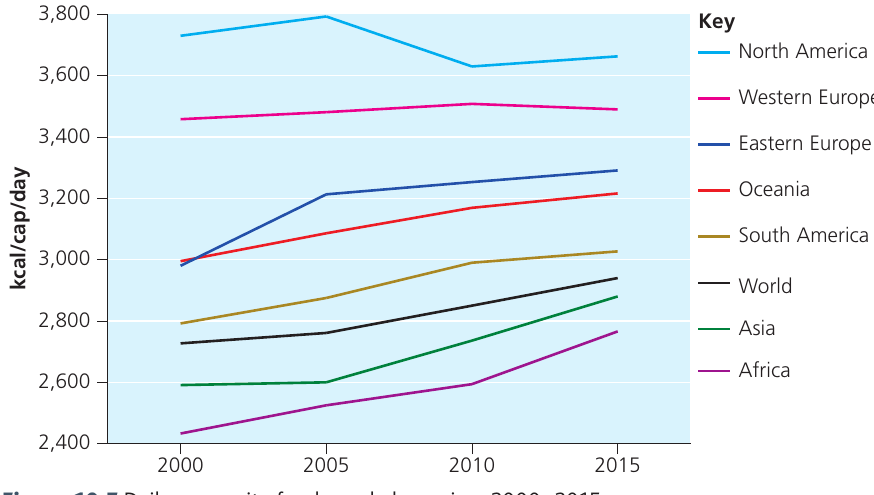
The graph shows how daily caloric intake differs by region, reflecting:
- Agricultural productivity levels
- Economic development
- Food distribution systems
- Environmental constraints
North America shows the highest daily caloric intake, whilst Africa has the lowest but is showing improvement over time. This highlights global inequalities in food security.
Important
Food Security Inequalities:
The disparity in caloric intake between regions represents more than just numbers - it reflects fundamental inequalities in access to resources, technology, and economic opportunities. Whilst some regions face obesity and food waste challenges, others struggle with malnutrition and food scarcity. Addressing these inequalities requires coordinated global efforts in agricultural development, fair trade, and sustainable food systems.
Population impact on environment
Rapid population growth and development have created significant environmental challenges:
- Impact varies depending on where people live and their individual lifestyles
- Access to resources and services affects per-person environmental footprint
- Industrialised, urbanised populations often have larger ecological impacts
- Growing populations increase pressure on land, water, forests and other natural resources
The relationship between population and environment requires careful management to ensure sustainable development that meets human needs without depleting the planet's resources.
Key definitions
Important
Agricultural productivity
Agricultural productivity refers to the ratio of agricultural outputs to agricultural inputs. Higher productivity means more food produced per unit of land, labour or other resources invested.
Important
Agriculture
Agriculture is the science or practice of farming. This includes cultivating soil to grow crops and rearing animals to provide food and other products such as wool, cotton or rubber.
Important
Climate
Climate describes a region's long-term weather patterns. It is measured through average precipitation, maximum and minimum seasonal temperatures, sunshine hours, wind speeds, humidity and the frequency of extreme weather events.
Important
Food security
Food security exists when all people at all times have access to sufficient, safe, nutritious food to maintain a healthy and active life.
Important
Soil
Soil is the upper layer of earth in which plants grow. It appears as a black or dark brown material, typically consisting of a mixture of organic remains, clay and rock particles.
Important
Zonal soil
Zonal soil refers to a categorised soil group covering a wide geographical region. Its profile and properties are determined primarily by the actions of regional climate and natural vegetation on the parent rock from which it formed.
Important
Topography
Topography describes the relief and drainage patterns of an area, including its physical features, elevation changes and water flow.
Important
Salinisation
Salinisation is the build-up of salts in soil, eventually reaching toxic levels for plants. This can occur through irrigation, poor drainage or other factors, reducing agricultural productivity.
Important
Greenwashing
Greenwashing is a term describing exaggerated environmental claims, usually made to promote the green credentials of big corporations. It represents a form of environmental propaganda rather than genuine environmental benefit.
Remember!
Summary
Key Points to Remember:
-
Global population has exploded from 1 billion in 1800 to 7.8 billion today, driven by agricultural and industrial development, plus improved disease control.
-
Asia dominates with 60% of the world's population, containing the two most populous countries, China and India.
-
Growth rates vary dramatically by region - Sub-Saharan Africa is projected to double by 2050, whilst Europe and Northern America will grow by only 2%.
-
Environment and population interact in both directions - Physical factors like climate, soil and topography influence where people can live, whilst population growth impacts environmental quality.
-
Food security depends on agricultural productivity, which varies globally based on environmental conditions and development levels, creating significant inequalities in nutrition.