Population Size vs Resources (AQA A-Level Geography): Revision Notes
📚Revision Notes
Population Size vs Resources
Introduction
The relationship between human population size and available resources raises critical questions for our planet's sustainability. As global population continues to grow, we face fundamental challenges about how many people Earth can support and at what standard of living. This topic explores the balance between what we consume and what the planet can provide.
The key questions we must consider are:
- At what point will breaking-point be reached?
- How many people can live on the planet sustainably?
Important
These questions become increasingly urgent as continued population growth places mounting pressure on Earth's resources and environment, affecting us all in some way.
Carrying capacity and ecological footprint
Understanding carrying capacity
Carrying capacity is an ecological concept originally applied to animal and plant populations. It represents the maximum population size that a particular environment can sustain indefinitely.
Population ecologist Professor William Rees adapted this concept to human populations, recognising that carrying capacity varies based on lifestyle and consumption patterns. This means Earth could potentially support different population sizes depending on how we live.
Example
Illustration: Varying Carrying Capacity
Earth's carrying capacity depends on consumption levels:
- Earth might support a larger population of 10 billion people if consumption remains modest
- However, carrying capacity would be much lower if we all consumed resources at the level enjoyed in rich industrialised countries
The ecological footprint concept
Ecological footprint – A measure in global hectares (gha) of the land and water area needed to produce the resources that humans (individually or as societies) demand, and to assimilate the waste generated from this production.
Together with his PhD student Mathis Wackernagel, Rees developed the ecological footprint concept. Their arguments emphasise that carrying capacity depends on varying levels of resource consumption across different parts of the world.
The ecological footprint serves as a useful tool to assess the pressure we place on the planet's resources. Each of us creates demand on the Earth's biosphere (the biological component of Earth systems where life exists).
Biosphere – The biological component of Earth systems (the parts of the Earth where life exists, also known as the ecosphere).
Note
A major component of each person's ecological footprint is their carbon footprint. This represents the waste product that needs to be assimilated into Earth's systems. The concept challenges us to consider: how much of Earth's surface is needed to support me in the lifestyle to which I am accustomed?
Calculating carrying capacity and ecological footprint
The calculation method
Earth has bio-productive limits. It can only accommodate a certain level of resource consumption. The basis for calculating carrying capacity involves measuring the total productive bio-capacity of Earth and dividing this by the total population.
Total productive bio-capacity = the total biologically productive area of Earth's land and water systems (measured in gha) available to provide the food, water, energy and other resources we use as humans and to absorb our waste.
The calculation provides the global hectares available for each person on the planet. This represents the ecological footprint we are each entitled to, with a population of nearly 8 billion.
Understanding global hectares
One global hectare (gha) = a unit of measurement which represents the average productivity of all biologically productive areas (cropland, forests, fishing grounds etc.) on Earth in a given year.
Global hectares per person (in this calculation) = the average amount of global hectares (gha) available to each person to provide for their consumption of resources and assimilation of waste.
Current global situation
In 2019, there were 12.2 billion hectares of biologically productive land and water on Earth. If this total productive biocapacity is shared evenly by the global population of 7.7 billion, each person would have nearly 1.6 global hectares (gha) available to them.
Important
However, ecological footprint values vary enormously and are distributed unevenly around the world. Although in some parts of the world average footprints are at or below the 1.6 gha level, most regions are well above this in terms of consumption.
Global distribution of ecological footprints
The map below shows how ecological footprints vary dramatically across different countries and regions.
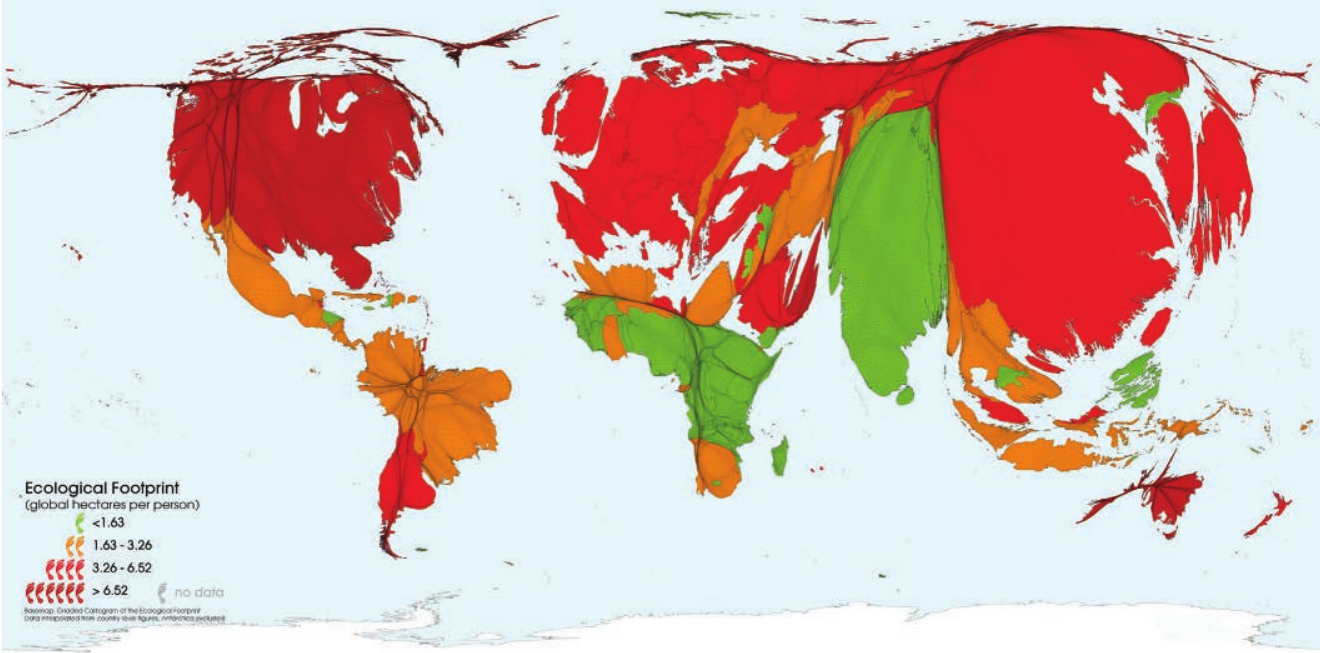
Key patterns visible include:
- Highest footprints (over 6.52 gha per person) – North America, Russia, Australia, parts of Europe
- Medium-high footprints (3.26-6.52 gha per person) – shown in light red
- Low-medium footprints (1.63-3.26 gha per person) – shown in orange
- Lowest footprints (less than 1.63 gha per person) – Africa and parts of South America, shown in green
Note
This distortion in footprint size demonstrates the vast inequality in global resource consumption. The colour shading illustrates each country's average ecological footprint per person, revealing stark contrasts between developed and developing nations.
Changes in ecological footprint over time
Components of the ecological footprint
Ecological footprint accounting represents human consumption of resources and generation of waste. The graph below shows the component parts of the ecological footprint and how it has changed over the past 60 years.
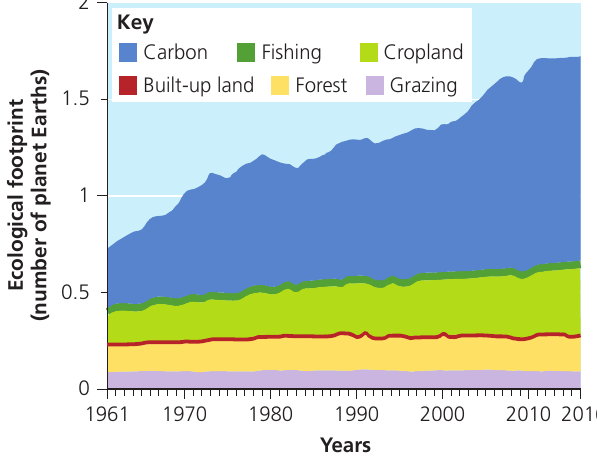
The compound graph reveals several critical trends from 1961 to 2016:
Carbon waste is the largest and fastest growing component:
- Started at approximately 0.7 planet Earths in 1961
- Grown to approximately 1.7 planet Earths by 2016
- Dominates the overall footprint increase
Other components remain relatively stable:
- Fishing grounds (dark green)
- Cropland (lime green)
- Built-up land (dark red)
- Forest products (yellow)
- Grazing land (light purple)
Important
The total ecological footprint crossed the sustainable threshold of 1.0 planet Earth around 1970. By 2016, humanity's footprint reached approximately 1.7 planet Earths, meaning we are consuming 70% more resources than Earth can regenerate.
Country-specific comparisons
Ecological footprints by country
Different countries show vastly different levels of resource consumption per person.
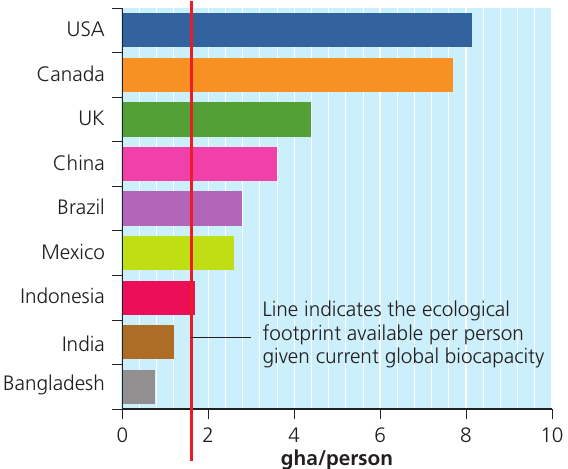
The bar graph compares nine countries, revealing:
Highest consumers:
- USA: approximately 8 gha per person
- Canada: approximately 7 gha per person
- UK: approximately 5 gha per person
Medium consumers:
- China: approximately 3.6 gha per person
- Brazil: approximately 2.8 gha per person
- Mexico: approximately 2 gha per person
Lowest consumers:
- Indonesia: approximately 1.5 gha per person
- India: approximately 1.2 gha per person
- Bangladesh: approximately 0.8 gha per person
Note
The red vertical line on the graph indicates approximately 2 gha per person, representing the sustainable ecological footprint threshold based on current global biocapacity. Only India and Bangladesh fall below this sustainable level.
Example
Worked Example: Calculating Earth's Carrying Capacity by Lifestyle
Using the ecological footprint data, we can calculate how many people Earth could support at different consumption levels:
If everyone lived like the average Indian (1.2 gha per person):
- Total biocapacity: 12.2 billion gha
- Footprint per person: 1.2 gha
- Capacity: billion people ✓
If everyone lived like the average UK citizen (5 gha per person):
- Total biocapacity: 12.2 billion gha
- Footprint per person: 5 gha
- Capacity: billion people (approximately 2.8 billion)
If everyone lived like the average US citizen (8 gha per person):
- Total biocapacity: 12.2 billion gha
- Footprint per person: 8 gha
- Capacity: billion people (approximately 1.5 billion)
These calculations demonstrate the dramatic impact of lifestyle choices on Earth's carrying capacity.
Biocapacity reserves and deficits
The productive biocapacity available varies between countries due to different land and sea areas they occupy and the productive potential of those areas. The table below compares six selected countries.
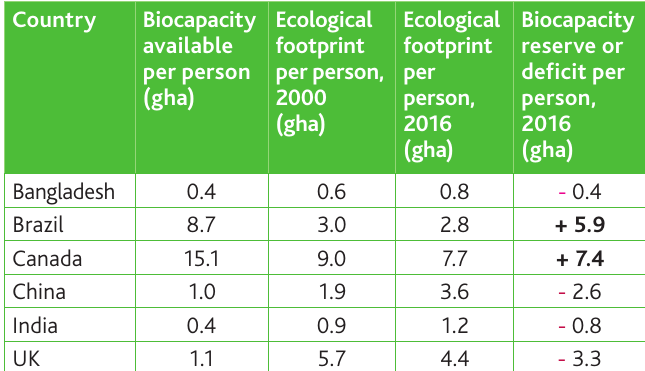
Countries with biocapacity reserves (surplus):
- Brazil: 9.7 gha available per person, footprint of 2.8 gha, reserve of +5.9 gha
- Canada: 15.1 gha available per person, footprint of 7.7 gha, reserve of +7.4 gha
Countries with biocapacity deficits (consuming more than available):
- Bangladesh: 0.4 gha available, footprint of 0.8 gha, deficit of -0.4 gha
- China: 1.0 gha available, footprint of 3.6 gha, deficit of -2.6 gha
- India: 0.4 gha available, footprint of 1.2 gha, deficit of -0.8 gha
- UK: 1.1 gha available, footprint of 4.4 gha, deficit of -3.3 gha
Note
This data reveals whether countries have a biocapacity reserve or are running an ecological deficit. For example, Brazil has the highest total biocapacity of any country at 1.8 billion gha.
Trends in ecological footprints
In general, ecological footprints in many high-income countries are slowly decreasing in size because of:
- Deindustrialisation
- Increased environmental awareness
- Strategies to mitigate consumption and waste (for example, recycling)
However, footprints in developing countries such as China and India are rising because of:
- Industrialisation
- Increased consumption levels
- Growing middle class populations
Implications of exceeding carrying capacity
The concept of overshoot
Overshoot – In ecological terms this refers to a point when a population's consumption of resources exceeds the long-term capacity of the environment to regenerate the resources being consumed.
Figures for humanity's global ecological footprint are already unsustainable. Evidence suggests that we are already in a state of overshoot. The implications of current measures of carrying capacity and ecological footprint mean that:
Important
Humanity uses more resources than the Earth provides – each year levels of consumption exceed the productive bio-capacity of the planet, not only in terms of its ability to produce but also in its ability to assimilate our pollution and waste.
Global consumption is unevenly distributed – it favours a few and is inefficient because of excessive waste and unnecessary usage of resources.
The Global Footprint Network perspective
According to the Global Footprint Network (GFN), we are living beyond the means of the planet to sustain us. It estimates that we need 1.7 planets to support our current way of life.
The GFN introduces the concept of an Earth Overshoot Day each year. This is designated as the day when it is thought we have used the productive biocapacity of the planet for that year. After that day we are living 'on ecological debt'.
Key dates:
- The overshoot day was 21 August in 2010
- By 2019 it had moved to 29 July
- In 2020, the COVID-19 pandemic caused a sudden contraction of humanity's ecological footprint, meaning the overshoot day moved three weeks later to 22 August
Note
The shift in Earth Overshoot Day over time demonstrates how rapidly our ecological debt is accelerating – moving from late August to late July in less than a decade represents a significant worsening of our overshoot situation.
Negative environmental implications
The negative environmental implications of enlarging ecological footprints are particularly acute and include:
- Climate change and exacerbation of global warming
- More land used for settlement, industry and transport
- Degradation of natural ecosystems
- Increased threat of species extinction
- Over-cultivation and overgrazing reducing land and soil quality
- Depletion of fish stocks beyond recovery
Future scenarios for population and resources
The implications for human population will depend on different scenarios:
Scenario 1: Continued consumption at existing rates
If we continue to consume resources at existing rates, a number of 'population checks' may continue to occur in the form of:
- Famines
- Water shortages
- Disease pandemics, which increase mortality rates
Note
This is already evident in poorer countries of sub-Saharan Africa despite the efforts of the UN's Sustainable Development Goals.
Scenario 2: Conflicts over resources
An increase in wars or conflicts over limited resources. This will also increase mortality and may exacerbate the problem by reducing biocapacity through positive feedback mechanisms.
Scenario 3: Rapid reduction in consumption
A rapid and significant decrease in consumption of resources to reduce ecological footprints would mean a substantial reduction in the standard of living for most of the world's population. This may not be acceptable for those in wealthier developed economies.
More optimistic perspectives
More positive views of the future are suggested by:
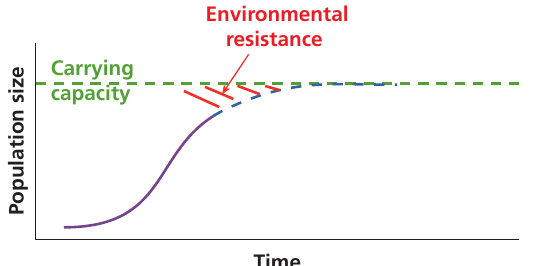
Evidence that population growth rates, on a global scale, are slowing down – the view of 'transition' theorists is that the population growth curve is gradually forming as a 'sigmoidal' or 'S' shaped curve. As it adjusts more gradually to carrying capacity, this adjustment suggests that as population size increases, the rate of increase declines as more environmental resistance is encountered (for example, dwindling food and water resources). This will eventually lead to an equilibrium population size fixed by carrying capacity.
Note
The sigmoid or S-curve of population growth shows how environmental resistance creates limiting factors that slow down the growth rate as population approaches carrying capacity.
The notion that carrying capacity can be increased – advances in technology in the past have enabled increases in the productivity of food and access to more resources than were thought available. However, many of the technologies that have increased the carrying capacity have also increased humanity's ecological footprint.
Important
Solutions are now needed that can increase carrying capacity but without placing increased demand on resources. Green technologies such as the transition to renewable energy have made some progress in this direction.
The population, resources and pollution model
At the beginning of this chapter, we considered the relationship between humans and their environment – how humans exploit and utilise resources provided, which in turn has an impact on the environment.
The population, resources and pollution (PRP) model represents a fundamental ecological relationship true to all organisms including humans. The model:
- Provides an insight into the human-environment interaction
- Illustrates several important relationships between the two
- Adopts a 'systems' approach – understanding that a consequence of changing one variable in the model is that others will be affected
- Promotes 'systems thinking' which is vital to sustainable development
- Provides an insight into sustainable solutions – for example, to control resource depletion, population control measures might be adopted; encouraging less demand for resources will reduce levels of pollution, for example in energy generation
- Uses the concepts of positive and negative feedback
Note
The model demonstrates how population size, resource consumption and pollution generation are interconnected, and how changes in one element affect the others in complex ways.
Remember!
Summary
Key Points to Remember:
-
Carrying capacity represents the maximum population an environment can sustain indefinitely, and it varies depending on lifestyle and consumption levels
-
Ecological footprint measures the land and water area needed to support our consumption and absorb our waste, measured in global hectares (gha)
-
Humanity currently needs 1.7 planet Earths to sustain our current consumption levels – we are in a state of overshoot
-
Global inequality is stark: if everyone lived like the average US citizen, Earth could only support 1.5 billion people, but if everyone lived like the average Indian, it could support 10 billion
-
Carbon waste is the largest and fastest-growing component of our ecological footprint, growing from 0.7 to 1.7 planet Earths between 1961 and 2016