Projected Distributions (AQA A-Level Geography): Revision Notes
📚Revision Notes
Projected distributions
Introduction to global population projections
The world's population distribution is set to undergo major transformations throughout the 21st century. According to the United Nations' 2019 World Population Prospects report, these changes will significantly reshape where people live across different continents and regions. Understanding these projected distributions helps us prepare for future demographic challenges and opportunities.
Note
These projections are based on medium variant forecasts, meaning they represent the most likely scenario given current trends. However, it's important to remember that projections always carry some uncertainty, as they depend on assumptions about future fertility rates, mortality rates, and migration patterns.
Regional population projections 2020-2100
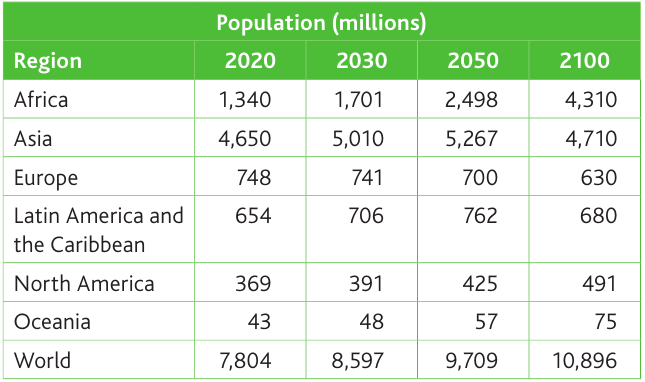
The table below shows how population is expected to change across major world regions over the coming decades:
Africa
Africa is projected to experience the most dramatic population growth of any region. The continent's population is expected to more than triple, rising from 1,340 million in 2020 to 4,310 million by 2100. This means that more than half of all global population growth between 2020 and 2050 will occur in Africa.
Sub-Saharan Africa specifically is growing at an exceptionally rapid pace of 2.5% annually. The region's population is projected to nearly double by 2050, representing a 99% increase. This growth is driven by sustained high fertility rates, which remain well above replacement level in many African countries.
Important
Fertility replacement rate is the level of fertility at which a population exactly replaces itself from one generation to the next. This is approximately 2.1 children per woman in developed countries.
Note
This unprecedented growth in Africa will create both opportunities and challenges. The continent will need massive investments in infrastructure, education, healthcare, and job creation to harness the potential of its growing population while avoiding social and environmental pressures.
Asia
Asia remains the world's most populous region, though its growth rate is more modest compared to Africa. The continent's population will peak at around 5,267 million in 2050 before declining slightly to 4,710 million by 2100. This represents relatively small growth in comparison to historical trends.
Central and Southern Asia will grow by 25% between 2019 and 2050, while Eastern and South-Eastern Asia will see much slower growth at just 3%. This variation reflects different stages of demographic transition across Asian countries.
A landmark demographic shift will occur when India surpasses China as the world's most populous country in 2027. This change reflects China's sustained low fertility rates and India's larger base of young people entering reproductive years.
Europe
Europe faces a distinctive demographic challenge: population decline. The continent's population is projected to fall from 748 million in 2020 to just 630 million by 2100. This decrease of nearly 120 million people results from sustained low fertility rates well below replacement level, combined with limited immigration in some areas.
Important
Between 2019 and 2050, 55 countries or areas are projected to experience population decreases of 1% or more. These declining populations will mostly be found in parts of Europe, Japan, China, and other parts of Asia and the Americas.
This demographic decline poses serious challenges for economic growth, pension systems, and healthcare provision as the ratio of workers to retirees decreases.
Latin America and the Caribbean
This region will experience moderate but steady growth, increasing from 654 million in 2020 to 762 million by 2050, before stabilising at around 680 million by 2100. The growth rate of 18% between 2019 and 2050 reflects falling fertility rates that are approaching or reaching replacement level.
Recent reductions in fertility mean that the working-age population in Latin America is growing faster than other age groups, creating potential for economic acceleration through the demographic dividend.
Note
The demographic dividend represents a window of opportunity for accelerated economic development. However, realising this potential requires strategic investments in education, healthcare, and job creation to ensure the expanded workforce can contribute productively to the economy.
North America
North America shows relatively stable population trends, with modest growth from 369 million in 2020 to 491 million by 2100. The region's low growth rate of just 2% between 2019 and 2050 reflects low fertility rates balanced by continued immigration.
Oceania
Oceania (including Australia and New Zealand) remains the smallest region by population, growing from 43 million in 2020 to 75 million by 2100. Despite its small size, the region shows steady growth of 28% between 2019 and 2050, driven by both natural increase and immigration.
Visualising changing population distributions
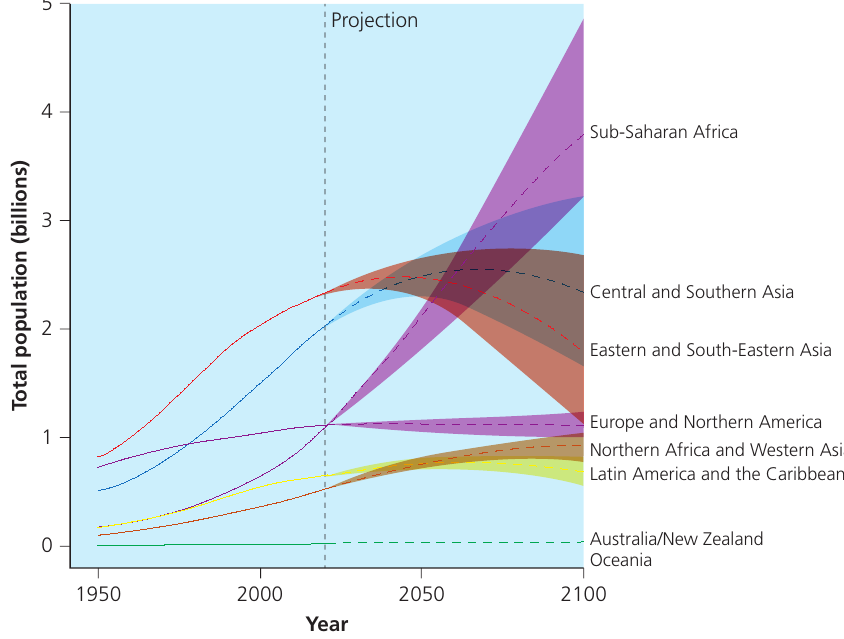
This stacked area chart illustrates how dramatically population distribution will shift by region through the century. The visualization clearly shows Sub-Saharan Africa's explosive projected growth trajectory, which stands in stark contrast to the plateauing or declining trends in Europe, Northern America, and parts of Asia.
Note
The vertical dashed line marks the transition from historical data to future projections, emphasising that while past trends inform these forecasts, the future remains uncertain. These projections assume continuation of current demographic trends, but unexpected changes in policy, technology, or social norms could alter these trajectories.
Changing country rankings
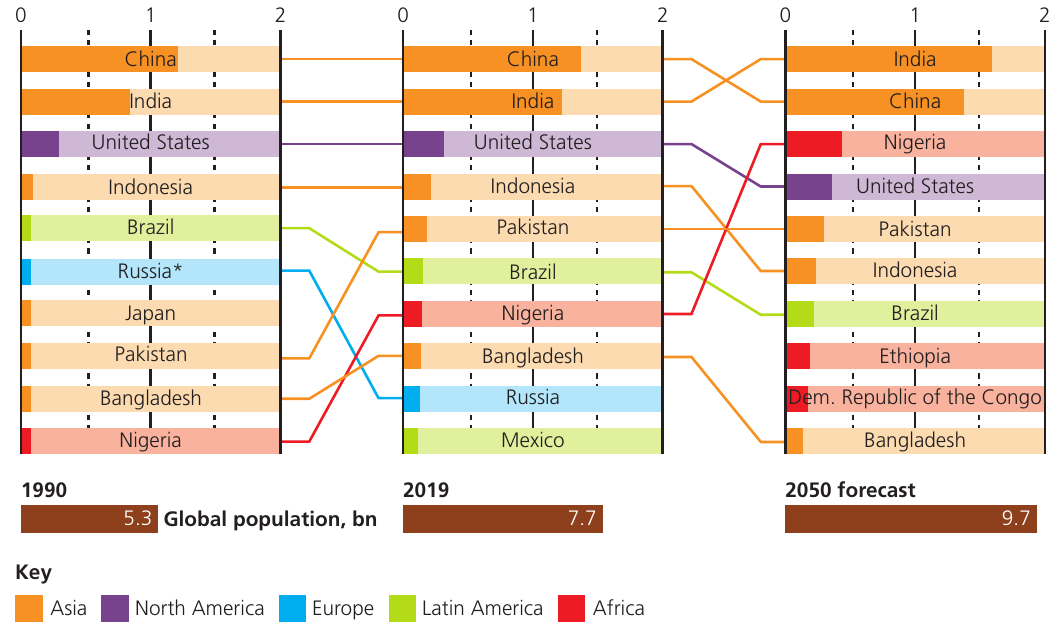
The global hierarchy of the most populous countries is being completely reordered. In 1990, China and India dominated, followed by the United States, Indonesia, and Brazil. By 2050, the picture will look very different.
Key changes in country rankings include:
- India moves to the top position, overtaking China
- Nigeria makes a dramatic leap into the top three, reflecting Africa's rapid growth
- Democratic Republic of Congo and Ethiopia enter the top ten
- Pakistan and Bangladesh maintain significant positions
- Indonesia remains among the largest countries
- Traditional powers like Japan and Russia fall in rankings due to declining populations
Important
Just nine countries will contribute more than half of the world's projected population growth between now and 2050: India, Nigeria, Pakistan, Democratic Republic of Congo, Ethiopia, Tanzania, USA, Indonesia, and Egypt. This concentration of growth highlights how demographic change will be geographically uneven.
Demographic trends shaping the future
The ageing world population
One of the most significant global demographic trends is population ageing. The world's population is growing older, with those aged 65 and over becoming the fastest-growing age group.
Between 2020 and 2050, the proportion of people in this elderly age group will nearly double from 9% to 16% of the global population. Remarkably, in 2018, for the first time in recorded history, people aged 65 or over outnumbered children under five years of age.
This ageing trend creates different challenges across regions:
-
Around 30 countries (including Japan and many European nations) have a falling proportion of working-age populations and increased ageing dependency. This puts pressure on social welfare and pension systems and may impede future economic performance.
-
In sub-Saharan Africa and parts of Asia and Latin America, declining fertility rates mean working-age populations are growing faster than other age groups. This creates an opportunity for accelerated economic growth through what economists call the demographic dividend.
Important
Demographic dividend refers to the economic growth potential that results from shifts in a population's age structure, particularly when the working-age population is larger than the dependent population (children and elderly).
This dividend is not automatic - it requires deliberate policies to invest in education, health, and employment opportunities to transform a larger workforce into economic productivity.
Life expectancy trends
Average global life expectancy at birth continues its upward trajectory, projected to reach 77.1 years by 2050. However, this improvement masks significant inequalities. In 2019, life expectancy in Least Developed Countries remained more than ten years below the global average, reflecting persistent health and development challenges.
Note
Despite progress in reducing the longevity gap between richer and poorer countries, substantial differences remain that reflect underlying inequalities in healthcare access, nutrition, and living conditions. Closing this gap will require sustained investments in public health infrastructure and poverty reduction.
Fertility rates
Global total fertility rates will continue declining towards or below replacement level in most world regions. This trend reflects:
- Increased access to contraception and family planning
- Greater female education and workforce participation
- Rising costs of child-rearing in urbanised societies
- Changing social norms around family size
Important
Even if fertility in high-fertility countries were to fall immediately to replacement rates, population momentum would ensure continued growth for decades due to the large number of young people entering reproductive years.
This momentum effect means that population stabilisation is a gradual process that cannot be achieved quickly, even with rapid fertility decline.
Least Developed Countries
Important
Least Developed Countries (LDCs) are a group of 47 countries designated by the UN as the world's poorest and most economically vulnerable nations. Currently, 33 are in Africa and 13 in Asia.
Population growth remains especially high in LDCs, where fertility rates stay well above replacement level and youth populations are large. This creates both challenges (in providing services and employment) and opportunities (for economic growth if properly managed).
Population-environment relationships
The ongoing debate
There is ongoing debate about whether population growth or consumption patterns pose a greater threat to environmental limits set by planet Earth. In reality, both represent challenges to sustainability and should not be viewed in opposition to each other.
A growing and increasingly affluent global population creates particular challenges for:
- Ecological footprints: The demand for natural resources and ecosystem services continues to grow
- Carbon budgets: More people and higher living standards increase greenhouse gas emissions
Main environmental challenges
The fundamental challenge is to continue supplying the key resources needed for human survival and wellbeing:
- Food production must increase whilst protecting agricultural land and biodiversity
- Water resources face growing pressure from population growth and climate change
- Energy demands are rising, requiring transition to renewable sources
- Mineral resources must be extracted and used more efficiently
Important
Crucially, all of this must be achieved using sustainable methods that don't compromise the ability of future generations to meet their own needs.
Sustainable methods refer to ways of meeting current needs without depleting resources or causing environmental damage that would prevent future generations from meeting their needs.
Regional variations in challenges
The population-environment relationship plays out differently across regions:
Note
Regional Environmental Challenges:
-
High-income countries face challenges related to high per-capita consumption and carbon emissions, despite stable or declining populations
-
Rapidly growing regions like sub-Saharan Africa must find ways to lift populations out of poverty whilst managing environmental impacts
-
Emerging economies face the dual challenge of rising consumption and continued population growth
Each region requires tailored approaches that address their specific demographic and environmental circumstances while contributing to global sustainability goals.
Remember!
Summary
Key Points to Remember:
-
Africa will dominate future population growth, with more than half of global growth between 2020-2050 occurring on the continent; sub-Saharan Africa's population is projected to nearly double by 2050.
-
India will become the world's most populous country by 2027, overtaking China. Nigeria will enter the top three by 2050, while just nine countries will contribute over half of all global population growth.
-
The world is rapidly ageing: the proportion of people aged 65+ will nearly double from 9% to 16% between 2020-2050, creating challenges for pension and healthcare systems in developed countries.
-
Population decline is becoming a reality: 55 countries are projected to see populations decrease by 1% or more, mostly in Europe, Japan, and parts of Asia, due to sustained low fertility rates.
-
Population and consumption both matter for sustainability: the debate shouldn't be either/or - both growing numbers and rising affluence create challenges for ecological footprints and carbon budgets that require sustainable solutions.