Role of International Agencies and NGOs (AQA A-Level Geography): Revision Notes
📚Revision Notes
Role of International Agencies and NGOs
Introduction
International agencies and non-governmental organisations (NGOs) play a crucial role in promoting health and combating disease worldwide. These organisations work across borders to address health challenges that individual countries cannot tackle alone. They provide medical care, funding, expertise and coordinate global responses to health crises.
Note
The scale of global health challenges often exceeds what individual nations can address alone. International cooperation through agencies and NGOs enables coordinated responses to pandemics, disease eradication campaigns, and humanitarian crises that transcend national borders.
International agencies
The World Health Organization (WHO)
The WHO was established in 1948 and leads health efforts within the United Nations system. It serves as the global authority on health matters.
Important
The WHO defines health as "a state of complete physical, mental and social well-being and not merely the absence of disease or infirmity". This broad definition recognises that health involves more than just the absence of illness – it encompasses physical, mental and social well-being.
WHO's primary role and objectives:
- Direct and coordinate international health work within the UN system
- Achieve the highest possible level of health for all people globally
- Provide advice and support on health issues to national governments
As of 2020, the WHO has 194 member states and 6 regional offices.
WHO's initial priorities
When first established, the organisation focused on three key areas:
- Combating communicable diseases: Fighting infectious diseases including influenza, malaria, tuberculosis (TB) and venereal diseases
- Addressing mothers' and children's health: Supporting mothers and children to survive and be healthy
- Improving nutrition and environmental sanitation: Raising nutritional standards and improving sanitation facilities
WHO's expanded work
The WHO's agenda has grown over time. Today it also includes:
- Providing advice and support on non-communicable diseases such as cancer and cardiovascular diseases (CVDs)
- Addressing newer communicable diseases including HIV/AIDS and Ebola
- Responding to COVID-19 (since 2020)
Key areas of WHO work include:
- Developing the International Classification of Diseases (the worldwide standard for clinical and epidemiological purposes)
- Advising national health ministries on technical issues and providing assistance on health systems and care services
- Advising on prevention and treatment of both communicable and non-communicable diseases
- Working with other UN agencies, NGOs and partners on international health issues
- Ensuring safety of air quality, food, water and medicines/vaccines that people need
Major WHO achievements
The organisation has achieved significant progress in global health:
Smallpox eradication (1970s): WHO efforts led to the complete eradication of smallpox – the only major infectious disease ever to be fully eliminated. This is considered WHO's greatest achievement.
Note
The smallpox eradication campaign demonstrated that with coordinated international effort, even widespread infectious diseases can be completely eliminated. This success provides a blueprint for tackling other global health challenges.
Global Polio Eradication Initiative (1988): By 2006, polio cases had been reduced by more than 99 per cent worldwide.
HIV/AIDS response: The WHO has adapted its HIV/AIDS policies to fit different regional needs. For example:
- In sub-Saharan Africa, where the epidemic spreads largely through heterosexual sex
- In Eastern Europe, where injecting drug use is the primary mode of transmission
Millennium Development Goals (MDGs): The WHO worked with other agencies to help achieve health-related MDGs by 2015.
Women's and Children's Health Strategy (2010-2015): This strategy successfully mobilised global resources under the 'Every Woman, Every Child' movement. It is estimated to have saved 16 million women and children. Building on this success, the Global Strategy for Women's, Children's and Adolescents' Health was launched in 2016 to prevent deaths among these groups.
WHO's comprehensive health interventions
The organisation's work covers multiple aspects of global health:
- Healthcare spectrum issues (including crisis intervention)
- Response to humanitarian emergencies
- Officially declaring pandemics
- Establishing international health regulations for countries to follow
- Identifying disease outbreaks and preventing their spread
- Prevention of chronic diseases
Criticisms of WHO
Note
Balancing Bureaucracy with Action
The WHO has faced criticism for being overly bureaucratic and lacking practical 'front-line' application to health issues. However, the organisation's ability to focus, promote and coordinate efforts to tackle health problems on an international scale, using international experts and collating recent research, has achieved undeniable progress and success in global health.
This tension between centralised coordination and practical implementation reflects the inherent challenges of managing global health initiatives across diverse contexts and political systems.
Other international organisations
The WHO is not alone in supporting global health. Other UN bodies contribute significantly to this work:
UNAIDS
An innovative partnership formed in 1994 that leads and inspires global action to combat the HIV/AIDS pandemic. UNAIDS was created as the main advocate for accelerated, comprehensive and coordinated efforts to achieve universal access to HIV prevention, treatment, care and support.
United Nations Population Fund (UNFPA)
Supports reproductive, adolescent and maternal health programmes worldwide.
World Bank
Provides vital financial and technical assistance to developing countries globally. The Bank helps countries fight poverty, including making investments to improve health systems and healthcare access.
UNICEF
UNICEF works with numerous other agencies, including NGOs, to establish and develop work on the Sustainable Development Goals (SDGs). The organisation is partly responsible for eight of the SDGs and custodian for 19 SDG indicators.
UNICEF's main priorities include:
- Reducing child mortality by aiming to reach vulnerable children everywhere
- Working to end preventable maternal, newborn and child deaths by scaling up immunisation programmes
- Supporting and promoting curative services for pneumonia, diarrhoea and malaria
- Tackling health emergencies in places affected by conflicts, natural disasters, migration or political/economic instability, to ensure children are secure
- Helping to develop resilient health systems that can withstand crises
Non-governmental organisations (NGOs)
Important
Definition: Non-Governmental Organisation (NGO)
A non-governmental organisation (NGO) is any non-profit association that operates independently of both government and of profitable businesses.
NGOs are organised at local, national or international levels and are primarily funded by public donations.
NGOs have a long history of involvement in promoting human well-being and have increasingly been promoted as alternative healthcare providers to the state, especially in developing countries.
Why NGOs are effective
Governments cannot always cope with the enormity of some health issues such as HIV/AIDS, malaria or viral outbreaks and pandemics without support. NGOs are increasingly instrumental in the implementation of international health programmes because they possess several important attributes:
Note
Key Strengths of NGOs in Health Provision
- Ability to reach areas of severe need: NGOs can access remote or conflict-affected areas where governments struggle to operate
- Promotion of local involvement: They engage local communities in health solutions
- Relatively low cost of operations: NGOs often operate more efficiently than large governmental programmes
- Adaptiveness and innovation: They can respond flexibly to changing circumstances
- Independence and sustainability: NGOs maintain operational independence from political pressures
Flexibility and responsiveness
NGOs have more flexibility and freedom to respond in creative ways to a range of situations. They can promote health goals while being less hampered by bureaucracy and resource constraints compared to governmental organisations.
Roles of NGOs in health provision
The work of NGOs in health promotion and provision can be divided into four main areas:
1. Service providers
NGOs act as front-line providers of clinical healthcare. They treat illness either:
- In the absence of any existing government provision, or
- As complementary services to existing government or private provision
This role is particularly important in areas where government health services are weak or non-existent.
2. Social welfare activities
NGOs work to provide or ensure that health infrastructure is in place. This includes:
- Food supply programmes
- Clean water provision
- Public hygiene facilities
- Sanitation systems
- Shelter for the unwell and vulnerable populations
These activities address the broader determinants of health that affect communities.
3. Support activities
NGOs work with and train local populations as health workers. Examples include:
- Training in family planning advice
- Hygiene and disease control education
- Building local capacity to deliver healthcare
This approach ensures sustainable health improvements by empowering local communities.
4. Research and advocacy
NGOs engage in research to improve the efficacy of prevention campaigns for both communicable and non-communicable diseases. They also advocate for better health policies and practices at local, national and international levels.
Case study: Médecins Sans Frontières (MSF)
Example
Case Study: Médecins Sans Frontières (MSF) – Doctors Without Borders
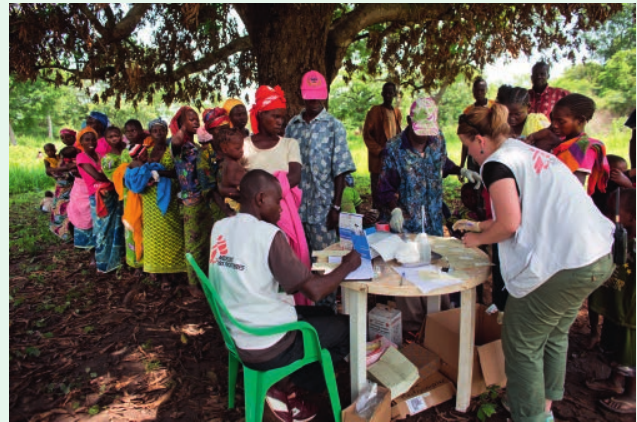
Médecins Sans Frontières (MSF), also known as Doctors Without Borders, is an international NGO that exemplifies effective humanitarian medical work. This case study demonstrates how NGOs can deliver critical healthcare in the world's most challenging environments.
Background and establishment
MSF exists to save lives by providing medical aid where it is needed most. Since 1971, MSF has cared for millions of people caught up in crises such as:
- Natural disasters
- Conflicts and wars
- Famines
- Refugee exoduses
- People excluded from healthcare
MSF's workforce and operations
MSF employs 35,000 personnel globally. Approximately 90 per cent of these are recruited locally by European managers. The workforce includes:
- Majority of local doctors, nurses and medical specialists
- Logistics experts
- Water and sanitation engineers
MSF operates projects in over 74 countries, requiring both rapid response capabilities and longer-term specialist medical help to tackle health crises and diseases. Their work encompasses treating COVID-19, cholera, Ebola, malaria, meningitis and HIV/AIDS.
Funding model and independence
In 2019, 96.2 per cent of MSF's funding came from 6.5 million individual donors around the world. This funding model helps ensure operational independence and flexibility. The remaining funds come from governments and international organisations.
Note
Maintaining Independence Through Funding Choices
MSF does not accept contributions from companies in industries whose core activities may compromise their ability to provide independent care. Examples include the tobacco, mining and pharmaceutical industries.
Since 2016, MSF has taken a principled stance by refusing to accept funding from the EU to protest at the EU's reluctance to accept more migrants fleeing from conflicts in the Middle East and the EU's deal with Turkey to hold more refugees there. This demonstrates how NGOs can use funding decisions as a form of advocacy.
Medical and nutritional interventions
Treating malnutrition: MSF treats malnutrition with ready-to-use therapeutic food (RUTF). This specially formulated food includes all the nutrients needed by children. It is mainly a peanut butter paste that:
- Has been revolutionised for treatment of severe malnutrition
- Can be stored for long periods
- Can be used in a variety of settings
Maternal and child health programmes: MSF healthcare teams work with midwives, and train traditional birth attendants to set up programmes. These ensure that complicated births can be identified quickly to help prevent maternal deaths.
Research and advocacy work
MSF undertakes invaluable field research to generate evidence that improves the effectiveness and quality of the clinical care they provide. Research topics include:
- Treatment of multi-drug-resistant tuberculosis (TB)
- HIV/AIDS treatment and care
- Combating neglected tropical diseases such as Chagas and kala-azar
- Mental health in crisis settings
Campaign for Access to Essential Medicines
MSF acts as a watchdog to protect public health needs against corporate interests. MSF initiated the international 'Campaign for Access to Essential Medicines', which has since been joined by other NGOs.
Campaign objectives:
- Increase the availability of essential medicines in developing countries
- Lobby both governments and pharmaceutical companies
- Challenge the high cost of existing medicines
- Address the absence of treatment for many diseases affecting patients in developing countries
- Push for price cuts to medicines, vaccines and diagnostic tests
- Encourage production of more affordable generic products
- Steer research towards development of new drugs and vaccines
Important
The Market Failure in Drug Development
This campaign addresses the critical issue that many diseases predominantly affecting developing countries lack effective treatments because pharmaceutical companies have insufficient financial incentive to develop them. Without intervention, market forces alone will not provide solutions for diseases that primarily affect populations with limited purchasing power.
The importance of careful NGO engagement
Despite their valuable work, NGOs must be careful that their efforts do not undermine the ability of host countries to provide and maintain strong public health services. By diverting local health workers into parallel operations and attempting to plug gaps in healthcare left by underfunded public health systems in less developed countries (LDCs), NGOs can sometimes reinforce geographical inequality in healthcare provision and in the types of diseases treated.
The NGO Code of Conduct for Health Systems
In response to WHO concerns, the Global Health Workforce Alliance introduced the NGO Code of Conduct for Health Systems. The code aims to:
- Provide guidance to NGOs on working in a way that supports the primacy of the government's responsibility for organising healthcare delivery
- Strengthen government-supported health provision through clinics
- Lead to more equitable care for populations
Note
This code helps ensure that NGO work complements rather than replaces government health services. Effective international health work requires balancing immediate humanitarian needs with long-term capacity building in national health systems.
Summary
Summary
Key Points to Remember:
- The WHO, established in 1948, is the leading international agency for global health, coordinating efforts to combat diseases and promote health worldwide
- Major WHO achievements include the complete eradication of smallpox and the near-elimination of polio through global vaccination campaigns
- NGOs like Médecins Sans Frontières provide vital front-line medical care in crisis situations, reaching areas where governments cannot operate effectively
- NGOs play four key roles: service providers, social welfare activities, support activities, and research and advocacy
- Effective NGO work requires careful coordination with governments to strengthen rather than undermine national health systems