Soil: Problems and Management (AQA A-Level Geography): Revision Notes
📚Revision Notes
Soil: Problems and Management
Introduction to soil problems
Soil is one of our most valuable natural resources, yet it faces numerous threats from both natural processes and human activities. Agricultural soils are particularly vulnerable because intensive farming practices can damage soil structure, remove protective vegetation, and alter natural water balances. Understanding these problems and their management is essential for sustainable food production.
Note
The main soil problems affecting agricultural productivity include:
- Erosion by water and wind
- Waterlogging due to poor drainage
- Salinisation from irrigation practices
- Structural deterioration from cultivation and compaction
Each of these issues reduces soil fertility and crop yields, threatening food security for growing populations.
Soil erosion
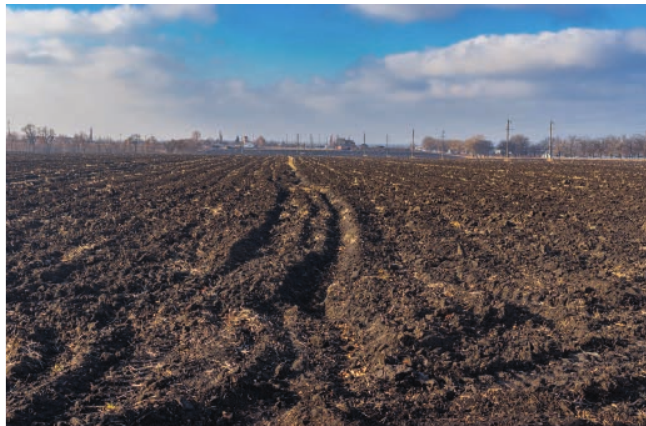
Soil erosion is the wearing away of the upper layer of soil, known as topsoil. This is the most fertile layer because it contains the highest concentrations of organic matter and nutrients that crops need to grow.
Soil erosion represents one of the most serious environmental challenges facing agriculture today. The Food and Agriculture Organization (FAO) estimates that approximately 36 billion tonnes of topsoil are lost globally each year through erosion and deforestation. Between five and seven million hectares of productive agricultural land is lost annually through various forms of degradation, with erosion being a primary cause.
Topsoil is particularly valuable because:
- It contains the most organic and nutrient-rich materials
- Farmers depend on it for growing crops
- Animals rely on it for grazing
- It takes centuries to form but can be lost in years
Effects of soil erosion on fertility
When topsoil is eroded, soil fertility decreases through several mechanisms:
- Removal of nutrient-rich topsoil - The most fertile layer containing organic matter is physically removed from fields
- Reduction in soil depth - Less soil available for plant roots to access water and nutrients
- Decreased water infiltration - Erosion creates surface crusts that increase runoff rather than allowing water to soak into the soil
Important
These changes create a cascade of further problems:
- Loss of seeds, seedlings, fertilisers and pesticides that have been applied to fields
- Young plants being 'sandblasted' by wind-borne soil particles, damaging their growth
- Increased fuel consumption and labour hours needed for farming operations on degraded land
Environmental impacts of soil erosion
Beyond the farm gate, soil erosion damages the wider environment:
- Sedimentation - Eroded soil is deposited onto roads, neighbouring farmland, drainage ditches and watercourses
- Water quality degradation - Rivers, lakes and streams receive excessive inputs of sediment and nutrients, leading to eutrophication (nutrient overloading that causes algal blooms and oxygen depletion)
- Increased flood risk - Sediment clogs rivers and drainage systems, raising water levels downstream
- Damage to fish spawning grounds - Suspended sediment in rivers interferes with fish reproduction
Water erosion
Water erosion is generally considered more serious than wind erosion because it can remove larger quantities of soil more rapidly. It occurs when the force of moving water overcomes the cohesive forces holding soil particles together.
Types of water erosion
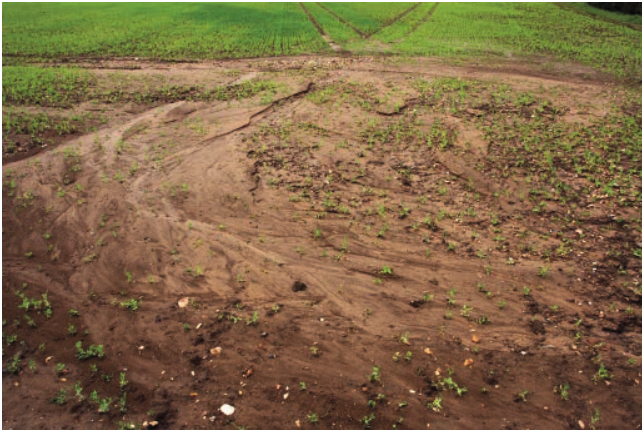
Rill erosion occurs when water flowing across fields creates small, short-lived channels. These channels, called rills, are well-defined streams that do not penetrate deeply into the soil. When water cannot soak into the ground quickly enough, it gathers on the surface and flows downhill in these shallow channels.
Sheet erosion (also called overland flow) happens when raindrops loosen soil particles, and the overland flow of water transports topsoil across the surface in a relatively uniform fashion. This resembles a thin bed sheet sliding off a bed. Sheet erosion is particularly insidious because it removes soil evenly, making the damage less immediately obvious to farmers.
Gully erosion develops when rills are not repaired and continue to grow into larger channels. These deep channels cannot be crossed by farm machinery, rendering affected land unusable for crop production. The large ditches created by gully erosion represent a significant hazard for farm equipment.
River bank erosion occurs when soil is washed away by unmanaged rivers as they meander across floodplains. This is a natural process but can be accelerated by human activities that remove vegetation or alter river flows.
Water erosion control
The fundamental principle for controlling water erosion is to reduce the volume and velocity of surface water flow. This can be achieved through various management strategies:
Drainage management:
- Install and maintain field drains to remove excess water from fields
- Sediment should be regularly cleared from ditches and returned to fields as a nutrient source
- Reduce the amount of water running off roads and farm tracks onto fields through proper drain placement
Soil stabilisation:
- Apply farmyard manure judiciously to improve soil structure and increase infiltration
- The organic matter in manure helps bind soil particles together, making them more resistant to erosion
Protective vegetation:
- Protect soil during winter months through early sowing of crops or by planting cover crops that shield the soil surface from raindrop impact
- Maintaining vegetation cover is one of the most effective erosion control measures
Contour farming:
- Work across slopes rather than up and down whenever possible
- Contour ploughing creates small ridges that follow the land's contours, reducing overland flow
- These ridges slow water movement, allowing more time for infiltration and preventing the formation of rills and gullies
Note
Contour Farming in Practice
Contour ploughing follows the natural curves of the landscape rather than working straight up and down slopes. The ridges created act as small barriers that intercept flowing water, giving it time to infiltrate into the soil rather than continuing downslope. This simple technique can dramatically reduce both soil and water loss from sloping agricultural land.
Wind erosion
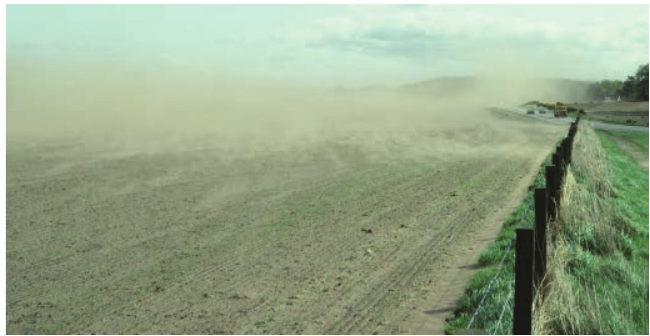
Wind erosion becomes a problem when wind forces exceed the gravitational and cohesive forces holding soil particles to the ground surface. Unlike water erosion, wind can transport soil particles over vast distances, sometimes across entire continents.
Wind erosion processes
Wind moves soil particles through several distinct mechanisms:
Saltation is the primary process of soil transportation by wind. Suspended particles between and mm in diameter are lifted by wind, then fall back to the ground. As they fall, these particles hop or bounce across the soil surface, striking other particles and potentially dislodging them. This creates a chain reaction of particle movement.
Creep occurs when particles larger than mm in diameter are too heavy to be lifted by wind. Instead, the wind rolls these particles along the soil surface, or they are moved when hit by other particles engaged in saltation. This rolling motion slowly transports coarser material.
Suspension happens when very small particles (less than mm in diameter) are lifted into the air and remain suspended as dust. These tiny particles are transported away from the erosion site and can travel hundreds of kilometres. When they eventually settle, this sediment is called loess. The majority of particles settle back to the ground within kilometres of their source.
Abrasion and attrition occur when suspended particles cause abrasion of soil surface materials when they fall back to the ground. The particles themselves can also break into smaller particles through this collision process, creating more material susceptible to suspension.
Important
Understanding Particle Size and Transport
The size of soil particles determines how wind moves them:
- < 0.1 mm: Lifted and suspended as dust, can travel hundreds of km
- 0.1-0.5 mm: Saltation - hop and bounce across the surface
- > 0.5 mm: Too heavy to lift, roll along the ground (creep)
This size-selective transport means the finest, most fertile soil particles are often carried the furthest from their source, permanently removing nutrients from agricultural land.
Wind erosion control
Managing wind erosion requires strategies to reduce wind speed at ground level and increase soil cohesion:
Increasing soil cohesion:
- Apply organic matter such as farmyard manure to the soil surface
- This improves soil structure by binding particles together into larger, more stable aggregates
- Well-aggregated soil is much more resistant to wind erosion
Increasing surface roughness:
- Leave crop residues or stubble in fields rather than ploughing them under
- In countries like Burkina Faso, farmers leave millet and sorghum stubble standing at cm to one metre height
- This high stubble stabilises the soil surface and traps wind-blown dust and leaves
- Over time, this material adds organic matter to the soil, further improving its structure and fertility
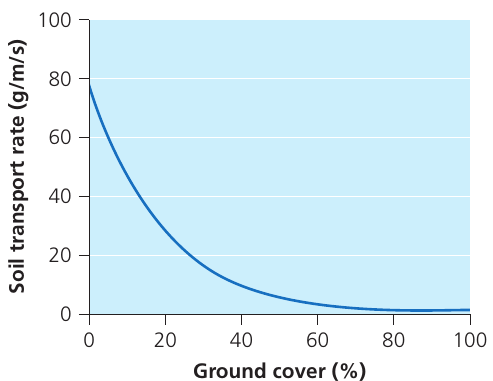
Increasing plant cover:
- Maintain vegetation cover to protect the soil surface
- Plant cover of about 50 per cent provides adequate protection against wind erosion
- Vegetation slows wind speed near the ground, reducing its erosive power
Establishing windbreaks:
- Plant lines of trees or hedgerows perpendicular to prevailing winds
- Trees cut wind speed, reducing both evaporation (by up to ) and wind erosion
- A tree line provides wind protection for up to 12 times the height of the trees, both upwind and downwind of the barrier
- This means cropped areas can be as wide as metres if the trees are over metres tall
- Large-scale windbreak projects, such as the Great Green Wall across the Sahel in Africa, aim to prevent further desertification through massive tree-planting programmes
Example
Worked Example: Calculating Windbreak Protection
Problem: If a farmer plants a windbreak of trees that grow to metres tall, what width of cropland will be protected?
Solution:
Step 1: Identify the protection formula
Step 2: Substitute the tree height
Step 3: Calculate the result
Answer: The windbreak will provide protection for approximately metres of cropland on either side of the tree line.
Waterlogging of soil
Waterlogging occurs when sufficient pore spaces in the soil are occupied by water rather than air, creating anaerobic conditions (insufficient oxygen) that prevent plants from respiring properly.
Soil consists of solid particles with spaces (pores) between them. Under normal conditions, these pores contain both air and water. Plants absorb oxygen from the air in these pores through their roots. Different plant species have varying oxygen requirements, so there is no universal threshold that defines waterlogged conditions for all plants. Additionally, a plant's oxygen demand changes throughout its growth cycle.
How waterlogging affects plants
When soil pores fill with water, oxygen cannot reach plant roots. This oxygen deficiency causes root tissues to decompose, preventing the plant from absorbing water and nutrients. The consequences include:
- Stunted plant growth and development
- Reduced crop yields
- In severe cases, plant death
Note
Plant Recovery from Waterlogging
Waterlogged conditions often do not persist long enough to kill plants entirely. Once a waterlogging event passes and soil conditions become more moist rather than saturated, plants can recommence respiration. The older roots closer to the soil surface allow the plant to survive, though it may be stunted and produce lower yields.
Types of waterlogging
Surface-fed waterlogging occurs when precipitation, irrigation water or river floodwater exceeds the combined rate of evapotranspiration and percolation (water movement down through the soil). The water accumulates both within the soil profile and on the surface.
This type is most common in areas with:
- Heavy rainfall events
- Excessive irrigation application
- Poor soil drainage
- Flat topography that prevents runoff
Groundwater-fed waterlogging develops when the rate of rising groundwater exceeds the rate of evapotranspiration. This may result from:
- Natural rises in the groundwater table
- Seepage from irrigation canals
- Over-irrigation that causes water to percolate down and raise the water table
In poorly drained soils or areas with high water tables, irrigation can inadvertently cause groundwater levels to rise into the root zone.
Salinisation
Salinisation refers to the accumulation of salts in soil, eventually reaching toxic levels for plants. Salt concentrations of 3,000-6,000 parts per million (ppm) cause problems for most cultivated crops.
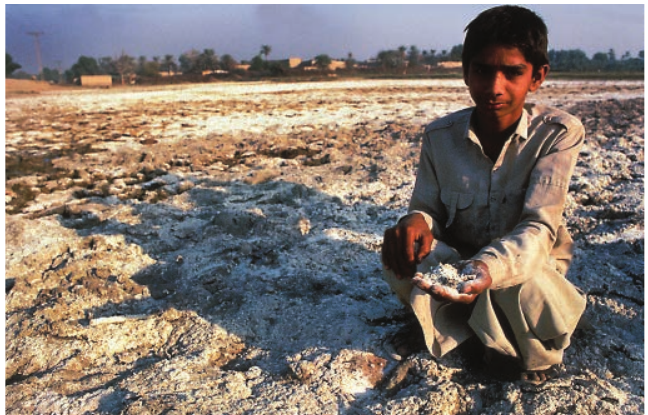
How salinisation develops
All irrigation water contains dissolved salts that it has picked up while passing over and through rocks and soil. This is particularly true for water from groundwater sources. Even rainwater contains some dissolved salts, though in much smaller concentrations.
The salt accumulation process works as follows:
- Irrigation water containing dissolved salts is applied to fields
- Water evaporates from the soil surface in dry conditions
- Salts cannot evaporate, so they remain behind in the soil
- Over time, repeated irrigation cycles cause salt concentrations to build up
Important
This problem is most severe in hot, semi-arid regions where:
- High temperatures increase evaporation rates
- Low rainfall means insufficient water to flush salts from the soil
- Irrigation is essential for crop production but limited rainfall cannot dilute or remove the salts
Effects of salinisation on plants
Salt can be directly toxic to plants at high concentrations, but its primary damaging effect is that it decreases the osmotic potential of soil water. This means water molecules are more strongly attracted to the dissolved salt than to plant roots. If the soil solution has higher concentrations of solute (dissolved salts) than the plant root, the plant cannot absorb water from the soil. Essentially, the plant experiences drought-like conditions even when surrounded by moist soil.
Global extent of salinisation
Salinisation affects agricultural land in more than one hundred countries worldwide, and irrigation is frequently a major contributing factor. Current estimates suggest:
- Approximately 10 per cent of all arable land globally is affected
- About 25 per cent of irrigated land experiences salt-related problems
The issue is particularly acute in hot, semi-arid regions that are poorly drained and heavily dependent on irrigation water. These areas lack sufficient rainfall to naturally flush salts from the soil profile. Examples include:
- The Northern Plain of China
- Central Asia
- The San Joaquin Valley of California, USA
- The Indus Plain of Pakistan
Note
In the Indus Plain, salt concentrations in some irrigated areas have risen high enough to significantly reduce crop yields. In extreme cases, farmers have abandoned land entirely because it has become too salty to farm profitably.
Managing salinisation
The theoretical solution to salinisation is to flush the soil with large quantities of water, washing the salts deeper into the soil profile or removing them entirely. However, this approach creates significant problems:
Downstream impacts - When the Lower Colorado River valley underwent salt flushing, the river became too salty downstream for Mexican farmers to use for irrigation. The United States government was forced to construct a desalination plant near the Mexican border to make the water useable again.
Water availability - In hot, semi-arid regions where salinisation is most problematic, there is rarely enough water available for effective salt flushing.
Salt accumulation - The flushing process does not remove the salts; it simply moves them to rivers and groundwater, causing salinisation of water resources.
Extreme cases - When the salt crust on the soil surface becomes too thick, water simply runs off the salty surface without infiltrating, making flushing impossible.
Important
The Salinisation Paradox
Flushing salts from soil with water may solve the immediate problem for farmers, but it creates downstream water quality issues and does not eliminate the salts from the environment - it merely relocates them. This makes salinisation one of the most difficult soil problems to manage sustainably.
Structural deterioration of soil
Soil structure is the arrangement of soil particles into groupings called peds or aggregates, which often form distinctive shapes found in certain soil horizons.
Well-aggregated soils are described as having 'good soil tilth'. Soil aggregation is a key indicator of soil workability - how easily soil can be cultivated. When soil particles group together into stable aggregates, they create pore spaces that allow:
- Water to circulate easily through the soil
- Air to reach plant roots
- Roots to penetrate to greater depths
- Better drainage and reduced waterlogging
Types of soil structure
Soil structures can be classified into four main categories:
Granular and crumb structures consist of individual particles of sand, silt and clay grouped together in small, nearly spherical grains. Water circulates very easily through such soils, making them highly desirable for agriculture. These structures are typically found in the top, A-horizon of the soil profile where organic matter accumulates.
Blocky structures form when soil particles cling together in nearly square or angular blocks with more or less sharp edges. Relatively large blocks indicate that the soil resists penetration and movement of water. Blocky structures commonly occur in the lower (B-horizon) layers of the soil profile where clay has accumulated over time.
Prismatic and columnar structures are soil particles that have formed into vertical columns or pillars separated by vertical cracks. There is some permeability, allowing water to move more slowly through the soil than in granular structures, but drainage is generally poor. These structures are also found in the lower, clay-rich layer of soil.
Platy structures consist of soil particles aggregated into thin plates or sheets piled horizontally on one another. Plates often overlap, greatly impairing water circulation through the soil. These structures are commonly found in forest soils and high latitude environments.
Causes of structural deterioration
Under natural conditions, the breakdown of soil structure is relatively rare. However, agricultural practices commonly damage soil structure. The two main causes are:
Reduction in soil organic matter:
Cultivation causes physical fracturing and mixing of soil, increasing aeration. This accelerated breakdown of soil organic matter releases nutrients but reduces the organic compounds that bind soil particles into stable aggregates.
When crops are harvested, most plant matter is removed from the field rather than being returned to the soil as decaying organic material. This continuous removal depletes the soil's organic matter reserves.
Burning stubble after harvest, though now less common, completely eliminates the return of organic material to the soil.
Compaction of soil:
Farm machinery creates compaction through a combination of pressure and sliding forces. Tractor wheels, plough soles and rotary blades exert concentrated weight on small areas of soil. When vehicles repeatedly travel over the same ground, the soil becomes compacted into ruts, which eventually become impermeable to water.
Grazing livestock, particularly cattle, compress the soil through a process known as poaching. Animal hooves exert significant pressure on wet soil, breaking down soil structure.
Note
Factors Affecting Soil Compaction
The way soil responds to pressure depends on several factors:
- Soil texture (the proportions of sand, silt and clay)
- How hard and deep the soil is
- The shape and weight distribution of the machinery or animal
- Contact area between the source of pressure and the soil
- Soil moisture content at the time
Compaction is particularly problematic in wet conditions when soil particles can be easily displaced and compressed.
Problems resulting from structural deterioration
From organic matter reduction:
The bonds holding aggregates together weaken as organic matter content decreases. Without these binding agents, aggregates cannot withstand disruptive forces such as raindrop impact.
Individual particles break away from the aggregates, causing structural breakdown. When heavy rain falls on soils with poor structure, a surface crust may form that impedes water infiltration. This can lead to surface waterlogging or increased runoff, creating seedling emergence problems.
From compaction:
The concentrated weight of farm vehicles repeatedly moving over the same ground compacts soil into ruts that become impermeable to water.
Rainwater gathers in ruts and runs off downslope, causing extreme cases of gully erosion.
Plough soles create an impermeable layer called a plough pan immediately below the depth of a plough furrow. This hard, compacted layer prevents water infiltration and restricts root penetration.
Livestock hooves compact soil, breaking structure and creating impermeable trampled areas prone to erosion.
Management of soil structure deterioration
To address organic matter loss:
- Reduce use of chemicals and avoid multi-harvesting practices that place soil under repeated pressure
- Replace lost organic material with compost or manure (though artificial fertilisers restore fertility, they do nothing to restore soil structure)
- Plant trees through agro-forestry schemes, as tree litter and debris from felled trees replenishes organic matter
- Leave land fallow or rotate crops to allow natural stabilisation of weakened soil structures
To address compaction:
- Use existing drive lines to minimise compaction over a wider area
- Reduce tyre pressure (low inflation tyres reduce compaction)
- Adopt conservation agriculture with zero tillage practices
- Use additional tool attachments behind tractor tyres to loosen compacted soil
- Avoid working soils when wet, as moist soil is particularly vulnerable to compaction
- Manage stock levels to sustainable rates that prevent overgrazing and excessive poaching
Example
Worked Example: Soil Structure Management Plan
Scenario: A farmer notices soil compaction and reduced yields in a field that has been intensively cultivated for five years with no organic matter additions.
Analysis:
Step 1: Identify the problems
- Soil structure deterioration from organic matter loss
- Compaction from repeated machinery use
- Reduced water infiltration and root penetration
Step 2: Develop management solutions
For organic matter restoration:
- Apply tonnes per hectare of composted farmyard manure annually
- Implement crop rotation including legumes
- Leave crop residues on the field after harvest
For compaction reduction:
- Use controlled traffic farming (designated wheel tracks only)
- Reduce tyre pressure to bar
- Avoid field work when soil moisture is above field capacity
- Deep rip compacted areas to break up plough pan
Step 3: Monitor improvements
- Test soil organic matter content annually
- Measure water infiltration rates
- Assess crop yields over time
Expected outcome: Within 2-3 years, soil structure should improve significantly, with better water infiltration, root development, and crop yields.
Summary
Key Points to Remember:
-
Soil erosion removes fertile topsoil through water and wind action. Approximately billion tonnes of topsoil are lost globally each year, reducing soil fertility and causing environmental damage.
-
Water erosion control focuses on reducing surface water flow through drainage systems, protective vegetation, contour ploughing and organic matter application. Wind erosion control relies on windbreaks, surface roughness, and maintaining at least ground cover.
-
Waterlogging creates anaerobic conditions that damage plant roots by preventing respiration. It can be surface-fed (from excess precipitation or irrigation) or groundwater-fed (from rising water tables).
-
Salinisation results from salt accumulation in irrigated soils when evaporation leaves dissolved salts behind. It affects of arable land globally and is difficult to remedy without creating downstream water quality problems.
-
Soil structural deterioration occurs through loss of organic matter and compaction from machinery and livestock. Good soil structure is essential for water circulation, root growth and preventing erosion. Management includes returning organic matter, reducing tillage, and avoiding work on wet soils.