The Demographic Dividend (AQA A-Level Geography): Revision Notes
📚Revision Notes
The demographic dividend
Understanding population structures
Countries around the world have very different population structures, which create distinct challenges and opportunities for development. The age composition of a population significantly affects economic growth, resource demands and social services.
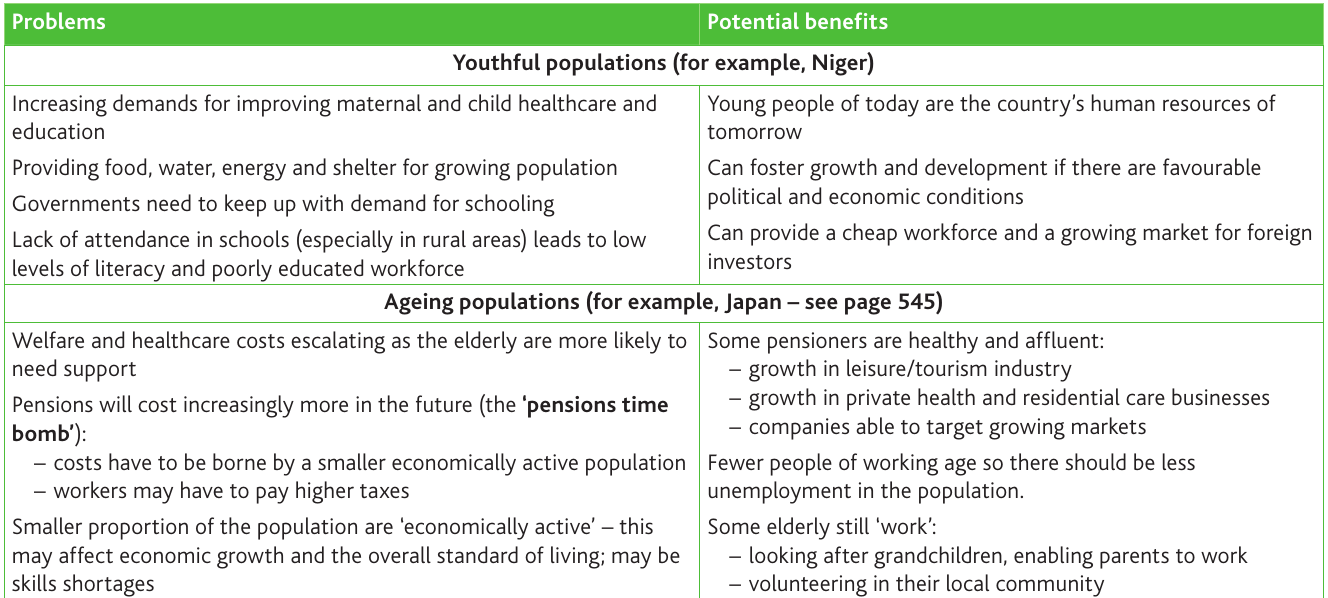
Youthful populations
Countries with youthful populations, such as Niger, have a large proportion of children and young people. This creates specific challenges:
- Healthcare demands: Growing populations require improved maternal and child healthcare services, putting pressure on medical facilities and resources
- Education provision: Schools must expand rapidly to accommodate increasing numbers of children, requiring substantial investment in buildings, teachers and materials
- Basic resource needs: Governments must provide adequate food, water, energy and shelter for rapidly growing populations
- Educational challenges: School attendance is often low, particularly in rural areas, leading to poor literacy rates and an inadequately educated workforce for the future
Note
Youthful populations face a critical challenge: they must invest heavily in education and infrastructure today to create the human resources needed for tomorrow's economy.
However, youthful populations also offer potential benefits:
- Future human resources: Today's young people represent tomorrow's workforce and economic potential
- Economic growth opportunity: If favourable political and economic conditions exist, a large young population can drive development
- Labour market advantages: A growing young workforce can attract foreign investors seeking affordable labour
- Market expansion: A large and growing population creates expanding domestic markets for goods and services
Ageing populations
Countries with ageing populations, such as Japan, face different challenges:
- Healthcare and welfare costs: As the proportion of elderly people increases, spending on healthcare and welfare support escalates
- Pension pressures: The 'pensions time bomb' refers to rapidly rising pension costs in the future, which must be funded by a smaller economically active population through higher taxes
- Shrinking workforce: A smaller proportion of the population is economically active, which may slow economic growth and create skills shortages in key sectors
However, ageing populations also have potential benefits:
- Affluent consumers: Many pensioners are healthy and affluent, supporting growth in the leisure, tourism and private healthcare industries. Companies can target these growing markets effectively
- Reduced unemployment: With fewer people of working age, unemployment rates may fall
- Social contribution: Elderly people often contribute through caring for grandchildren (enabling parents to work) and volunteering in their communities
What is the demographic dividend?
Important
Demographic dividend
The demographic dividend refers to the economic benefit a country experiences when its working population exceeds its dependants (children and elderly people). This boost in economic productivity results from having more people in the workforce relative to the number of dependants.
The demographic dividend represents a period when the population structure of a country creates conditions of low dependency. This means a large proportion of the population is of working age, while relatively few are dependent children or elderly people requiring support.
How the dividend occurs
The demographic dividend emerges due to a time lag between falling death rates and subsequently falling birth rates. This process typically unfolds over one or two generations:
- Death rates fall first: Improvements in healthcare, nutrition and sanitation cause mortality rates to decline, particularly infant and child mortality
- Birth rates remain high initially: Parents take time to adjust to lower infant mortality rates, continuing to have similar numbers of children as before
- Population growth accelerates: This creates a period of rapid population growth and produces a 'generational bulge' - a large cohort that moves up through the population pyramid over time
- Birth rates eventually fall: As parents adapt and have fewer children, the birth rate declines
- The bulge reaches working age: The large generation enters the workforce while there are fewer young dependants (due to falling birth rates) and relatively few elderly dependants (due to previously low life expectancy)
- Dependency ratio falls: The proportion of working-age people to dependants reaches its peak, creating optimal economic conditions
Note
The key to understanding the demographic dividend is recognizing the time lag: death rates fall first (due to improved healthcare), but birth rates take longer to decline as parents adjust their family planning. This creates a temporary surge in the working-age population.
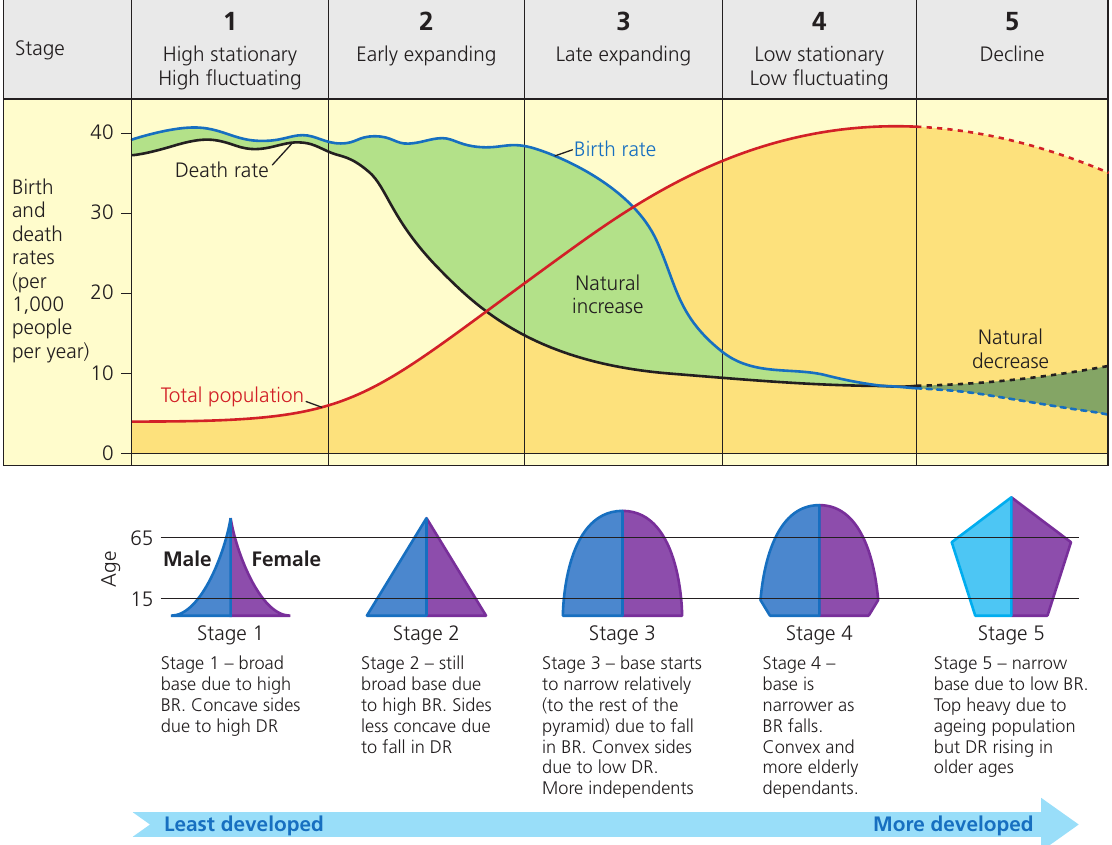
This demographic window appears most clearly in Stage 3 of the Demographic Transition Model, where birth rates are falling but the working-age population remains large. Countries like China, Brazil and India have experienced this transition relatively quickly over the past 50 years.
Population pyramids and demographic stages
Different countries are at various stages of demographic transition, which is reflected in their population pyramid shapes:
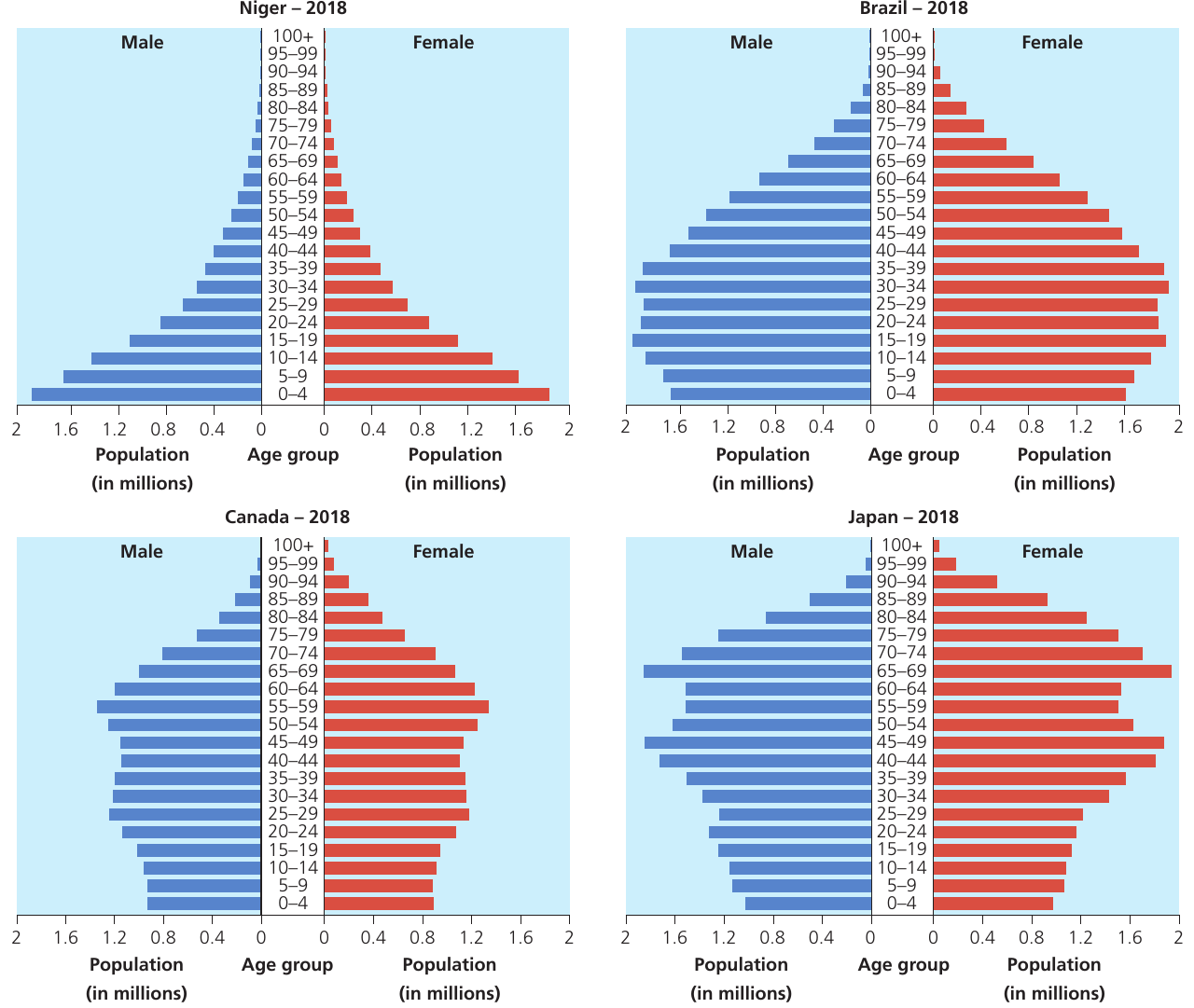
- Niger (2018): Shows a classic expansive pyramid with a very wide base, indicating high birth rates and a youthful population. This represents early demographic transition stages
- Brazil (2018): Displays a transitional pyramid with a moderating base, showing falling birth rates but still a large working-age population. Brazil is experiencing its demographic dividend
- Canada (2018): Has a more rectangular pyramid shape, indicating stable or slowly ageing population with relatively balanced age groups
- Japan (2018): Shows a constrictive pyramid with a narrow base and bulging elderly cohorts, representing an ageing society with very low birth rates and high life expectancy
Note
Population pyramids are powerful visual tools that reveal a country's demographic stage at a glance. The shape tells you whether the population is growing rapidly (wide base), transitioning (narrowing base), or ageing (narrow base with wide middle or top).
Economic benefits of the demographic dividend
When a country experiences its demographic dividend, several powerful economic benefits can emerge:
Workforce expansion
A large, young and educated workforce becomes available, attracting investment from transnational corporations (TNCs) and other foreign investors seeking skilled labour. This can stimulate industrial growth and employment opportunities.
Increased savings and investment
Workers with fewer children can invest more of their income rather than spending it on childcare and education. This leads to:
- Greater financial stability for families
- Increased domestic savings rates
- More capital available for investment in businesses and infrastructure
- Enhanced economic growth potential
Gender equality and female participation
Fewer children per family means more women can join the workforce rather than focusing solely on childcare. This promotes:
- Greater gender equality in employment
- Increased household incomes
- Enhanced skills and education levels across the population
- Social progress alongside economic development
Note
The increased participation of women in the workforce is both an economic benefit and a social advancement. This dual impact makes it one of the most significant outcomes of the demographic dividend.
Growing consumer markets
A larger proportion of economically active, salaried workers creates an expanding market for goods and services. This growing consumer base stimulates:
- Domestic economic activity
- Business development
- Retail and service sector growth
- Attraction of international brands and investors
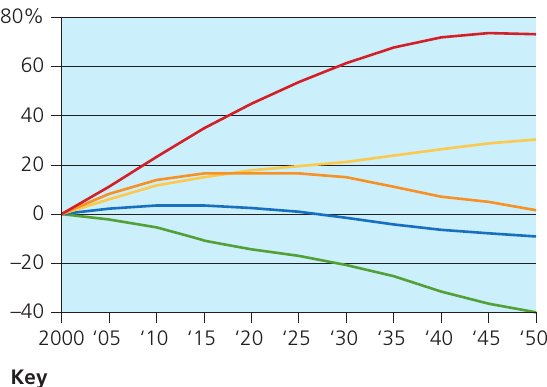
The graph shows how working-age populations are projected to change dramatically between 2000 and 2050. India shows strong growth in its working-age population, whilst Europe and particularly Japan face significant declines.
Conditions for maximizing the dividend
Countries can only take advantage of their demographic dividend if certain conditions are met. The dividend represents a valuable but temporary opportunity that requires proper preparation and policy.
Important
Critical Requirements for Success
The demographic dividend is not automatic - it requires deliberate policy action and investment. Without the right conditions in place, countries can miss this one-time opportunity entirely.
Essential requirements
- Investment in education: The workforce must be educated and skilled to meet the demands of modern economies. Without adequate education, the demographic advantage is wasted
- Employment creation: Jobs must be available for the growing working-age population. This requires investment in industry, infrastructure and business development
- Political stability and good governance: Investors need confidence that the country offers a stable environment with transparent and democratic institutions
- Encouragement of foreign investment: Governments should create policies that attract international companies whilst protecting workers' rights and environmental standards
- Natural resource base: Countries with rich natural resources can better support growing demand, as seen in Brazil and China
Examples of success
The Asian Tiger economies (South Korea, Taiwan, Singapore, Hong Kong) provide excellent examples of countries that successfully capitalised on their demographic dividends through strategic investment in education, infrastructure and export-oriented industries. China and Brazil have also leveraged their demographic transitions to achieve remarkable economic growth.
Challenges and sustainability
However, several factors can prevent countries from benefiting fully from their demographic dividend.
Barriers to success
Important
Major Obstacles to Realizing the Dividend
Even with favorable demographics, countries can fail to capitalize on the dividend if these barriers are not addressed:
- Poor educational attainment: Without quality education, the workforce cannot meet the skill requirements of modern industries
- Lack of transparency and democracy: Corruption and poor governance deter investment and prevent economic opportunities from materialising
- Political instability: Conflict and instability drive investment away and may cause young people to emigrate, taking their skills elsewhere
- Youth emigration: If employment opportunities are lacking, educated young people may leave for better prospects abroad, wasting the dividend
Countries like Myanmar have struggled to benefit from their demographic potential due to these challenges.
Environmental and sustainability concerns
The boost in productivity and economic growth creates extra demand in the economy, which can cause:
- Environmental degradation
- Increased pressure on natural resources
- Pollution and habitat destruction
- Climate change impacts
Note
Economic growth during the demographic dividend period must be balanced with environmental sustainability. The resources consumed during this period of rapid development must be managed carefully to prevent long-term damage that could undermine the benefits gained.
These resources must be managed sustainably to prevent long-term damage. The demographic dividend itself can only be sustained by managing fertility rates at replacement level. Even then, improved life expectancy will eventually cause the bulge to move up the pyramid, creating an ageing population structure. This will put pressure on services such as healthcare, creating new challenges for future generations.
The temporary nature of the dividend
It is important to understand that the demographic dividend is a 'one-time opportunity' for most countries. The favourable age structure is temporary - the large working-age cohort will eventually age, and if birth rates remain low, the population structure will shift towards an ageing society with renewed dependency challenges. This makes it crucial for countries to maximise the benefits during the window of opportunity.
Remember!
Summary
Key Points to Remember:
-
The demographic dividend occurs when the working-age population exceeds dependants, creating economic opportunities through a low dependency ratio
-
The dividend results from a time lag between falling death rates and falling birth rates, creating a large working-age cohort or 'generational bulge'
-
Economic benefits include a large educated workforce, increased savings and investment, more women in employment, and growing consumer markets
-
Countries must invest in education and employment and maintain political stability to capitalise on the dividend - it is not automatic
-
The demographic dividend is a temporary opportunity that eventually leads to an ageing population structure, requiring sustainable resource management and long-term planning