Supply and Globalisation (AQA A-Level Geography): Revision Notes
📚Revision Notes
Supply and Globalisation
The global energy landscape is increasingly interconnected, with oil and gas playing central roles in international trade. Understanding how energy resources move around the world and who controls them is crucial for grasping modern energy security challenges.
Competing national interests
Oil and gas are among the most heavily traded commodities globally. Their uneven distribution across the planet creates significant challenges, as both producing and consuming nations are sensitive to events affecting supply and demand.
Important
Countries dependent on imported oil face particular vulnerability when external events disrupt their energy supplies. This creates a complex web of international dependencies and geopolitical tensions.
Future scenarios for fossil fuel trade
As non-renewable fossil fuel reserves continue to decline, several patterns are emerging:
- European dependence will remain substantial, with continued reliance on oil and gas imported from multiple supplier nations
- Asian demand for Gulf oil is set to increase as economies like China and India continue rapid industrialisation
- China's strategy involves developing oil reserves in Africa, particularly in countries such as Chad and Sudan
- US tight oil reserves are being exploited, transforming the USA into a net oil exporter, though the country will still import certain grades needed for refining processes
- Natural gas growth is accelerating as the fastest-growing tradeable primary energy source, requiring increased investment in cross-border pipelines and LNG (liquefied natural gas) tankers
- Russia's expansion of oil exports to China, Japan and South Korea through the East Siberian Pacific Ocean (ESPO) pipeline, whilst maintaining gas and oil supplies to Europe
- Renewable energy sources are gradually increasing their share, which will slowly reduce dependence on fossil fuel trade
Note
Aside from growing trade between Russia and its eastern Asian partners, significant changes to global oil production and trade patterns are unlikely in the near future.
Role of transnational corporations (TNCs)
Important
A transnational corporation (TNC) is a large company that operates across multiple countries, involved in various stages of resource extraction, processing and distribution.
Major energy TNCs dominate the international oil and gas sector. In 2018, six of the top ten largest TNCs by revenue were oil companies, including Royal Dutch Shell, BP and Exxon-Mobil. These wealthy energy corporations wield significant influence over global energy markets and can shape economic activities in host countries. They can even influence government policies, sometimes by being granted exploration rights in specific areas to begin resource development there.
How TNCs operate
Energy TNCs typically participate in all stages of resource development, organising their activities into three key areas:
- Upstream – exploration and drilling activities to locate and extract resources
- Midstream – transportation of resources via pipeline or tanker vessels
- Downstream – refining crude oil into various products for distribution and sale to consumers
Note
Many TNCs engage in joint ventures with other energy companies or with host governments where they operate. This collaborative approach allows them to share risks, combine expertise and navigate local political environments.
Increasingly, major TNCs are adapting to energy transition by investing considerably in renewable energy development, positioning themselves for a lower-carbon future.
Developing country energy companies
Energy companies based in developing nations are also gaining global influence. These companies largely control production within their own countries. Some are fully or partially state-owned, such as Sinopec and CNPC in China (51% state-owned), Gazprom in Russia (state-owned), and Petrobras in Brazil (a semi-public company).
Case study: Royal Dutch Shell
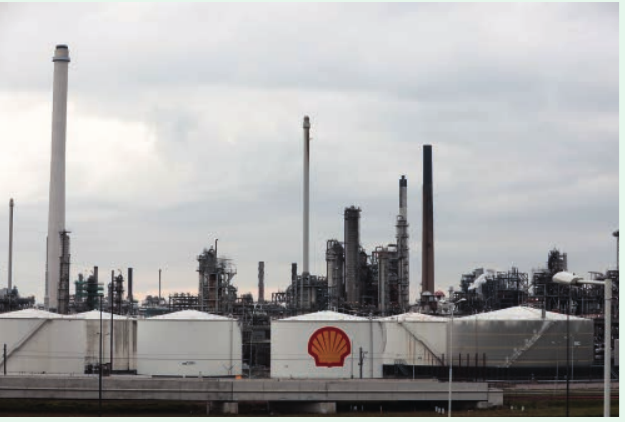
Shell is an Anglo-Dutch transnational oil and gas company headquartered in the Netherlands, representing one of the world's largest energy corporations.
Vertical integration
Shell demonstrates vertical integration, meaning it is active across every stage of the oil and gas industry:
- Exploration and production – using geological expertise to locate new reserves
- Refining – operating 35 refineries globally
- Distribution – maintaining its own fleet of oil tankers and lorries
- Petrochemicals – producing chemical products derived from petroleum
- Power generation and trading – involvement in electricity markets
- Renewable energy investment – developing alternative, sustainable energy sources with ambitions to become a major electricity supplier
Note
Shell operates in over 70 countries and produces approximately 3.7 million barrels of oil equivalent per day. Major production activities occur in South East Asia and in the Niger Delta region of Nigeria.
Shell has faced criticism for damaging local communities and the environment in areas like the Niger Delta. However, the company also provides employment and income whilst improving skills, education and training for local workforces.
Shell frequently collaborates through consortiums or joint ventures with other companies. For instance, it works with Petronas (the Malaysian state company) to gain exploration rights, or partners with other TNCs to invest in mutually beneficial infrastructure such as oil pipelines.
Case study: Athabasca tar sands development in Alberta, Canada
Background to unconventional oil sources
As conventional crude oil sources become depleted, unconventional sources such as bitumen found in tar sands (also known as oil sands) are playing an increasing role in offsetting declining conventional production.
Location and scale
Canada's tar sands reserves are concentrated in three major deposits in Alberta province, where they underlie approximately 140,000 km² of pristine boreal forest – an area roughly the size of Florida state. The largest and most commercially viable deposit is the Athabasca River deposit.
Note
Extraction Methods and Scale:
Only 20% of the oil sands lie near enough to the surface for open-pit strip mining. The remaining deposits, located more than 75 metres below ground, require extraction using thermal 'in-situ' methods.
Current estimates suggest the tar sands contain 175 billion barrels of recoverable crude bitumen reserves.
Extraction development
The oil sands have been mined since the 1960s, but significant advances in extraction technology combined with rising oil prices have made large-scale commercial exploitation increasingly viable.
Summary
Key Points to Remember:
- Oil and gas remain the most traded energy commodities globally, making countries dependent on imports vulnerable to supply disruptions
- Six of the world's ten largest TNCs are oil companies, giving them enormous influence over global energy markets and national economies
- TNCs operate across three key stages: upstream (exploration/drilling), midstream (transportation), and downstream (refining/distribution)
- Shell exemplifies vertical integration, operating in over 70 countries across all stages of the oil and gas industry
- Unconventional sources like Alberta's tar sands are becoming increasingly important as conventional oil reserves decline, with Canada's deposits estimated at 175 billion barrels