Supply and Physical Geography (AQA A-Level Geography): Revision Notes
📚Revision Notes
Supply and Physical Geography
The availability of energy resources depends heavily on physical geography. Different energy sources are constrained by distinct physical factors. For fossil fuels like coal, oil and natural gas, geological conditions determine where deposits form and whether they can be economically extracted. For renewable energy sources such as wind and solar power, climate patterns are the primary limiting factor. Hydroelectric power depends on the physical characteristics of drainage basins.
Geology
Geological processes occurring over millions of years create the fossil fuel deposits we rely on today. Understanding these processes helps explain why energy resources are unevenly distributed across the planet.
Coal formation and types
Coal originates from plant material that accumulated in swampy environments millions of years ago. This organic matter was buried under layers of sediment in anaerobic (oxygen-free) conditions, which slowed decomposition. As more sediment accumulated on top, the plant debris was subjected to increasing heat and pressure over geological time.
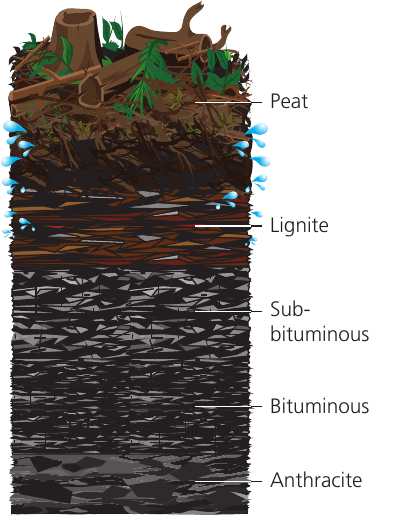
This process transforms the organic material through several stages in what is called coalification. Initially, the plant matter becomes peat, then progressively changes into different types of coal as heat and pressure increase. During coalification, moisture and volatile materials are driven off, while the carbon content increases. The longer the process continues, the higher the quality of coal produced.

Important
Coalification is the geological process through which buried plant material is transformed into coal through the application of heat and pressure over millions of years. This process progressively increases the carbon content and energy density of the coal.
Different types of coal form depending on how long the coalification process has continued:
-
Anthracite: The highest grade coal with 86-98% pure carbon. It burns very hot with little smoke, making it an excellent fuel for heating homes. It is relatively rare because it requires the most intense heat and pressure to form.
-
Bituminous coal: Contains 70-86% carbon. This is the most abundant type of coal and is used to produce coke, which is essential for steel production in blast furnaces.
-
Sub-bituminous coal: Contains 70-76% carbon. It is burned in industrial boilers for electricity generation and heating.
-
Lignite: The lowest grade coal with only 65-70% carbon. Often called 'brown coal', it has high moisture content and is a low-grade fuel used in industrial boilers. It represents an early stage in the coalification process.
Note
For electricity generation, thermal power stations use a grade called steam coal, which falls between anthracite and bituminous coal in quality. The coal is ground into a fine powder before burning, increasing its surface area so it combusts more rapidly and efficiently.
Oil and natural gas formation
Oil and natural gas are hydrocarbons formed from the remains of marine organisms (plankton, algae, and small animals) that settled on the seafloor millions of years ago. These organic remains were buried in fine-grained sedimentary rocks called source rocks, such as shale.
As burial continued and temperatures rose above 110°C, the organic matter underwent chemical changes. It first transformed into a waxy substance called kerogen. With further heating, the kerogen broke down into liquid oil. If temperatures became even hotter, the oil was converted into natural gas.
Once formed, oil and gas do not stay in the source rock. Pressure forces these fluids to migrate upwards and sideways through the rock layers. They move into more porous and permeable rocks (such as sandstone), which have spaces between their grains that allow fluids to flow through them.
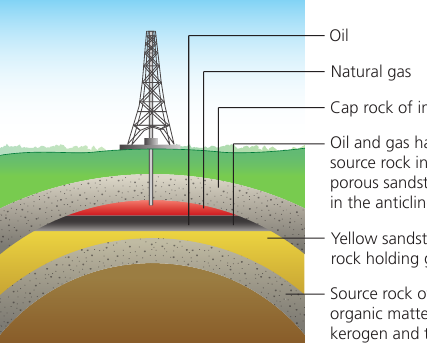
For oil and gas to accumulate in sufficient quantities to be worth extracting, they must become trapped. This happens when their upward migration is blocked by an impermeable rock layer called a cap rock. The cap rock acts as a seal, and the oil and gas slowly build up in the porous rock beneath it, forming a reservoir.
Important
A reservoir is a sedimentary rock formation that holds oil, natural gas, or both within its pore spaces. The rock acts like a sponge, with all the spaces filled with water, gas or oil. Crude oil is a complex mixture of hydrogen, carbon and trace elements.
There are two main types of geological traps:
Structural traps form where the Earth's crust has been deformed through tectonic forces. The most common is an anticline trap, where rock layers have been folded upwards into a dome shape. Oil and gas accumulate at the highest point of the dome, with natural gas (being the lightest) at the top, oil in the middle, and water at the bottom.
Stratigraphic traps form due to changes in the rock layers themselves, such as where a porous reservoir rock thins out or changes into impermeable rock.
Unconventional oil and gas reserves
Traditional oil and gas extraction involves drilling vertically down into conventional reservoirs. However, new technology has made it possible to access hydrocarbons that were previously considered uneconomical to extract.
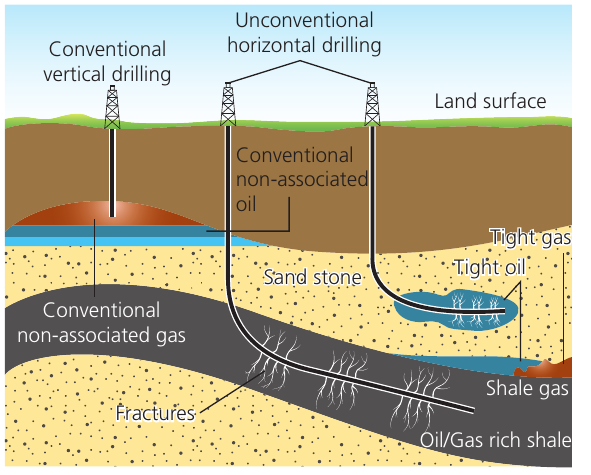
Hydraulic fracturing (fracking) has enabled the development of unconventional reserves, particularly from shale rock. Shale contains oil and gas, but its pore spaces are so tiny that these fluids cannot flow through it easily into a conventional well.
Note
Modern drilling techniques overcome this problem through a multi-step process. Engineers drill down to the shale layer, then turn the drill bit to bore horizontally through the rock. High-pressure water is pumped down the well to fracture the shale, creating new pathways for trapped oil and gas to flow into the well and be pumped to the surface.
Modern drilling techniques overcome this problem through several steps:
- Engineers drill down to the level of the shale layer
- The drill bit then turns to bore horizontally through the shale rock
- Water is pumped down the well at extremely high pressure
- This pressure fractures the shale rock, creating new pathways
- The fractures allow trapped oil and gas to flow into the well
- The hydrocarbons can then be pumped to the surface
This technology has transformed previously 'possible resources' of oil and gas into accessible 'measured reserves'. Areas that were once written off as uneconomical have become productive oil and gas fields.
Oil and tar sands represent another type of unconventional petroleum deposit. These are bituminous sands that have become resource frontiers due to technological advances. Major deposits exist along the Athabasca River in Alberta, Canada, and in the Orinoco basin in Venezuela (though these are technically 'heavy oils' rather than tar sands).
The bitumen in tar sands is too thick to be pumped as a liquid, so it must be extracted through strip mining or open pit mining. The relatively low recovery rate (around 10% of oil) is compensated for by the massive scale of the reserves and relatively low extraction costs. However, approximately four tonnes of tar sands are needed to produce just one barrel of oil.
Climate
Climate conditions determine the viability and productivity of renewable energy sources, particularly solar and wind power.
Solar energy
Solar energy can theoretically be harnessed anywhere that receives sunlight, making it abundantly available globally. However, its effectiveness varies considerably depending on location and weather patterns. Solar power is less practical in overcast or cloudy regions and cannot generate electricity at night, requiring storage solutions to provide continuous power.
Several climatic factors affect how much solar energy can be captured:
Sunlight availability:
- Tropical and sub-tropical regions receive the most reliable and regular sunlight throughout the year
- At these latitudes, the sun follows a higher arc across the sky, meaning days are longer and more solar energy is available
- Cloudy regions face challenges with solar systems, though they can still function (it simply becomes harder to justify the investment economically)
Note
Fog, smog and air pollution: These atmospheric conditions reduce the amount of sunlight reaching solar panels, significantly decreasing their output. Even in sunny regions, high levels of air pollution can substantially impact solar panel efficiency.
Air density: Solar panels perform better at higher elevations in mountainous areas than at sea level. This is because thinner air at altitude scatters less sunlight, allowing more direct solar radiation to reach the panels.
Snowfall: Photovoltaic (PV) systems cannot operate effectively when covered by heavy layers of snow, making them less reliable in regions with harsh winters.
Rainfall: While not directly blocking sunlight, rain can damage electrical and metallic components of solar installations if they are not properly protected. Humid conditions also increase the susceptibility to corrosion.
Wind: Frequent strong winds pose two problems for solar installations. They can physically damage panels and mounting structures. Additionally, wind cools down the surfaces of solar water heating panels rapidly, reducing their efficiency.
Wind energy
Wind energy is inherently variable and intermittent, making it a challenging renewable resource to rely upon. For economic reasons, wind farms are most viable in locations where the average wind speed exceeds 5.5 metres per second.
Several wind speed thresholds are important for turbine operation:
Wind speed requirements:
- The minimum wind speed at which turbines begin generating usable electricity is between 7 and 10 mph for most designs
- The minimum speed at which a turbine reaches its designated maximum power output (called 'rated power') is between 25 and 35 mph
- At very high wind speeds of 50-80 mph, turbines must shut down completely. This is a safety feature (the 'cut-out speed') that protects the turbine from damage
Important
Turbine spacing: Wind turbines must be positioned well apart from each other to prevent eddying (turbulent air flow) or reductions in wind speed between turbines. This means wind farms require large areas of land, even though the turbines themselves occupy relatively little ground space.
Air density: The denser the air, the more energy can be extracted by a turbine. Air is less dense at higher elevations than at sea level. Warm air is also less dense than cold air. This means wind farms at sea level in cold climates can generate more power than those at high elevation or in warm regions, assuming wind speeds are equal.
Prevailing winds: Optimal conditions for wind energy generation exist where there is a consistent, prevailing wind direction. This allows turbines to be positioned and oriented for maximum efficiency.
Note
The UK possesses excellent wind energy potential compared to other European countries. Its position at temperate latitudes on the north-east rim of the Atlantic Ocean provides a long fetch of uninterrupted air flow. Prevailing south-westerly winds blow consistently across the ocean, providing reliable wind resources for both onshore and offshore wind farms.
Drainage systems for hydroelectric power
The physical characteristics of drainage basins determine whether large-scale or small-scale conventional hydroelectric power (HEP) can be developed. Dam construction requires specific geographical conditions.
Two fundamental factors determine the potential electricity generation:
Flow: This is the volume of water moving through the river system. Rivers with high discharge provide more water to turn turbine generators.
Head: This is the height through which the water falls, representing its potential energy. The greater the vertical drop, the more energy is available for conversion to electricity.
The relationship between these factors is expressed in the equation:
Note
The topography of the drainage basin is crucial for dam site selection. An ideal location is a steep-sided valley basin with a relatively narrow exit. This design maximises the volume of the reservoir while making dam construction more manageable and cost-effective.
The geology of the area must also be suitable. The rocks underlying and surrounding the dam site should be:
- Stable: capable of supporting the immense weight and pressure of the dam structure
- Impermeable: preventing water seepage that would undermine the dam's integrity or reduce reservoir capacity
These geological requirements ensure the dam remains secure and maintains water levels effectively for power generation.
Summary
Key Points to Remember:
-
Coal forms through coalification: Plant material buried in swamps undergoes increasing heat and pressure over millions of years, progressively transforming from peat through lignite, sub-bituminous, and bituminous coal to anthracite, with carbon content increasing at each stage.
-
Oil and gas require geological traps: Hydrocarbons migrate from source rocks through permeable rocks until blocked by impermeable cap rocks. Structural traps (like anticlines) and stratigraphic traps create the reservoirs where oil and gas accumulate in extractable quantities.
-
Hydraulic fracturing accesses unconventional reserves: Horizontal drilling and high-pressure water injection fractures tight shale rock, releasing trapped oil and gas that cannot flow through conventional methods, transforming 'possible resources' into 'measured reserves'.
-
Climate determines renewable energy viability: Solar power depends on sunlight intensity, air density and atmospheric clarity, being most effective in tropical and sub-tropical regions. Wind power requires average speeds above 5.5 m/s and optimal conditions include consistent prevailing winds and cooler, denser air.
-
HEP requires specific drainage basin characteristics: Power generation depends on both flow (water volume) and head (vertical drop). Ideal sites have steep-sided valleys with narrow exits and stable, impermeable geology to support dam construction and maintain reservoir integrity.