Supply Management Strategies (AQA A-Level Geography): Revision Notes
📚Revision Notes
Supply Management Strategies
Introduction to supply management
To ensure energy security, countries need to develop strategies that make future energy supplies more reliable and dependable. At the same time, these strategies must work alongside efforts to reduce consumption by improving energy efficiency.
A key decision in energy security planning involves diversifying the energy mix. Countries like the UK aim to avoid becoming too dependent on a single energy source, which would leave them vulnerable to economic disruption and supply shortages.
Note
Energy security depends on two complementary approaches: ensuring diverse and reliable energy supplies while simultaneously improving energy efficiency to reduce overall consumption.
Oil and gas exploration
Finding new reserves
When fossil fuel prices increase, countries invest more effort in exploring for new oil and gas reserves. This includes reassessing speculative reserves to determine whether they have become economically viable to develop. Governments become more willing to grant exploration rights during these periods.
UK oil and gas exploration
Although North Sea oil and gas production has passed its peak, exploration continues and new discoveries are still being made.
In 2019, gas production started from the large Culadan field located 230 km off the Aberdeenshire coast. This project required significant investment:
- A special three-platform rig costing over \£3 billion to access the gas
- The field is operated by Total
- It supplies five per cent of the UK's demand for gas

Hydraulic fracturing (fracking)
Rising oil and gas prices encourage transnational corporations (TNCs) to develop new technologies for accessing previously unviable reserves. Hydraulic fracturing is one such technology that has been successful in the USA.
In England, fracking operations by companies such as Cuadrilla have faced opposition. The UK government stopped these operations in November 2019 following environmental protests. Key concerns included:
- An earth tremor measuring 2.9 in magnitude was recorded near Cuadrilla's Lancashire site in August 2019
- The government cited fears of damage from earthquake tremors as the reason for placing a moratorium on operations
- However, they stopped short of an outright ban
Important
Fracking remains controversial due to environmental concerns, particularly the risk of seismic activity. The UK government placed a moratorium on fracking operations in 2019 following earthquake tremors, though this falls short of a complete ban.
Nuclear power
Nuclear power is a long-term, efficient energy source that provides a viable alternative for energy security in many countries that have become over-reliant on fossil fuels.
Current nuclear capacity in the UK
Nuclear power currently generates around 20 per cent of the UK's electricity. However, all operating energy plants will be closed by 2030, except Sizewell B in Suffolk. This is significant because no new reactors have been opened since the Pressurised Water Reactor (PWR) at Sizewell B was commissioned in 1995.
Plans for new nuclear capacity
The UK's Department of Business, Energy and Industrial Strategy (BEIS) plans to increase new nuclear capacity as an important part of growing energy supply. The UK government relies on the private sector to build new reactors, although funding remains a challenge.
Example
Major Nuclear Project: Hinkley Point C
Construction for EDF's twin reactors at Hinkley Point in Somerset (C1 and C2) started in 2012. They are expected to be operational by 2025.
Key Project Details:
- Total investment: \£25 billion
- Developers: EDF (French energy company)
- Requirement: Guaranteed electricity rates to secure investment
- Significance: First new UK reactors since 1995
This project illustrates both the potential and challenges of nuclear power expansion - while it will provide substantial low-carbon energy, the enormous costs require government-backed financial guarantees to attract private investment.
Challenges facing new projects
Several proposed nuclear projects have faced difficulties:
- Projects at Oldbury (Gloucestershire) and Wylfa (Anglesey) have been shelved as developers Hitachi-GE failed to attract investors
- Plans for new reactors at Sizewell C and Bradwell B (Essex) in the mid-2030s using Chinese technology mean that nuclear power will remain part of the UK energy supply strategy for the rest of the century
Benefits of nuclear power
There are important reasons why nuclear power remains an essential part of a country's energy supply strategy:
- Low carbon emissions: It is a low carbon choice that supports climate change goals by generating electricity without emitting greenhouse gases
- Reliable baseload power: It produces electricity 24 hours a day, regardless of the weather
- Fuel efficiency: Reactors do not require a daily supply of new fuel to operate
Note
Nuclear power offers three critical advantages for energy security: continuous 24/7 operation independent of weather conditions, extremely low carbon emissions supporting climate goals, and high fuel efficiency requiring minimal fuel replenishment compared to fossil fuel plants.
Development of renewable resources
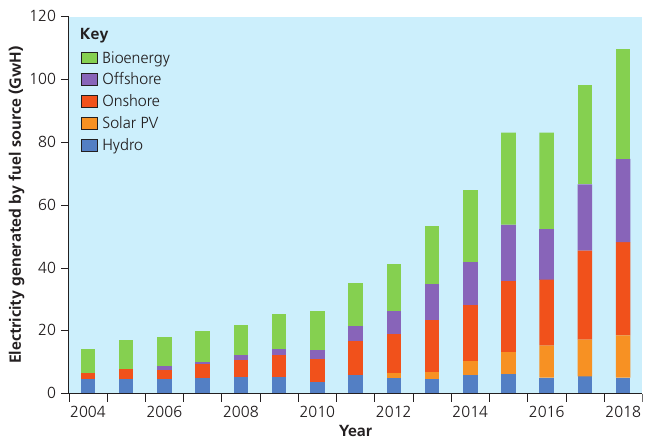
Since the Paris Climate Agreement was signed in 2016, developing renewable energy has become a key strategy to increase energy supply in many countries. However, high installation costs often require government intervention through subsidies.
More recently, the drive for energy transition and decarbonisation has increased market demand and investment from the private sector.
Government support for renewables
In the UK, various government subsidies were offered to provide financial support for renewable electricity suppliers. These were stopped in 2015 because falling installation costs meant they were no longer necessary.
The government's Review of Energy Policy in 2019 placed climate change higher on the agenda than ever before. The UK committed to net zero greenhouse gas emissions by 2050.
Important
Contracts for Difference (CfD) is the BEIS's main mechanism for supporting low carbon electricity generation. It incentivises investment in renewable energy but also supports nuclear and carbon capture development.
The CfD scheme guarantees a minimum price for electricity generated from low-carbon sources, reducing financial risk for investors and encouraging private sector investment in renewable infrastructure.
Growth of renewable energy in the UK
Incentives have driven rapid growth of renewable energy in the UK, particularly from wind, solar and biomass sources. The UK has become the world leader in offshore wind energy, which generates around 10 per cent of the nation's energy supply.
By 2019, renewable energy competed with gas to become the largest source of power in the UK. Both contributed around 39 per cent of the electricity mix. With nuclear energy still providing nearly 20 per cent, renewables have largely replaced coal in the country's electricity mix.
Note
The UK's renewable energy sector has experienced remarkable transformation since the Paris Agreement. In just a few years, renewables grew from a minor contributor to matching gas as the dominant electricity source, demonstrating the effectiveness of government support mechanisms and private sector investment.
Notable UK renewable energy projects
Example
Leading UK Renewable Energy Installations
Solar Power:
- Blackfriars Bridge: The world's largest solar bridge with 4,400 solar PV panels installed on its roof spanning the Thames. It provides over 50 per cent of the energy for Blackfriars Station.
Wind Power:
- Walney Extension (659 MW) off the Cumbrian coast
- London Array (630 MW) - UK's largest offshore wind farms
- Whitelee (539 MW) on Eaglesham Moor in Scotland - largest onshore wind farm
Biomass:
- Drax thermal power station in North Yorkshire generates two-thirds of its 4,000 MW capacity by burning wood pellets imported from Canada and the USA (the remainder is generated from coal)
These projects demonstrate the UK's commitment to diverse renewable energy sources and showcase the scale of investment in low-carbon electricity generation.
Demand management strategies – managing energy consumption
The focus is set to reduce overall energy consumption through international agreements such as the Paris Agreement. Energy conservation efforts are mostly driven by:
Government incentives
Governments provide financial support for energy-saving measures. For example, they may subsidise householders' loft and cavity wall insulation to reduce heat loss from homes.
Media campaigns and awareness
Campaigns to raise awareness about energy saving may be government-led or run by energy-saving NGOs such as the Carbon Trust. These help educate the public about ways to reduce consumption.
Pricing strategies
The cost of fuel provides a natural incentive for energy saving. However, off-peak electricity pricing can also reduce pressure on electricity generation by encouraging people to use energy at different times of the day.
Household energy saving
The EU Directive on the Energy Performance of Buildings is part of government strategy for tackling climate change. The directive requires an Energy Performance Certificate (EPC) to be issued whenever a property is constructed, rented out or sold.
Example
Energy Performance Certificates (EPC)
The EPC shows the energy efficiency rating of a dwelling on an A–G rating scale, similar to those used for household appliances.
Purpose:
- Helps potential buyers or renters understand how energy efficient a property is
- Encourages property owners to make energy efficiency improvements
- Provides clear comparison between different properties
- Required by law when properties are constructed, rented or sold
This regulation creates market incentives for energy efficiency by making it a visible factor in property decisions, driving improvements across the housing sector.
Note
Demand management strategies work through multiple mechanisms: direct financial incentives reduce the cost barrier to energy-saving improvements, awareness campaigns educate consumers about conservation opportunities, pricing strategies encourage behavioral changes in energy use timing, and regulations like EPCs create market-driven incentives for efficiency improvements.
Summary
Key Points to Remember:
-
Supply management strategies aim to increase the reliability and diversity of energy sources whilst reducing dependence on single fuels
-
Nuclear power provides low-carbon, 24/7 electricity generation but requires significant investment and faces public concerns
-
Renewable energy has grown rapidly in the UK since 2016, with wind, solar and biomass now competing with gas as the largest electricity sources
-
Demand management strategies focus on reducing consumption through incentives, awareness campaigns, pricing mechanisms and regulations like EPCs
-
The UK aims to achieve net zero greenhouse gas emissions by 2050 through a combination of supply and demand management approaches
-
Contracts for Difference (CfD) scheme is the government's primary tool for encouraging investment in low-carbon electricity generation
-
By 2019, renewable energy and gas each contributed around 39% of UK electricity, marking a historic shift away from fossil fuels