Copper (AQA A-Level Geography): Revision Notes
📚Revision Notes
Copper
Introduction to copper
Copper (Cu) is the third most-used metal globally, ranking behind only steel and aluminium. As a base metal, copper possesses valuable physical properties that make it essential across numerous industries. Its importance to modern economies and infrastructure cannot be overstated.
Note
Base metal
A base metal is a common, relatively inexpensive metal that oxidises or corrodes easily when exposed to air or moisture. Copper is classified as a base metal despite its high value due to its widespread availability and industrial applications.
Where copper is found
Formation and occurrence
Copper ores occur primarily in two geological settings:
- Igneous rocks - where copper forms as hydrothermal deposits
- Sedimentary rocks - where copper accumulates through chemical processes
For a copper mine to be economically viable, the ore must contain sufficient copper concentration. Mining operations typically only develop when there is more than 5 kg of copper per tonne of rock (equivalent to 0.5 per cent of mass).
Important
Cut-off ore grade
The cut-off ore grade is the minimum concentration of metal in ore that makes extraction economically worthwhile. For copper, this is typically 0.5 per cent, though ideally operations target closer to 2 per cent to establish a profitable reserve.
Major copper ores
Three main mineral ores contain most of the world's copper:
- Bornite - a copper iron sulphide mineral
- Chalcopyrite - currently the most common source, accounting for approximately 50 per cent of global copper production
- Malachite - a green carbonate mineral
The chemical formula for chalcopyrite is , making it a copper-iron sulphide compound.
How copper deposits form
Copper ore formation involves complex geological processes:
Igneous copper deposits form when geothermal solutions (extremely hot, pressurised fluids) bring dissolved copper from deep underground towards the surface. As these solutions cool near the surface and reach favourable temperature and pressure conditions, dissolved minerals are released. This creates:
- Veins - linear deposits where minerals fill cracks
- Disseminations - spread-out deposits distributed throughout the rock
This process is known as mineral precipitation. The resulting deposits typically consist of copper metal (Cu) or copper sulphide minerals.
Note
Understanding Mineral Precipitation
Mineral precipitation occurs when dissolved minerals in hot geothermal fluids are released as the solutions cool. Think of it like sugar crystallising from a saturated solution as it cools - the minerals can no longer remain dissolved and solidify into deposits.
Sedimentary copper deposits develop through different mechanisms. Copper-bearing fluids move through permeable rock layers (such as sandstones and shales). When these fluids encounter specific rock types that act as 'chemical traps', the rock chemistry changes in ways that prevent metals from remaining in solution. The metals then precipitate out, forming copper-bearing layers. Examples of this type include deposits found in Zambia and the Democratic Republic of Congo.
Global distribution of copper
Types of deposits worldwide
Copper deposits are classified as either:
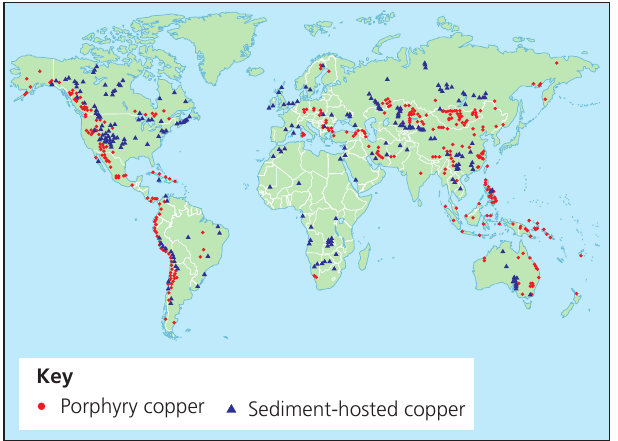
- Porphyry copper deposits (shown as red markers on distribution maps) - found in igneous rocks, accounting for about 60 per cent of identified global copper resources
- Sediment-hosted copper deposits (shown as blue markers) - concentrated in sedimentary rock layers, representing approximately 20 per cent of world copper resources
Together, these deposit types produced around 21 million tonnes of copper in 2019.
Regional distribution patterns
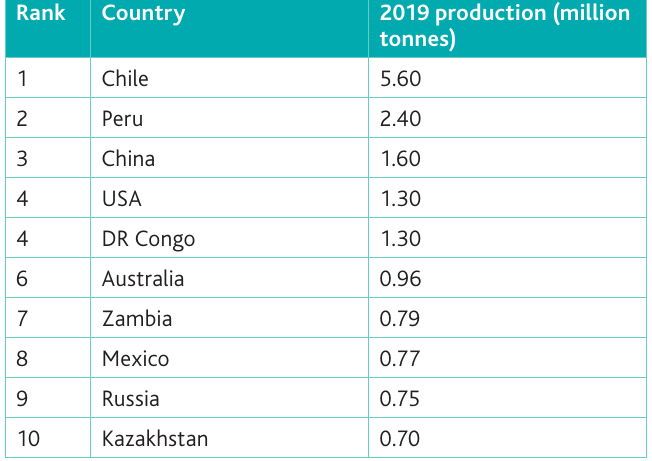
South America hosts the largest measured and undiscovered copper resources globally. The Andean region has emerged as the world's most productive copper area since the 1990s, producing 90 per cent of global copper in 2019. Chile stands as the single largest producing nation, though output has stabilised recently. Peru's production continues to increase rapidly. The region contains six of the world's top ten largest mine developments, including three in Chile (notably Escondida, the world's largest mine) and three in Peru.
Note
Why South America Dominates Copper Production
The Andes Mountains contain extensive porphyry copper deposits formed by volcanic and tectonic activity along the Pacific Ring of Fire. This geological setting has created ideal conditions for copper mineralisation over millions of years, making the region uniquely rich in copper resources.
North America possesses substantial porphyry copper reserves. The Morenci mine in Arizona and the Cananea mine in Sonora, Mexico were the sixth and eighth largest operations globally in 2019. Most US copper production originates from Arizona, Utah and New Mexico. Mining operations in Poland operate underground rather than as open-pit mines, which is typical of European operations. Russia and Poland are Europe's largest producers, with much of Russia's production concentrated in Asia.
China has rapidly increased production, becoming simultaneously the world's largest copper consumer and third largest producer. Growing production costs have made Chinese mining operations overseas, particularly in the African copper belt, more economically attractive.
Developing regions are becoming increasingly important copper sources:
- South East Asia - The archipelagos contain significantly large reserves with major ore deposits in Indonesia, Papua New Guinea and the Philippines. The Grasberg mine in Papua Highlands, Indonesia was the third largest copper producing operation in 2019.
- Africa and the Middle East - These regions hold the world's largest accumulation of sediment-hosted copper reserves. Large deposits exist in the African 'copper belt' countries (Democratic Republic of Congo and Zambia). Considerable possible copper resources remain to be discovered in Africa.
Future reserves
According to the US Geological Survey (USGS) 2019 data, discovered copper deposits globally total approximately 2.1 billion tonnes. Beyond this, an estimated 3.5 billion tonnes of undiscovered reserves exist, including those in deep sea nodules. Mineral-rich nodules containing copper, magnesium and other metals form on the ocean floor as products of deep-sea volcanic activity. However, retrieving these nodules remains too expensive currently to serve as a major copper source.
Note
Deep Sea Copper Nodules
These nodules, sometimes called polymetallic nodules, form over millions of years on the ocean floor through precipitation of metals from seawater. While they represent a massive potential resource, the technical challenges and environmental concerns of deep-sea mining make their exploitation economically unviable at present.
Properties of copper and their applications
Key physical properties
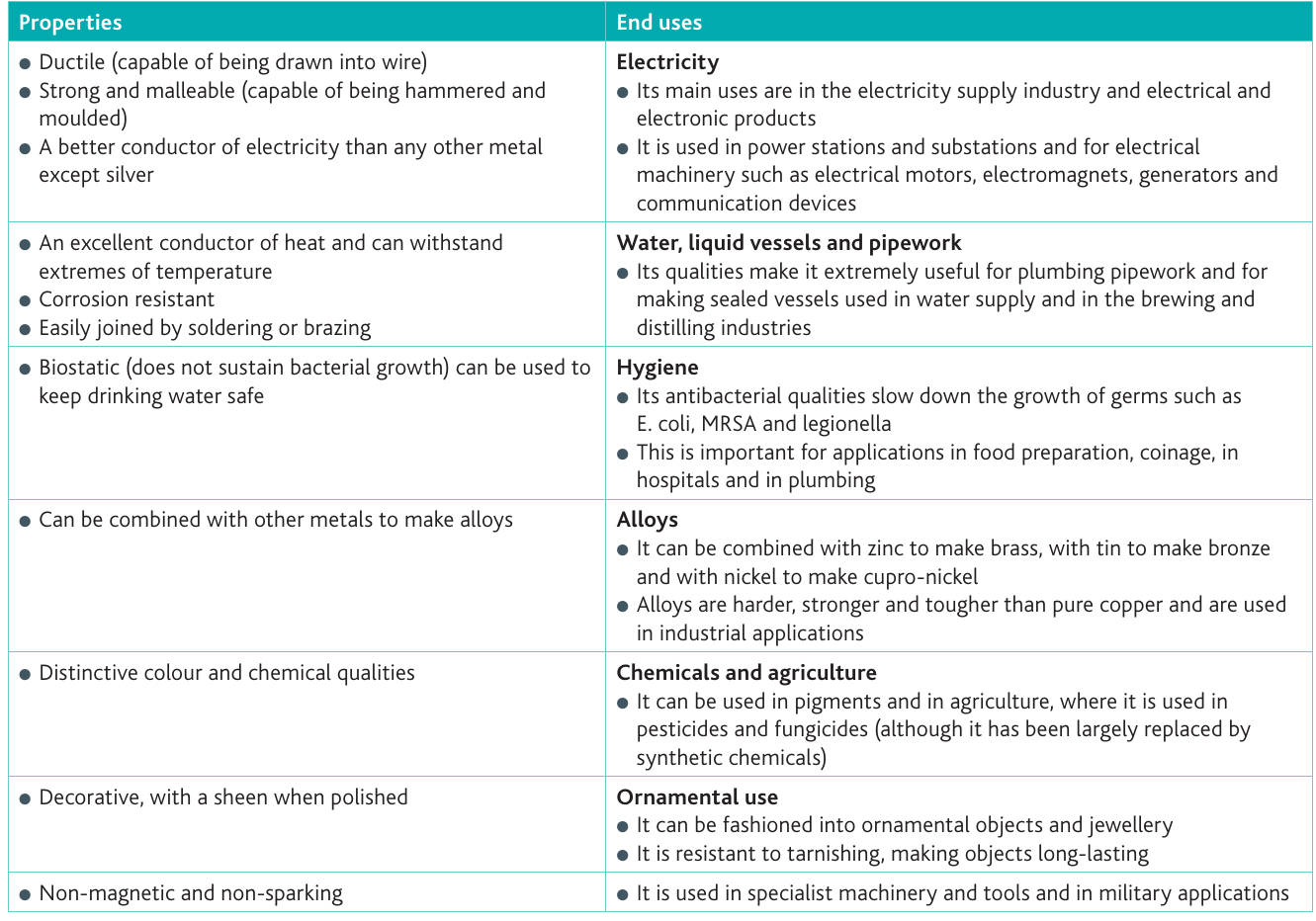
Copper's widespread use stems from its unique combination of physical and chemical properties:
Electrical properties:
Copper is ductile (can be drawn into wire), strong and malleable (can be hammered and moulded), and an excellent conductor of electricity - better than any other metal except silver. These qualities make copper essential for:
- The electricity supply industry
- Electrical and electronic products
- Power stations and substations
- Electrical motors, electromagnets, and generators
- Communication devices
Thermal properties:
Copper is an excellent conductor of heat, can withstand temperature extremes, is corrosion resistant, and easily joined by soldering or brazing. These properties make it perfect for:
- Plumbing pipework
- Sealed vessels in water supply
- Brewing and distilling industries
Note
Why Copper for Plumbing?
Copper's combination of corrosion resistance, thermal conductivity, and ease of joining makes it ideal for plumbing. Unlike many materials, copper doesn't degrade in water systems and can handle both hot and cold water without deterioration over decades of use.
Antimicrobial properties:
Copper is biostatic (prevents bacterial growth) and can keep drinking water safe. Its antibacterial qualities slow growth of germs such as E. coli, MRSA and legionella. These properties are important for:
- Food preparation surfaces
- Coinage
- Hospital applications
- Plumbing applications
Chemical and physical versatility:
Copper can combine with other metals to create alloys (brass with zinc, bronze with tin, cupro-nickel). These alloys are harder, stronger and tougher than pure copper for industrial applications. Copper's distinctive colour and chemical qualities allow use in:
- Pigments
- Agriculture (pesticides and fungicides, though largely replaced by synthetic chemicals)
- Decorative with a sheen when polished
- Objects that are resistant to tarnishing and long-lasting
- Ornamental objects and jewellery
Specialist properties:
Copper is non-magnetic and non-sparking, making it valuable for:
- Specialist machinery
- Tools
- Military applications
Copper in homes
The average UK household contains approximately 180 kg of copper used for electrical wiring, plumbing and electrical appliances. Most copper installed in wiring and plumbing systems remains in use for at least 50 years, demonstrating the metal's durability.
Demand for copper by sector
The equipment and construction industries consume the largest proportion of copper globally. Understanding sector demand helps explain price fluctuations and resource security concerns.
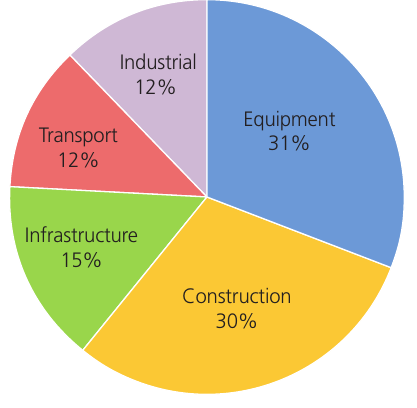
Equipment sector (31%)
This sector encompasses a wide range of capital equipment deployed across industries:
- Gears, bearings, tanks, pressure vessels and pipes
- Heat exchange equipment (copper's excellent heat transfer capabilities make it ideal)
- Power cables, transformers and electrical equipment for renewable energy industries
- Motors driving consumer electrical appliances
The electrical and renewable energy industries represent major consumers within this category.
Construction sector (30%)
Construction uses copper extensively in building components:
- Taps, valves and pipes
- Fire sprinkler systems and fittings
- Brass applications
These applications take advantage of copper's corrosion resistance and ease of working.
Infrastructure sector (15%)
Copper and copper alloys form critical components of telecommunications infrastructure:
- Wires and cables for telecommunications networks
- Fixed-line telephone cables and network connectivity wires (though increasingly substituted with fibre-optic cables)
- The $300 billion semi-conductor industry represents a major copper consumer
Transport sector (12%)
Copper contributes to numerous transportation applications:
- Railway industry applications
- Radiators in vehicle cooling systems
- Motors, brakes and bearings in the vehicle industry
Industrial sector (12%)
Various industrial applications account for the remaining demand.
Global copper trade
Trading copper in different forms
Copper moves through international markets in various forms, from raw material to finished products:
- Raw material as copper concentrates
- Semi-finished products (copper semis)
- Refined copper
- End-use products containing copper
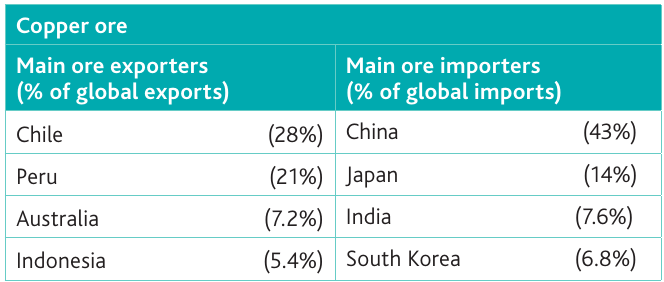
Copper ore trade
Countries producing more copper than their domestic industries require become exporters. Conversely, nations with developed smelting industries import ore.
Main copper ore exporters:
- Chile (28% of global exports)
- Peru (21%)
- Australia (7.2%)
- Indonesia (5.4%)
Main copper ore importers:
- China (43% of global imports)
- Japan (14%)
- India (7.6%)
- South Korea (6.8%)
Note
China's Dominant Position
China's position as the largest importer of copper ore (43%) reflects its massive manufacturing and construction sectors. The country needs to import vast quantities of ore despite being the third largest producer, demonstrating the enormous scale of its copper consumption.
Refined copper trade
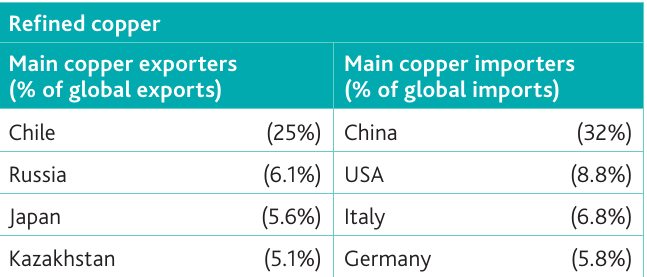
The pattern differs for refined copper, with smelting nations becoming exporters.
Main refined copper exporters:
- Chile (25% of global exports)
- Russia (6.1%)
- Japan (5.6%)
- Kazakhstan (5.1%)
Main refined copper importers:
- China (32% of global imports)
- USA (8.8%)
- Italy (6.8%)
- Germany (5.8%)
Recyclability and indirect trade
Copper possesses exceptional recyclability - it is virtually 100 per cent recyclable, making it one of the most widely recycled metals. Approximately 40 per cent of global copper demand is satisfied by recycled copper.
Important
The Sustainability of Copper Recycling
Recycled copper and its alloys can be used directly or further reprocessed to refined copper without losing any chemical or physical properties. This unique characteristic makes copper one of the most sustainable metals in use, as it can be recycled indefinitely without degradation.
Copper also trades indirectly as part of end-use products. For instance, importing electronic equipment represents importing the copper used in its production.
Major producers and consumers
Production: Leading copper ore producing companies include:
- Freeport-McMoRan (US)
- Rio Tinto
- Glencore
- BHP Billiton
- State-controlled Codelco (Chile)
Chinese mining companies have also become major producers.
Consumption: Due to copper's importance in construction and power transmission infrastructure, any copper supply disruption would significantly impact demand and prices.
Copper prices and the global economy
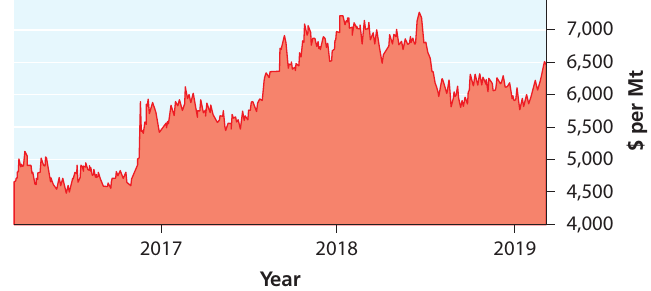
Price trends 2016-2019
Copper prices reflect the health of the global economy. The metal's diversified usage across electronic products, construction and vehicles makes it an excellent indicator of overall economic health. This has earned copper the nickname 'Dr Copper' (steel and aluminium show more concentrated usage in construction and vehicles, making them less reliable economic indicators).
Note
Why 'Dr Copper'?
The nickname 'Dr Copper' reflects the metal's ability to 'diagnose' economic health. Because copper is used across so many sectors - from construction to electronics to transportation - its price movements provide a comprehensive view of global economic activity. When copper prices rise, it typically signals economic growth; when they fall, it often indicates economic slowdown.
Copper prices tend to mirror Chinese economic performance. Between 2015-2017, prices generally declined during China's economic slowdown. Recovery in 2018 saw prices rise again. Prices were expected to reach $7,000 per metric tonne in 2020, but the COVID-19 pandemic crashed the Chinese and global economies, reflected in falling commodity prices.
Production and consumption drivers
Copper prices serve as the key driver for production. When prices fall, producers prefer to 'leave the copper in the ground', anticipating that supply shortages will eventually raise prices. World production and consumption of copper have increased dramatically over the past 25 years as large developing countries entered the global market, driving increased demand.
Physical geography of copper deposits
Geological conditions for formation
If all mineral resources were evenly distributed throughout Earth's crust, none would be sufficiently concentrated to become viable reserves for exploitation. Geological processes have created localised concentrations of deposits, enabling exploitation to occur.
Based on geological formation processes, mineral deposits fall into four broad categories:
1. Magmatic deposits
These deposits link directly to magma emplaced into the crust (either continental or oceanic). They form within rock types derived from crystallising magmas. The crystallisation process separates ore and non-ore minerals according to their crystallisation temperature. These deposits also include ores containing nickel-copper deposits and platinum metals.
2. Hydrothermal deposits
Another igneous process associated with magma intrusions forms these deposits. Rocks surrounding intrusions may be lifted and deformed, causing cracks and fissures to appear. These cracks allow hot solutions containing dissolved minerals to escape towards the surface. As solutions cool down, minerals precipitate in a predictable order according to their solubility. The result is concentrated deposits that are more viable for exploitation. Most metal ores, including iron, copper, tin and lead, occur as hydrothermal deposits.
Note
Hydrothermal Deposits - The Most Common Copper Source
Hydrothermal deposits represent the most important source of copper and many other metal ores. The process of hot, mineral-rich fluids moving through cracks and cooling creates highly concentrated deposits that would be impossible to form through other geological processes. This is why most major copper mines exploit hydrothermal deposits.
3. Metamorphogenic deposits
Metamorphic processes change pre-existing mineral deposits and form new ones. Intense heat and pressure applied over long periods of time cause changes. For example, low density minerals are replaced by minerals of high volumetric mass. These deposits are found primarily in PreCambrian formations, including:
- Iron ore deposits in Ukraine
- Manganese deposits in Brazil and India
- Gold and uranium ores in South Africa
4. Sedimentary deposits (including placer deposits)
Not all metal deposits have igneous origins. Sedimentary deposits can also provide valuable metal sources, including copper. Sedimentary deposits generally appear tabular and sheet-like, horizontal in form but frequently folded and faulted. Beds containing metallic ore are generally less than 20 ft thick.
Beyond copper, other metals found in sedimentary deposits include lead and zinc. Placer deposits represent a specific type of sedimentary deposit. These are alluvial deposits carried in flowing water and deposited when water slows down. Dense minerals settle first, including tin ore and gold.
Location and working considerations
Mineral deposits can occur in all types of geological formations. Traditionally, major physical geographical constraints on exploration and mine development were determined by:
- Remoteness of location
- Access to processing facilities and markets
- Ability to exploit the resource
Areas with extreme temperatures, physical environments such as deserts, densely forested areas or high mountains were largely avoided and left unexplored.
Important
Technology Has Changed Mining Geography
Advances in mechanical and transport technology have released these constraints. Geologists can now explore suitable geological formations anywhere on Earth. This explains why modern copper mines operate in extreme environments like the high Andes (Escondida mine at over 3,000m elevation) or remote Indonesian highlands (Grasberg mine).
Remember!
Summary
Key Points to Remember:
-
Copper is the world's third most-used metal, essential for electricity, construction, and manufacturing industries due to its excellent electrical and thermal conductivity.
-
Major copper reserves are concentrated in South America (especially Chile and Peru), with Chile alone producing 5.60 million tonnes in 2019 - making it the world's largest producer.
-
Copper forms through various geological processes including hydrothermal deposits (most common), magmatic deposits, metamorphogenic deposits, and sedimentary deposits, with the cut-off ore grade typically at 0.5 per cent.
-
Copper is virtually 100 per cent recyclable, with approximately 40 per cent of global demand met by recycled copper, making it one of the most sustainable metals in use.
-
Copper prices serve as a global economic indicator (nicknamed 'Dr Copper'), reflecting worldwide economic health due to the metal's diversified usage across construction, electronics, and transport sectors.