Physical Geography and Occurrence (AQA A-Level Geography): Revision Notes
📚Revision Notes
Physical Geography and Occurrence
Introduction
Mineral resources are not evenly spread across the Earth's crust. If they were distributed uniformly, none would exist in high enough concentrations to make extraction economically worthwhile. Geological processes have created concentrated deposits in specific locations, making it possible to mine these valuable resources profitably.
Note
The uneven distribution of minerals is actually essential for mining to be possible. Without geological processes that concentrate minerals into specific deposits, the cost of extracting them would always exceed their value, making all mining economically impossible.
Geological conditions
The formation processes of rocks determine how mineral deposits are created and where they can be found. Based on these geological processes, mineral deposits can be grouped into four main categories:
1. Magmatic deposits
These deposits form when magma is forced into the Earth's crust (either continental or oceanic). They are found in rock types that develop from the crystallisation of magma.
The crystallisation process separates different minerals based on their crystallisation temperatures. This natural sorting creates distinct zones where ore minerals are concentrated separately from non-ore minerals. These deposits may also contain valuable ores with nickel-copper and platinum group metals.
Key characteristics:
- Linked to volcanic and igneous activity
- Form through crystallisation of molten rock
- Temperature-dependent mineral separation
- Can contain multiple valuable metals
Note
Definition: Magmatic deposits
Named because they are linked with magma which is emplaced into the crust (either continental or oceanic) and are found within rock types derived from the crystallisation of such magmas.
2. Hydrothermal deposits
Hydrothermal deposits form through a different igneous process involving magma intrusions. When magma pushes into surrounding rocks, it creates heat that lifts and deforms the nearby rock layers. This process produces cracks and fissures in the rock.
Hot solutions carrying dissolved minerals can then move through these cracks towards the surface. As the solutions cool, minerals precipitate out (become solid) in a predictable sequence based on their solubility. The result is concentrated deposits that are easier to exploit economically.
Important metals found in hydrothermal deposits:
- Iron
- Copper
- Tin
- Lead
Note
Definition: Hydrothermal deposits
These are mineral concentrations formed when hot, mineral-rich solutions escape through rock fractures and precipitate minerals as they cool. Most metal ores, including iron, copper, tin and lead, are found in these deposits.
3. Metamorphogenic deposits
Metamorphic processes alter existing mineral deposits and create new ones. These changes happen through intense heat and pressure applied over extended periods.
During metamorphism, low-density minerals can be replaced by minerals with higher volumetric mass. This process increases the concentration and value of the deposit. These deposits are mainly found in very old PreCambrian rock formations.
Examples include:
- Iron ore deposits in Ukraine
- Manganese deposits in Brazil and India
- Gold and uranium ores in South Africa
Note
Definition: Metamorphogenic deposits
Metamorphic processes change pre-existing mineral deposits and form new ones through the application of heat and pressure over long time periods.
4. Sedimentary deposits
Not all valuable metal deposits have igneous origins. Sedimentary deposits provide an alternative source for many metals, including copper. These deposits are typically:
- Flat and sheet-like in shape
- Horizontal in orientation
- Often folded and faulted by geological forces
- Less than 20 feet thick in metallic ore zones
Placer deposits
Placer deposits are a special type of sedimentary deposit formed by water action. These are alluvial deposits - meaning they are carried by flowing water and settle when the water velocity decreases.
Dense minerals are the first to settle out of the water, creating concentrated deposits. This natural sorting process makes placer deposits valuable sources of tin ore and gold.
Note
Definition: Placer deposits
Placer deposits are alluvial; they are carried in flowing water and deposited when the water slows down. The natural sorting by water creates concentrated deposits of dense minerals like tin and gold.
Location and working
Physical geographical constraints
Mineral deposits can theoretically occur in any type of geological formation. However, traditionally, the main physical geographical limitations on exploration and mine development included:
- Remoteness from infrastructure and markets
- Access difficulties for processing facilities
- Ability to exploit the resource with available technology
- Extreme environments such as:
- Deserts
- Dense rainforests
- High mountain ranges
Areas with these challenging physical conditions were generally avoided and remained unexplored for many years.
Evolution of mining accessibility
Modern mechanical and transport technology has dramatically reduced these physical constraints. Geologists can now explore suitable geological formations anywhere on the planet (except Antarctica).
Note
Technology's Impact on Mining Locations
The twentieth century saw a dramatic shift in where mining could occur. Previously inaccessible locations are now routinely exploited thanks to advances in:
- Heavy machinery and mechanisation
- Transportation infrastructure
- Remote operations technology
- Processing methods
Recent trends show mining has expanded into:
- The Atacama Desert in Chile (copper extraction)
- Amazon rainforests in Brazil (iron ore)
- Other locations in continental interiors of Australia, Africa and Asia
The final frontier for mineral exploration is now the hypothetical and speculative resources in deep seabed locations.
Ore extraction: underground and open-pit mining
Mine working methods have changed significantly during the twentieth century. There has been a major shift from underground mining to open-pit mining (sometimes called open-cast). This change has become increasingly common in emerging economies.
Important
The Mining Revolution
Productivity has increased substantially over the past 50 years through:
- Ability to access lower grade ores
- More efficient processing methods
- Large-scale capital equipment deployment
The main advantage of open-pit mining is mechanisation. Large digging machines and trucks can rapidly remove enormous amounts of material - far more efficient than traditional underground mining methods.
The physical characteristics of the deposit discovered during exploration determine which extraction method is used. The shape, size, quantity and grade (purity) of the ore deposit all influence whether mining will be underground or open-pit.
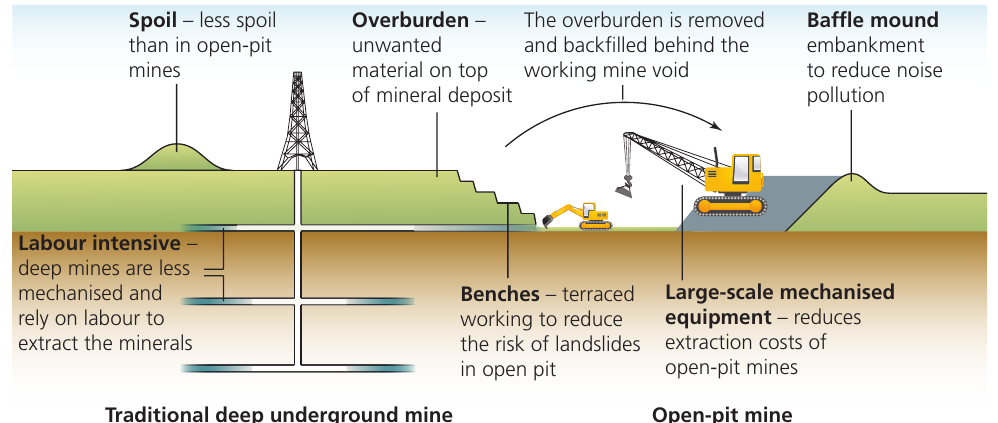
Underground mining characteristics
- Labour intensive - requires more workers
- Less mechanised operations
- Produces less spoil on the surface
- Requires vertical shafts and horizontal tunnels
- Needs ground support systems
- Requires ventilation systems
Open-pit mining characteristics
- Highly mechanised - uses large equipment
- Creates terraced benches to reduce landslide risk
- Generates large amounts of overburden (waste rock)
- Lower extraction costs per tonne of ore
- Can mine lower grades of ore profitably
- Uses baffle mounds (embankments) to reduce noise pollution
Factors affecting extraction costs
Extraction costs vary depending on the size, shape and location of the ore reserve. These costs must be carefully balanced against the potential value that can be extracted from the mine.
Major cost factors
Overburden removal:
Rock and soil sitting above the mineral deposit can be expensive to remove. In open-pit mines, this material is blasted away. The first choice for extraction is when a deposit is:
- Close to the surface
- Large in size
- Has minimal overburden
Note
Definition: Overburden
Rock and soil lying above the deposit. Removing overburden is often one of the largest cost components in open-pit mining operations.
Water removal:
As mines become deeper, more water infiltrates into the workings. This water must be continuously pumped out. Water removal costs increase with depth in both mining types.
Depth:
Costs rise as mining goes deeper. For underground mining, this includes additional requirements such as:
- Ventilation systems for air quality
- Ground support structures for safety
- Finding safe and cost-effective routes to reach the surface with ore
Form of the deposit:
Costs increase when the mineral is dispersed irregularly or occurs in thin layers. Deposits that are more compact and thicker are less expensive and safer to access in open-pit operations.
Economic viability considerations
Costs must be evaluated against potential mine revenue. This depends on two key economic concepts that determine whether a discovered deposit can be developed into a working mine:
Important
The Stripping Ratio
The stripping ratio is the amount of waste rock that must be mined compared to the amount of ore extracted. For example, a stripping ratio of 3:1 means three times as much waste rock is removed as ore.
To be profitable, an open-pit mine must be designed so the cost of removing waste rock does not exceed the value of the ore.
Important
Cut-off Ore Grade
The cut-off ore grade is the lowest ore purity that can be exploited economically. Processing costs depend on ore purity. This threshold varies depending on which metal or mineral is being extracted.
Below this grade, the cost of processing exceeds the value of the metal recovered, making extraction unprofitable.
Summary
Key Points to Remember:
-
Four geological processes create mineral deposits: magmatic (from crystallising magma), hydrothermal (from hot mineral solutions), metamorphogenic (from heat and pressure transformation), and sedimentary (including water-deposited placer deposits).
-
Physical geography has historically limited mining to accessible areas, but modern technology now allows exploitation of remote locations like deserts, rainforests and continental interiors.
-
Open-pit mining has largely replaced underground mining because mechanisation allows rapid, cost-effective removal of large volumes of material and access to lower grade ores.
-
Extraction costs depend on four main factors: overburden volume, water removal needs, mining depth, and the form/shape of the deposit.
-
Economic viability requires careful calculations of the stripping ratio (waste rock vs ore) and cut-off grade (minimum profitable ore purity) to ensure extraction costs don't exceed ore value.