Sustainability Issues: Extraction, Trade and Processing (AQA A-Level Geography): Revision Notes
📚Revision Notes
Sustainability Issues: Extraction, Trade and Processing
Introduction to mineral ore sustainability
The extraction, trade and processing of mineral ores present significant sustainability challenges. Whilst technology continues to advance—enabling better exploration, more efficient extraction methods and improved recycling—concerns remain about the long-term viability of our metal supplies.
Several factors can extend the lifespan of mineral resources:
- More cost-effective exploration techniques that discover new deposits
- Advanced machinery that extracts resources more efficiently
- Better recycling technologies that transform waste into reusable materials
- Substitution strategies that replace scarce metals with more abundant alternatives
Important
However, the fundamental issue persists: mineral ores are finite resources with limited availability. Managing the balance between supply and demand is crucial for future resource security.
Ore extraction and environmental impacts
Mining operations create different sustainability challenges depending on their location. In wilderness areas, extraction damages ecosystems. In agricultural regions, it reduces productive farmland and grazing areas. In urban settings, mining primarily generates noise and visual pollution.
The environmental consequences of unsustainable mineral extraction are substantial and varied. Understanding both these impacts and potential solutions is essential for developing more responsible mining practices.
Land use impacts
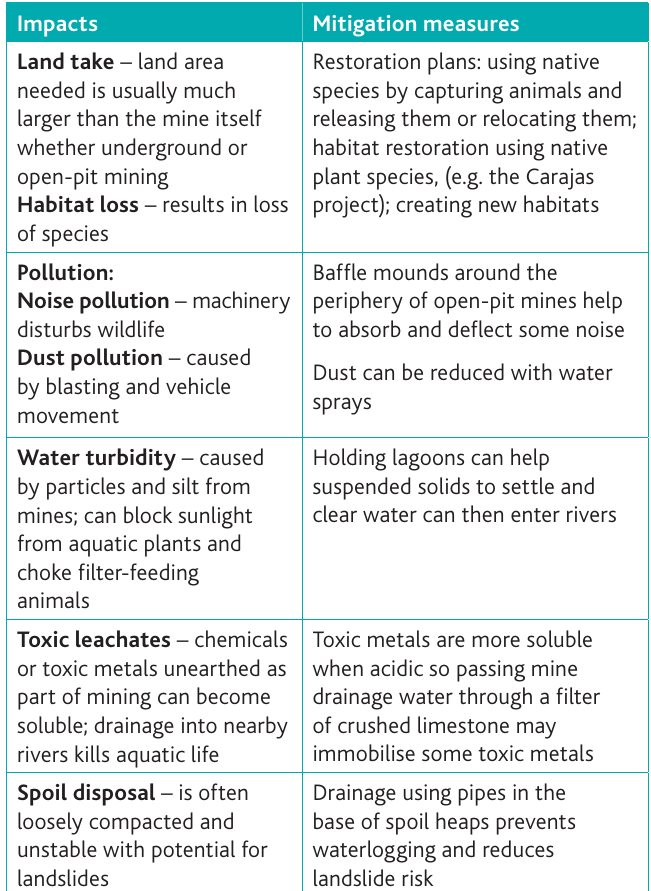
Mining operations require extensive land areas, typically exceeding the actual size of the mine site itself. This applies to both underground and open-pit operations. The consequence is habitat loss, which results in declining species populations and reduced biodiversity in affected regions.
Mitigation approaches:
- Developing restoration plans that use native plant species to recreate natural habitats
- Capturing and releasing animals, or relocating them to protected areas
- Creating entirely new habitats to compensate for those destroyed
Example
Example: The Carajás Project
The Carajás project incorporated habitat restoration using indigenous species that are cultivated in separate nursery facilities. This demonstrates how proactive restoration planning can help mitigate habitat loss from mining operations.
Pollution from mining operations
Mining creates multiple forms of pollution that affect surrounding environments:
Noise pollution stems from heavy machinery operating continuously at extraction sites. The constant mechanical noise disturbs wildlife and nearby communities.
Solution: Constructing baffle mounds (earth barriers) around the edges of open-pit mines helps absorb and deflect noise, reducing its impact on surrounding areas.
Dust pollution results from blasting operations and vehicle movement across mining sites. Airborne particles can travel considerable distances, affecting air quality and visibility.
Solution: Water spray systems can suppress dust by dampening surfaces and preventing particles from becoming airborne.
Water quality degradation
Water turbidity occurs when particles and sediment from mining operations enter water systems. The suspended solids block sunlight penetration, which prevents aquatic plants from photosynthesising effectively. This disrupts food chains and can suffocate filter-feeding organisms.
Note
Solution: Holding lagoons allow suspended particles to settle naturally through gravity. Once the water clears, it can safely enter river systems without harming aquatic ecosystems.
Chemical contamination
Note
Toxic leachates are chemicals or heavy metals concentrated in mine water. These substances become soluble when exposed to acidic conditions, creating mine drainage that kills aquatic organisms when released into rivers and streams.
Solution: Passing drainage water through filters made of crushed limestone neutralises acidity. This causes toxic metals to become immobilised and less harmful before the water enters natural waterways.
Spoil disposal challenges
Mining generates enormous quantities of waste rock and soil, known as spoil. This material is typically piled in heaps near the mine site. Without proper management, spoil heaps become structurally unstable, particularly when saturated with water, creating significant landslide hazards.
Solution: Installing drainage pipes within spoil heaps prevents waterlogging. This maintains slope stability and reduces the risk of catastrophic collapse.
Tailing dam failures
Note
Tailings consist of a semi-liquid mixture combining water, pulverised waste rock, sand, and toxic chemical reagents used during ore extraction. These materials are stored in specially constructed containment facilities called tailing dams.
Tailing dams are built using rock and earth waste from mining operations. They are inherently vulnerable to failure through overspilling or structural collapse. When failures occur, toxic mud flows rapidly through channels and watercourses downstream, causing devastating environmental and human consequences.
Example
Case Study: Buenavista Copper Mine, Mexico (August 2014)
In north-west Mexico, approximately 40,000 cubic metres of copper sulphate acid spilled into the Sonora river and public waterways. Heavy rainfall caused the tailings reservoir at the Grupo Mexico-operated Buenavista copper mine to overflow. The massive spill contaminated a 60-kilometre stretch of river, creating water shortages for 20,000 people in an already water-stressed region.
Example
Case Study: Córrego do Feijão Iron Ore Mine, Brazil (January 2019)
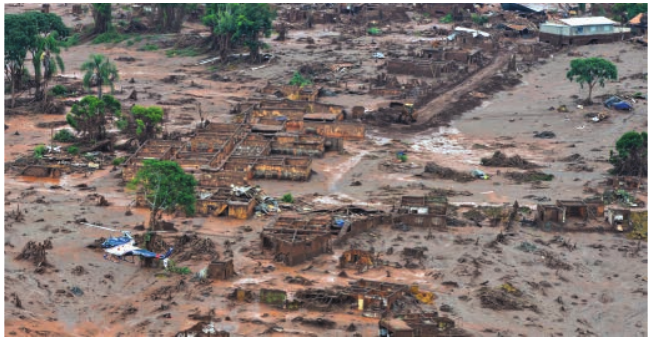
Vale's catastrophic tailing dam failure near Brumadinho in Minas Gerais state, south-east Brazil, released a massive mudflow when the 86-metre high dam—constructed from sand and dried mud—dissolved into liquid. The resulting flood engulfed the company's offices and nearby settlements and farms.
Important
The Samarco Mine Disaster (2015)
The Samarco mine disaster in 2015 represents Brazil's worst environmental catastrophe. Key impacts included:
- Human casualties: 17 people killed when mudflow from failed iron ore tailings dam inundated Mariana municipality
- Land devastation: 270 people died as the mudflow covered vast territories, destroying half of a protected natural forest area
- Water pollution: 300 kilometres of surrounding river networks became polluted, causing thousands of fish deaths in the Paraopeba river
This disaster occurred less than four years after a similar tailing dam failure at the nearby Samarco mine (operated jointly by BHP Billiton and Vale), which killed 17 people. Following the Brumadinho disaster, Vale's chief executive resigned, and numerous employees considered responsible faced arrest.
These repeated failures demonstrate that despite increased environmental awareness within mining companies, inadequate safety standards and poor maintenance continue to cause preventable disasters.
Trade and sustainable mineral markets
International trade patterns can either support or undermine resource sustainability. When countries recognise their comparative advantages, trade can become mutually beneficial and promote more sustainable practices.
Encouraging ore-producing nations to develop processing industries adds value to raw material exports and helps prevent resource depletion. This approach can also protect these nations from the resource curse—the paradoxical situation where abundant natural resources correlate with slower economic development and increased poverty.
The Mining and Metals Scenarios to 2050 project
In 2015, the World Economic Forum launched this initiative to examine the future of the minerals and metals sector. A central recommendation advocates for transitioning towards circularity—an economic model emphasising recycling and reuse of metals to sustain trade.
Several factors justify this transition:
- Global population growth increases demand within a context of finite resources
- Primary extraction volumes cannot realistically match growing metal demand
- Metal trading companies can serve as intermediaries between commodity producers and end-user industries, becoming suppliers of recycled materials
- Recycling processes consume significantly less energy than primary production (for example, recycling aluminium requires only 5-10% of the energy needed to produce primary aluminium)
Green Trade Alliance (GTA)
The World Economic Forum also introduced the Green Trade Alliance concept to promote environmental sustainability without compromising economic competitiveness. The framework would establish a 'Sustainable Trade Organisation' to oversee GTA agreements.
Note
Key Features of the Green Trade Alliance:
- Environmental standards applied to both recycled and primary materials form the basis for tariff structures
- Trade between GTA members and non-members would initially be restricted
- Non-GTA members would be encouraged to adopt equivalent sustainability standards, enabling them to join the alliance eventually
This approach aims to create a level playing field where environmental responsibility becomes integrated into international trade mechanisms.
Processing and recycling
Metal and mineral commodities are non-renewable with finite total availability. However, recycling and reuse processes significantly enhance long-term sustainability by extending the productive lifespan of these materials.
Note
End-of-life (EOL) stocks comprise old scrap materials from discarded products and waste materials from industrial processes. These constitute the primary sources for metal recycling and can be remanufactured into new products.
Recycling programmes have become well established in many countries following commitments made through Agenda 21. Lead acid battery recycling, for instance, has achieved particularly high organisation and efficiency levels.
Current recycling rates
A 2011 United Nations Environment Programme (UNEP) report provided end-of-life recycling rate (EOL-RR) estimates for major metals:
Iron and steel: 70-90% recycled, contributing approximately 35% of new production
Aluminium: 40-60% recycled, contributing around 24% to new production
Copper: 40-50% recycled, contributing roughly 18% of new production
Lead: Recycling estimates vary between 60-90%, contributing approximately 55% to new production
Tin: Approximately 90% recycled
These statistics demonstrate that whilst secondary resources make substantial contributions to metal production, primary extraction of new raw materials remains necessary.
Challenges in expanding secondary resource use
Increasing reliance on secondary resources as a production source for new materials presents considerable difficulties:
Long-term material retention: A large proportion of metals becomes incorporated into built infrastructure (buildings, bridges, railways) where they remain inaccessible for decades or centuries.
Complex product composition: Many modern products combine metals with other materials in ways that make separation and recycling technically challenging or economically unviable.
Factors affecting recycling rates
Barriers to effective recycling:
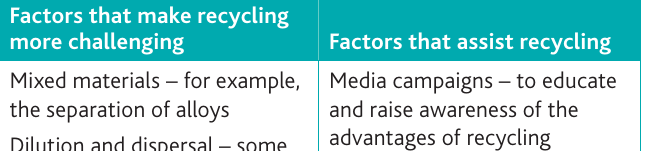
- Mixed materials: Products containing alloys or multiple metals require separation before recycling, adding complexity and cost
- Dilution and dispersal: When materials are used in small quantities across many applications, recovery becomes impractical
- Transport costs: Moving scrap materials over long distances may be economically prohibitive
- Labour intensity: Recycling requires significantly more manual labour than raw material extraction
Factors supporting recycling:
- Public awareness campaigns: Media initiatives educate populations about recycling benefits and promote environmental consciousness
- Design considerations: Products designed for easy disassembly allow useful components to be removed efficiently at end-of-life
- Clear labelling: When assembled products clearly indicate their material composition, recycling facilities can process them more effectively
- Component reuse: Parts that retain functionality can be repurposed rather than completely remanufactured
- Legislative frameworks: Government regulations (such as EU Directives on battery and electronic equipment disposal) mandate recycling practices
- Economic incentives: Financial mechanisms like landfill taxes make recycling more economically attractive than disposal
Summary
Key Points to Remember:
-
Mining creates severe environmental impacts including habitat destruction, water pollution, and toxic contamination. Mitigation measures exist but require proper implementation and monitoring.
-
Tailing dam failures cause catastrophic disasters with both human and environmental consequences. Recent examples in Mexico and Brazil demonstrate ongoing safety challenges despite increased awareness.
-
Transitioning to circular economy models through increased recycling and reuse is essential for long-term metal resource sustainability, reducing energy consumption and environmental impact.
-
Trade frameworks like the Green Trade Alliance can promote sustainable practices by integrating environmental standards into international commerce without sacrificing competitiveness.
-
Recycling rates vary significantly by metal type (tin ~90%, iron/steel 70-90%, aluminium 40-60%) and whilst secondary resources contribute substantially to production, primary extraction remains necessary to meet global demand.