Case Study: Aswan High Dam and Lake Nasser (AQA A-Level Geography): Revision Notes
📚Revision Notes
Case Study: Aswan High Dam and Lake Nasser
Introduction
The Aswan High Dam is one of the world's largest and most significant water management projects. Located on the River Nile in southern Egypt, this massive structure demonstrates both the benefits and challenges of large-scale river engineering. The dam created Lake Nasser, an enormous reservoir that transformed Egypt's water management but also brought unexpected environmental and social consequences.
Note
The Aswan High Dam represents a classic example of how large-scale engineering projects can achieve their intended goals while simultaneously creating unforeseen environmental and social challenges. Understanding both the successes and difficulties of this project provides valuable lessons for future water management schemes.
Location and construction
The Aswan High Dam sits across the River Nile at Aswan in southern Egypt. Construction began in 1960 and was completed in 1970, with financial and technical support from the Soviet Union, who sought to gain influence in the region during the Cold War period.
Physical characteristics
The dam's impressive dimensions include:
- Width of nearly 4 kilometres across the valley
- Lake Nasser reservoir extending 550 kilometres southwards into northern Sudan
- Maximum width of 35 kilometres at its widest point
- Water storage capacity of approximately 132 km³
This makes it one of the world's largest artificial reservoirs by volume.
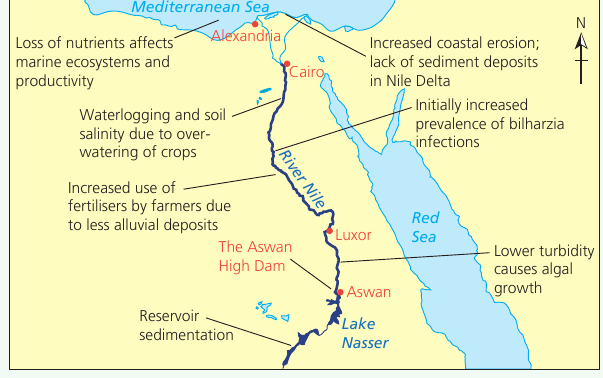
Purpose and design
The Aswan High Dam was engineered as a multi-purpose scheme with several key objectives:
- Flood regulation: Controlling the Nile's annual flooding patterns
- Water storage: Creating a strategic water reserve for agricultural irrigation
- Hydroelectric power generation: Producing electricity for Egypt's development
- Economic security: Establishing a national freshwater reserve
Note
Multi-purpose dam is a reservoir and dam system designed to serve multiple functions simultaneously, such as flood control, irrigation water supply, and electricity generation.
The water held in Lake Nasser effectively serves as Egypt's national freshwater bank and has had a substantial impact on the country's economy and development.
Historical context: the Nile's flooding pattern
Before the construction of the dam system, the Nile River followed a natural annual flooding cycle each late summer. These floods brought both benefits and challenges:
Benefits of natural flooding
The natural flooding system provided essential benefits for agriculture:
- High volumes of water reached the floodplain and delta regions
- Nutrient-rich sediments and minerals were deposited on farmland
- Fertile soil along the floodplain created ideal conditions for agriculture
- Natural fertilisation supported crop growth, particularly vital for farming communities
Problems with natural flooding
The unpredictability of floods created serious challenges:
- High water years: Excessive flooding could destroy entire harvests
- Low water years: Insufficient flooding led to widespread drought and famine
- Farmers faced uncertainty about crop yields each season
- The cotton industry, economically important to Egypt, suffered from unreliable water supplies
Important
The desire to control these unpredictable floods and guarantee reliable irrigation water for cotton cultivation drove the decision to build the High Dam. An earlier, smaller Low Dam had already been constructed but proved insufficient to address Egypt's water management needs.
Socio-economic impacts
The dam's construction and operation created wide-ranging social and economic effects, both positive and negative.
Positive impacts
Resettlement and new land creation
Whilst Lake Nasser flooded approximately 100,000 Nubian people's homes in lower Nubia, requiring their resettlement to purpose-built villages in Sudan and Egypt, the scheme also created opportunities:
- Stored water enabled irrigation of previously unfarmable land surrounding the lake
- New agricultural areas became available for farming
- Displaced populations received new farmland in compensation
Fishing industry development
The vast reservoir supported the growth of a substantial fishing industry:
- Annual fish production exceeded 25,000 tonnes
- Created new employment opportunities
- Provided an additional food source for the region
Hydroelectric power generation
The dam's power-generating capacity reached 10 billion kilowatt-hours per year:
- Initially supplied half of Egypt's electricity needs
- Supported industrial development and modernisation
- Currently provides around 10% of national electricity (percentage has fallen as total demand has grown significantly)
Flood control and water security
- Regular, controlled water release replaced unpredictable natural flooding
- Water could be stored during high-flow periods and released when needed
- Agriculture became more reliable and predictable
Negative impacts
Effects on downstream farmers
Farmers living downstream of the dam faced new challenges:
- The controlled annual flood no longer deposits fertile alluvial sediments on their fields
- These sediments remain trapped in the reservoir behind the dam
- Farmers must now purchase and apply artificial fertilisers to maintain soil fertility
- Increased costs of production
- Fertiliser use creates additional environmental problems (pollution, runoff)
Note
This shift from natural to artificial fertilisation represents an indirect environmental cost of the dam. The economic burden on individual farmers increased significantly, as they now had to budget for fertiliser purchases that were previously unnecessary due to natural soil enrichment.
Environmental impacts
When the dam was built, planners anticipated the main benefits but underestimated several environmental consequences. Critics in the 1970s began pointing out potential problems that have since materialised.
Coastal erosion
The Mediterranean coastline has experienced accelerated erosion rates, particularly severe at the Rosetta and Damietta promontories in the Nile Delta.
Causes:
- The dam traps sediment that would naturally flow down to the delta
- Without this sediment supply, the coastline cannot replenish itself
- Wave action removes coastal material faster than it is replaced
Consequences:
- Expensive coastal protection infrastructure has been necessary
- Despite these efforts, attempts to prevent coastline retreat have been largely unsuccessful
- The delta region faces ongoing vulnerability to erosion
Important
The loss of sediment to the Nile Delta represents one of the most significant unintended consequences of the dam. Despite expensive engineering interventions, the natural balance between sediment deposition and coastal erosion has been permanently disrupted.
Reservoir sedimentation
Note
Sedimentation refers to the accumulation of sediment (sand, silt, and clay particles) that settles at the bottom of a reservoir, gradually reducing its water storage capacity.
The reservoir faces a long-term storage capacity problem:
- Current storage capacity: 162 km³ (including 31 km³ of "dead storage" at the bottom that cannot be used)
- Sediment accumulates much faster in the upper sections of Lake Nasser
- The live storage zone (usable water) has already been affected
- Projections suggest approximately 900 years until the storage zone fills completely with sediment
- However, the dam will become unworkable before complete filling occurs
Mitigation efforts:
- Dredging the reservoir has been attempted to remove accumulated sediment
- This is technically challenging and expensive
- A more practical approach involves dredging river sections before water enters the reservoir
- Nevertheless, sedimentation remains an ongoing challenge
Marine ecosystem changes
The Mediterranean Sea's marine ecosystems have been significantly affected.
Nutrient depletion:
- Nutrients that previously flowed down the Nile to the Mediterranean are now trapped behind the dam
- The sardine catch off the Egyptian coast initially declined massively
- Fish populations have partially recovered but remain at only half their pre-dam levels
Salinity changes:
- Less freshwater entering the Mediterranean from the Nile has increased sea salinity in the region
- This affects the Mediterranean's outflow current into the Atlantic Ocean
- The influence can be traced thousands of kilometres into the Atlantic
- Changes in salinity alter the habitat conditions for marine species
Note
The far-reaching impact of the dam on marine ecosystems demonstrates how local engineering projects can have effects that extend across entire ocean basins. The salinity changes from reduced Nile discharge influence water circulation patterns far beyond the immediate Mediterranean region.
Health and disease: schistosomiasis
Note
Schistosomiasis (also called bilharzia) is an infectious disease caused by parasitic worms that live in fresh water in subtropical and tropical regions. The parasites are carried by snails and can penetrate human skin during contact with contaminated water.
The dam's water management system inadvertently created conditions that increased disease transmission:
How the dam increased disease risk:
- Irrigation channels receive a constant supply of water from the reservoir
- Standing water in these channels provides ideal breeding conditions for snails
- Snails carry the bilharzia parasite
- Natural fluctuations in water levels previously limited snail populations
- Constant water levels removed this natural control mechanism
- Incidence of bilharzia infections increased in communities using irrigation water
Mitigating factors:
The story is not entirely negative. Several factors have helped reduce the overall disease prevalence:
- Improved provision of clean drinking water
- Better sanitation facilities in rural areas
- Health education programmes raising awareness about disease transmission
- Rural health clinics providing treatment
- Poor sanitation and limited health awareness were actually larger contributing factors than the dam itself
Waterlogging and soil salinity
Note
Waterlogging occurs when soil becomes saturated with water, preventing adequate drainage and oxygen circulation to plant roots.
Soil salinity refers to the concentration of salt in soil. High salinity prevents most crops from growing successfully.
Before the High Dam's construction, groundwater levels in the Nile Valley naturally fluctuated by as much as 8-9 metres per year in response to changing water levels in the river.
The natural system's benefits:
- During summer, when evaporation rates were highest, groundwater levels dropped significantly
- This prevented salts dissolved in groundwater from being drawn to the surface
- Natural flushing during annual floods removed accumulated salts
Changes caused by continuous irrigation:
The dam enabled year-round irrigation, fundamentally altering this system:
- Groundwater levels now remain high with little seasonal fluctuation
- The distance between the soil surface and groundwater table has decreased
- Capillary action can now draw water (and dissolved salts) upward to the surface
- As water evaporates, salts accumulate on the soil surface
- Annual flooding no longer flushes these salts away
- Over time, relatively small concentrations of salt gradually build up
- Soils have become saltier and less fertile
Important
Most farmland initially lacked proper subsurface drainage systems to lower groundwater tables and prevent salt accumulation. The problem took twenty years after the Aswan scheme's completion to properly address—a significant delay that allowed substantial soil degradation to occur.
Solutions implemented:
- Installation of subsurface drainage systems in two million hectares of farmland
- These drainage systems cost more than constructing the High Dam itself
- They allow groundwater to be artificially lowered, reducing salt accumulation
Overall agricultural impact:
Despite these challenges, agricultural production in Egypt has actually increased overall due to the dam:
- More reliable and constant water supply throughout the year
- Multi-cropping (growing several crops per year on the same land) is now possible
- Egyptian farmers have adopted more productive seed varieties
- Improved harvesting methods have increased efficiency
- The benefits have outweighed the costs of addressing waterlogging and salinity
Algal growth and water quality
The dam created unexpected water quality problems downstream.
The mechanism:
- Water released from the dam has lower turbidity (cloudiness) than natural river water
- Clearer water allows sunlight to penetrate deeper
- Farmers applying fertilisers to replace lost alluvial nutrients contribute nitrogen and phosphorus to the water
- These nutrients, combined with increased light penetration, promote excessive algae growth in the Nile
Consequences:
- Algal blooms have become more common
- Water treatment costs have increased to supply safe drinking water
- This was an unforeseen consequence not anticipated when planning the High Dam scheme
Note
The algal growth problem demonstrates how multiple effects of the dam can combine to create new challenges. The need for artificial fertilisers (caused by trapped sediment) combined with clearer water (another effect of the dam) to produce water quality issues that planners never anticipated.
Remember!
Summary
Key Points to Remember:
-
The Aswan High Dam (1960-1970) created Lake Nasser, one of the world's largest reservoirs, holding 132 km³ of water and extending 550 km into Sudan.
-
The dam successfully achieved its primary goals of flood control, reliable irrigation water supply, and hydroelectric power generation (10 billion KWh/year), though HEP now provides only 10% of Egypt's electricity as demand has grown.
-
Approximately 100,000 Nubian people were resettled, but the project created new farmland, a fishing industry (25,000 tonnes/year), and more reliable agriculture through year-round irrigation.
-
Major environmental impacts include: coastal erosion from trapped sediment, declining Mediterranean fish stocks, reservoir sedimentation reducing long-term capacity, and changes to marine ecosystems extending into the Atlantic Ocean.
-
Continuous irrigation caused waterlogging and soil salinisation by maintaining high groundwater levels, costing more than the dam itself to fix through drainage systems. However, overall agricultural production increased through multi-cropping and modern farming methods, demonstrating both challenges and successes of large-scale water engineering.