Sources (AQA A-Level Geography): Revision Notes
📚Revision Notes
Sources
Understanding water security
Water security refers to a population's ability to maintain reliable access to sufficient quantities of clean water. This is essential for several critical purposes:
- Supporting people's livelihoods and economic activities
- Maintaining human health and wellbeing
- Enabling socio-economic development
- Protecting against waterborne diseases and pollution
- Safeguarding ecosystems whilst maintaining peace and stability
Ensuring stable freshwater supplies is a global priority, yet many countries face increasing challenges in securing adequate water resources.
Important
By 2025, approximately 1.8 billion people will be living in areas experiencing absolute water scarcity. Additionally, two-thirds of the global population may face water-stressed conditions where overuse threatens long-term availability.
Main sources of water
Water used to meet various demands comes from three primary sources:
Surface water supplies
These include rivers and reservoirs, which collect water from rainfall and runoff. Surface water is often the most accessible source and is widely used across all sectors.
Note
Surface water sources are particularly valuable because they can be accessed with relatively simple infrastructure compared to other sources. However, they are also more vulnerable to seasonal variations and pollution.
Underground stores
Groundwater aquifers are natural underground reservoirs where water accumulates in porous rock layers. These provide a crucial source, particularly in areas where surface water is limited or seasonal.
Note
Aquifers act as natural storage systems, often maintaining water quality better than surface sources. They provide a buffer during dry periods when surface water may be scarce.
Seawater
Seawater can be converted to freshwater through desalination processes. Whilst this technology is developing, it remains energy-intensive and is typically used in coastal areas with severe water scarcity.
How water is used globally
Water demand can be divided into three main sectors, each serving different purposes:
Agricultural use
This is the dominant water consumer globally, primarily for crop irrigation. Water is also needed for cleaning farming equipment and providing for livestock. Agriculture accounts for the largest proportion of freshwater withdrawals worldwide.
Industrial and commercial use
Industries require water for various processes including:
- Cooling systems in electricity generation
- Steam production for turbines
- Transport and processing in manufacturing
- Textile, paper, and fibre production
- Metal processing and food production
- Construction activities
Domestic or household use
Also known as public or municipal water supply, this sector covers water used in homes for drinking, food preparation, personal hygiene, sanitation, and general washing and cleaning.
Global water consumption patterns
Across the world, freshwater is distributed between these sectors in the following proportions:
Note
Global Water Distribution by Sector:
- Agriculture: 69%
- Industry: 19%
- Domestic use: 12%
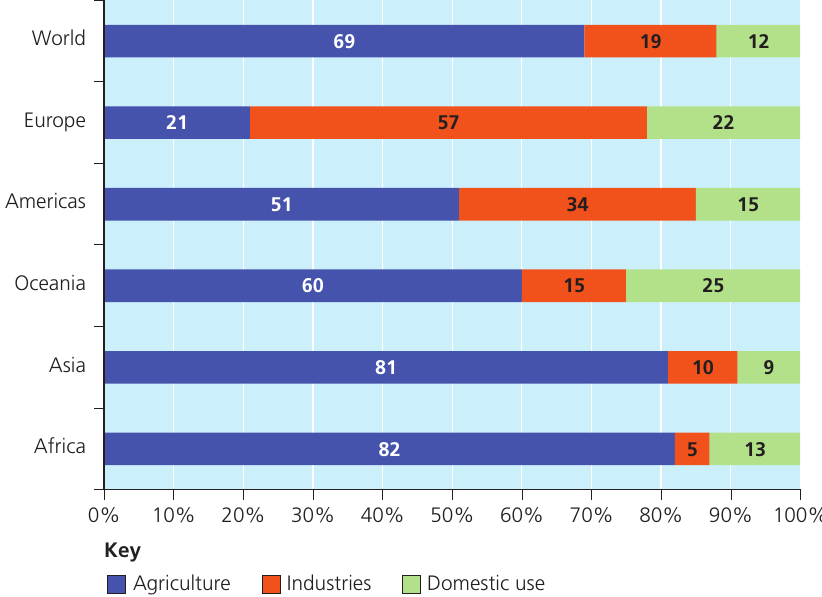
However, these proportions vary significantly between different regions. Less economically developed countries and arid regions typically use a much higher percentage of their water for agriculture compared to wealthier temperate areas. In regions with plentiful rainfall and lower evapotranspiration rates, less irrigation is needed. These areas tend to be more affluent with advanced industries, resulting in higher proportions of water used in domestic and industrial sectors.
Example
Regional Water Use Variations:
Europe: Uses only 21% of its water for agriculture but 57% for industry, reflecting its advanced industrial economy and temperate climate.
Africa: Uses 82% for agriculture and just 5% for industry, highlighting the importance of irrigation in food security.
Asia: Shows a similar pattern to Africa with 81% agricultural use, reflecting the crucial role of irrigation in food production across the continent.
Understanding water stress
Important
Water stress occurs when there is an imbalance between water consumption and available water resources, creating a situation where water scarcity significantly constrains human activities. International organisations measure water stress as water availability below 1,700 m³ per person annually.
An alternative indicator examines the ratio of water withdrawal to total water resources available. When this ratio is high, it indicates that water users are competing for limited supplies, placing pressure on the resource.
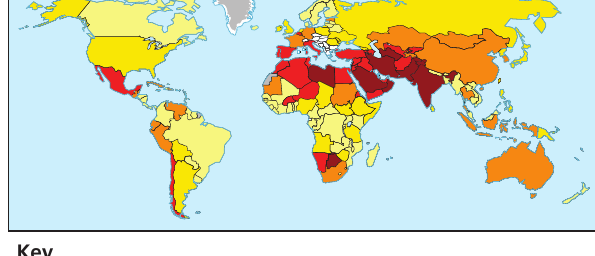
Different regions experience varying levels of water stress based on their ratio of withdrawals to supply. Areas showing higher percentages face greater competition for water resources, with users drawing heavily on available supplies.
Impacts of water stress
Water stress causes deterioration in freshwater supplies affecting both quantity and quality:
Quantity impacts
Over-abstraction from rivers, reservoirs, or aquifers reduces the volume of water available for other users and environmental needs. This creates competition and potential conflicts over water allocation.
Quality impacts
When water sources are over-exploited, several problems arise:
- Organic pollution increases as contaminants become more concentrated
- Eutrophication of surface water occurs when nutrients accumulate
- Saltwater intrusion may occur into freshwater aquifers in coastal areas
- Overall water quality deteriorates, requiring more treatment before use
Note
The relationship between quantity and quality is critical: as water volumes decrease through over-abstraction, the concentration of existing pollutants increases, creating a compound effect on water quality.
Physical geography and water availability
Physical factors play a crucial role in determining whether reliable water sources are available in a region. Several requirements must be met:
-
Reliable annual rainfall: Whilst rainfall patterns may be seasonal, adequate precipitation throughout the year provides the foundation for water availability. Storage facilities can help manage temporal variations.
-
Large surface freshwater bodies: Lakes and rivers provide the most accessible water sources. Their presence depends on factors including rainfall patterns, topography, and drainage systems.
-
Low evaporation rates: In hot climates, high evaporation can significantly reduce surface water availability. Cooler regions with lower evaporation rates maintain more reliable supplies.
-
Suitable geological structures: Certain rock formations create natural groundwater aquifers. Porous and permeable rocks allow water to infiltrate and be stored underground, providing a buffer against surface water shortages.
Rivers and lakes as water sources
When deciding to extract water from rivers for human use, several factors must be carefully assessed:
River discharge: The annual flow volume must be sufficient to support abstraction whilst maintaining the river's ecological functions.
Flow variations: Seasonal and shorter-term fluctuations in river flow need consideration when planning abstraction rates. This ensures supply remains reliable during low-flow periods.
Water quality: The contamination level and turbidity of the water affect treatment requirements. Higher quality source water reduces processing costs.
Alternative river uses: Other demands on the river must be considered, such as navigation, transportation, wildlife conservation, and recreational activities.
Consequences of over-abstraction
Excessive withdrawal from rivers and lakes creates multiple problems:
Important
Key Impacts of Over-abstraction:
- Reduced water volume concentrates pollutants, degrading water quality
- Decreased flow velocity and discharge increase sedimentation downstream, affecting river morphology
- Lower water levels reduce downstream flooding, which can negatively impact soil quality in floodplains that depend on nutrient-rich sediment deposition
- Reduced flow impacts aquatic ecosystems and habitats, potentially harming or eliminating aquatic species
Reservoirs as water sources
Reservoirs are artificial water storage facilities created by constructing dams across river valleys. The dam blocks the river flow, allowing water to accumulate in a reservoir behind it. This stored water can then be released in a controlled manner for abstraction and use.
Creating reservoirs presents both opportunities and challenges:
Advantages:
- Provides reliable water storage that can buffer against seasonal variations
- Allows controlled water release for abstraction
- Can support multiple uses including power generation and recreation
Challenges:
- Conflicts with other valley uses, particularly when settlements or agricultural land must be flooded, displacing local populations and food production
- Disrupts the natural hydrological cycle and impacts the entire river system downstream
- Location decisions are difficult because the best sites for reservoir capacity often have the highest scenic and wildlife value
Note
The decision to build a reservoir requires careful consideration of these trade-offs between water security benefits and environmental and social costs. This involves balancing immediate water needs against long-term ecological impacts and community displacement.
Remember!
Summary
Key Points to Remember:
-
Water security means ensuring populations have reliable access to adequate quantities of clean water for livelihoods, health, economic development, and ecosystem protection
-
The three main water sources are surface water (rivers and reservoirs), underground stores (aquifers), and seawater (through desalination)
-
Globally, agriculture uses 69% of freshwater, industry 19%, and domestic purposes 12%, though these proportions vary significantly between regions
-
Water stress occurs when water withdrawal approaches or exceeds available supply, causing both quantity and quality problems through over-abstraction and increased pollution
-
Physical geography factors - including reliable rainfall, large freshwater bodies, low evaporation rates, and suitable geological structures - determine whether regions have adequate water sources