Strategies to Increase Supply (AQA A-Level Geography): Revision Notes
📚Revision Notes
Strategies to Increase Supply
When water demand exceeds available supply, countries and regions can implement various strategies to increase the amount of water available. These approaches focus on capturing, storing, transferring, or creating new water sources to meet growing needs. Understanding these strategies is essential for addressing water stress and ensuring water security.
Storage by reservoir
Reservoirs are a key method for increasing and managing water supply on both regional and national scales. They work by capturing and storing water that would otherwise flow away unused.
Dams are constructed to trap and store excess winter rainfall or to regulate river flow throughout the year. This serves multiple purposes including maintaining habitats for wildlife and preventing flooding in downstream areas. The stored water can then be released when needed during drier periods.
Note
There are different types of reservoirs depending on their primary function. Direct supply reservoirs store water specifically for release through pipelines to municipal water supplies, providing drinking water directly to urban populations. Multi-purpose reservoirs serve several functions simultaneously, including flood control, power generation, water supply, and recreation.
Important
A reservoir is an artificial lake created by building a dam across a river valley to store water for various purposes including drinking water supply, flood control, and power generation.
Example
Case Study: Lake Vyrnwy, Wales
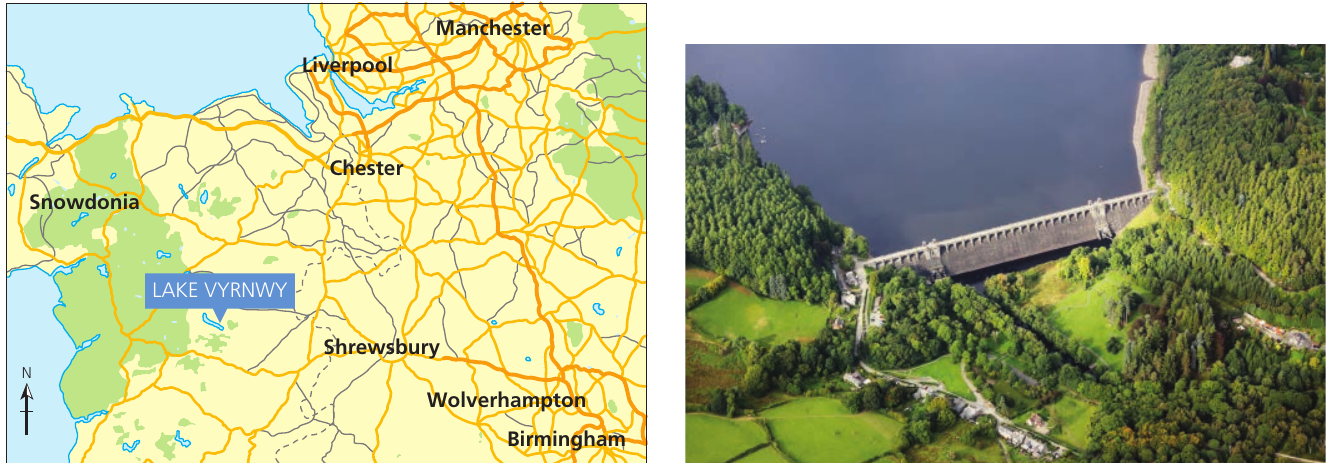
Lake Vyrnwy in mid-Wales serves as an excellent example of a direct supply reservoir. Built in the late 19th century, it was constructed specifically to supply water to the growing city of Liverpool, located 70 miles away.
Key features:
- Located in the high-rainfall area of Snowdonia
- Stores water from winter rainfall
- Releases water via pipeline to Liverpool's municipal supply
- Demonstrates how reservoirs can transport water over long distances to urban populations
Multi-purpose reservoirs serve several functions simultaneously beyond just water supply. Large-scale examples include the Three Gorges Dam on the Yangtze River in China and the Aswan Dam on the River Nile. These massive structures provide:
- Flood control to protect downstream populations
- Hydroelectric power generation
- Water supply for cities and agriculture
- Fishing opportunities
- Tourism and recreation facilities
Important
Environmental Concerns
Large reservoir projects are not without environmental problems. These can include displacement of communities, disruption of river ecosystems, changes to sediment flow, and loss of agricultural land. These impacts must be carefully weighed against the benefits when planning new reservoir projects.
Diversion and inter-basin transfer
This strategy addresses the spatial mismatch between water availability and water demand by moving water from areas with surplus to areas experiencing shortages.
River diversion transfers water from one river catchment to another when there is excess water in one area and insufficient supply in another. Water is drawn from rivers, reservoirs, and aquifers, then pumped across regions using pipelines and aqueducts. This enables localised droughts to be tackled quickly, as water can be moved to where it's needed most. Transfer can occur through river diversion schemes or extensive canal networks.
UK examples
The United Kingdom experiences huge variation in average rainfall between different regions. Snowdonia in Wales receives over 400 cm of rain per year, whereas parts of East Anglia receive only 55 cm per year. Demand also varies significantly due to population distribution.
Note
Regional Water Transfer in Action
To address this imbalance, water transfer schemes operate on a regional scale in Britain. Heavy rainfall in sparsely populated mid-Wales is stored in reservoirs and then transported via rivers and pipelines to the densely populated West Midlands conurbation, which includes cities like Birmingham and Wolverhampton.
This demonstrates how the UK manages its water resources by moving surplus water from wet, sparsely populated areas to drier, densely populated regions.
Larger national scale schemes have also been proposed to move surplus water from the north and west to the drier south-east. Proposals have included taking water from the Kielder reservoir in Northumberland via a 'Newark to London' pipeline, and a River Severn to Thames inter-basin transfer. The idea of transferring water from areas of water surplus to areas experiencing water stress is attractive.
However, these projects remain on hold due to several factors:
- Prohibitive construction costs
- Ecological concerns about environmental impacts
- Public resistance to building more reservoirs to store the transferred water
International examples
In water-stressed developing countries that remain heavily reliant on water for agriculture, irrigation canals transfer water from major river basins to farming areas. The Sindh province of Pakistan has developed a network of irrigation canals that abstract water from the Indus basin. Unfortunately, high evaporation rates and poor maintenance of canal linings cause large losses of water through leakages. This leads to the dual problems of waterlogging (excess water accumulating) and salinity (salt buildup), which destroys crops and renders the soil infertile.
China's South to North Water Diversion Project
Example
The World's Largest Water Transfer Scheme
China has constructed the world's largest inter-basin water transfer scheme. The South to North Water Diversion Project comprises three routes that take water from the Yangtze basin northwards by canal and pipeline to treatment stations near Beijing, an area experiencing severe water shortages.
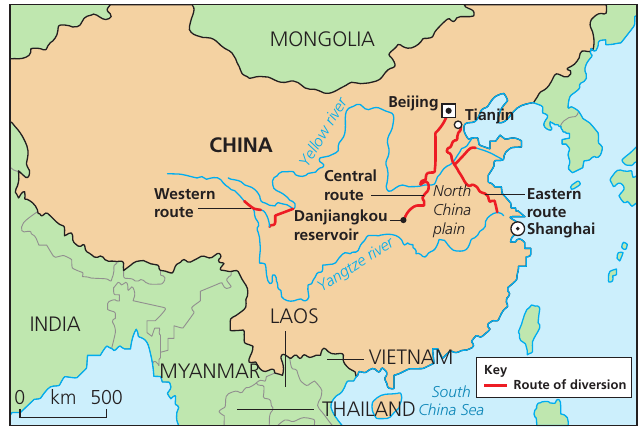
The Three Routes:
1. The Eastern route
- Uses the ancient Grand Canal
- Moves water northwards along the eastern coast
2. The Central route
- Opened in 2014
- Takes water 1,432 kilometres from the Danjiangkou reservoir on a tributary of the Yangtze river
- Supplies two-thirds of Beijing's tap water, demonstrating its crucial importance to the capital city
3. The Western route
- Would transfer water from the Tibetan plateau
- Has been indefinitely postponed due to the area being prone to earthquakes and landslides
- Construction deemed too risky and dangerous
Scale of the project: The two working stretches can transfer up to 25 billion tonnes of water annually from south to north, making this a truly massive engineering project.
Evaluation of inter-basin transfer
Like all water management strategies, inter-basin transfer has both benefits and drawbacks that must be carefully considered.
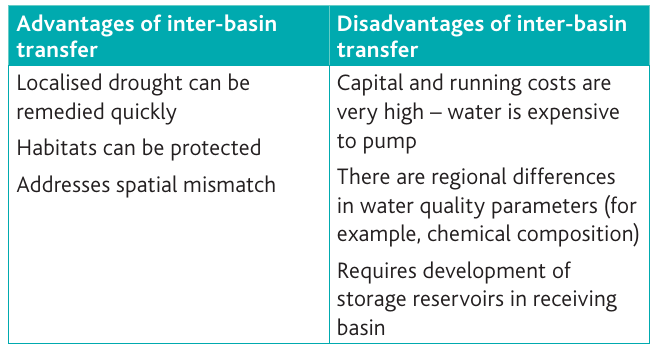
Advantages:
- Localised drought can be remedied quickly by bringing water from elsewhere
- Habitats can be protected by maintaining water levels in rivers and ecosystems
- Addresses spatial mismatch between water supply and demand across regions
Disadvantages:
- Capital and running costs are very high – water is expensive to pump over long distances
- There are regional differences in water quality parameters (such as chemical composition), which may cause problems when waters are mixed
- Requires development of storage reservoirs in the receiving basin to hold the transferred water
Desalination
The removal of salt from seawater would provide a huge supply of water, but desalination is an expensive process which is not considered sustainable. This is because it is very energy intensive and represents a significant source of greenhouse gas emissions. Nevertheless, there are two main methods used in desalination.
Important
Desalination is the process of removing salt and other minerals from seawater to produce fresh, potable water suitable for human consumption and agricultural use.
Reverse osmosis
This method involves filtration of seawater at high pressure (600-1,000 PSI) through a partially permeable membrane. The membrane uses small polyamide tubes to convert seawater to potable water. This process collects fresh water and rejects very saline water, which is then pumped back into the sea. Reverse osmosis is the most common desalination method globally.
Distillation
Water is boiled by heating under reduced pressure to save energy (water boils at a lower temperature in a vacuum). The steam produced is condensed and collected separately as fresh water, while the salt is left behind in the boiler. This method separates pure water from the dissolved salts through evaporation and condensation.
Where desalination is used
Desalination plants have generally been developed in wealthier countries with water stress or scarcity issues. These include Middle Eastern nations such as Saudi Arabia, Oman and the UAE, but also locations in the Mediterranean region, the USA and Australia.
Example
Thames Water Beckton Desalination Plant
In the UK, Thames Water's desalination plant at Beckton in East London provides a practical example of large-scale desalination in action.
Key statistics:
- Provides water for 400,000 households
- Uses reverse osmosis membrane filtration
- Can process 180 million litres of water daily
- Water drawn from the Thames by giant pumps
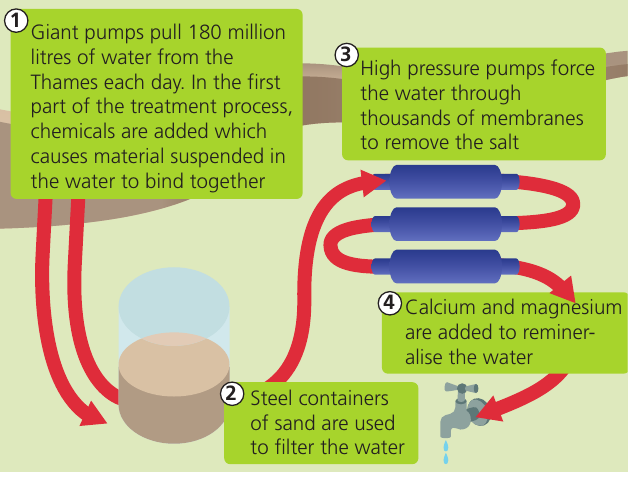
The four-stage process:
-
Extraction and initial treatment: Giant pumps pull 180 million litres of water from the Thames each day. Chemicals are added which cause material suspended in the water to bind together
-
Filtration: Steel containers of sand are used to filter the water further
-
Desalination: High pressure pumps force the water through thousands of membranes to remove the salt
-
Remineralisation: Calcium and magnesium are added to remineralise the water, making it suitable for drinking
Note
While desalination provides a valuable additional water source, particularly during droughts, its high energy consumption and costs mean it is typically used as a backup option rather than the primary water supply method.
Summary
Key Points to Remember:
-
Reservoirs increase supply by storing excess rainfall and river flow for release during times of higher demand. They can serve single purposes (water supply) or multiple purposes (flood control, power generation, recreation).
-
Inter-basin transfer moves water from areas with surplus to areas with deficit through pipelines, canals and aqueducts. The UK has regional schemes (Wales to West Midlands), while China operates the world's largest system transferring up to 25 billion tonnes annually.
-
Advantages of water transfer include rapid drought relief and habitat protection, but disadvantages include very high capital and pumping costs, regional water quality differences, and the need for storage reservoirs in receiving areas.
-
Desalination removes salt from seawater using reverse osmosis (high-pressure filtration) or distillation (boiling under reduced pressure). Thames Water's Beckton plant processes 180 million litres daily for 400,000 households.
-
Desalination limitations: Despite providing a large potential water source, desalination remains expensive, energy intensive, and generates significant greenhouse gas emissions, making it less sustainable than other options.