Resource Development Over Time (AQA A-Level Geography): Revision Notes
📚Revision Notes
Resource Development Over Time
Understanding possible resources
When geographers discuss resource availability, they distinguish between resources we know exist and those we believe might exist based on geological evidence. This distinction helps us understand future resource potential and guides exploration efforts.
Possible resources are identified through broad geological knowledge about deposits that likely exist but remain mostly undiscovered. Scientists base these estimates on their understanding of geological patterns and expect these resources may become economically valuable over time. However, there's less certainty about their availability compared to resources already confirmed through exploration.
Types of possible resources
There are two main categories of possible resources, each with different levels of confidence:
Hypothetical resources are materials that haven't been discovered yet but are likely to exist in known mining regions. These resources would be found in regions where similar geological conditions have already produced valuable deposits. For example, if a particular rock formation has yielded copper in one location, geologists might reasonably expect to find more copper in similar formations nearby.
Speculative resources are even more uncertain. These are materials that might exist in geological settings similar to known deposits, but where no discoveries have yet been made. The expectation is based on matching geological patterns rather than direct evidence from the area itself.
Important
Understanding these classifications helps explain why resource estimates change over time. As exploration continues and technology improves, speculative and hypothetical resources can become confirmed reserves.
Factors affecting resource development
Whether a resource deposit will actually be developed depends on evaluating multiple risk factors. These fall into two main categories: physical risks and geopolitical risks.
Physical risks
Physical risks relate to the practical challenges of accessing and extracting resources. Decision-makers must evaluate:
- Quantity discovered: The amount of the resource that has been found in a specific location
- Quality of the resource: How pure or concentrated the deposit is, which affects extraction costs
- Physical location and accessibility: Whether the resource is easy to reach or requires overcoming geographical barriers
- Available technology: Whether current technology makes extraction economically feasible
The economic viability depends on whether the benefits outweigh these physical challenges. As technology advances, it plays a crucial role in making previously inaccessible resources available. Remote deposits that were once considered too difficult or expensive to exploit may become viable as new extraction methods develop.
Note
Rising resource prices can trigger exploration in more remote locations. When the value of a resource increases, deposits that were previously unprofitable become worth developing. This price-driven exploration has opened up resource frontiers throughout history.
The costs involved can be substantial. Building a modern ore mine requires a minimum investment of £500 million and can easily exceed £1 billion. This means that reserves are classified as either recoverable or possible based on current economic conditions.
Geopolitical risks
Beyond physical challenges, political and economic factors significantly influence resource development:
- Concentrated production: When relatively few countries control production of a resource, this creates supply vulnerabilities and potential price manipulation
- Trading confidence: Countries must trust that producers won't use their market position to exert excessive political or economic pressure
- Political stability: The risk of conflict, war, or major political tensions in resource-producing regions can disrupt supply chains
Important
All these factors must be carefully weighed before companies or governments decide to develop a resource deposit. The decision involves balancing potential profits against multiple types of risk.
Classification of reserves
Not all identified resources are equally ready for extraction. Geographers classify reserves based on how confident we are about extracting them profitably.
Recoverable reserves are quantities of a resource that are likely to be extracted commercially within a specific timeframe using current technology. Within this category, proven reserves have at least a 90% probability of being successfully recovered under present conditions.
Possible reserves are deposits believed to exist because the geological conditions match areas where similar resources have been found, but no exploration has yet confirmed their presence.
Note
This classification system helps companies and governments plan resource development strategies and understand how much of a resource is genuinely available for use in the near term.
The cycle of natural resource development
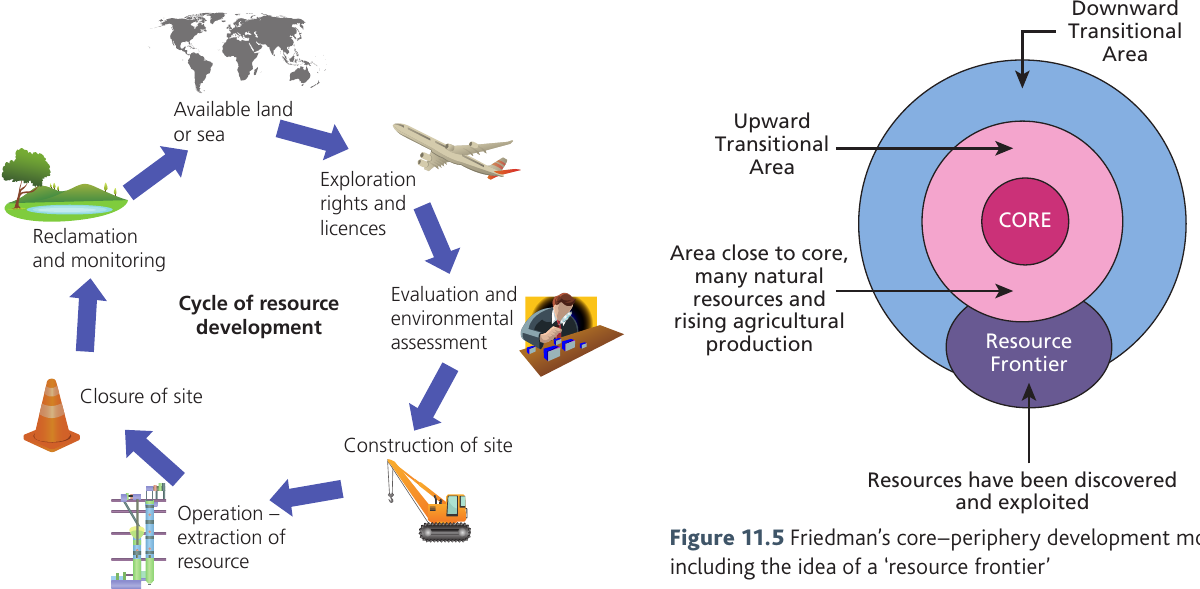
Resource development follows a systematic process that varies depending on the type of resource and its location. Understanding this cycle helps explain why bringing a new resource into production takes many years and requires significant investment.
Key stages in the development cycle
The development process typically follows these stages:
1. Exploration and licensing
Organisations such as transnational corporations (TNCs) must first apply for licences from appropriate authorities. In the UK, for instance, the Department of Energy and Climate Change grants exploration rights. This stage can take several years as companies use satellite imagery, geophysical surveys, and field data to assess potential sites. They must determine both the extent and quality of reserves before proceeding.
2. Evaluation and environmental assessment
Once potential sites are identified, they undergo thorough evaluation to determine production viability given current market conditions and costs. In developed countries, an environmental impact assessment is usually required before extraction begins. This ensures potential environmental damage is understood and mitigation plans are in place.
3. Construction
After licences are awarded, necessary infrastructure must be built. This includes constructing access roads, laying pipelines for oil or gas transport, and establishing port facilities if needed. This infrastructure investment represents a significant portion of the total development cost.
4. Operation and extraction
Active resource extraction begins and continues until economically viable reserves are depleted. The operational lifespan varies considerably depending on the resource type and quantity available. Companies often run exploration programmes during operations to locate additional viable reserves nearby, potentially extending the operation's life.
5. Closure
When extraction ends, this doesn't necessarily mean all reserves are exhausted. Remaining deposits may be uneconomical to recover. For valuable resources like oil, secondary and tertiary recovery methods (such as steam injection or chemical solutions) may be employed to extract additional quantities that would otherwise remain underground.
6. Reclamation and monitoring
In developed countries with stricter environmental regulations, operating organisations must rectify environmental damage caused by resource extraction. This reclamation process is an essential part of responsible resource development, though it's not always enforced in developing countries where environmental laws may be weaker.
Resource frontiers
As resource exploration extends into new areas, it creates what geographers call resource frontiers - regions where resources are brought into production for the first time.
Friedman's core-periphery model
In 1963, economist John Friedman proposed a model explaining how resource development creates uneven spatial patterns of economic growth. His core-periphery model suggests that countries develop around a core region that attracts most wealth and investment due to its advantageous location and existing resources.
As development spreads outward from the core, surrounding areas begin to benefit. However, peripheral regions often remain largely underdeveloped, failing to attract investment and experiencing lower living standards compared to the core. These peripheral areas lag behind in economic growth and development indicators.
Note
Within the periphery, resource frontiers represent areas where valuable resources like minerals or fossil fuels are discovered. This discovery can prompt rapid investment inflows to the area, creating employment both directly in resource extraction and indirectly through supporting industries. Social conditions in these frontiers may initially remain underdeveloped, but the region experiences rapid economic growth as workers migrate to take advantage of new opportunities.
Examples of resource frontiers
Resource frontiers can be identified at various geographical scales:
Example
Example: Scotland as a National Resource Frontier
Within the UK, Scotland could be identified as a peripheral region situated far from the core economic zone in south-east England. The development of North Sea oil reserves from the 1980s onwards transformed north-east Scotland into a resource frontier.
The local economy boomed as the oil industry brought associated technology and supporting industries to the region, demonstrating how resource discovery can transform peripheral areas into economically significant zones.
Example
Example: Alaska as a Regional Resource Frontier
Alaska provides another clear example of resource frontier development. Overcoming the transportation challenges of Arctic crude oil through the construction of the Trans-Alaskan oil pipeline enabled Alaska to become a resource frontier within the USA.
The pipeline infrastructure made previously inaccessible oil reserves economically viable to exploit, fundamentally changing Alaska's role within the US economy.
These examples demonstrate how technological solutions to accessibility problems can transform remote regions into economically important resource frontiers, fundamentally changing their role within national and global economies.
Summary
Key Points to Remember:
-
Resource classification matters: Possible resources include hypothetical resources (expected in known mining regions) and speculative resources (might exist in similar geological settings), each with different confidence levels.
-
Multiple risk factors determine development: Both physical risks (quantity, quality, location, technology) and geopolitical risks (production concentration, trading relationships, political stability) must be evaluated before resource exploitation proceeds.
-
Development follows a clear cycle: Resources move through exploration, evaluation, construction, operation, closure, and reclamation stages - a process that can take many years from discovery to production.
-
Reserves are classified by viability: Recoverable reserves can be extracted profitably now with current technology, whilst possible reserves might become viable in the future as prices rise or technology improves.
-
Resource frontiers create uneven development: Friedman's core-periphery model explains how resource discovery in peripheral regions can trigger rapid economic growth, though social development may lag behind economic gains.