Bismarck's introduction of pensions and health insurance in the 1880s (AQA A-Level History): Revision Notes
📚Revision Notes
Bismarck's introduction of pensions and health insurance in the 1880s
In response to growing socialism, Bismarck introduced policies for the establishment of a welfare state.
Note
Although considered as a first in legislation, Bismarck's health insurance scheme was not a completely original idea. Since the bubonic plague in the 14th centuries, several Italian city states utilised similar scheme
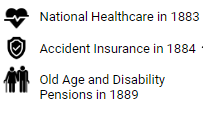
Also referred to as the Bismarck Model, the Social Health Insurance Model was first introduced by Bismarck in 1883. This health insurance system provided health care benefits to workers and their families. First designed for workers, payment of health insurance was divided between employers (⅓ of payment) and employees (⅔ of payment). The insurance covered treatment costs, sickness allowance, death benefits and women in childbirth.
In 1884, the Accident Insurance Bill was introduced to assist workers in case of accidental injury incurred through their employment or the commute to or from work. Similar to health insurance, it was financed by both workers and employers. Industrial and agrarian wage earners and their families were covered by the insurance.
In 1889, the Old Age and Disability Insurance Law provided pension annuity to workers upon reaching the age of 70. Similar to the health and accident insurance bill, pension was also financed by the workers and employers. However, they mainly differed on the scope of the programme.
The insurance covered all categories of employees, unlike the first two which only covered industrial and agricultural workers. Only the old age and disability pensions were subsidised by the national government.
Note
All insurance schemes were mandatory for all workers with an annual income of less than 2,000 Reichsmarks.
1885 Berlin Conference and the 'Scramble for Africa'
Also known as the Congo Conference or West Africa Conference, the Berlin Conference held in 1885 put an 'end' to the 'Scramble for Africa'. The conference organised by Otto von Bismarck regulated European imperialism in Africa.
The European Scramble for Africa began in the early 1800s with the discovery of gold deposits and ivory supply in the continent. From limited trading influence in coastal Africa, European merchants began to penetrate the interior markets. In 1876, King Leopold II of Belgium formed the International African Association. After two years, the king penetrated the Congo. At this time, France, Great Britain, Portugal, Spain, Italy and Germany had their own pieces of Africa. By 1914, only Liberia, which was established by the United States for freed slaves and Abyssinia (modern Ethiopia) were free and independent from European control.
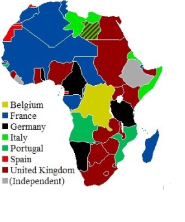
Map of Africa in 1914
Participated in by 14 countries, the Berlin Conference came up with the General Act containing the following points:
- The end of slavery and slave trade by African and Islamic powers.
- Territories under the International Congo Society were confirmed as King Leopold's private property.
- Free trade throughout the Congo Basin. Moreover, the Niger and Congo rivers were made free for shipping.
- European powers could only acquire colonial lands under the principle of effective occupation. This required colonial powers to have existing treaties with local leaders.

The Berlin Conference was attended by delegates from Germany, Austria-Hungary, Belgium, Denmark, Spain, United States, France, United Kingdom, Italy, the Netherlands, Portugal, Russia, Sweden-Norway and the Ottoman Empire.