Kaiser Wilhelm I and Otto von Bismarck (AQA A-Level History): Revision Notes
📚Revision Notes
Kaiser Wilhelm I and Otto von Bismarck
Born on 22 March 1797, William I or Wilhelm I was the King of Prussia (1861) and the first German Emperor (1871). During his rule and ministership of Otto von Bismarck**,** Germany was unified under one empire. At a young age, William served in the army and against Napoleon I during the War of the Sixth Coalition.
In 1857, when his brother, Frederick William IV (Frederick I) suffered from a stroke, William became Prince Regent of Prussia. On 2 January 1861, William ascended the throne following the death of his brother. The following year, William I had a conflict with the Landtag or Prussia's bicameral legislature. When the Landtag refused to increase the military budget, William I considered abdicating. However, his son advised him not to do it. Instead, William I appointed Otto von Bismarck as Minister President.
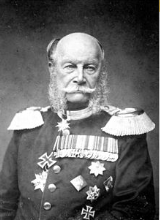
William I in 1884
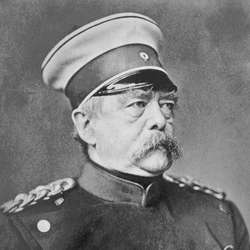
Otto von Bismarck
Otto von Bismarck was the prime minister of Prussia (1862-73, 1873-90) and first chancellor of the German Empire (1871-90). In 1851, Bismarck was appointed as the Prussian representative to the Diet in Frankfurt by Frederick William IV. By 1859, he was sent to Russia as Prussian ambassador. In 1862, Bismarck went to the court of Napoleon III in Paris.
After 11 years of experience in foreign affairs (Russia, France and Austria), Bismarck became the foreign minister and minister president of Prussia in 1862. The appointment of Bismarck became the last option of William I to mediate the crisis against the Landtag.
Along with Helmuth von Moltke (Chief of Staff of the Prussian Army) and Albrecht von Roon (Minister of War), Bismarck took charge of improving Prussia's relationship with Great Britain, France, Austria and Russia. Through Bismarck's diplomacy and Roon and Moltke's military knowledge, Germany was unified under one empire.
With the appointment of Bismarck, William I was able to push the proposed military budget. Bismarck pointed out a constitutional gap which soon led to the dissolution of the Diet in 1863.
Bismarck also issued an edict restricting freedom of the press. Despite becoming an unpopular politician, he gained the king's full support. In order to avoid opposition, Bismarck excluded Austria in the establishment of the one German Empire. With growing tensions associated with Prussian expansion, Emperor Franz-Josef I declared the Austro-Prussian War in 1866. By 1870, the Franco-Prussian War occurred which resulted in the Prussian-German occupation of the French border, Alsace-Lorraine.
William I and Bismarck ruled unified Germany through the following measures and policies:


In the 1870s, Bismarck employed Kulturkampf or cultural struggle against Catholics in Germany.
Parochial schools were placed under state control, while the Jesuits were expelled. This move against Catholics ended in 1878, following the socialist threat.
Anti-socialist laws which expanded police power and repressed socialist activities.
Note
Bismarck initiated policies towards the development of a welfare state, the first in the history of modern Europe at that time.