Moments (AQA A-Level Mathematics): Revision Notes
📚Revision Notes
4.1.5 Using Moments - Harder
Moments: Nonuniform Rods
Note
Definition:
A nonuniform rod is one which does not (necessarily) have its centre of mass at the centre of the object. Reasons for this could include:
- The rod has different thicknesses at different points.
- The rod is made from different materials with different densities.
Note
Problem 1:
A nonuniform rod , of length 4 m and weight 6 N, rests horizontally on two supports, and . Given that the centre of mass of the rod is 2.4 m from the end ,
Question : find the reactions at the two supports.
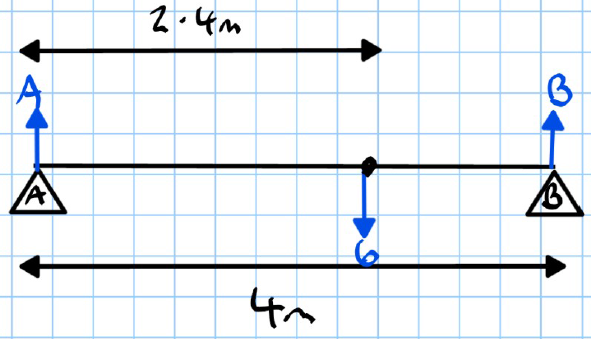
Solution:
- Resolve the forces:
- Let the reactions at supports and be and , respectively.
- The weight of the rod (6 N) acts at the centre of mass, 2.4 m from .
- Apply the equilibrium conditions: Vertical force balance:
Taking moments about point :
- Substitute back into the force balance equation:
Result:
- Reaction at .
- Reaction at .
Note
Problem 2:
A non-uniform bar of length 5 m is supported horizontally on supports and . The reactions at these supports are 3 N and 7 N, respectively.
Questions:
- (a) State the weight of the bar.
- (b) Find the distance of the centre of mass of the bar from A.
Solution:
Part (a): Weight of the Bar
- Vertical force balance:
- Let the weight of the bar be .
- The sum of the reactions at the supports equals the weight of the bar.
Result: The weight of the bar is 10 N.
Part (b): Distance of the Centre of Mass from A
- Take moments about point :
- Let be the distance of the centre of mass from .
- The distance from to the centre of mass is .
Result: The distance of the centre of mass of the bar from is 3.5 m.
Tips:
Note
- Choose the pivot point wisely: Pick a point where multiple unknown forces act (e.g., a support or hinge). This simplifies the problem by eliminating those unknown forces from the moment equation, making it easier to solve for other quantities.
- Resolve forces carefully: Ensure all forces, including angled or distributed loads, are resolved into horizontal and vertical components. For angled forces, use trigonometry:
- Consider all equilibrium conditions: In addition to moments , ensure the system satisfies both horizontal and vertical force equilibrium: