Parallel & Perpendicular Gradients (AQA A-Level Mathematics): Revision Notes
📚Revision Notes
3.1.2 Parallel & Perpendicular Gradients
Parallel and Perpendicular Lines:
Fact:
Note
Two lines are perpendicular if the product of their gradients is -1.
- If and are perpendicular, then: This implies .
Parallel and Perpendicular Gradients
When working with straight lines in coordinate geometry, the gradients (or slopes) of lines are essential in determining whether lines are parallel or perpendicular.
1. Gradient (Slope) of a Line
Note
The gradient of a line measures how steep the line is. Mathematically, the gradient of a line passing through two points and is given by:
This tells us how much changes for a given change in .
2. Parallel Lines
Note
- Parallel lines have the same gradient.
- This means that if two lines are parallel, their gradients are equal.
Example:
If the equation of one line is , the gradient is .
For any line parallel to this, the gradient will also be . So, a parallel line might have an equation like .
3. Perpendicular Lines
Note
- Perpendicular lines have gradients that are negative reciprocals of each other.
- If the gradient of one line is , the gradient of a line perpendicular to it will be .
Example:
If the gradient of one line is , the gradient of a line perpendicular to it will be
So, if one line has an equation , a perpendicular line might have the equation
4. How to Find the Gradient from a Line Equation
Note
To find the gradient from a line equation, rearrange the equation into the form , where is the gradient, and is the -intercept.
Example:
For the equation :
- Rearrange to make the subject:
- Here, the gradient
5. Exam Tip: Working with Gradients
Note
- Parallel Lines: Just set the gradients equal to each other.
- Example: If you're told that a line is parallel to , the gradient of your line must also be .
- Perpendicular Lines: Multiply the gradients together to check for perpendicularity. If and are the gradients of two lines, the lines are perpendicular if:
Example:
Check if the lines and are perpendicular.
- Gradient of the first line:
- Gradient of the second line: Multiplying the gradients:
Since the product is , the lines are perpendicular.
Note
Example:
Find the equation of the line that is perpendicular to and passes through .
- Find the Gradient of the Given Line: Rearrange to slope-intercept form :
Gradient
-
Find the Gradient of the Perpendicular Line: Gradient of the perpendicular line =
-
Use Point-Slope Form to Find the Equation: Given point :
- Simplify to Standard Form:
Final Answer:
The equation of the line that is perpendicular to and passes through is:
Note
Example: Finding the Equation of the Perpendicular Bisector
Find the equation of the perpendicular bisector of the points and .
-
Calculate the Gradient of the Line Segment:
-
Find the Gradient of the Perpendicular Bisector:
-
Find the Midpoint of the Line Segment:
-
Use the Point-Slope Form to Find the Equation:
Note
Example Problem Set: Points and
(i) Find the length of AB.
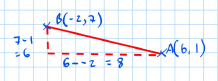
Solution:
(ii) Find the gradient of the line AB.
Solution:
(iii) Determine whether the line is perpendicular to AB.
Solution:
-
Rewrite the given line equation in slope-intercept form:
-
Compare gradients:
- Check the product of the gradients:
Conclusion: The lines are perpendicular since the product of their gradients is .
Note
Example: Finding the Equation of a Perpendicular Line
Problem: is the point and is the point . The line is perpendicular to the line and passes through the midpoint of . Find the equation of , giving your answer in the form , where are integers.
Solution:
-
Find the Midpoint of :
-
Find the Gradient of the Given Line:
Rearrange to slope-intercept form :
Gradient .
-
Find the Gradient of the Perpendicular Line:
-
Use the Point-Slope Form to Find the Equation: Given point :
- Simplify to Standard Form with Integer Coefficients:
Multiply through by to clear the fraction:
Rearrange to standard form:
Final Answer:
The equation of the line in the form is: