Large Data Set (AQA A-Level Mathematics): Revision Notes
📚Revision Notes
6.1 Large Data Set
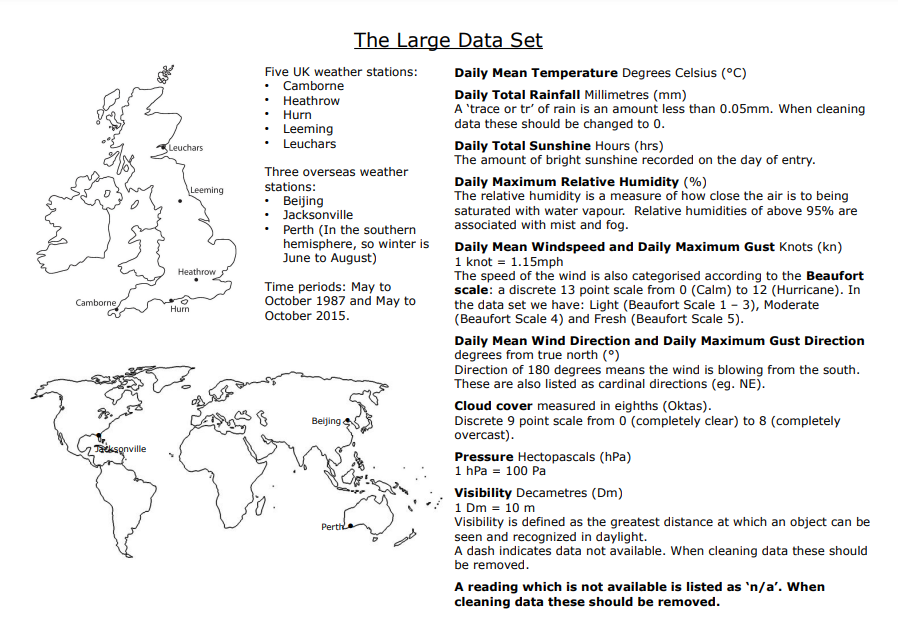
The Large Data Set (LDS) is a significant part of the A Level Mathematics curriculum. It is designed to help students develop skills in handling, analysing, and interpreting real-world data.
Overview of the Large Data Set
For the Edexcel A Level Maths course, the LDS typically includes data related to different aspects such as weather, economy, or demographics. The exact content may vary, but the data is usually extensive and offers opportunities for various statistical analyses.
Common features of the LDS include
- Multiple variables: Different types of data, such as categorical, discrete, and continuous.
- Real-world context: Data is based on actual events or records, making it relevant and applicable to real-life situations.
- Data exploration: Encourages the use of descriptive statistics, graphs, and summary measures to understand the dataset.
Examples of Analyses Using the LDS
Descriptive Statistics
- Mean, Median, Mode: Calculate the average, middle, and most frequent values of a variable in the dataset.
- Range and Interquartile Range (IQR): Assess the spread and variability of the data.
- Standard Deviation and Variance: Measure the dispersion of data points from the mean. Example: Suppose you are working with a dataset containing daily temperatures from different weather stations. You might calculate the mean temperature for each station and compare the variances to determine which location has the most variable weather.
Graphical Representation
- Histograms: Display the distribution of a continuous variable, such as rainfall amounts.
- Box Plots: Summarise the distribution of data, highlighting the median, quartiles, and potential outliers.
- Scatter Plots: Explore relationships between two variables, such as temperature and humidity. Example: You might use a scatter plot to examine the relationship between temperature and hours of sunshine across different regions. A positive correlation would suggest that higher temperatures tend to occur on sunnier days.
Correlation and Regression
- Pearson's Correlation Coefficient: Quantify the strength and direction of the linear relationship between two continuous variables.
- Linear Regression: Model the relationship between a dependent variable and one or more independent variables, predicting future values. Example: If you have data on the number of hours of sunshine and temperature, you could perform a linear regression to predict temperature based on the amount of sunshine.
Hypothesis Testing
- T-tests: Compare the means of two groups to see if they are statistically different from each other.
- Chi-Square Tests: Assess the association between categorical variables. Example: You might test whether the average rainfall in one region is significantly different from another using a t-test, or determine if there is a significant association between weather type (sunny, rainy, etc.) and region using a chi-square test.
Using the LDS in Exams
In exams, you may be asked to:
- Interpret Data: Explain what graphs or statistics tell you about the dataset.
- Perform Calculations: Use statistical formulas to calculate means, standard deviations, or other summary statistics.
- Draw Conclusions: Based on your analysis, make inferences or predictions about the data.
- Critically Evaluate: Discuss the limitations of the data, potential sources of bias, or the appropriateness of different statistical methods.
Note
Tips for Success
- Familiarise Yourself with the Dataset: Spend time exploring the LDS before your exams. Understand what each variable represents and how they relate to each other.
- Practice with Past Papers: Work on past exam questions involving the LDS to get comfortable with the types of analyses you might be asked to perform.
- Use Technology: Learn how to use calculators or software to perform statistical calculations quickly and accurately, especially for large datasets.
Conclusion
The Large Data Set offers a practical application of statistical methods. By mastering the analysis and interpretation of large datasets, you'll develop critical thinking skills and be well-prepared for both the exams and any future studies or careers that involve data analysis.